Backyard Birds of Tennessee: 15 Common Species (2026 Identification Guide)
Tennessee’s geographic spread from the Mississippi River bottomlands in the west through the Cumberland Plateau in the middle to the Great Smoky Mountains in the east creates one of the most diverse backyard bird communities in the South. The state hosts 425+ recorded bird species, with 30-45 commonly visiting suburban yards depending on region and season. Tennessee’s mild climate, abundant native forests, and position at the meeting point of the Mississippi and Atlantic Flyways make it both a year-round bird-watching paradise and a major migration corridor. From Nashville’s Cumberland River yards to Memphis’s bottomland forests to Knoxville’s Smoky Mountain suburbs, Tennessee offers distinctive bird communities by region. This guide covers the 15 most common backyard birds across Tennessee with field marks, regional ranges, and proven attraction strategies.
Quick Reference: 15 Common Backyard Birds of Tennessee
| Species | Size | Key ID Feature | Where in TN |
|---|---|---|---|
| Northern Mockingbird (state bird) | 10″ | Gray-white + white wing flashes + mimics | Statewide year-round |
| Northern Cardinal | 8.5″ | All red (male) + crest + black face mask | Statewide year-round |
| Carolina Chickadee | 4.75″ | Black cap + white cheeks + black bib | Statewide year-round |
| Carolina Wren | 5.5″ | Rust-brown + bold white eyebrow | Statewide year-round |
| Tufted Titmouse | 6.5″ | Gray crest + buff flanks + black eye | Statewide year-round |
| Blue Jay | 11″ | Blue crest + black necklace + white below | Statewide year-round |
| Mourning Dove | 12″ | Tan + long pointed tail + small head | Statewide year-round |
| House Finch | 5.5″ | Red head/breast (male) + streaky belly | Statewide year-round |
| American Goldfinch | 5″ | All yellow (summer male) + black wings | Year-round |
| Eastern Bluebird | 7″ | Blue back + rust breast + white belly | Statewide year-round |
| Downy Woodpecker | 6.75″ | Small + short bill + checkered wings | Statewide year-round |
| Red-Bellied Woodpecker | 9.25″ | Red cap + zebra back + tan belly | Statewide year-round |
| Ruby-Throated Hummingbird | 3.5″ | Iridescent green + ruby throat (male) | Summer (Apr-Oct) |
| American Robin | 10″ | Rust-orange breast + gray-brown back | Year-round |
| House Sparrow | 6.25″ | Gray crown + black bib (male) | Year-round (urban) |
Species Identification
Northern Mockingbird (State Bird)
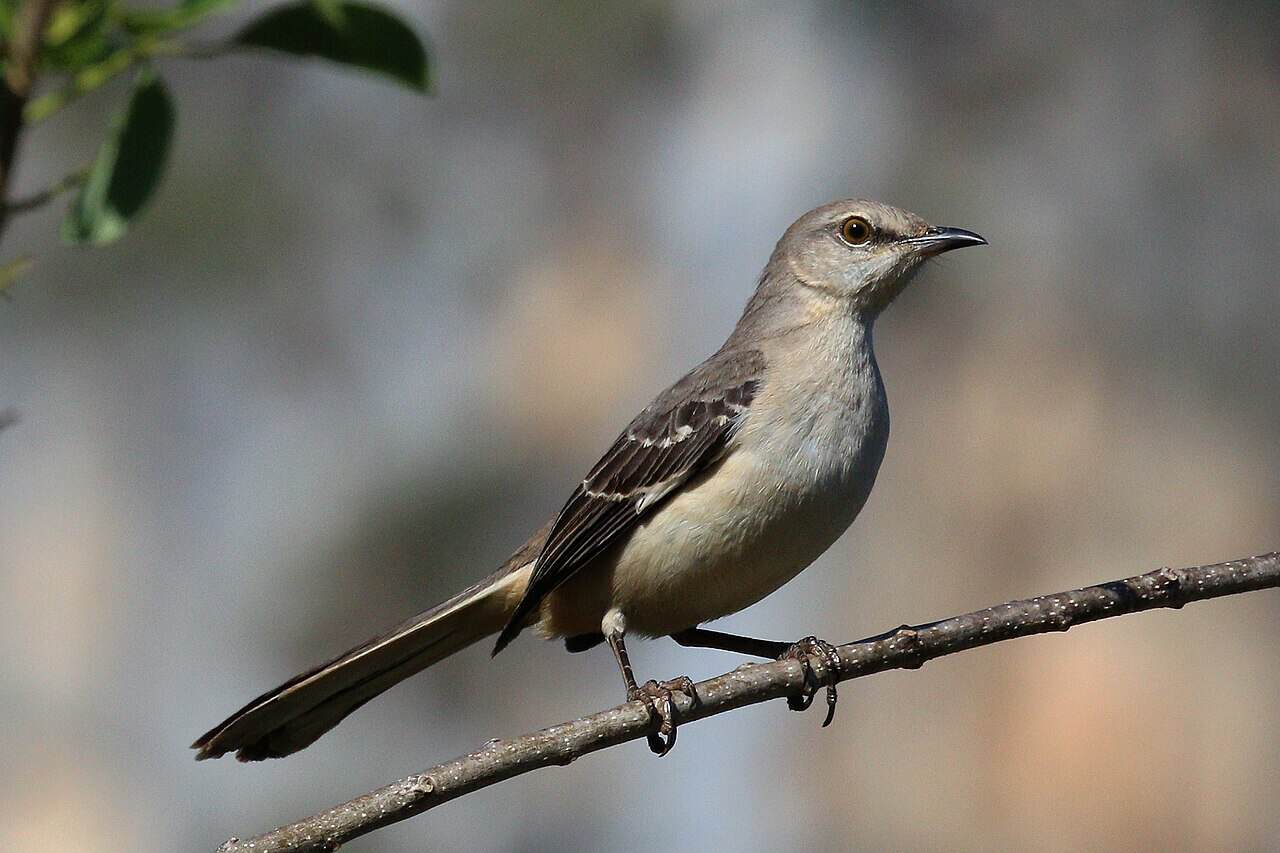
Tennessee’s official state bird, designated in 1933. Northern Mockingbirds are gray-white with darker wings, bold white wing flashes visible in flight, and a long tail often held cocked upward. Famous for mimicry, Tennessee mockingbirds may imitate 200+ other species’ songs plus mechanical sounds like sirens, car alarms, and cell phone ringtones.
Range in Tennessee: Statewide year-round.
Habitat: Suburban yards, parks, edges of natural habitat, urban areas.
Key ID: Gray-white + white wing flashes + long tail. Often singing from prominent perches, sometimes through the night during breeding season.
Where to see: Common in Tennessee neighborhoods. Will visit mealworm and fruit feeders. Plant native berry-producing shrubs like American Beautyberry, Wild Plum, and Possumhaw Holly.
Northern Cardinal
Tennessee’s beloved year-round red bird. Male Northern Cardinals are brilliant red overall with a pointed red crest, black face mask, and thick orange-red bill. Females are tan-brown with red highlights. Cardinal pairs mate for life and stay together year-round in Tennessee yards.
Range in Tennessee: Statewide year-round.
Habitat: Yards with shrubby cover, parks, woodland edges, urban areas with brush.
Key ID: Brilliant red + pointed crest + black face mask + thick orange-red bill (male).
Where to see: Hopper or platform feeders with sunflower or safflower seed. Cardinals prefer dawn/dusk feeding. Plant native shrubs (American Beautyberry, native viburnums) for nesting cover.
Carolina Chickadee
Tennessee’s small year-round companion. Carolina Chickadees have a black cap, black throat/bib, white cheeks, gray back, and buffy flanks. Smaller than the Black-Capped Chickadee (which occurs only at the very highest elevations in the Great Smoky Mountains). Faster, higher-pitched ‘chick-a-dee’ call distinguishes them by voice.
Range in Tennessee: Statewide year-round. (Highest Smoky Mountain peaks may have Black-Capped Chickadees.)
Habitat: Wooded yards, parks, forests.
Key ID: Black cap + black bib + white cheeks + small size. The chickadee species across most of Tennessee.
Where to see: Common at sunflower, peanut, and suet feeders. Will use small nest boxes (1.125 inch hole).
Carolina Wren
Tennessee’s loudest backyard voice. Carolina Wrens have rich rust-brown upperparts, buff underparts, and a striking bold white eyebrow stripe. Their loud, ringing ‘tea-kettle tea-kettle tea-kettle’ song carries throughout Tennessee yards year-round. They nest in unexpected places, flower pots, garage corners, hanging baskets.
Range in Tennessee: Statewide year-round.
Habitat: Wooded yards, gardens with brush, edges of forests.
Key ID: Rich rust color + bold white eyebrow + loud voice. Larger than House Wrens.
Where to see: Common at suet feeders. Will visit platform feeders. Provide brush piles for cover. Will use small nest boxes.
Tufted Titmouse
Tennessee’s perky crested feeder companion. Tufted Titmice have a clean gray back, white underparts with buff flanks, a pointed gray crest, large black eyes, and a small black forehead patch. Loud ‘peter-peter-peter’ calls fill Tennessee woodlands year-round.
Range in Tennessee: Statewide year-round.
Habitat: Mature deciduous forests, parks, suburban yards.
Key ID: Gray crest + buff flanks + black eye + small size. Distinctive crest separates from chickadees.
Where to see: Common at backyard feeders with sunflower seed, peanuts, and suet. Often in mixed flocks with Carolina Chickadees and nuthatches.
Eastern Bluebird
Tennessee’s bluebird species. Male Eastern Bluebirds have brilliant royal-blue heads and backs, rust-orange throats and breasts, and clean white bellies. Females are paler. Tennessee has active bluebird nest box programs across the state, populations have grown substantially.
Range in Tennessee: Statewide year-round.
Habitat: Open habitat with scattered trees, pastures, golf courses, parks, suburbs with old trees.
Key ID: Bright blue back + rust-orange breast + clean white belly. Eastern form has white belly.
Where to see: Install NABS-approved bluebird nest boxes on poles in open areas. Provide mealworms. Plant native berry shrubs (Eastern Red Cedar, Winterberry Holly).
Blue Jay
Tennessee’s familiar crested blue bird. Blue Jays have bright blue heads, wings, and backs (with black markings), white chests, and a prominent blue crest. Loud, intelligent, and dominant at feeders. Tennessee Blue Jays cache thousands of acorns each fall.
Range in Tennessee: Statewide year-round.
Habitat: Forests, parks, suburban backyards with mature trees.
Key ID: Blue + black necklace + prominent crest + white below.
Where to see: Platform feeders with peanuts in shell, sunflower seed, and corn. Bird baths regularly.
Ruby-Throated Hummingbird (Summer Visitor)
Tennessee’s only common breeding hummingbird. Male Ruby-Throated Hummingbirds have an iridescent green back and a brilliant ruby-red throat (gorget). Females have green backs with white throats. Migrate to Central America for winter (October-March).
Range in Tennessee: Statewide in summer (April-October).
Habitat: Gardens, parks, woodland edges with flowering plants.
Key ID: Iridescent green back + ruby throat (male, requires good light) + tiny size.
Where to see: Hummingbird feeders (4:1 water-to-sugar ratio, no red dye). Plant native flowers (cardinal flower, bee balm, native salvias, coral honeysuckle).
Red-Bellied Woodpecker
Tennessee’s medium woodpecker with a confusingly-named feature. Red-Bellied Woodpeckers have a red cap and nape (males) or just red nape (females), a barred black-and-white (zebra-pattern) back, and tan-buff underparts. The ‘red belly’ is actually a faint pinkish wash on the lower belly, rarely visible.
Range in Tennessee: Statewide year-round.
Habitat: Wooded yards, parks, forests with mature trees.
Key ID: Red cap/nape + zebra-pattern back + tan belly. The red is on the HEAD, not the belly.
Where to see: Common at suet feeders. Will also eat peanuts and sunflower seed at platform feeders.
Downy Woodpecker
Tennessee’s smallest and most common backyard woodpecker. Downy Woodpeckers have a clean black-and-white checkered pattern on the wings, a white back stripe, white underparts, and males have a small red patch on the back of the head.
Range in Tennessee: Statewide year-round.
Habitat: Forests, parks, backyards with mature trees.
Key ID: Small size (6.75 inches) + short bill (1/3 head length) + checkered pattern + small red nape (male).
Where to see: Common at suet feeders. Will also eat sunflower seed and peanuts at platform feeders.
American Goldfinch
Tennessee’s brightest summer bird. Summer male American Goldfinches are brilliant lemon-yellow overall with jet-black wings and a black cap. Females and winter birds are duller olive-brown with pale yellow wash. Goldfinches breed late (July-September) to coincide with peak thistle and weed seed availability.
Range in Tennessee: Statewide year-round.
Habitat: Open habitat with weeds, gardens, parks, suburban yards.
Key ID: Brilliant yellow (summer male) + black wings + black cap. Winter birds duller olive-brown.
Where to see: Nyjer (thistle) feeders. Will also visit sunflower feeders. Often in flocks throughout winter.
House Finch
Tennessee’s most common feeder finch. Male House Finches have red wash over the head, breast, and rump with brown-streaked flanks. Females are uniformly brown-streaked.
Range in Tennessee: Statewide year-round.
Habitat: Urban, suburban, agricultural areas.
Key ID: Red on head/breast (male) + brown-streaked flanks. Smaller than cardinals. Conical bill.
Where to see: Tube feeders with nyjer or sunflower seed. Often in small flocks.
Regional Variations Across Tennessee
Tennessee’s three grand divisions create distinct backyard bird communities. West Tennessee (Memphis, Jackson) shares characteristics with the Mississippi River bottomlands. Cardinals, Carolina Chickadees, Carolina Wrens, and Mourning Doves dominate suburban yards. Spring migration along the Mississippi River is spectacular, millions of birds funnel through the corridor. Reelfoot Lake hosts wintering Bald Eagles and waterfowl.
Middle Tennessee (Nashville, Murfreesboro, Clarksville, Cookeville) sits in the Highland Rim and Central Basin. Typical Southern backyard birds dominate. The Cumberland River corridor adds river-influenced species. Bald Eagles increasingly common around Tennessee reservoirs.
Cumberland Plateau (Crossville, Sparta) hosts higher-elevation species, Hermit Thrush in winter, plus typical mid-South backyard species year-round. Cooler than surrounding areas.
East Tennessee (Knoxville, Chattanooga, Johnson City) includes the Great Smoky Mountains National Park. Smoky Mountain elevations (above 3,500-4,000 feet) host Black-Capped Chickadees (rare for Tennessee), Dark-Eyed Juncos breeding (only place in TN where they breed), Hermit Thrushes, Common Ravens, Black-Throated Blue Warblers (summer). Spring migration through the Smokies is world-renowned.
Mississippi River bottomlands in western Tennessee (Reelfoot Lake region, Memphis-area floodplains) host bottomland forest species, Pileated Woodpecker, Prothonotary Warbler (summer), Mississippi Kite (summer), plus wintering waterfowl on the river system.
Tennessee River reservoirs (Kentucky Lake, Pickwick Lake, Norris Lake) host abundant wintering waterfowl. Backyards near these lakes see diverse species year-round.
The Northern Mockingbird: Tennessee’s Master Mimic
The Northern Mockingbird (Mimus polyglottos) was designated Tennessee’s official state bird in 1933, chosen through a vote by Tennessee schoolchildren. Tennessee was the fifth state to choose this species, joining Florida, Texas, Arkansas, and others.
Tennessee mockingbirds embody the state’s musical heritage. A single mockingbird may learn 200+ different sounds, copying robin songs, cardinal whistles, hawk screams, car alarms, sirens, even cell phone ringtones. The species name ‘Mimus polyglottos’ literally means ‘many-tongued mimic’ in Latin.
Mockingbird songs are highly individual, no two birds have identical repertoires. Researchers have documented Tennessee mockingbirds copying everything from neighboring Northern Cardinals to dog barks to rusty gate hinges. Males sing aggressively during breeding season, sometimes performing through the night, especially under street lights.
Mockingbirds defend their territories aggressively. They’ll dive-bomb hawks, cats, and even humans who venture too near nests. This combative defense extends to mating displays, males perform ‘sing-and-flash’ maneuvers from prominent perches, vocalizing while jumping straight up to show off their bold white wing flashes.
Despite their abundance in Tennessee, mockingbird populations vary year-to-year with food availability. Plant native berry-producing shrubs (American Beautyberry, Possumhaw Holly, Wild Plum) to attract them. Mockingbirds will defend a favorite berry shrub aggressively from other birds, sometimes for weeks at a time. The state bird’s bold personality matched Tennessee’s character, the schoolchildren who voted in 1933 made an enduring choice.
How to Attract Tennessee Backyard Birds
Tennessee’s mild climate creates year-round backyard birding opportunities. Winter (December-February) feeder activity is the most rewarding watching season, natural food sources are scarce, and birds rely heavily on backyard feeders even in Tennessee’s relatively mild winters.
Winter feeding strategy: black oil sunflower seed in tube and hopper feeders (universal favorite), suet in cage feeders (attracts woodpeckers and Carolina Chickadees), peanuts (shelled, raw) for Blue Jays and chickadees, nyjer (thistle) seed in small-port feeders for goldfinches.
Heated bird baths aren’t strictly necessary in most of Tennessee (water rarely stays frozen for long), but they help on cold snaps. In the Smoky Mountains and Cumberland Plateau, heated baths become more valuable December-March.
Spring migration (April-May) brings warblers, vireos, thrushes, tanagers, and orioles through Tennessee. The Great Smoky Mountains are a world-class spring migration site. Most migrants don’t visit seed feeders but appreciate fruit (oranges, grape jelly for orioles), mealworms, and water features.
Summer (June-August) is breeding season. Provide nest boxes for cavity nesters: Eastern Bluebirds (1.5 inch hole, in open areas), Carolina Chickadees (1.125 inch), Tufted Titmice.
Hummingbird feeders are essential April through October. Ruby-Throated Hummingbirds breed across Tennessee. Use 4:1 water-to-sugar ratio, no red dye. Multiple feeders reduce male territorial fighting. Clean every 3-4 days during summer heat.
Native plant landscaping outperforms turfgrass dramatically. Tennessee-native plants (oaks, dogwoods, native viburnums, American Beautyberry, Eastern Red Cedar) support 10-100x more bird food than non-native landscaping.
Manage outdoor cats. Tennessee outdoor cats kill millions of birds annually. Keeping cats indoors is the single most effective bird protection strategy.
Avoid pesticides if possible. Most lawn ‘pests’ (grubs, caterpillars) are actually critical food for nesting birds.
Top Native Tennessee Plants for Backyard Birds
**White Oak (Quercus alba) or Northern Red Oak (Q. rubra):** Tennessee’s native oaks support hundreds of caterpillar species, the most productive single plantings for Tennessee yards. Acorns feed Blue Jays, woodpeckers, and many other species.
**Flowering Dogwood (Cornus florida):** Native small tree producing bright red berries in fall that feed 36+ bird species. Spring white flowers attract pollinators. Tennessee state flower.
**Eastern Red Cedar (Juniperus virginiana):** Native conifer producing blue-gray berries that feed Cedar Waxwings, American Robins, Yellow-Rumped Warblers, and many other species. Provides essential winter cover.
**American Beautyberry (Callicarpa americana):** Native shrub producing dramatic clusters of bright purple-violet berries in fall. Feeds Northern Mockingbirds, Cardinals, Brown Thrashers, and 40+ other Tennessee bird species.
**Coral Honeysuckle (Lonicera sempervirens):** Native vine with tubular red flowers attracting Ruby-Throated Hummingbirds. Spring through summer bloom. Native (not the invasive Japanese honeysuckle).
**Sourwood (Oxydendrum arboreum):** Native tree producing white bell-shaped flowers in summer (attracts pollinators and hummingbirds). Brilliant red fall foliage. Excellent for east Tennessee yards near the Smokies.
Frequently Asked Questions
What’s the most common backyard bird in Tennessee?
Northern Mockingbird (the state bird), Northern Cardinal, Carolina Chickadee, Carolina Wren, Mourning Dove, Tufted Titmouse, House Finch, and Blue Jay are all extremely common across Tennessee year-round. American Goldfinches and Eastern Bluebirds add abundance throughout the year.
When do hummingbirds arrive in Tennessee?
Ruby-Throated Hummingbirds typically arrive in Tennessee in late March to early April (west Tennessee first, east Tennessee Smoky Mountains by mid-April). They breed statewide and stay through October before migrating to Central America for winter. Have feeders up by late March.
What’s that loud singing bird in my Tennessee yard with many songs?
Most likely a Northern Mockingbird (Tennessee’s state bird), gray-white with bold white wing flashes, long tail, and remarkable mimicry (200+ song types). Brown Thrashers also occur in Tennessee but are larger with rust-brown bodies and heavy spots. Mockingbirds repeat phrases 3+ times; thrashers repeat twice.
Are there Black-Capped Chickadees in Tennessee?
Only at the very highest mountain elevations in the Great Smoky Mountains (above approximately 3,500-4,000 feet). Most of Tennessee has Carolina Chickadees only. If you’re in the high Smokies near Clingmans Dome or Mount LeConte, you might see Black-Capped Chickadees. Everywhere else in Tennessee, it’s Carolina Chickadee.
How do I attract Eastern Bluebirds to my Tennessee yard?
Install a NABS-approved bluebird nest box (1.5 inch entrance hole) on a pole 5-6 feet high in an open area with scattered trees. Provide mealworms (live or freeze-dried) in a shallow dish. Plant native berry shrubs like Eastern Red Cedar, Winterberry Holly, and American Holly. Bluebirds prefer open habitat, they won’t use boxes in dense forests.
Why is spring migration through the Smoky Mountains so famous?
The Great Smoky Mountains National Park hosts one of the highest spring warbler diversities in the eastern US, 30+ warbler species pass through or breed in the park. Elevation gradients (from below 1,000 feet to over 6,600 feet) create habitat for diverse bird communities. Yards near the park experience exceptional spring migration. Peak: late April through mid-May.
What’s the difference between Tennessee mockingbirds and other states’ state birds?
Tennessee shares the Northern Mockingbird with four other states (Arkansas, Florida, Mississippi, Texas). Brown Thrasher, by contrast, is Georgia’s unique state bird. Northern Cardinal is shared by seven states (including neighboring Kentucky, Virginia, and North Carolina). Tennessee’s mockingbird state bird is part of a regional southern preference for this loud, vocal species.
What native plants attract the most Tennessee birds?
White Oak and Northern Red Oak are the single most productive plantings for Tennessee yards, supporting hundreds of caterpillar species. Other top natives: American Beautyberry, Flowering Dogwood (state flower!), Eastern Red Cedar, Coral Honeysuckle, and Sourwood. Plant native, not non-native ornamentals, native plants support 10-100x more bird food.