Female Peacock: Peahen Identification, Nesting, and Facts
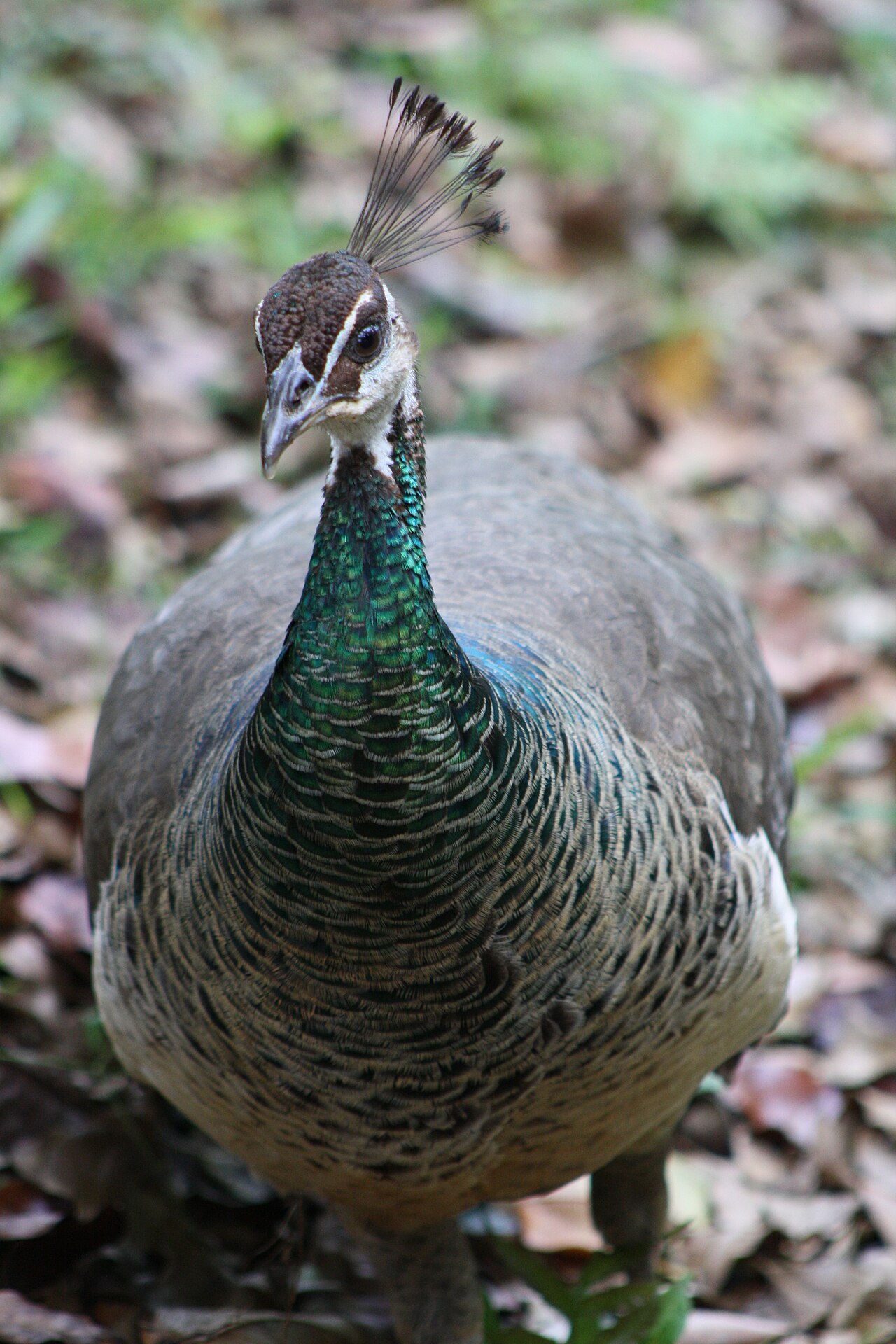
A female peacock is called a peahen, and strictly speaking the word peacock refers only to the male. The species as a whole is peafowl, with peahen for females, peacock for males, and peachick for the young. Peahens are brown and gray with an iridescent green neck, a white belly, and the same fan-shaped crest as the male, but they lack the long shimmering train of eyed feathers that made the species famous.
That plainness is not a deficiency. It is the direct result of the same evolutionary pressure that produced the male’s train, and it is what allows a peahen to sit on a ground nest for 28 days without being seen. This guide covers what peahens look like, how to tell the sexes apart at any age, why the female is camouflaged, whether peahens can fan their tails, how they nest and raise chicks, and what the white peahen actually is.
| Quick Facts | Peahen (Female Peacock) |
|---|---|
| Correct name | Peahen; the species is peafowl |
| Length | 34 to 40 in, versus 6 to 7.5 ft for a male with train |
| Weight | 6 to 9 lb |
| Plumage | Brown and gray body, iridescent green neck, white belly |
| Clutch size | 3 to 6 eggs, incubated about 28 days |
| Lifespan | 15 to 20 years in captivity |
A female peacock is called a peahen. She is brown and gray with an iridescent green neck, a white belly and the same fan-shaped crest as the male, but no train of eyespot feathers. The word peacock strictly means the male; the species as a whole is peafowl.
What Is a Female Peacock Called?
The correct term is peahen. Peafowl is the name for the birds as a group, peacock properly refers to the male alone, and peahen to the female. Common usage has blurred this thoroughly, and almost everyone says peacock for both sexes, but in ornithology and among breeders the distinction is maintained. Chicks of either sex are peachicks, and a group is a party or an ostentation of peafowl.
Three species carry the name. The Indian peafowl (Pavo cristatus) is the familiar blue-necked bird native to the Indian subcontinent and kept worldwide. The green peafowl (Pavo muticus) of Southeast Asia is larger, more uniformly iridescent, and endangered in the wild. The Congo peafowl (Afropavo congensis) of central Africa is a smaller, stockier bird discovered by science only in 1936.
The sexes differ most sharply in the Indian peafowl, which is why that species anchors nearly every discussion of peahens. Green peafowl females look far more like the males, with strong iridescence and a similar body shape, and they are distinguished mainly by the absence of the train. Congo peahens are chestnut and green with a short rufous crest, a much more subtle bird than either Asian relative.
What a Peahen Looks Like
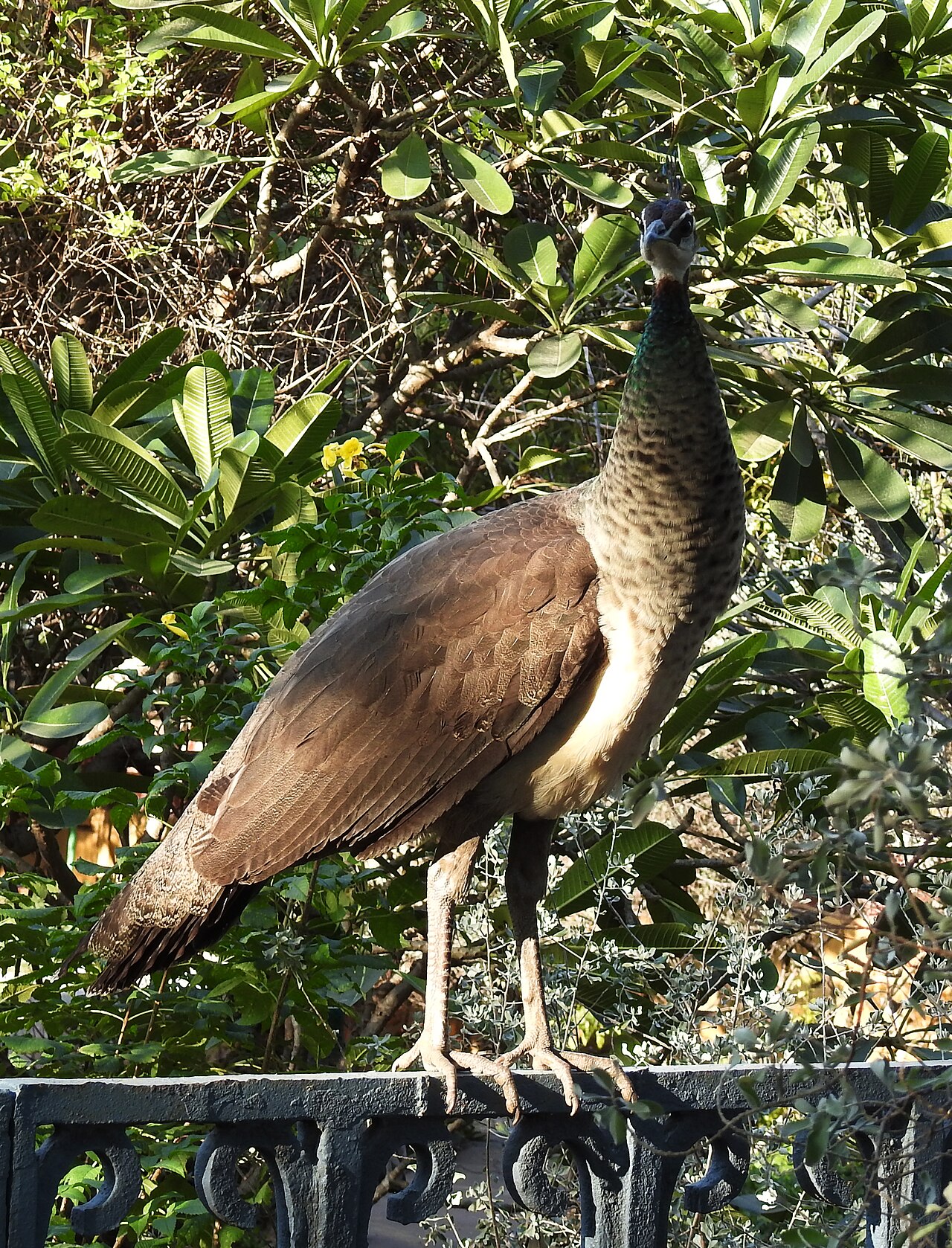
A peahen is a substantial bird, 34 to 40 in long and weighing 6 to 9 lb, with a mottled brown and gray body that reads as dull only in comparison to the male. Look closely and there is real subtlety in the plumage, with fine barring across the back and wings that breaks up her outline against dry grass and leaf litter.
Two features stop her from being a plain brown bird. The neck and upper breast carry the same metallic green iridescence as the male, forming a bright collar that flashes in sunlight, and the belly and undertail are creamy white, which shows clearly when she walks. She also wears the same fan-shaped crest of bare-shafted feathers on her head, though hers is usually brown-tipped rather than blue.
Her tail is short and brown, a functional tail rather than an ornament, and it gives her a compact silhouette next to the male’s extravagant profile. She flies better than her weight suggests, roosting in trees at night, and she runs quickly when startled. For the contrast that defines the species, our guide to peacock feathers covers the structure and color mechanism of the male’s train in detail.
Male vs Female Peacock: Key Differences
The train settles it instantly in adults. A mature male carries 150 to 200 elongated upper tail covert feathers, each ending in an iridescent eyespot called an ocellus, trailing 4 to 5 ft behind him. A peahen has none. Her longest feathers are ordinary tail feathers, and the difference in total body length is dramatic, roughly 34 to 40 in for her against 6 to 7.5 ft for him.
Color separates them from a distance. The male’s head, neck, and breast are a saturated cobalt blue with a metallic sheen, and his wings show bold black and white barring. The peahen substitutes brown and gray across the body, keeping only the green neck patch and the white belly. Both sexes wear the crest, which is often the first thing that identifies a distant bird as peafowl at all.
Size and voice complete the picture. Males weigh 9 to 13 lb against the female’s 6 to 9 lb, and males carry sharp leg spurs that females typically lack or have only in vestigial form. The loud rising may-AWE call that carries for miles is the male’s, though peahens have their own quieter repertoire of honks and alarm calls. Sexing young birds is far harder, which is why the same identification challenge shows up in our guides to the female mallard and the female wood duck.
Why Peahens Are Not Colorful
The answer is sexual selection, the mechanism Charles Darwin proposed specifically because the peacock’s train puzzled him. Natural selection could not explain a feature that makes a bird slower, heavier, and more visible to predators. His solution was that female choice drives the trait, with males evolving increasingly elaborate ornaments because peahens preferentially mate with the most impressive displays.
Peahens face the opposite pressure. A peahen incubates a ground nest alone for about 28 days and then leads flightless chicks through open country, so any bright coloration would be a direct liability. Her mottled brown plumage lets her disappear against dry grass and leaf litter, and this camouflage-versus-display split is one of the clearest examples of sexual dimorphism in the bird world.
What peahens actually assess has been studied for decades. Work led by Marion Petrie in the 1990s found that males with more eyespots in the train secured more matings, and that experimentally removing eyespots reduced a male’s success. Later research complicated the picture, showing that peahens spend much of their time looking at the lower portion of the train rather than the upper eyespots, and that display frequency and other cues matter too. The behavior is real, the precise signal is still debated.
Do Female Peacocks Have Tail Feathers or Fan?
Peahens have tail feathers, but not a train, and the distinction matters. The male’s famous fan is not his tail at all. It is made of elongated upper tail coverts, the feathers that normally lie over the tail, supported from beneath by the much shorter true tail feathers when he raises it. Peahens have the true tail feathers and lack the elongated coverts entirely.
They can still fan what they have. A peahen will raise and spread her short tail in defense, particularly when protecting chicks from a perceived threat, and the display is accompanied by wing spreading and a rush toward the intruder. It is a fraction of the male’s spectacle but it uses the same underlying muscle action.
Occasionally a peahen develops male-type plumage, including partial train feathers and blue neck coloration. This usually happens in older females when the ovary is damaged or ceases functioning, removing the hormonal suppression of male feather development. The phenomenon is documented in several bird species and produces a bird that looks partly male while remaining genetically female.
Peahen Eggs and Nesting
Peahens lay 3 to 6 eggs per clutch, occasionally up to 8, in a shallow scrape on the ground lined with grass and leaves and hidden under dense vegetation. The eggs are pale cream to light brown, roughly 2.75 in long, and noticeably larger than chicken eggs. Laying happens over several days, usually in spring and early summer in temperate climates.
Incubation takes about 28 days and the peahen does all of it. Males play no part in nesting, incubation, or chick rearing, which is typical of species with elaborate male display and a polygynous mating system. She leaves the nest only briefly to feed, and her camouflage is what keeps the nest from being found during those long sitting periods.
Peachicks hatch precocial, covered in down, eyes open, and able to follow their mother within hours. They can make short flights up to a low roost at only 7 to 10 days old, which gets them off the ground and away from predators far earlier than most birds manage. The mother leads them to food, broods them at night, and keeps them with her for several months. Ground-nesting strategies of this kind repeat across ornamental pheasants, as our guide to the golden pheasant shows.
White Peahens and Other Color Varieties
The all-white peafowl is not albino and not a separate species. It is a leucistic color morph of the Indian peafowl, produced by a recessive gene that suppresses pigment deposition in the feathers while leaving the eyes normally colored. Albino birds by contrast have no melanin anywhere and show pink or red eyes, which white peafowl do not.
A white peahen looks strikingly different from a normal one, being uniformly white with no green neck patch and no brown barring, while retaining the crest and the same body proportions. White males develop a full train of white feathers in which the eyespots are visible only as faint texture, since the structural color that produces the iridescence depends on pigment layers that the morph lacks.
Selective breeding has produced many other varieties in captivity, including pied birds with white patches on normal plumage, black-shouldered birds in which the male’s wing barring is replaced by solid dark shoulders, and purple, opal, and charcoal color forms. In these varieties peahens often show clearer differences than in wild-type birds, and black-shouldered peahens in particular are noticeably paler and creamier than standard females. Our guide to the albino peacock sorts out which of these morphs is actually albino and which are not.
Peahen Behavior, Sounds, and Mate Choice
Peafowl live in loose groups usually made up of one male and several females, and the peahens within a group forage together, roost in the same trees, and often nest near one another. They are omnivores, eating seeds, grain, insects, small reptiles, and plant matter, and they spend most of the day walking and foraging on the ground.
Their vocal range is wider than most people expect. The famous piercing may-AWE call belongs to the male, but peahens produce honks, cackles, and a distinct alarm call that alerts the group to predators. Peahens also call during mate assessment, and both sexes use quiet contact notes to keep a foraging group together.
Mate choice puts the female in charge of the entire display system. During courtship a male raises his train, vibrates it to produce a low rattling sound, and turns to catch the light while the peahen walks around and often appears to ignore him. She may inspect several males over days before choosing, and males with poor displays are simply passed over. The whole extravagance of the peacock exists because peahens have been making that judgment for a very long time, a dynamic explored further in our guide to peacock symbolism.
How Big Is a Peahen Compared With a Peacock?
A peahen is noticeably smaller and lighter than a peacock, and the gap widens once the male grows his train. Peafowl are the largest members of the pheasant family and among the heaviest birds still capable of flight, reaching up to about 13 pounds, with males at the top of that range and females below it.
The train accounts for most of the visible difference. A peacock’s elongated upper tail coverts form a display fan that can reach roughly five feet, decorated with 100 to 175 eyespots. A peahen has a much shorter tail with no eyespots at all, so her body outline is compact and pheasant-like rather than trailing. Both sexes prefer to walk or run and fly only in short bursts, usually to reach a night roost in the trees.
The Smithsonian’s National Zoo profile of common peafowl gives the weights, train measurements and eyespot counts behind those comparisons.
Frequently Asked Questions
What is a female peacock called?
A female peacock is called a peahen. The species as a whole is peafowl, peacock refers properly to the male only, and the young are peachicks. Everyday usage applies peacock to both sexes, but breeders and ornithologists keep the distinction.
Do female peacocks have colorful feathers?
Peahens are mostly brown and gray, but they are not plain. They carry the same iridescent green neck and upper breast as the male, a creamy white belly, fine barring across the back, and the same fan-shaped head crest. What they lack is the long train of eyed feathers.
Can a female peacock spread its tail?
Yes, but only her short true tail, not a train. Peahens raise and spread their tails defensively, especially when protecting chicks. The male’s fan is made of elongated upper tail coverts that females do not grow at all.
How many eggs does a peahen lay?
Usually 3 to 6 eggs per clutch, occasionally up to 8, laid in a shallow ground scrape hidden under vegetation. Incubation takes about 28 days and the peahen does all of it alone, since males take no part in nesting or chick rearing.
Why are female peacocks not colorful?
Because they incubate ground nests alone for four weeks and then lead flightless chicks through open country, where bright color would attract predators. Their mottled brown plumage is camouflage, and the contrast with the male is a textbook case of sexual selection driven by female mate choice.
How can you tell a male from a female peacock?
In adults the train settles it, since only males grow the 4 to 5 ft fan of eyespotted feathers. Males also have cobalt blue necks, bold black and white wing barring, leg spurs, and greater weight at 9 to 13 lb. Young birds are sexed by neck color, which turns blue in males at around 3 months.
What is a white peahen?
A white peahen is a leucistic Indian peafowl, not an albino and not a separate species. A recessive gene suppresses pigment in the feathers while the eyes stay normally colored, whereas true albinos have pink or red eyes. White peafowl are common in captivity and rare in the wild.