Peacock Sounds: Why Peafowl Scream and What Each Call Means
A peacock sounds like someone shouting for help. The signature call of a male Indian peafowl is a loud, rising two-note scream usually written as may-AWE or kee-OW, delivered in series of four to eight and audible over a kilometre in open country. Peafowl produce at least 11 distinct vocalizations beyond that scream, including alarm honks, low female contact calls, a short hoot given during courtship display, and a range of cackles and grunts.
The reason the call unsettles people is that it sits almost exactly in the frequency band of a human shout and a distressed cat. Police and animal control services in areas with feral peafowl populations receive calls about screaming women and injured animals every spring, and the source is almost always a male peafowl advertising for a mate from a rooftop or a tree.
| Sound | Meaning |
|---|---|
| May-awe scream | Male advertisement, attracting females |
| Ka-aan | Alarm, predator spotted |
| Honk series | Alarm in flight or when flushed |
| Hoot-dash | Short hoot before the display shiver |
| Low aow | Female contact call |
| Train rattle | Feather display, includes infrasound |
| Audible range | Roughly 1 to 2 km in open ground |
What a Peacock Sounds Like
The Indian peafowl, Pavo cristatus, is a pheasant, and its vocal apparatus produces sounds far closer to a game bird than to a songbird. The calls are loud, harsh, and unmusical, with almost no frequency modulation within a note. What they lack in complexity they make up for in volume and carrying distance, which is what a bird calling across open scrub and farmland needs.
The most heard sound by a wide margin is the male advertisement call. It rises sharply, holds, then drops, and the two-syllable shape is what produces the may-awe transcription. A calling male typically repeats it four to eight times with roughly two seconds between calls, then falls silent for several minutes before starting again.
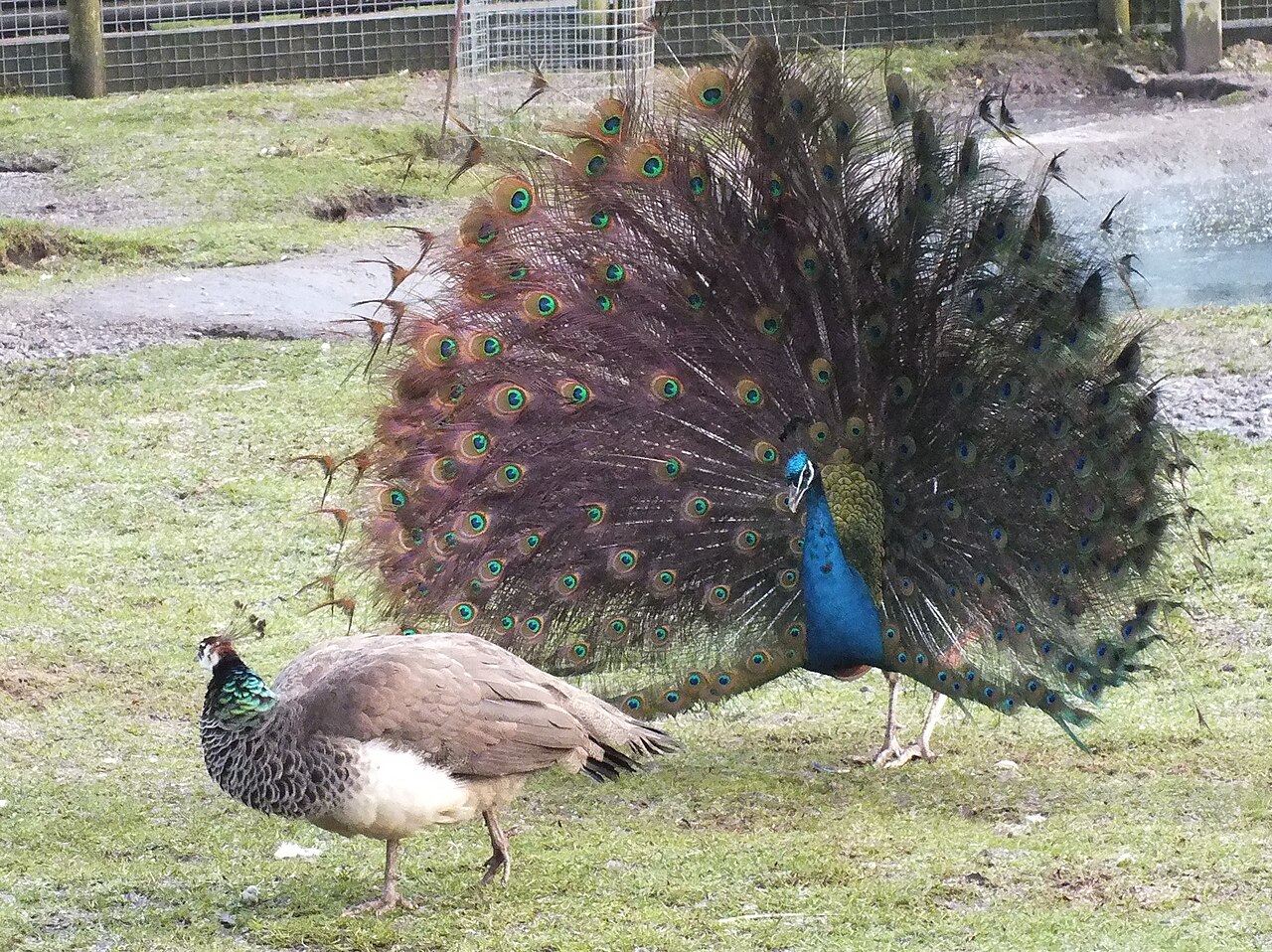
Females are far quieter but not silent. Peahens produce a lower, flatter contact note, a sharp alarm call, and a distinctive series of clucks when leading chicks. Anyone keeping peafowl learns to separate the two quickly, since the female calls carry a fraction of the distance. Our guide to the female peacock covers the other differences between the sexes.
The May-Awe Call: The Peacock’s Signature Scream
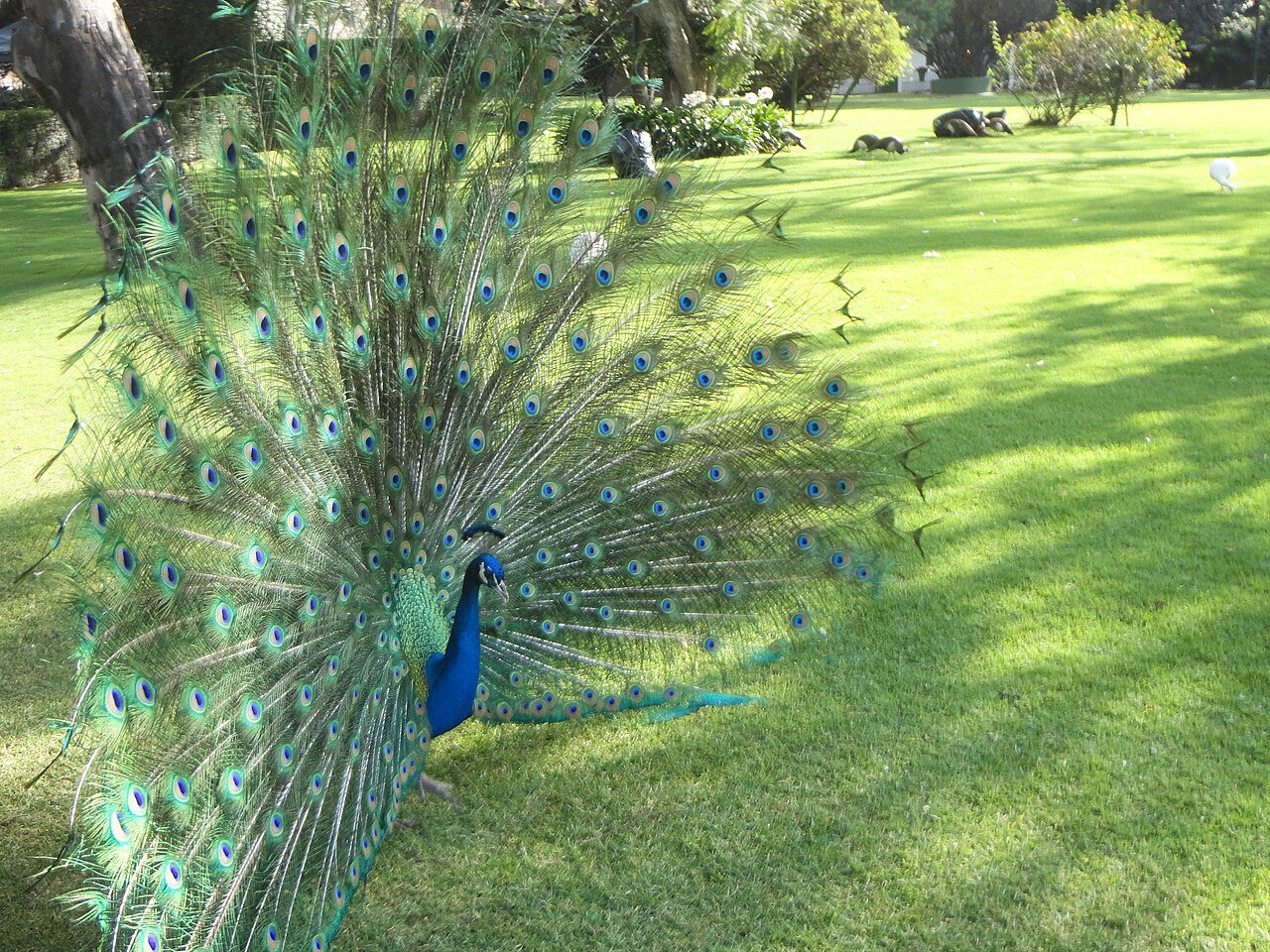
The advertisement call is a breeding signal, and its function is straightforward: it tells peahens where a displaying male is and it tells rival males the territory is occupied. Males call most intensely from elevated perches, which in rural India means trees and in suburban California means rooftops, and the elevation adds meaningfully to the range.
Call rate correlates with male quality in ways researchers have measured. Males with larger trains and better body condition call more frequently, and females approach higher-rate callers more often. The call therefore functions as an honest signal in the same way the train does, advertising a male who can afford the energetic cost and the predation risk of being loud and conspicuous.
The scream peaks during the breeding season, which in most of the introduced North American range runs from roughly March through August. Outside that window males still call but far less often, which is why neighbourhoods with feral peafowl experience the noise as a seasonal problem rather than a constant one.
Why Peacocks Scream at Night
Peafowl roost in trees overnight, and they call from those roosts. Night calling has two separate causes and telling them apart is straightforward once you know the pattern. The first is ordinary breeding advertisement, which continues after dark during peak season and often starts again well before dawn.
The second is alarm. A roosting peafowl that detects a predator below, most often a raccoon, coyote, or domestic dog, gives the sharp ka-aan alarm call or a rapid honk series, and one bird calling sets off every other bird in the roost. These outbursts are sudden, brief, involve multiple birds at once, and stop as abruptly as they started.
The distinction matters practically. A single bird calling in a regular rhythm for twenty minutes is advertising and there is nothing to investigate. A sudden multi-bird eruption at 2 a.m. usually means something is moving under the roost tree, which for anyone keeping peafowl is worth checking, since roosting birds are vulnerable to climbing predators.
Every Peafowl Call and What It Means
Researchers have documented at least 11 distinct vocalizations in Indian peafowl, and the functional set breaks down into advertisement, alarm, courtship, contact, and aggression. The may-awe scream handles advertisement. The ka-aan and the honk series handle alarm, with the honk given more often by birds in flight or freshly flushed.
Courtship has its own sound, and it is the one most people never hear. The hoot-dash is a short, explosive hoot a male gives at very close range immediately before charging a few steps toward the hen and shivering his train. It is quiet, it only happens within a metre or two of a female, and it is the acoustic component of a display that is otherwise entirely visual.
Contact and aggression calls fill out the rest. Low grunts and clucks pass between birds feeding together, hens use a specific series to gather chicks, and males in a territorial dispute produce harsh cackles alongside physical posturing. For the visual side of the same display, our guide to peacock feathers covers the train in detail.
Male vs Female Peafowl Sounds
The volume gap is the first thing to notice. A male’s advertisement scream carries over a kilometre and can exceed 100 decibels at close range. A peahen’s contact call is audible at perhaps 100 m and sits noticeably lower in pitch, closer to a flat honk than to a scream.

Females do give alarm calls, and those are loud. The ka-aan alarm is used by both sexes and sounds broadly similar from either, so an alarm outburst is not a reliable way to sex a bird by ear. The breeding advertisement scream, however, is male only, and hearing it confirms a male without any need to see the train.
Peahens leading chicks produce a distinctive soft clucking series that has no male equivalent, since males take no part in raising young. That call becomes the most audible female sound between roughly June and September in the introduced range. Our guide to the baby peacock covers the chicks themselves.
The Sounds You Cannot Hear
When a male peafowl shivers his train during display, the feathers vibrate at roughly 25 times per second, and researchers at the University of Manitoba demonstrated that this rattling generates substantial infrasound below the threshold of human hearing. Peafowl responded behaviourally to played-back infrasound recordings, which indicates the birds detect and use it.
The finding reframes the display considerably. What looks to a human observer like a purely visual performance carries an acoustic channel humans cannot perceive at all, and the infrasound travels further and around obstacles better than the audible calls do. A displaying male may be signalling to birds well out of sight.
The audible portion of the train rattle is a dry papery rustle, easily heard at close range and often described as sounding like a hand shuffling a deck of cards. If you are close enough to hear that rustle, you are also inside the range of the infrasound component and the hoot-dash, and you are seeing the full display rather than just the visual part.
Why Peacock Calls Sound Like a Cat or a Person Shouting
The resemblance is acoustic rather than coincidental. The peacock’s advertisement call has its dominant energy in roughly the same frequency band as a human shout and a cat’s yowl, it has a similar rising and falling contour, and it has the rough, non-tonal texture that human hearing associates with distress rather than with birdsong.
Human hearing is also tuned to be alert to exactly that signature. We detect and orient to sounds in the human vocal range faster than to any other category, and a call that mimics a shout for help triggers that response involuntarily. This is why residents in feral peafowl areas describe the experience as impossible to ignore rather than merely loud.
The comparison to a cat comes up most often at night, when the call is heard without a visible source. In daylight, with the bird in view, most people hear it as a bird immediately. The same effect explains why other loud non-musical bird calls get misattributed at night, a pattern our guide to guinea fowl sounds covers for a similar species.
Living Near Peafowl
Feral and semi-feral peafowl populations exist across parts of California, Florida, Texas, and Hawaii, and noise is the most common complaint about them. Realistic expectations help: the calling is seasonal, concentrated in spring and early summer, heaviest at dawn and dusk, and it will not stop while breeding-age males are present.
Feeding is the main lever residents actually control. Peafowl concentrate where food is reliable, and a neighbourhood where several households feed them will hold far more birds than the habitat alone supports. Coordinated cessation of feeding reduces local density over a season more effectively than any individual deterrent.
Legal status varies and matters. In many jurisdictions feral peafowl are treated as domestic animals rather than wildlife, which affects who is responsible for them and what removal options exist. Checking with the local animal control authority before taking any action is the sensible first step. Our guide to what peacocks eat explains what draws them to a property in the first place.
Frequently Asked Questions
What is the sound of a peacock?
The signature sound is a loud two-note scream usually written as may-awe or kee-ow, given by males during breeding season and audible over a kilometre. Peafowl also produce alarm honks, low female contact calls, courtship hoots, clucks, and a papery rattle when a male shivers his train.
Why do peacocks scream at night?
Two reasons. During breeding season males continue advertisement calling from roost trees after dark, in a slow regular rhythm. Separately, roosting birds give sudden alarm calls when a predator such as a raccoon or coyote moves below the tree, and those outbursts involve several birds at once and stop quickly.
What is the cry of a peacock called?
It is generally called a scream, and the bird is described as screaming rather than singing or calling. Ornithological descriptions use transcriptions such as may-awe or kee-ow for the male advertisement call and ka-aan for the alarm.
Does a peacock meow?
Not exactly, but the resemblance is real. The advertisement scream occupies a similar frequency band to a cat’s yowl and has a comparable rising and falling shape, which is why people hearing it at night without seeing the bird frequently report a distressed cat.
Do female peacocks make sounds?
Yes, but quieter. Peahens give a low flat contact call, share the sharp ka-aan alarm with males, and produce a soft clucking series when leading chicks. The loud may-awe advertisement scream is male only, so hearing it identifies the sex without seeing the bird.
How far can a peacock call be heard?
Roughly 1 to 2 km in open country, further when the bird calls from an elevated perch such as a rooftop or a tall tree. At close range the call can exceed 100 decibels, comparable to a chainsaw.
How long do peacocks live?
Indian peafowl typically live around 15 to 20 years in the wild and 20 to 25 years in captivity, with some captive birds recorded well beyond that. Males do not develop a full train until their third year, so a bird with a short train is young rather than unhealthy.