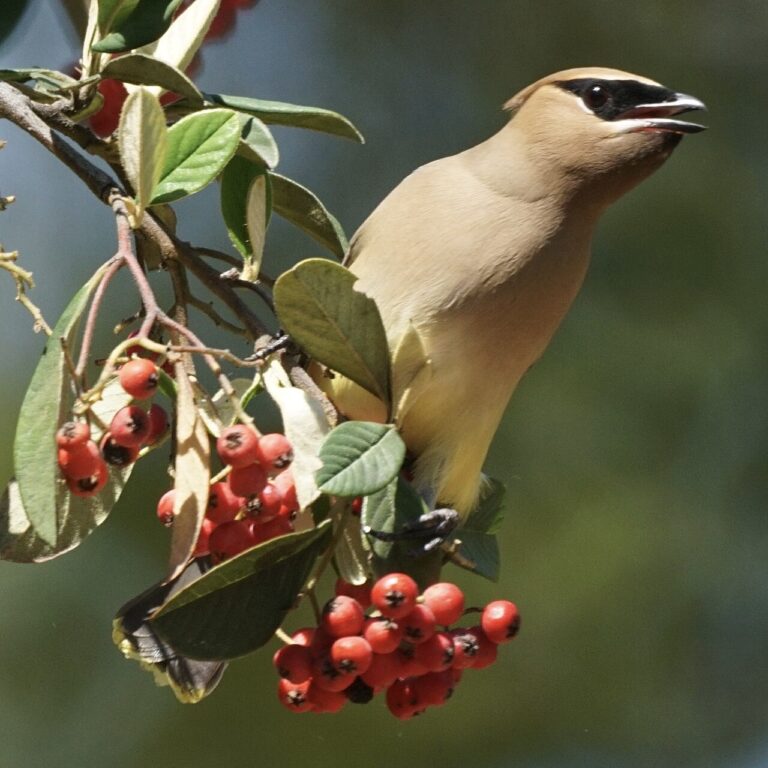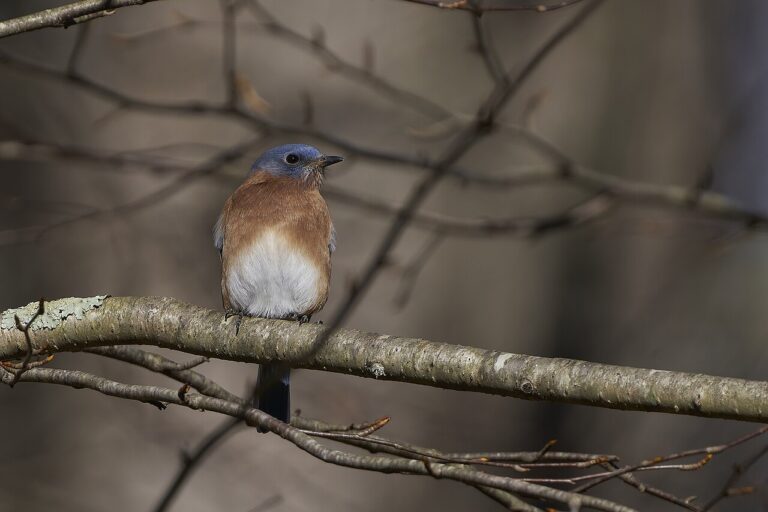
Backyard Birds of Arizona: 15 Common Species (2026 Identification Guide)
Arizona hosts one of the most unique backyard bird communities in the United States, completely different from any state east of the Rockies. The Sonoran Desert ecosystem supports species found nowhere else in the country, including the iconic Cactus Wren (Arizona’s state bird), Gila Woodpeckers nesting in saguaro cacti, Phainopeplas in mesquite groves, and Greater Roadrunners hunting along desert washes. Arizona’s geographic spread from the Sonoran Desert (Phoenix, Tucson) to the Mogollon Rim’s high-elevation pine forests (Flagstaff, Prescott) to the riparian Sky Islands of southeastern Arizona creates dramatically different bird communities within the state. Arizona is among the top US states for birding diversity, 550+ species recorded, and many of those visit suburban yards. This guide covers the 15 most common backyard birds across Arizona with field marks, regional ranges, and proven attraction strategies for the desert and elevation zones.
The most common backyard birds in Arizona are the Cactus Wren, Gambel’s Quail, Gila Woodpecker, Verdin, Curve-billed Thrasher, House Finch, Mourning Dove and Anna’s Hummingbird. The Sonoran Desert community shares almost nothing with an eastern backyard, and above about 6,000 feet it changes again into a montane list.
Quick Reference: 15 Common Backyard Birds of Arizona
| Species | Size | Key ID Feature | Where in AZ |
|---|---|---|---|
| Cactus Wren (state bird) | 8.5″ | Large wren + spotted breast + white eyebrow | Sonoran Desert |
| Gambel’s Quail | 10.5″ | Forward-curving black topknot + gray + chestnut crown (male) | Statewide desert |
| Mourning Dove | 12″ | Tan + long pointed tail + small head | Statewide year-round |
| White-Winged Dove | 11.5″ | Large + white wing patch + blue eye-ring | Statewide year-round |
| Inca Dove | 8.25″ | Tiny + scaly pattern + ‘no-hope’ call | Lower elevations |
| Gila Woodpecker | 9.25″ | Zebra back + red cap (male only) | Sonoran Desert |
| Curve-Billed Thrasher | 11″ | Long curved bill + spotted breast + orange eye | Desert and shrublands |
| Verdin | 4.5″ | Tiny + yellow head + gray body | Sonoran Desert |
| Phainopepla | 7.75″ | Black + red eye + crest (male) | Mesquite groves |
| House Finch | 5.5″ | Red head/breast (male) + streaky belly | Statewide year-round |
| Anna’s Hummingbird | 4″ | Iridescent rose-red head (male) | Statewide year-round |
| Costa’s Hummingbird | 3.5″ | Purple flared throat (male) | Sonoran Desert |
| Greater Roadrunner | 23″ | Crest + long tail + ground-running | Desert |
| Northern Cardinal | 8.5″ | All red (male) + crest + black face mask | Lower elevations |
| Pyrrhuloxia | 8.5″ | Gray + red highlights + yellow bill + crest | Sonoran Desert |
Species Identification
Cactus Wren (State Bird)
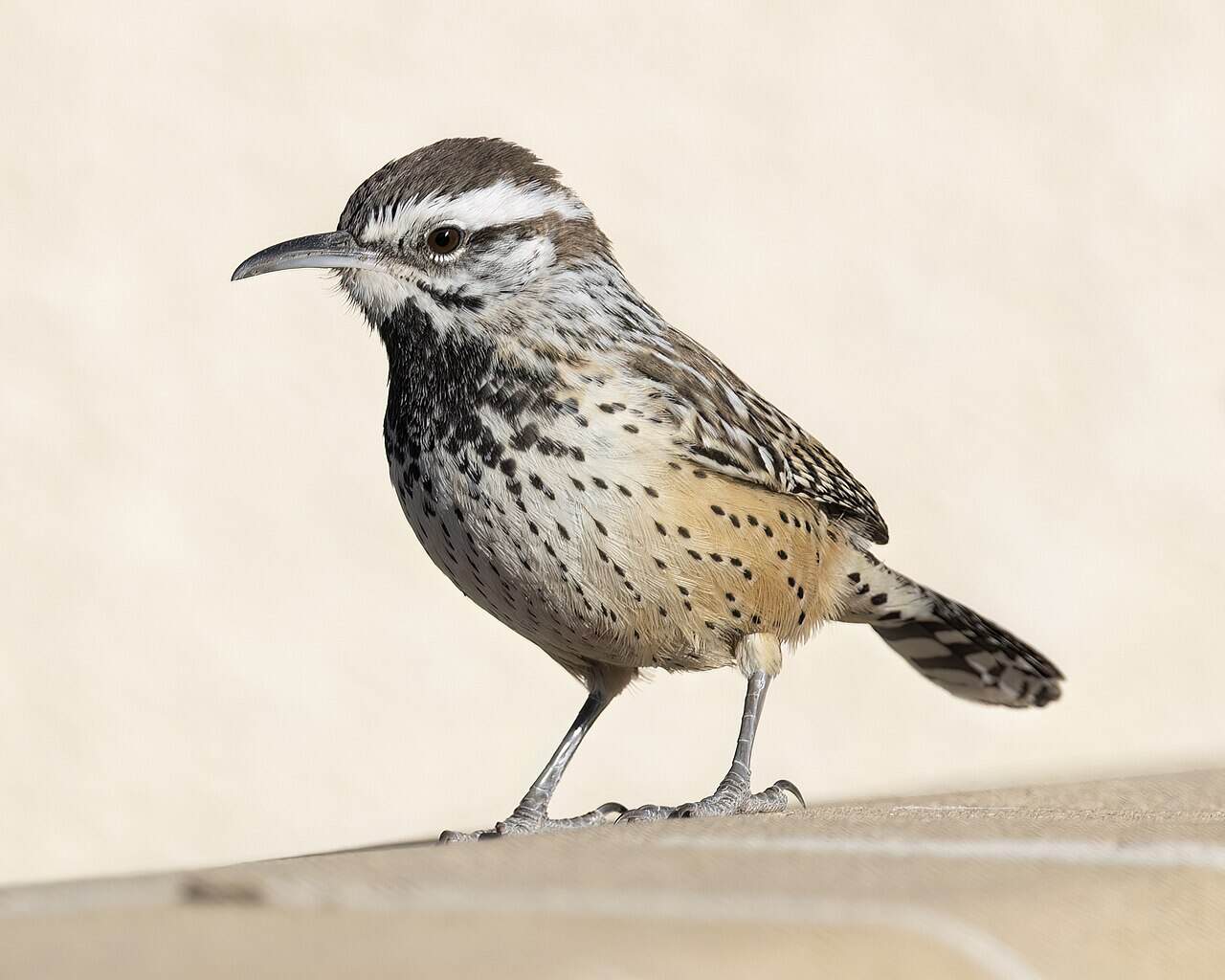
Arizona’s official state bird, designated in 1931, and the only state with this species as state bird. Cactus Wrens are large for wrens (8.5 inches, bigger than any other US wren), with a heavily-spotted breast on rich white-buff underparts, brown back, bold white eyebrow stripe, slightly downcurved bill, and brilliant orange eye. Loud, raspy ‘cha-cha-cha’ calls fill Sonoran Desert mornings.
Range in Arizona: Sonoran Desert, Phoenix, Tucson, and surrounding desert areas.
Habitat: Sonoran Desert with cholla and saguaro cacti. Suburban yards adjacent to or incorporating native desert.
Key ID: Large size + spotted breast + white eyebrow + orange eye + raspy voice. The largest US wren.
Where to see: Will visit ground feeders and platform feeders with mixed seed. Nest in cholla cacti, the thorns deter predators. Plant native cholla and saguaro if you have desert yard space.
Gambel’s Quail
Arizona’s iconic desert quail, and one of the most photogenic Southwest birds. Male Gambel’s Quail have a chestnut crown, black face with white outline, gray body with rusty flanks, and a black belly patch. The distinctive forward-curving black topknot (‘plume’) is shared between sexes. Highly social, coveys of 10-40 birds are common.
Range in Arizona: Statewide in desert and shrubland habitat.
Habitat: Sonoran Desert, mesquite bosques, suburban desert yards.
Key ID: Forward-curving black topknot + chestnut crown (male) + black belly patch + covey behavior. Cousin of California Quail but with chestnut (not solid black) crown.
Where to see: Ground feeders or scattered seed (millet, cracked corn). Coveys arrive at dawn and dusk in Arizona yards. Provide dense brush piles for cover.
Gila Woodpecker
Arizona’s iconic desert woodpecker, famous for nesting in saguaro cacti. Gila Woodpeckers have a black-and-white zebra-pattern back, tan-buff head and underparts, and males have a small red cap (females lack it). They excavate nest holes in saguaros, the cacti react by forming a hard ‘boot’ lining around the hole, which provides a perfect nesting cavity used by many other desert species after the woodpeckers leave.
Range in Arizona: Sonoran Desert (Phoenix, Tucson areas).
Habitat: Sonoran Desert with saguaros, mesquite bosques, suburban desert yards with mature trees.
Key ID: Zebra back + tan head + small red cap (male). The ‘desert woodpecker’, the only common woodpecker in most Sonoran Desert yards.
Where to see: Will visit suet feeders, oranges, and sugar water (yes, they sometimes drink from hummingbird feeders!). Will excavate nests in saguaros, mesquites, and even some buildings.
Curve-Billed Thrasher
Arizona’s desert mockingbird relative. Curve-Billed Thrashers are large (11 inches), grayish-brown overall with a heavily-spotted breast, brilliant orange eyes, and a long downcurved bill. They have a loud, distinctive ‘whit-wheet’ call that carries far in the desert. The downcurved bill is adapted for probing into cholla cacti and digging in desert soil.
Range in Arizona: Statewide in desert and shrublands.
Habitat: Sonoran and Chihuahuan Deserts, mesquite bosques, suburban desert yards.
Key ID: Long downcurved bill + spotted breast + orange eye + grayish-brown body. Distinguished from mockingbird by the bill curve and spots.
Where to see: Will visit ground feeders with mixed seed. Native cholla cacti provide essential nest sites, the thorns protect against predators.
Verdin
Arizona’s tiny desert specialist. Verdins are very small (4.5 inches, smaller than chickadees), with a bright yellow head, gray body, and small chestnut shoulder patches. Active and constantly moving. They build distinctive ball-shaped nests with side entrances in thorny desert shrubs.
Range in Arizona: Sonoran and Chihuahuan Deserts.
Habitat: Mesquite, palo verde, cholla, and other desert shrub habitats.
Key ID: Tiny size + yellow head + gray body. The yellow head is diagnostic, no other tiny Arizona desert bird has it.
Where to see: Will visit sugar-water feeders (they steal from hummingbird feeders) and suet. Plant native mesquite, palo verde, and acacia for habitat.
Phainopepla
Arizona’s mesquite specialty. Male Phainopeplas are glossy black overall with a prominent crest and red eyes. Females are gray with the same crest and red eyes. Their diet is heavily dependent on desert mistletoe berries, Phainopeplas are major dispersers of mistletoe in mesquite groves. They have an unusual two-stage breeding strategy: nesting first in lowland desert (Feb-Apr), then migrating to higher elevation oak woodlands to nest again (May-Jul).
Range in Arizona: Lowland deserts in winter/spring, higher elevations in summer.
Habitat: Mesquite bosques, desert riparian areas, oak woodlands at higher elevations.
Key ID: Glossy black + prominent crest + red eye (male). Females gray with same features. The combination of crest and red eye is diagnostic.
Where to see: Plant native mesquite if possible. They rarely visit feeders but visit yards with mistletoe-bearing mesquites.
White-Winged Dove
Arizona’s larger dove with bold white wing markings. White-Winged Doves have grayish-brown bodies, a large WHITE patch on each wing (visible in flight as a bold white line), and a distinctive blue eye-ring. Their distinctive ‘who-cooks-for-you’ call is a Sonoran Desert summer sound. They feed extensively on saguaro fruit during the brief flowering season.
Range in Arizona: Statewide, especially abundant in Sonoran Desert.
Habitat: Urban/suburban areas, desert with saguaros, agricultural edges.
Key ID: Larger than Mourning Dove + bold white wing patch + blue eye-ring + square tail (not pointed).
Where to see: Platform feeders with mixed seed, sunflower, or cracked corn. Often noisy in flocks.
Greater Roadrunner
Arizona’s famously cartoon-like ground bird. Greater Roadrunners are large (23 inches), brown-streaked overall with a long tail (often held cocked), prominent crest, long legs, and stout bill. They run rapidly on the ground (up to 20 mph) instead of flying when possible. They eat lizards, snakes (including rattlesnakes), insects, and rodents.
Range in Arizona: Statewide in deserts and shrublands.
Habitat: Sonoran and Chihuahuan Deserts, shrublands, suburban yards with desert vegetation.
Key ID: Very large + brown-streaked + long cocked tail + crest + ground-running. Unmistakable.
Where to see: They don’t visit feeders but will hunt insects and lizards attracted to your yard. Some Arizona yard birders see Roadrunners ambush House Sparrows or doves at feeders.
Anna’s Hummingbird
Arizona’s most common year-round hummingbird. Male Anna’s Hummingbirds have brilliant iridescent rose-red heads and throats, the only US hummingbird with red covering the entire head, not just the throat. Females are green above with a small red throat patch. Year-round residents throughout most of Arizona.
Range in Arizona: Statewide year-round.
Habitat: Urban and suburban gardens, parks, anywhere with flowers or sugar-water feeders.
Key ID: Iridescent rose-red entire head (not just throat) + green back + tiny size. The most common Arizona hummingbird year-round.
Where to see: Hummingbird feeders year-round (4:1 sugar-water ratio, no red dye). Multiple feeders reduce male territorial fighting. Plant native ocotillo, chuparosa, and desert salvias.
Costa’s Hummingbird
Arizona’s flashy small desert hummingbird. Male Costa’s Hummingbirds have a brilliant purple throat that extends downward in dramatic ‘mustache’ projections on either side, looking like a flared purple collar. Females are plain. Smaller than Anna’s Hummingbirds. Closely associated with desert habitat.
Range in Arizona: Sonoran Desert (lower elevations).
Habitat: Sonoran Desert with cholla and ocotillo, suburban desert yards.
Key ID: Purple throat with flared ‘mustache’ (male). Smaller than Anna’s. Females very similar to female Anna’s, best distinguished by male presence.
Where to see: Hummingbird feeders. Plant native ocotillo, chuparosa, and desert salvias. Often shares feeders with Anna’s Hummingbirds.
Northern Cardinal
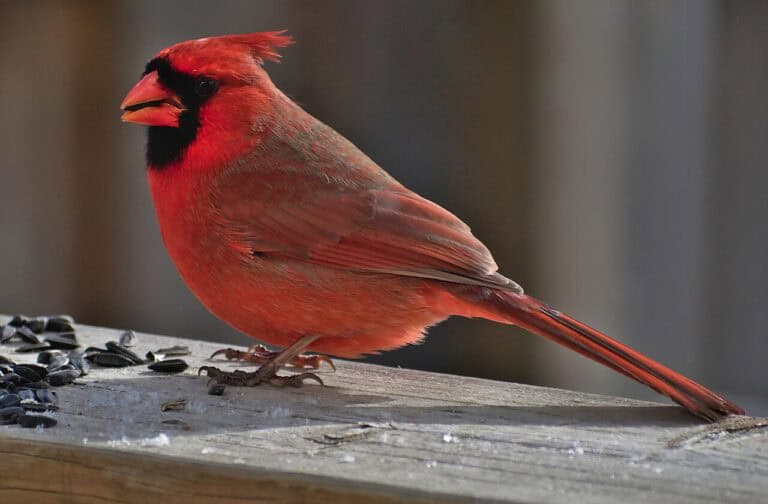
Arizona’s iconic red bird (in lower elevations). Male Northern Cardinals are brilliant red overall with a pointed red crest, black face mask, and thick orange-red bill. Females are tan-brown with red highlights. Once primarily an eastern US bird, Cardinals have expanded into Arizona along riparian corridors.
Range in Arizona: Lower-elevation desert and riparian areas (Phoenix, Tucson, riparian zones).
Habitat: Riparian zones with mesquite and dense vegetation, suburban yards with brush cover.
Key ID: Brilliant red + pointed crest + black face mask + orange-red bill (male). The red is brighter than Pyrrhuloxia.
Where to see: Hopper or platform feeders with sunflower or safflower seed. Cardinals need a perching surface.
Pyrrhuloxia (Desert Cardinal)
Arizona’s desert cardinal cousin. Pyrrhuloxias have a gray body with red wash on the face, crest, breast, and wings, plus a distinctive yellow bill (Cardinals have orange-red bills). The pointed crest is similar to Cardinals. Often called ‘desert cardinals’ for their adaptation to arid environments where Cardinals can’t thrive.
Range in Arizona: Sonoran and Chihuahuan Deserts.
Habitat: Desert with mesquite and dense thorn scrub, arid suburban yards.
Key ID: Gray body with red highlights + yellow bill (NOT orange-red like Cardinal) + pointed crest. Cardinal-like shape but desert colors.
Where to see: Will visit feeders with sunflower or safflower seed in their range. Native mesquite and acacia provide essential cover.
Regional Variations Across Arizona
Arizona’s elevation gradient from below sea level (Yuma, Colorado River) to over 12,000 feet (San Francisco Peaks) creates dramatically different bird communities by region and elevation. The Sonoran Desert (Phoenix, Tucson, Yuma) hosts the most distinctive species, Cactus Wren, Gila Woodpecker, Verdin, Phainopepla, Costa’s Hummingbird, Gambel’s Quail, Greater Roadrunner. These species occur in few or no other states.
Sky Islands of Southeastern Arizona (Madera Canyon, Chiricahuas, Huachucas, Santa Ritas) are among North America’s premier birding destinations. Yards in towns like Patagonia and Portal host 14 hummingbird species (Magnificent, Blue-Throated, Violet-Crowned, Broad-Billed, plus more common species), Elegant Trogons, Painted Redstarts, and other species rarely found north of Mexico.
Mogollon Rim and northern Arizona high country (Flagstaff, Prescott, Williams) host ponderosa pine forest species, Pygmy Nuthatch, Grace’s Warbler, Western Bluebird, Steller’s Jay, Mountain Chickadee, Cassin’s Finch. Winter brings Pine Grosbeaks and Pine Siskins in irruption years. Cooler climates and four-season weather more like Colorado than Phoenix.
Riparian zones along desert rivers (Salt River, San Pedro River, Verde River, Gila River) attract concentrated bird activity. Backyards near riparian areas see dramatically higher species diversity than dry desert yards just a few miles away.
Grand Canyon and northwestern Arizona high desert plateaus host yet another community, Pinyon Jay (declining), Black-Throated Gray Warbler, and high-desert species adapted to extreme conditions.
The Arizona/Mexico border (Nogales, Bisbee, Naco) is the northern range edge for many Mexican species, Berylline Hummingbird, Rufous-Capped Warbler, occasional Elegant Trogons. Some yards in southeastern AZ are among the most species-rich in the country.
The Cactus Wren: Arizona’s Unique State Bird
The Cactus Wren (Campylorhynchus brunneicapillus) was designated Arizona’s official state bird in 1931. Arizona is the only US state with this species as state bird, making it one of the most uniquely-identifying state bird choices.
Cactus Wrens are the largest wren species in the United States, substantially bigger than House Wrens or Carolina Wrens. They’re masters of the Sonoran Desert ecosystem, with adaptations enabling year-round residency in extreme desert conditions. Cactus Wrens get most of their water from the insects and fruits they eat, they rarely need to drink free water, though they will visit bird baths when available.
Cactus Wrens are famous for their distinctive nest architecture. They build large, football-shaped enclosed nests in cholla cacti, the cholla’s vicious thorns deter predators. A pair may build multiple nests within their territory: one for active breeding, others as ‘decoy’ or roosting nests. The dense thorny location makes Cactus Wren nests among the most predator-resistant of any US bird.
Cactus Wrens are loud and vocal year-round. Their raspy ‘cha-cha-cha’ calls (sometimes compared to an unoiled engine starting) carry far in the desert. Both male and female sing year-round to maintain territory.
To attract Cactus Wrens to your Arizona yard, maintain native Sonoran Desert vegetation. Cholla cacti are essential, they provide both food and nest sites. Saguaro and palo verde provide additional structure. Cactus Wrens will visit ground feeders with millet, sunflower, and mealworms. Provide a quality bird bath with shallow water, even desert-adapted birds appreciate clean water during Arizona’s hot summers.
How to Attract Arizona Backyard Birds
Arizona’s extreme climate (hot dry summers, mild winters, monsoon rains July-September) creates unique backyard birding strategies. Unlike most US states, water is more critical than food for Arizona backyard birds.
Water is the single most important attractant. Provide a quality bird bath with daily fresh water, especially during summer when natural water sources are scarce. Add a dripper or fountain, moving water doubles or triples bird visitation in dry climates. Shaded baths under trees stay cooler and cleaner. Mosquito control: change water at least every 2 days. During summer heat (100°F+), refresh bath water at least once daily.
Native plant landscaping is more important in Arizona than in any other US state. Non-native plants need massive irrigation in Arizona’s climate and support virtually no native birds. Native desert plants (mesquite, palo verde, ironwood, ocotillo, saguaro, cholla, desert sage, chuparosa) support 50-100x more bird food than non-native landscaping AND need minimal water.
Hummingbird feeders are essential Arizona equipment year-round. Anna’s Hummingbirds are year-round residents; Costa’s Hummingbirds inhabit lower deserts. Use 4:1 water-to-sugar ratio, no red dye. Clean every 2 days during summer heat (sugar water spoils quickly in Arizona heat). Multiple feeders reduce male territorial fighting.
For seed feeders: black oil sunflower seed (universal), safflower seed (cardinals and pyrrhuloxias love it), white millet (for doves, sparrows, quail), mixed seed for ground-feeders. Position feeders within 10 feet of native shrub cover.
Native mesquite, palo verde, and ironwood trees are the most productive Arizona yard plants for supporting nesting birds. These trees host hundreds of caterpillar species, critical food for nesting baby birds. Plant them if you have space.
Saguaro cacti host Gila Woodpeckers, Elf Owls, Cactus Wrens, and many other species. Preserving existing saguaros (and planting new ones if you have desert yard space) provides multi-decade bird habitat.
Provide cover for ground birds. Cactus Wrens, Gambel’s Quail, and California Towhees all prefer yards with dense brush piles, native shrub thickets, or other dense cover for escape routes.
Manage outdoor cats. Arizona outdoor cats kill significant numbers of native birds. Desert birds especially have nowhere to escape, keeping cats indoors is essential.
Avoid pesticides if possible. Most lawn ‘pests’ (grubs, caterpillars) are actually critical food for nesting birds. Arizona has fewer non-native pest species than most states, the insects in your yard mostly are critical bird food.
Top Native Arizona Plants for Backyard Birds
**Mesquite (Prosopis velutina or P. glandulosa):** Arizona’s most important native tree for backyard birds. Velvet Mesquite (P. velutina) is the Sonoran Desert native; Honey Mesquite (P. glandulosa) is widespread. Mesquite supports hundreds of caterpillar species, provides essential cover, and produces seed pods feeding doves and quail. Drought-tolerant. The single most productive Arizona yard tree.
**Palo Verde (Parkinsonia florida or P. microphylla):** Arizona’s state tree, native to the Sonoran Desert. Produces brilliant yellow flowers in spring (feeding many pollinators that support food chains). Provides essential cover. Beautiful green bark and architectural form.
**Saguaro Cactus (Carnegiea gigantea):** Iconic Sonoran Desert native. Provides nest sites for Gila Woodpeckers, Elf Owls, Cactus Wrens, and other species. Flowers feed nectar-feeding birds. Fruits feed White-Winged Doves and other species. Plant carefully, they grow extremely slowly but live 150+ years.
**Desert Hackberry (Celtis pallida):** Native shrub producing orange-red berries that feed many Arizona bird species. Tolerates extreme heat and drought.
**Ocotillo (Fouquieria splendens):** Native shrub with brilliant red tubular flowers in spring. Critical hummingbird nectar source, especially for Costa’s Hummingbird. Tolerates extreme desert conditions.
**Chuparosa (Justicia californica):** Native shrub with red tubular flowers blooming nearly year-round. Named for hummingbirds (‘chuparosa’ means ‘hummingbird’ in Spanish). Critical food for Anna’s, Costa’s, and Black-Chinned Hummingbirds.
Related reading: Owls in Arizona.
How Do I Identify a Bird in My Arizona Backyard?
Start with the fact that most eastern identification instincts do not transfer. Arizona’s desert birds are largely grey, brown and buff, built for heat and cover rather than for display, so colour is a weaker clue here than shape, bill and behaviour.
Use four checks. Size against a Mourning Dove, which is present everywhere. Bill shape: a long down-curved bill means thrasher, a chisel means Gila Woodpecker or Ladder-backed, a tiny needle means Verdin or hummingbird, a stout cone means finch or towhee. Where the bird is: on the ground in a covey means Gambel’s Quail, clambering through cholla means Cactus Wren, hovering at a flower or feeder means one of several hummingbirds. And sound, which does more work in the desert than anywhere, since the Cactus Wren’s grinding chug and the Curve-billed Thrasher’s sharp whit-wheet carry a long way through open ground.
Desert and High Country: Arizona’s Two Bird Communities
Arizona effectively has two backyard bird lists, and which one you have depends on elevation rather than on region. Below about 4,000 feet, in Phoenix, Tucson and the Sonoran and Mojave lowlands, expect the desert set: Cactus Wren, Gila Woodpecker, Verdin, Gambel’s Quail, Curve-billed Thrasher, Abert’s Towhee, Anna’s and Costa’s Hummingbirds.
Above roughly 6,000 feet, in Flagstaff, Prescott, Show Low and the White Mountains, the community switches to a montane one that would look more familiar to a visitor from Colorado: Steller’s Jay, Mountain Chickadee, Pygmy Nuthatch, Dark-eyed Junco, Acorn Woodpecker and Broad-tailed Hummingbird. The transition zone between them, oak and juniper woodland, carries elements of both plus specialities such as the Bridled Titmouse. Audubon’s Cactus Wren account covers the state bird’s range within the lower zone.
Frequently Asked Questions
What’s the most common backyard bird in Arizona?
Mourning Dove, House Finch, Anna’s Hummingbird, White-Winged Dove, House Sparrow, Cactus Wren (state bird, in Sonoran Desert), and Gambel’s Quail are all extremely common in Arizona desert backyards. Higher elevation yards (Flagstaff, Prescott) have completely different species, Steller’s Jays, Western Bluebirds, Mountain Chickadees, Acorn Woodpeckers.
What’s that loud bird with the spotted breast in my Arizona yard?
Most likely a Cactus Wren (Arizona’s state bird), large for wrens, with heavily spotted breast on white-buff underparts, bold white eyebrow, and raspy ‘cha-cha-cha’ call. Curve-Billed Thrasher is similar but larger with a long downcurved bill. Cactus Wrens nest in cholla cacti; thrashers nest in dense shrubs.
Do hummingbirds stay in Arizona all winter?
Yes, Anna’s Hummingbirds are year-round residents throughout most of Arizona. Costa’s Hummingbirds are year-round in lower Sonoran Desert. Black-Chinned Hummingbirds migrate to Mexico for winter but return in spring. Arizona is one of the best US states for year-round hummingbird watching, and the Sky Islands of southeastern Arizona host 14 hummingbird species during peak migration.
What’s that funny crested bird running across my Arizona yard?
Greater Roadrunner, Arizona’s iconic ground bird. Large (23 inches), brown-streaked with a long cocked tail, prominent crest, and ability to run up to 20 mph. They eat lizards, snakes, insects, and small mammals. They don’t typically visit feeders but may hunt other birds (House Sparrows) attracted to feeders.
Why does my Gila Woodpecker drink from my hummingbird feeder?
Gila Woodpeckers commonly use hummingbird feeders for sugar water in Arizona. They’re flexible feeders, eating insects, fruit, cactus flowers, and sugar water. To exclude them from hummingbird feeders, use feeders with smaller perches (woodpeckers can’t grip well) or hang feeders in locations woodpeckers find harder to access. Some Arizona birders dedicate a separate sugar-water dish for the woodpeckers.
How do I attract Cactus Wrens (Arizona’s state bird) to my yard?
Plant native cholla cacti (Cactus Wrens nest in cholla, the thorns deter predators). Maintain native Sonoran Desert vegetation including saguaro, palo verde, and mesquite. Provide ground feeding with millet, sunflower, and mealworms. Provide a quality bird bath. Cactus Wrens are loud and territorial, once they discover your yard, they’ll often visit regularly.
What’s the difference between Cactus Wren and Curve-Billed Thrasher?
Both are spotted brown desert birds. Cactus Wren: smaller (8.5 inches), bold white eyebrow stripe, straight bill, raspy ‘cha-cha-cha’ call. Curve-Billed Thrasher: larger (11 inches), long downcurved bill, orange eye, no eyebrow stripe, loud ‘whit-wheet’ call. Both visit Arizona yards but have distinct shapes and bills.
Why are there so many hummingbirds in southeastern Arizona?
Southeastern Arizona’s Sky Islands (Madera Canyon, Chiricahuas, Huachucas) host 14 hummingbird species during spring/fall migration, the highest diversity in the United States. Magnificent, Blue-Throated, Violet-Crowned, Broad-Billed, Berylline, and several other species occur there alongside more common species. The combination of Mexican biogeography and elevational gradients creates ideal hummingbird habitat. Yards near these Sky Islands host extraordinary hummingbird diversity.