Dark-Eyed Junco: Complete Identification, Diet, and Behavior Guide (2026)
The Dark-Eyed Junco (Junco hyemalis) is one of North America’s most familiar winter birds, often called ‘snowbirds’ for their seasonal arrival in lower-elevation yards. With their classic ‘slate-gray hood + clean white belly + pink bill’ appearance, Dark-Eyed Juncos are familiar fixtures at winter feeders across nearly the entire continent. But there’s more to Juncos than meets the eye: the species comprises FIVE highly distinctive geographic forms (subspecies) that look so different that birders previously considered them separate species. From the Slate-Colored Junco of the East to the Oregon Junco of the West to the rare White-Winged Junco of the Black Hills, Dark-Eyed Juncos showcase remarkable geographic diversity. This comprehensive guide covers Junco identification (including the five subspecies forms), range, diet, behavior, breeding, vocalizations, and proven strategies for attracting these winter visitors to your backyard.
Dark-Eyed Junco: Key Facts at a Glance
| Attribute | Detail |
|---|---|
| Scientific Name | Junco hyemalis |
| Family | Passerellidae (New World sparrows) |
| Size | 5.5-6.3 inches (14-16 cm) length |
| Wingspan | 7.1-9.8 inches (18-25 cm) |
| Weight | 0.6-1.1 oz (18-30 g) |
| Lifespan | 3 years average; up to 11 years recorded |
| Diet | Primarily seeds (75%) + insects in summer |
| Habitat | Coniferous forests (summer); backyards, edges (winter) |
| Range | All of North America (breeds in north, winters across continent) |
| Population Status | Very common, 630 million estimated North American population |
| Conservation Status | Least Concern (IUCN) |
| Distinctive Feature | White outer tail feathers (flash in flight) |
| Nickname | Snowbird (for winter arrival) |
| Subspecies | 5 distinctive geographic forms |
| Migration | Most populations migrate (south for winter) |
Dark-Eyed Junco Identification: Five Distinctive Forms
Dark-Eyed Junco identification requires knowing which of the five geographic forms (subspecies) occurs in your region. The five forms look remarkably different, though they’re all the same species.
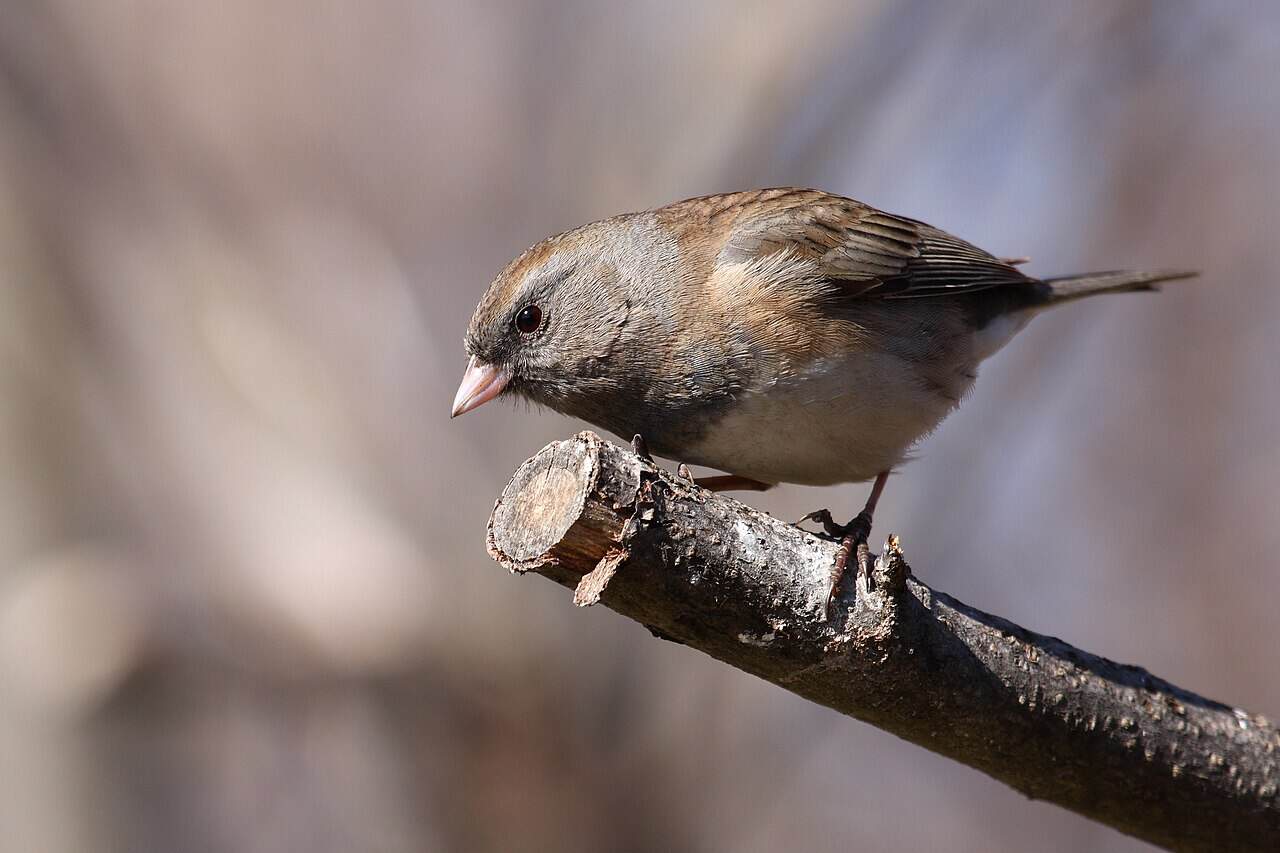
1) Slate-Colored Junco (eastern form): The classic ‘snowbird’ appearance, uniformly slate-gray above (males darker than females), clean white belly with crisp boundary against the gray, and pink bill. Found across most of the eastern half of North America during winter.
2) Oregon Junco (western coastal form): More colorful, dark black hood (head), warm brown back, pinkish-brown sides, and white belly. Found along the Pacific Coast, with breeding range from California to Alaska.
3) Gray-Headed Junco (Rocky Mountain form): Uniformly gray head and chest, with a rufous (rust-colored) back. Found in the central Rocky Mountains (Colorado, Wyoming, New Mexico).
4) Pink-Sided Junco (Northwest interior form): Gray head, brown back, and distinctive pink-buff sides. Found in the northern Rocky Mountains and intermountain west.
5) White-Winged Junco (Black Hills form): Light gray overall with prominent white wing bars. The rarest and most localized form. Found only in the Black Hills of South Dakota.
All forms share key features: small sparrow-sized body, white outer tail feathers that flash in flight, pink bill, and dark eyes (giving the species its name).
Hybrid forms: At range boundaries, the five forms hybridize freely, creating intermediate birds. A birder in the Great Plains in winter may see Slate-Colored, Oregon, and intermediate birds at the same feeder. The hybridization led ornithologists to combine all forms into a single species (Dark-Eyed Junco) in 1973.
All sexes: Males of all forms tend to be slightly more colorful and contrasting than females. Females generally have grayer or browner heads and less crisp pattern boundaries. Juvenile Juncos look like brown-streaked sparrows for several weeks before molting into adult plumage.
Dark-Eyed Junco Range and Habitat
Dark-Eyed Juncos have one of the most extensive ranges of any North American bird, they’re found across nearly the entire continent in some season. The species breeds in northern coniferous forests (boreal forest belt across Canada and Alaska, plus high mountain regions like the Rockies and Appalachians) and winters across most of the United States.
Migration patterns: Most Junco populations are migratory. Breeding birds from northern Canada, Alaska, and high mountains migrate south to winter across the southern half of their range. The arrival in lower-elevation backyards in October is one of the most reliable signals of winter for North American backyard birders.
Habitat by season: Summer breeding habitat is coniferous and mixed forests, especially in mountain or high-latitude regions. Winter habitat is much more varied, backyards, gardens, parks, woodland edges, agricultural fields, and brushy areas at lower elevations.
Year-round populations: Some Junco populations are year-round residents in specific regions. Examples: Slate-Colored Juncos breed in the southern Appalachians and remain year-round; Oregon Juncos breed at higher elevations and may winter at lower elevations within the same general region.
Range expansion: Juncos are highly adaptable. Their wintering range has shifted slightly with climate change, some populations now winter slightly farther north than historically. Backyard feeders have likely helped support their winter range expansion.
Abundance: Dark-Eyed Juncos are extraordinarily abundant, estimated 630 million in North America. They’re among the most common backyard winter visitors across the entire continent.
Dark-Eyed Junco Diet
Dark-Eyed Juncos are primarily granivorous, seeds make up ~75% of their diet. The remaining diet is insects (during summer breeding) and small fruits/berries.
Spring/summer diet: Caterpillars, beetles, ants, spiders, and other invertebrates (essential protein for nestlings). Juncos also continue eating seeds during summer, they’re not as exclusively insectivorous as some species during breeding.
Fall/winter diet: Almost entirely seeds, weed seeds, grass seeds, agricultural grains, and backyard feeder offerings. Top wild foods include weed seeds (pigweed, lambsquarters, ragweed), grass seeds (foxtail, panicgrass), and various forb seeds.
Foraging behavior: Juncos are ground-feeders. They hop on the ground beneath trees, shrubs, and feeders, picking up dropped seeds. They have a characteristic double-footed scratching behavior, they kick both feet backwards simultaneously to expose seeds and insects in leaf litter. The scratching is distinctive enough to identify Juncos by sound (leaf rustling).
At feeders: Top backyard feeder choices include white millet (universal Junco favorite, they prefer it over almost any other seed), black oil sunflower seed, cracked sunflower hearts, and milo. Juncos almost exclusively feed on the GROUND or low platform feeders. They generally don’t use tube feeders or hopper feeders that require perching.
Feeding behavior: Juncos typically arrive at feeders in flocks of 5-15 birds. They feed for 10-30 minutes, then retreat to nearby cover. They alternate between intense feeding and watching for predators.
Dark-Eyed Junco Behavior
Dark-Eyed Juncos are social birds with complex flock behavior, especially during winter.
Winter flocks: Juncos form winter flocks of 5-30 birds, often with strict dominance hierarchies. Dominant birds (typically older males) feed first and get the best feeding spots. Subordinates wait their turn or feed at the periphery. The hierarchy is maintained through subtle displays (postures, calls, occasional minor scuffles).
Pair bonds: During breeding season, Juncos form pair bonds and defend small territories. The pair bond typically lasts one breeding season, Juncos may pair with different mates in successive years.
Mobbing behavior: Juncos participate in mobbing predators (especially Cooper’s Hawks). When a predator is detected, Juncos vocalize alarm calls and gather with other species to harass the threat.
Hand-feeding potential: Less commonly trained to hand-feed than Chickadees or Titmice, Juncos are more wary of humans. However, with patience, some bolder individuals can be trained to accept seeds from outstretched hands.
Predator vulnerability: As ground-feeders in open areas, Juncos are highly vulnerable to predators. Cooper’s Hawks are major predators, taking Juncos directly from ground feeders. Outdoor cats kill substantial numbers. Window strikes also cause significant mortality. Their relatively short average lifespan (3 years) reflects these high mortality factors.
Lifespan: Wild Juncos have been recorded surviving 11 years, exceptional. Average lifespan is 3 years for adults that survive their first year. First-year mortality is high (~50%).
Dark-Eyed Junco Breeding and Nesting
Dark-Eyed Junco breeding begins in April-May in lower elevations, May-June in higher elevations and northern range. Most pairs raise 1-2 broods per year.
Nest construction: Female Dark-Eyed Juncos build nests on the ground or in low vegetation. Nests are cup-shaped, made of grass, twigs, rootlets, and lined with finer materials (hair, fine grass). Construction takes 3-7 days.
Nest placement: Ground nests are placed under overhanging vegetation, rocks, or other cover for protection. Some Juncos nest in low shrubs (1-3 feet above ground), and a few use unusual nest sites like cliffs, road banks, or even hanging baskets.
Eggs: Each clutch contains 3-5 eggs (typically 4). Junco eggs are pale grayish-white with brown spotting. Incubation takes 12-13 days, performed primarily by the female. The male feeds the female during incubation.
Nestling period: Both parents feed nestlings, primarily insects during the first days, then a mix of insects and seeds. Nestlings remain in the nest for 9-13 days. After fledging, juveniles remain with parents for 2-3 weeks while learning to forage.
Cowbird parasitism: Junco nests are occasionally parasitized by Brown-Headed Cowbirds, which lay eggs in host nests. Cowbird chicks often outcompete Junco chicks for parental food. Juncos sometimes reject cowbird eggs but more often raise them.
Nest box use: Juncos rarely use nest boxes. They strongly prefer natural nest sites in vegetation or on the ground. Nest box programs are more important for Eastern Bluebirds, Wood Ducks, and cavity nesters than for Juncos.
Dark-Eyed Junco Vocalizations
Dark-Eyed Juncos have a more limited vocal repertoire than some species but produce several distinctive sounds.
Song: Male Juncos sing a simple trill of musical notes, a rapid ‘trill’ lasting 2-3 seconds. The song varies regionally and individually. Eastern Slate-Colored Juncos sing slightly different songs than Western Oregon Juncos.
Singing period: Juncos sing primarily during breeding season (April-August). In winter, they’re mostly silent. The transition from silent winter Juncos to singing spring Juncos is one of the most reliable signals of spring across northern North America.
Calls: Soft ‘tsick’ or ‘tic’ contact calls between flock members. Sharp ‘chip!’ calls used as alarm. Various other quiet calls used between paired birds.
Junco flight calls: Distinctive sharp calls given in flight. Useful for identifying Juncos by sound when birds are passing overhead.
Acoustic mimicry: Dark-Eyed Juncos don’t significantly mimic other species. Their vocal complexity is moderate compared to some backyard birds (Northern Mockingbirds, for example, mimic dozens of species).
Dark-Eyed Junco Subspecies, The Five Geographic Forms
Dark-Eyed Juncos are uniquely diverse for a single species, comprising five highly distinctive geographic forms (subspecies). Until 1973, the forms were considered separate species. They were lumped into a single species because they freely hybridize where their ranges meet.
Slate-Colored Junco (J. h. hyemalis, J. h. carolinensis, J. h. cismontanus): The largest and most familiar subspecies group. Found across most of the eastern half of North America. The ‘snowbird’ that most eastern North Americans see. Breeds in Canada and the high Appalachians; winters across most of the eastern US.
Oregon Junco (J. h. thurberi, J. h. shufeldti, J. h. oreganus, plus other races): The Pacific Coast subspecies group. Distinctly more colorful, dark black hood, warm brown back, pinkish-brown sides. Breeds from California to Alaska; winters in the western US.
Gray-Headed Junco (J. h. caniceps): Central Rocky Mountains. Uniformly gray head and chest, rufous (rust-colored) back. Found in Colorado, Wyoming, New Mexico, Utah, Nevada.
Pink-Sided Junco (J. h. mearnsi): Northern Rocky Mountains and intermountain west. Gray head with brown back and distinctive pink-buff sides. Breeds in Idaho, Wyoming, Montana, Alberta.
White-Winged Junco (J. h. aikeni): The rarest and most localized form. Found only in the Black Hills of South Dakota. Light gray overall with prominent white wing bars. The smallest population of any Junco form.
Mexican forms: Additional Junco populations occur in Mexican mountains. Some ornithologists consider these separate species (Mexican Junco, Yellow-Eyed Junco). Taxonomic debate continues.
Hybridization at boundaries: Where the five Dark-Eyed Junco forms’ ranges meet, hybrids occur freely. A single winter flock in the Great Plains may include Slate-Colored, Oregon, intermediate, and rare White-Winged Juncos. The hybrid zone behavior is part of what makes Juncos so taxonomically interesting.
How to Attract Dark-Eyed Juncos to Your Backyard
Dark-Eyed Juncos are reliably attracted to suburban yards across nearly all of North America during winter. A few key strategies dramatically increase Junco abundance.
1. Provide white millet on the ground or platform feeders. White millet is the universal Junco favorite. They prefer it over almost any other seed. Scatter millet directly on the ground beneath trees or shrubs, or use a low platform feeder (1-2 feet above ground). Tube feeders DON’T work for Juncos, they’re ground feeders.
2. Use ground or platform feeding. Juncos almost exclusively feed on the ground or on low platforms. They don’t use tube feeders or hopper feeders that require perching. Scattering seed on the ground beneath your feeder area attracts Juncos within hours of arrival in fall.
3. Provide black oil sunflower seed. Universal favorite for most backyard birds. Juncos eat sunflower seeds (especially cracked hearts), though they prefer millet. Scatter on the ground.
4. Provide cover for escape routes. Juncos are highly wary of predators. They need dense cover (shrubs, brush piles, evergreens) within 10 feet of feeding areas. The cover provides escape routes from Cooper’s Hawks and other predators.
5. Plant native shrubs and grasses. Native plants that produce seeds Juncos eat include native asters, native sunflowers, native grasses, native goldenrods, ragweed (yes, the same plant that causes allergies, wildlife loves the seeds). Native plants support Juncos throughout winter.
6. Leave fallen leaves and brush piles. Juncos use leaf litter for foraging and brush piles for cover and shelter. Skip excessive leaf removal, instead, push leaves to garden beds where Juncos can forage. Brush piles in protected corners of your yard provide essential winter cover.
7. Provide a quality bird bath. Juncos drink and bathe regularly. Use a shallow bath (1-2 inches deep) with reliable fresh water; add a heated bath in winter for year-round water access.
8. Avoid pesticides. Pesticides reduce the insect populations Juncos eat during breeding, and seeds Juncos consume in fall and winter.
9. Manage outdoor cats. Outdoor cats are major predators of ground-feeding Juncos. Keeping cats indoors substantially improves Junco survival.
10. Don’t expect Juncos year-round. In most regions, Juncos arrive in October and leave in April. In year-round Junco regions (high mountains, southern Appalachians), they’re present all year but harder to attract during breeding season (they move into forests).
Once Juncos discover your yard, they become reliable daily visitors throughout winter. The same individual birds may return to your yard for multiple winters, winter flock fidelity to specific feeding locations is well-documented in Dark-Eyed Juncos.
Frequently Asked Questions
What bird looks like a junco but has a crest?
That is a Tufted Titmouse. The two are close in length at 5.5 to 6.3 in and both are small gray backyard birds, but the titmouse carries a pointed gray crest, a black patch above the bill and peach-buff flanks, and it feeds at the feeder rather than on the ground beneath it.
What’s a snowbird?
Snowbird is a popular name for the Dark-Eyed Junco, referring to their seasonal arrival in lower-elevation North American yards as winter snow begins. Juncos breed in northern coniferous forests and high mountains during summer, then migrate south for winter to backyards across the United States. Their arrival in October-November is one of the most reliable signals of winter for backyard birders.
What are the five types of Dark-Eyed Juncos?
Five geographic forms (subspecies) of Dark-Eyed Junco: 1) Slate-Colored Junco (eastern North America), uniformly slate-gray above; 2) Oregon Junco (Pacific Coast), black hood, brown back, pink-brown sides; 3) Gray-Headed Junco (Central Rockies), gray head, rufous back; 4) Pink-Sided Junco (Northern Rockies), gray head, brown back, pink-buff sides; 5) White-Winged Junco (Black Hills), light gray with white wing bars. All five are the same species and hybridize where ranges meet.
When do Juncos arrive in fall?
Dark-Eyed Juncos typically arrive in lower-elevation backyards in October-November across most of North America. The exact arrival date depends on weather, latitude, and elevation. Northern areas (Upper Midwest, Great Lakes region) see Juncos arrive in October. More southern regions (Carolinas, central US) see arrivals in November. Their arrival is one of the most reliable signals of winter for backyard birders.
When do Juncos leave in spring?
Dark-Eyed Juncos typically leave in April-May across most of their wintering range. They migrate north to breeding grounds in coniferous forests across Canada, Alaska, and high mountains. Birds in southern areas leave earlier (March-April); northern areas may have Juncos through early May.
Why are Juncos called ‘snowbirds’?
Juncos are called ‘snowbirds’ for two reasons: 1) Their seasonal arrival in lower-elevation yards as winter snow begins; 2) Their white belly that appears especially clean against snow. The name has been in use for centuries, the term appears in early American writings about birds. The name perfectly captures their winter-only presence and their snow-white belly contrast.
Do Juncos use bird feeders?
Yes, but only ground or low platform feeders. Juncos are ground-feeders, they don’t use tube feeders or hopper feeders that require perching. Scatter white millet, black oil sunflower seed, or other small seeds directly on the ground or on a low platform feeder (1-2 feet above ground). They’ll feed on dropped seeds beneath your other feeders as well.
How long do Dark-Eyed Juncos live?
Wild Dark-Eyed Juncos have been recorded surviving 11 years, exceptional. Average lifespan is 3 years for adults. First-year mortality is high (~50%) due to predation, window strikes, and learning to forage. Major mortality factors include Cooper’s Hawks (major predator at feeders), outdoor cats, and window strikes.
Do Juncos return to the same yard each winter?
Yes, Dark-Eyed Juncos show winter site fidelity. Many individual Juncos return to the same feeding locations year after year, joining flocks of other birds. Some banded Juncos have been documented returning to the same yard for 5-7 consecutive winters. Maintaining reliable food and water supports return visits from familiar individuals.