Lyrebird: The Bird That Copies 20 Species in One Song
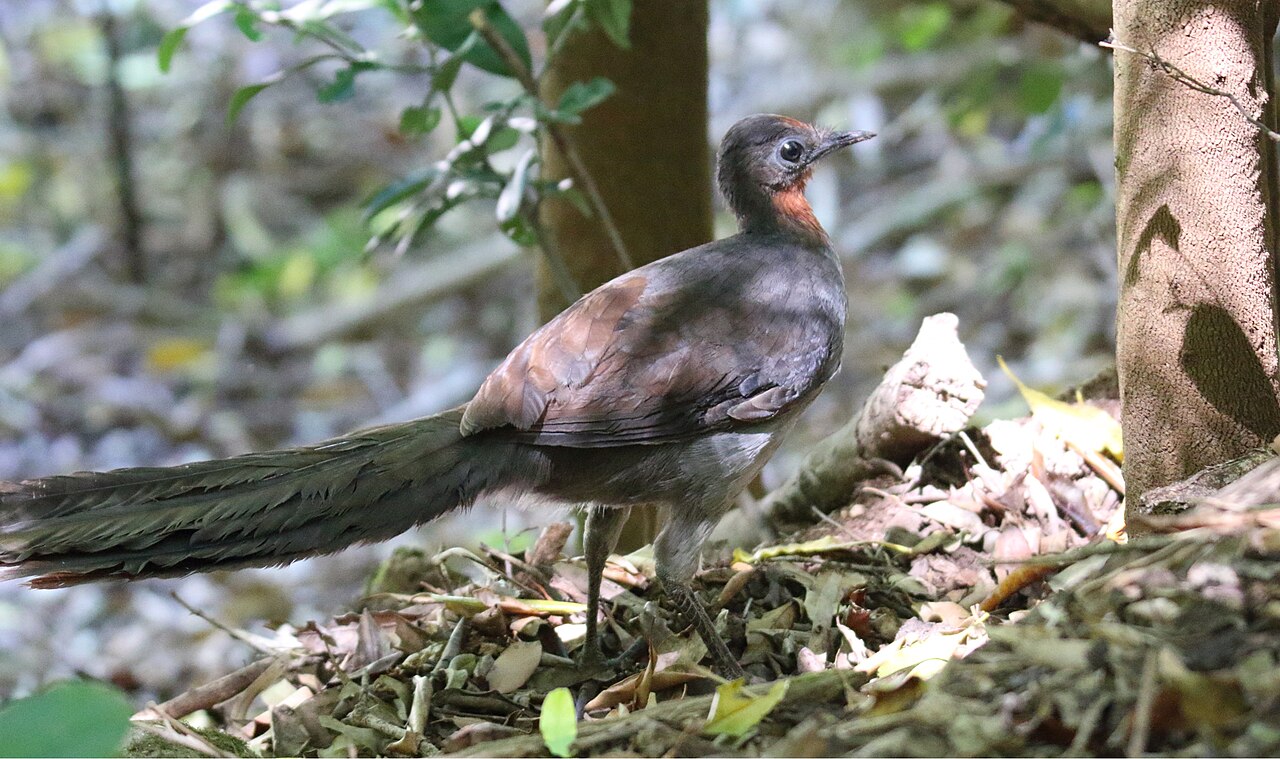
The lyrebird is an Australian ground bird that copies almost every sound in its forest, including car alarms, camera shutters and the calls of twenty other bird species in sequence. Two species exist, the superb lyrebird (Menura novaehollandiae) and Albert’s lyrebird (Menura alberti), both confined to the wet forests of eastern Australia.
What makes the bird famous is the accuracy rather than the range. A male in full display reproduces the rhythm and timbre of a kookaburra so exactly that other kookaburras answer him.
The lyrebird is a large Australian songbird with the most accurate vocal mimicry of any animal. It imitates other bird species, mammal calls and mechanical noises, though the famous chainsaw recording came from captive birds. The superb lyrebird is common in its range; Albert’s lyrebird numbers about 3,500 birds and is near threatened.
| Feature | Superb lyrebird | Albert’s lyrebird |
|---|---|---|
| Scientific name | Menura novaehollandiae | Menura alberti |
| Length with tail | 31 to 39 in (80 to 100 cm) | 29 to 35 in (75 to 90 cm) |
| Range | Victoria to southern Queensland | NSW and Queensland border ranges |
| Population | Common, not threatened | About 3,500 birds, near threatened |
| Tail | Ornate lyre shaped feathers | Plainer, no lyre shape |
| Display site | Bare earth mound | Platform of trampled vines |
| Lifespan | Up to 30 years | Up to 30 years |
What Is So Special About the Lyrebird?
The lyrebird has the most complex syrinx of any songbird, and it uses that machinery to copy rather than invent. Roughly 80 percent of a male’s winter song is borrowed: the calls of whipbirds, currawongs, kookaburras and rosellas, delivered in long medleys with the pauses in the right places. Males learn from other lyrebirds as much as from the original birds, so local populations share repertoires that persist for generations.
The display is just as unusual. A male clears a mound of bare earth, throws his tail forward over his head so the silver undersides form a canopy, and sings while shuffling in place. Females visit, judge and leave, then raise the single chick alone. The closest visual parallel is peafowl, whose fanned train works the same way with no song at all, as the pale variants in albino peacocks show.
Can a Lyrebird Imitate the Human Voice?

Lyrebirds can imitate human speech in captivity, with documented cases of birds reproducing words and whistled tunes, but it is not wild behavior. Wild lyrebirds copy what surrounds them, and that is overwhelmingly other birds. When people report a lyrebird speaking, the bird has usually lived near a keeper for years.
The chainsaw and camera shutter clips deserve the same caveat. A 2021 review traced those recordings to captive birds at Adelaide Zoo and Healesville Sanctuary and found no verified wild recording of either sound. What wild birds do imitate is startling enough: one Victorian population reproduced flute melodies for decades, apparently learned from a farm bird in the 1930s.
How Rare Is a Lyrebird?
The superb lyrebird is common across its range and easy to hear in places like the Dandenong Ranges near Melbourne, though hard to see, since it stays in dense understory and runs rather than flies. Albert’s lyrebird is the rare one, with roughly 3,500 birds in fragmented rainforest along the New South Wales and Queensland border, an area badly hit by the 2019 and 2020 bushfires.
Both face feral cats and foxes, habitat clearing and increasingly frequent fire in forests that need long unburnt understory. Lyrebirds also matter mechanically: a single bird turns over an estimated 200 tons of soil and leaf litter per year while foraging, which slows fire spread and mixes nutrients. Losing them changes the forest floor, not just the soundtrack.
Are There Lyrebirds in America?
No. Lyrebirds occur naturally only in eastern Australia, plus a small introduced population in Tasmania, and no wild birds exist in North or South America. A few zoos outside Australia held them historically, but Australia restricts export of native wildlife, so US collections do not have them today.
North American birders wanting comparable mimicry have three options. The northern mockingbird runs through dozens of borrowed phrases in one bout, the European starling copies mechanical sounds convincingly, and the American robin learns local song variants much as lyrebirds learn regional repertoires. None match a lyrebird for accuracy.
Lyrebird Habitat and Daily Life
Lyrebirds live in wet eucalypt forest, temperate rainforest and fern gully, from sea level to about 5,000 ft. They feed on the ground nearly all day, raking litter apart with strong feet for worms, insect larvae, spiders, centipedes and the occasional small frog, nothing like the burrowing species in African bullfrogs. At night they roost high in trees, flying up in stages and gliding down at dawn, since they manage only weak flight compared with a soaring specialist such as the Andean condor.
Breeding runs through the southern winter, June to August, when males sing from their mounds for hours a day. The female builds a bulky domed nest of sticks and moss on the ground, a rock ledge or a tree fern, lays a single egg and incubates it about 50 days, the longest incubation of any songbird. The chick stays with her up to nine months. Species accounts and recordings are available through Audubon.
Frequently Asked Questions
Is it legal to own a lyrebird?
No. Lyrebirds are protected under Australian state and federal law, cannot be taken from the wild, and are not permitted as pets. Australia also bars commercial export of native birds, so there is no legal route to owning one in the United States. Only licensed zoos hold them.
How do you pronounce lyrebird?
It is pronounced LYRE-bird, the first syllable rhyming with fire, after the lyre shaped tail of the superb lyrebird male. One word is standard, though older Australian sources write lyre bird as two. Albert’s lyrebird lacks the lyre shape entirely.
Do lyrebirds really imitate chainsaws?
Captive lyrebirds have done so and those recordings became famous, but a 2021 review found no confirmed case of a wild lyrebird imitating a chainsaw. Wild birds copy other birds almost exclusively. The story persists because the captive clips circulated for decades without that context.
How long do lyrebirds live?
Superb lyrebirds live up to about 30 years in the wild, exceptional for a songbird. Males need years to perfect their repertoire and reach full display plumage only at six to eight, so the long life is part of how the mimicry gets so accurate. Compare the American goldfinch at 3 to 6 years or Allen’s hummingbird at about 4.