Black and White Chicken Breeds: ID and Egg Output
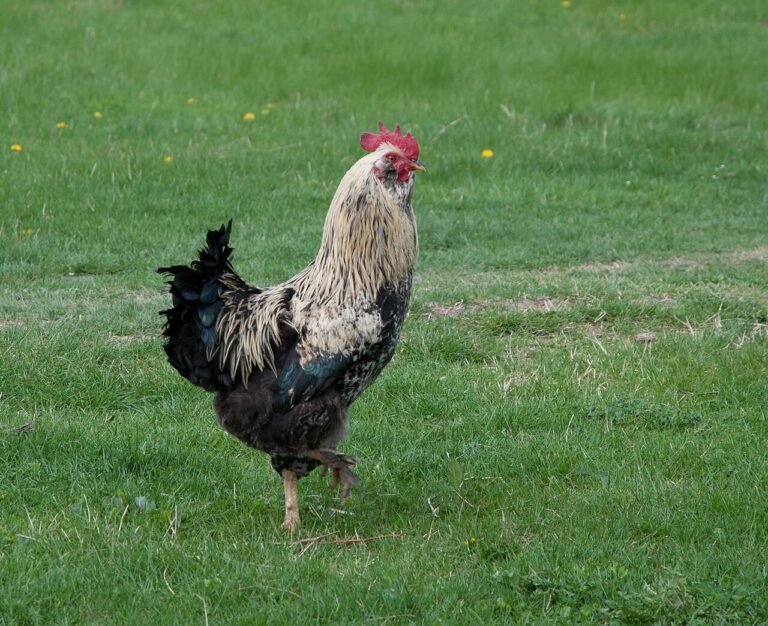
The best known black and white chicken breeds are the Barred Plymouth Rock, the Dominique, the Silver Laced Wyandotte, the Ancona, the Silver Spangled Hamburg, the Light Sussex, the Columbian Wyandotte, the Silkie in its black and white varieties, and the Lakenvelder. Each carries a different pattern, and the pattern is what identifies the breed rather than the colours themselves.
Barring, lacing, spangling, and Columbian patterning look distinct once you know what to look for, and the difference between a Barred Rock and a Dominique comes down to comb shape rather than plumage at all. This guide covers the main breeds, how to tell the confusing pairs apart, laying performance, temperament, and which to choose for a backyard flock.
The main black and white chicken breeds are Barred Plymouth Rock, Dominique, Silver Laced Wyandotte, Ancona, Silver Spangled Hamburg, Light Sussex, and Lakenvelder. Patterns differ: barring runs in stripes across each feather, lacing outlines the edge, spangling puts a spot at the tip. Barred Rocks and Dominiques are separated by comb shape.
| Breed | Pattern and Notes |
|---|---|
| Barred Plymouth Rock | Crisp barring, single comb, 200+ eggs |
| Dominique | Softer barring, rose comb, oldest US breed |
| Silver Laced Wyandotte | Black-edged white feathers, rose comb |
| Ancona | Black with white tips, flighty, prolific layer |
| Silver Spangled Hamburg | White with black spangles, small and active |
| Light Sussex | White body, black neck and tail (Columbian) |
| Lakenvelder | White body, solid black neck and tail |
What Breed of Chicken Is Black and White?
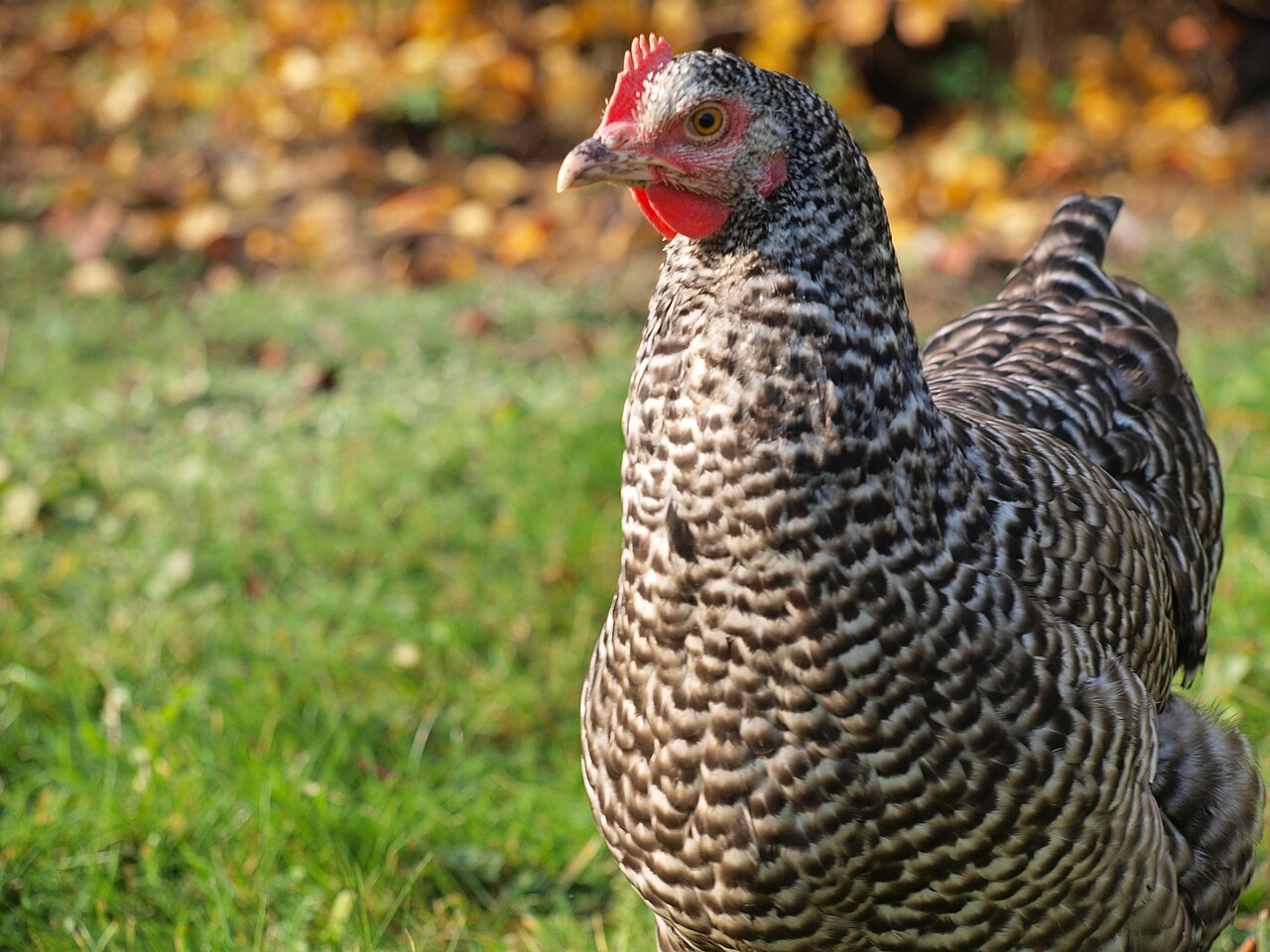
Several, and they fall into distinct pattern groups. Barred birds have black and white stripes running across every feather, giving an overall grey-checked look at a distance: Barred Plymouth Rock, Dominique, Barred Rock bantams, and the Cuckoo Marans and Cuckoo Orpington in the softer cuckoo version of the same pattern.
Laced birds have white or silver feathers outlined in black, giving a scalloped appearance: Silver Laced Wyandotte is the classic, along with Silver Laced Polish and Sebright bantams. Spangled birds carry a black spot at the tip of each feather, as in the Silver Spangled Hamburg and Speckled Sussex.
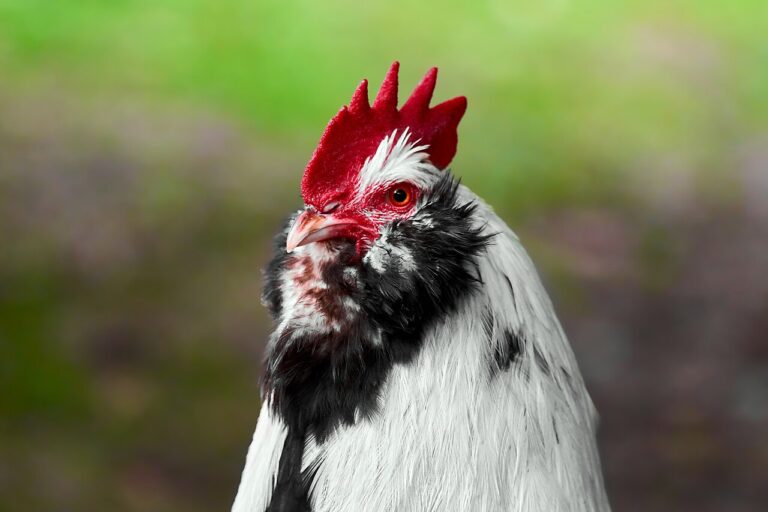
Columbian and Lakenvelder patterns keep the body white with black confined to the neck hackles and tail, as in the Light Sussex, Columbian Wyandotte, and Lakenvelder. Then there are solid combinations such as black and white Silkies and the Exchequer Leghorn, which is randomly mottled. The Polish chicken guide covers one of the crested varieties.
Barred Rock or Dominique?
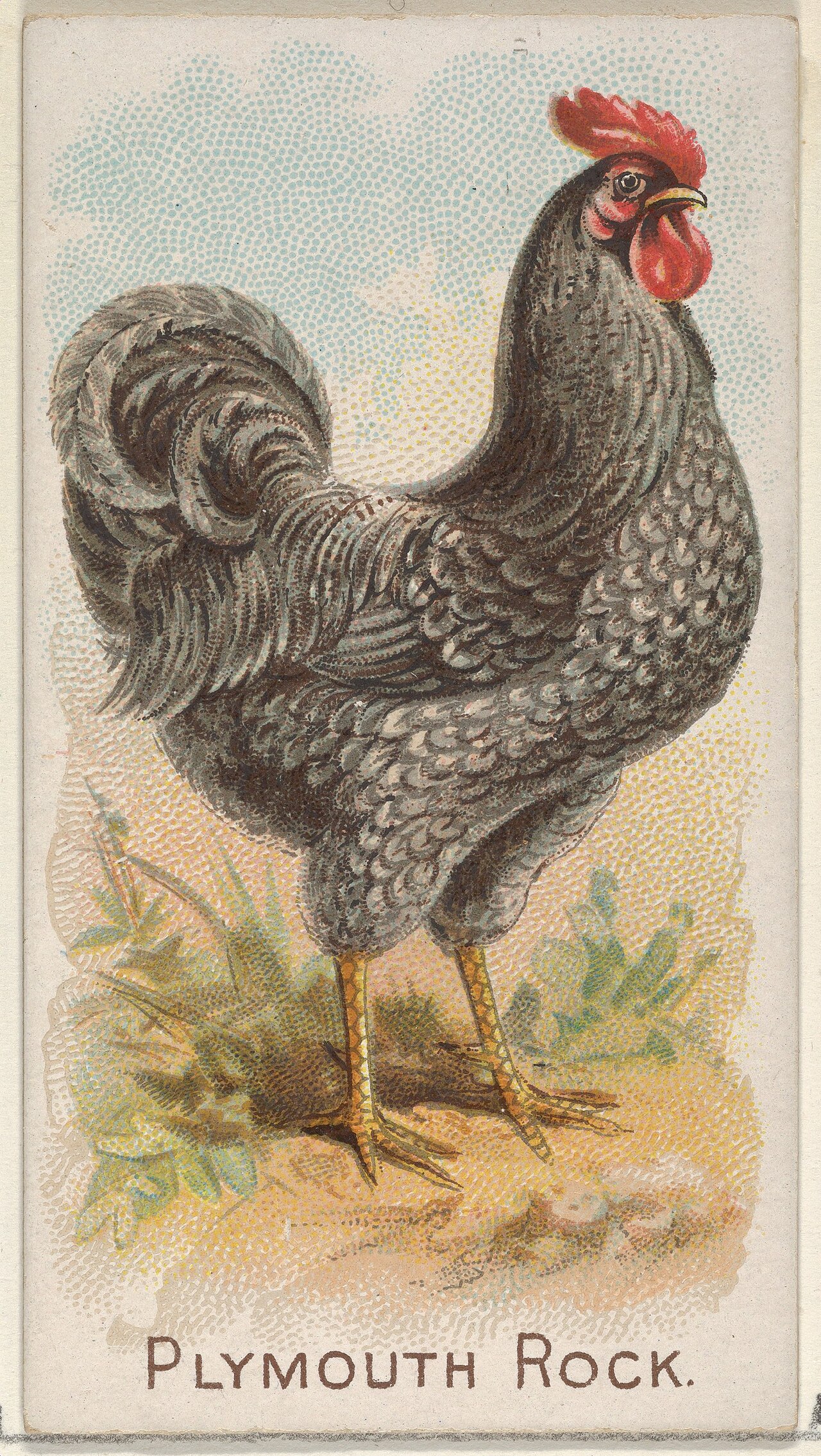
The comb settles it, not the feathers. Barred Plymouth Rocks have a single comb, a straight upright ridge with points along the top. Dominiques have a rose comb, low and flat with a small backward-pointing spike. That is the reliable difference and it is visible from a few feet away.
Plumage differs subtly. Barred Rock barring is crisper and more sharply defined with straighter bar edges, while Dominique barring is softer, slightly irregular, and often described as more V-shaped where the bars cross the feather shaft. Roosters of both are lighter overall than hens because they carry two barring genes.
History explains why they look so similar. The Dominique is the oldest American chicken breed, established well before the Civil War, and the Barred Plymouth Rock was developed from stock that included Dominiques in the mid-nineteenth century. The Dominique nearly disappeared twice and remains a conservation-priority breed. The Brahma chicken guide covers another heritage American breed.
Which Black and White Breeds Lay Best?
Anconas are the strongest layers in the group, producing 220 to 280 white eggs a year, and they are a Mediterranean breed built for output rather than meat. Silver Spangled Hamburgs are close behind at around 200 or more small white eggs, and both rarely go broody.
Barred Plymouth Rocks are the best all-rounder, laying 200 to 280 brown eggs a year while also being a solid dual-purpose meat bird, calm, cold-hardy, and easy to handle. Light Sussex are similar at around 250 light brown eggs and are one of the most reliable backyard breeds in Britain.
Silver Laced Wyandottes lay 180 to 260 brown eggs and are notably cold-hardy thanks to the rose comb, which resists frostbite. Dominiques lay a more modest 230 or so and go broody more readily, which makes them useful if you want to hatch. Silkies lay only 100 to 120 small cream eggs and are kept for broodiness and temperament rather than production.
Which Are Best for a Backyard Flock?
Barred Plymouth Rock for most people. They are docile, tolerate confinement, handle cold well, lay reliably for years, and are widely available, and they are among the breeds most often recommended for a first flock or for families with children.
Light Sussex and Silver Laced Wyandotte fill the same role with slightly different strengths, Sussex being particularly good foragers and Wyandottes the most cold-hardy of the group. All three are calm enough to be handled regularly.
Anconas and Hamburgs are the ones to think twice about. Both are small, flighty, excellent fliers that clear fences easily, and neither enjoys handling or confinement, so they suit free-range setups with high boundaries rather than a small run. Silkies are the opposite extreme: gentle, unable to fly, and the most reliable broody hens available. The bantam chicken guide covers the miniature versions of several of these.
What Is a Large Black and White Chicken?
Barred Plymouth Rocks and Light Sussex are the substantial dual-purpose options at seven to eight pounds for hens and eight to ten for roosters, and both were bred for meat as well as eggs.
Larger still are the Barred Cochin and the black and white varieties of Brahma, which reach nine to twelve pounds and are feather-footed, slow-moving, and extremely docile. They are poor layers by comparison at 100 to 150 eggs a year but are exceptionally cold-hardy and calm.
The Jersey Giant in its black variety is the largest American breed at up to thirteen pounds for males, though it is solid black rather than patterned. For a genuinely large patterned bird, a Light Brahma with its Columbian pattern of white body and black hackles and tail is the usual answer.
How Do You Identify a Chicken Breed?
Work through five features in order: comb type, leg colour, earlobe colour, feather pattern, and body size and shape. Comb type comes first because it is fixed and easily seen, and single, rose, pea, walnut, V-shaped, and buttercup combs each narrow the field considerably.
Leg colour is the next filter. Yellow legs indicate American and Asiatic breeds, white or slate legs point to Mediterranean and English breeds, and feathered legs narrow it to Brahma, Cochin, Faverolles, Silkie, and a handful of others. Silkies also have five toes rather than four and black skin.
Earlobe colour predicts egg colour reasonably well: white earlobes generally mean white eggs, red earlobes usually mean brown, though there are exceptions. Combining those with the pattern group gets most birds to a breed, and hatchery listings and breed standards from the American Poultry Association fill in the rest.
Are Black and White Chickens Good Layers?
As a group, yes, and better than average, though that is a function of which breeds happen to carry these patterns rather than anything about the colour. Barring and lacing are common in the productive American dual-purpose breeds and in the Mediterranean laying breeds.
Colour has no direct effect on laying. What determines output is breed genetics, age, daylight hours, feed quality, and health, and any breed will lay poorly on inadequate feed or with fewer than about fourteen hours of light. Peak production comes in the first two years and declines steadily afterwards.
Egg colour is worth checking before buying, since it surprises people. Anconas, Hamburgs, and Leghorns lay white; Plymouth Rocks, Wyandottes, Sussex, and Dominiques lay brown; Silkies lay cream. Nothing in the black and white group lays blue or green. Extension poultry programmes such as the University of Kentucky (uky.edu) publish breed comparison charts for small flocks, and the guide to chicken treats covers what does and does not affect laying.
Why Do Black and White Patterns Exist?
Barring comes from a single well-studied gene on the Z chromosome that periodically switches off pigment production as each feather grows, producing alternating bands. Because it sits on a sex chromosome, males carry two copies and females one, which is why barred roosters are visibly lighter than barred hens.
That sex linkage has a practical use. Crossing a barred hen with a non-barred rooster produces chicks that can be sexed at hatch by a white head spot present on males and absent on females, and this sex-linked cross is one of the oldest tricks in poultry breeding, used before vent sexing was developed.
Lacing, spangling, and Columbian patterning come from different genes controlling where pigment is deposited within each feather rather than when. Camouflage is the likely original function: broken patterns break up an outline against dappled ground far better than solid colour, which is why wild junglefowl hens are mottled brown rather than a single shade.
What About Temperament?
It varies more between these breeds than the shared colouring suggests. Plymouth Rocks, Sussex, Wyandottes, Brahmas, Cochins, and Silkies are all consistently described as calm and handleable, and Rocks in particular are the standard recommendation for households with children.
Anconas, Hamburgs, Lakenvelders, and Leghorns are the active end: alert, fast, excellent foragers, wary of handling, and strong fliers. They are not unfriendly so much as uninterested, and they thrive with space and do badly in a small run.
Roosters are a separate consideration regardless of breed. Individual temperament varies enormously and any rooster can become aggressive, though Rocks, Sussex, and Brahmas have better reputations than Mediterranean breeds. Many urban ordinances permit hens and prohibit roosters, which is worth checking before buying straight-run chicks since sexing is imperfect. The chicken flock guide covers the social dynamics.
Related reading: Small Chicken Breeds.
Frequently Asked Questions
What breed of chicken is black and white?
Several, grouped by pattern: barred birds like Plymouth Rock and Dominique, laced birds like Silver Laced Wyandotte, spangled birds like Silver Spangled Hamburg, and Columbian birds like Light Sussex.
How do you tell a Barred Rock from a Dominique?
The comb. Barred Rocks have a single upright comb; Dominiques have a low flat rose comb with a backward spike. Dominique barring is also softer and more V-shaped.
What is a large black and white chicken breed?
Barred Plymouth Rock and Light Sussex at seven to ten pounds, or Barred Cochin and Light Brahma at nine to twelve pounds, both feather-footed, very docile, and poor layers by comparison.
Which black and white breeds lay best?
Anconas at 220 to 280 white eggs a year, then Light Sussex at around 250 and Barred Plymouth Rock at 200 to 280 brown. Silkies lay only 100 to 120.
What breed is speckled black and white?
Silver Spangled Hamburg, which is white with a black spot at each feather tip, or Speckled Sussex, which is mahogany with black and white tips rather than truly black and white.
How can I identify my chicken breed?
Check comb type first, then leg colour, earlobe colour, feather pattern, and size. Comb type is fixed and narrows the field fastest; feathered legs and five toes point to specific breeds.
Which is best for a backyard flock?
Barred Plymouth Rock for most people: docile, cold-hardy, tolerant of confinement, and a reliable layer. Anconas and Hamburgs are flighty and need space and high fences.

Similar Posts
What Can Chickens Eat? The Complete Safe Foods List
Which fruits, vegetables, and kitchen scraps are safe for backyard chickens, the 90/10 treat rule, and what to never feed them.
Small Chicken Breeds: 9 Compact Birds for Backyard Flocks
Ten small chicken breeds compared by weight, eggs per year, and temperament, from the 13 oz Serama to the broody Silkie bantam.
Can Chickens Eat Apples? Seeds, Cores, and Safe Amounts
Chickens can eat apples, and the seed panic is overblown. Here is what is safe, how much to feed, and why windfall apples are the real hazard.
Can Chickens Eat Bread? Safe Amounts and the Mold Rule
Chickens can eat bread but it is nearly empty calories, and moldy bread is genuinely dangerous. Here is how much is safe and what to feed instead.
Bantam Chicken: Size, Eggs, and Keeping Them
Miniature chickens at a quarter to half standard size, laying small eggs and eating far less feed. The real disadvantages, breed choices, and mixing them with standard hens.
Can Chickens Eat Cantaloupe? Yes, Here’s How Much
Find out if chickens can eat cantaloupe flesh, seeds, and rind, how much to feed, and which other melons are safe treats.