Backyard Birds of California: 15 Common Species (2026 Identification Guide)
California’s geographic diversity, Pacific coast, Sierra Nevada mountains, Mojave Desert, Central Valley farmland, and Mediterranean chaparral, supports over 650 documented bird species, more than any other US state. For backyard birders, this translates to a uniquely rich mix of visitors year-round. California yards regularly host species you won’t find anywhere else in the US: Anna’s Hummingbirds in winter, Acorn Woodpeckers in oak woodlands, California Towhees scratching in chaparral, and Yellow-Billed Magpies endemic to the Central Valley. This guide covers the 15 most common backyard birds across California, with the key field marks, ranges within the state, and attraction strategies tailored to California’s climate and native plants.
Quick Reference: 15 Common Backyard Birds of California
| Species | Size | Key ID Feature | Where in CA |
|---|---|---|---|
| Anna’s Hummingbird | 4″ | Iridescent rose-red head/throat (male) | Statewide year-round |
| California Towhee | 9″ | Plain gray-brown + rusty undertail + dark face | Statewide chaparral |
| Western Scrub-Jay | 11.5″ | Blue back + gray belly + no crest | Statewide |
| Acorn Woodpecker | 9″ | Red crown + black-and-white clown face | Oak woodlands |
| California Quail (state bird) | 10″ | Plump + forward-curving topknot plume | Statewide brushy areas |
| Oak Titmouse | 5.75″ | Plain gray-brown + small crest + black eye | Oak woodlands |
| Bushtit | 4.5″ | Tiny + plain gray + long tail + in flocks | Statewide |
| House Finch | 5.5″ | Red head/breast (male) + streaky belly | Statewide |
| Lesser Goldfinch | 4.5″ | Yellow body + black or olive back (male) | Statewide |
| Western Bluebird | 7″ | Blue head + rust on breast and flanks | Statewide |
| Dark-Eyed Junco | 6″ | ‘Oregon’ form: brown sides + dark head | Mountains + winter statewide |
| Northern Mockingbird | 10″ | Gray-white + white wing flashes | Statewide |
| Mourning Dove | 12″ | Tan + long pointed tail + small head | Statewide |
| Yellow-Rumped Warbler | 5.5″ | Yellow rump + yellow side patches | Winter statewide |
| Black Phoebe | 7″ | Clean white belly + black above + near water | Statewide near water |
Species Identification
Anna’s Hummingbird
California’s signature hummingbird, and one of the few US hummingbirds that stays year-round. Male Anna’s Hummingbirds have brilliant iridescent rose-red heads and throats that flash from pink to red depending on light angle. Females are green above with a small red throat patch. Unlike other US hummingbirds that migrate to Mexico for winter, Anna’s stay in California year-round, making them reliable yard birds even in January.
Range in California: Statewide year-round, especially common in urban and suburban gardens.
Habitat: Gardens, parks, backyards with flowers or sugar-water feeders.
Key ID: Iridescent rose-red entire head (not just throat) + green back + tiny size. The only common California hummingbird in winter.
Where to see: Hummingbird feeders (4:1 water-to-sugar ratio, no red dye). Native salvia, fuchsia, and red flowering plants. Multiple feeders to reduce territorial fighting between males.
California Towhee
An endemic California species you won’t find back East. California Towhees are uniformly plain gray-brown overall with a slightly darker face, rusty wash under the tail, and a thick conical bill. Often heard before seen, they scratch noisily in leaf litter with a distinctive double-footed kick (both feet at once).
Range in California: Statewide except high mountains, especially common in chaparral and suburban gardens.
Habitat: Brushy areas, gardens with native shrubs, chaparral.
Key ID: Larger sparrow shape + plain gray-brown + rusty undertail + scratching behavior. No bold markings.
Where to see: Common at ground feeders with millet or scattered seed. Plant native shrubs (coffeeberry, manzanita) for cover.
Western Scrub-Jay
California’s most familiar blue bird. Western Scrub-Jays have bright blue heads, wings, and tails contrasted with white throats and gray-brown backs. Unlike eastern Blue Jays, they have NO crest. Loud, intelligent, and aggressive at feeders, they often dominate other species.
Range in California: Statewide except high mountains.
Habitat: Oak woodlands, suburban yards, chaparral.
Key ID: Blue + no crest + white throat with gray necklace. Eastern Blue Jays don’t occur in California, if it has no crest, it’s a scrub-jay.
Where to see: Will visit platform feeders for peanuts, sunflower seed, and acorns. Known to cache thousands of acorns each fall.
Acorn Woodpecker
One of California’s most spectacular backyard birds, especially in oak country. Acorn Woodpeckers have a vivid red crown patch, clown-like white face with black mask, black back, and white wing patches. They live in family groups and famously store acorns in ‘granary’ trees, drilling thousands of holes and stuffing each with a single acorn.
Range in California: Oak woodlands throughout the state.
Habitat: Oak forests, parks with mature oaks, suburban yards with oak trees.
Key ID: Red crown + white face + clown-like appearance + always in groups. Family groups can have 12+ members.
Where to see: Will visit suet feeders and platform feeders with peanuts. Their granary trees (often telephone poles or dead trees full of acorn-stuffed holes) are unmistakable.
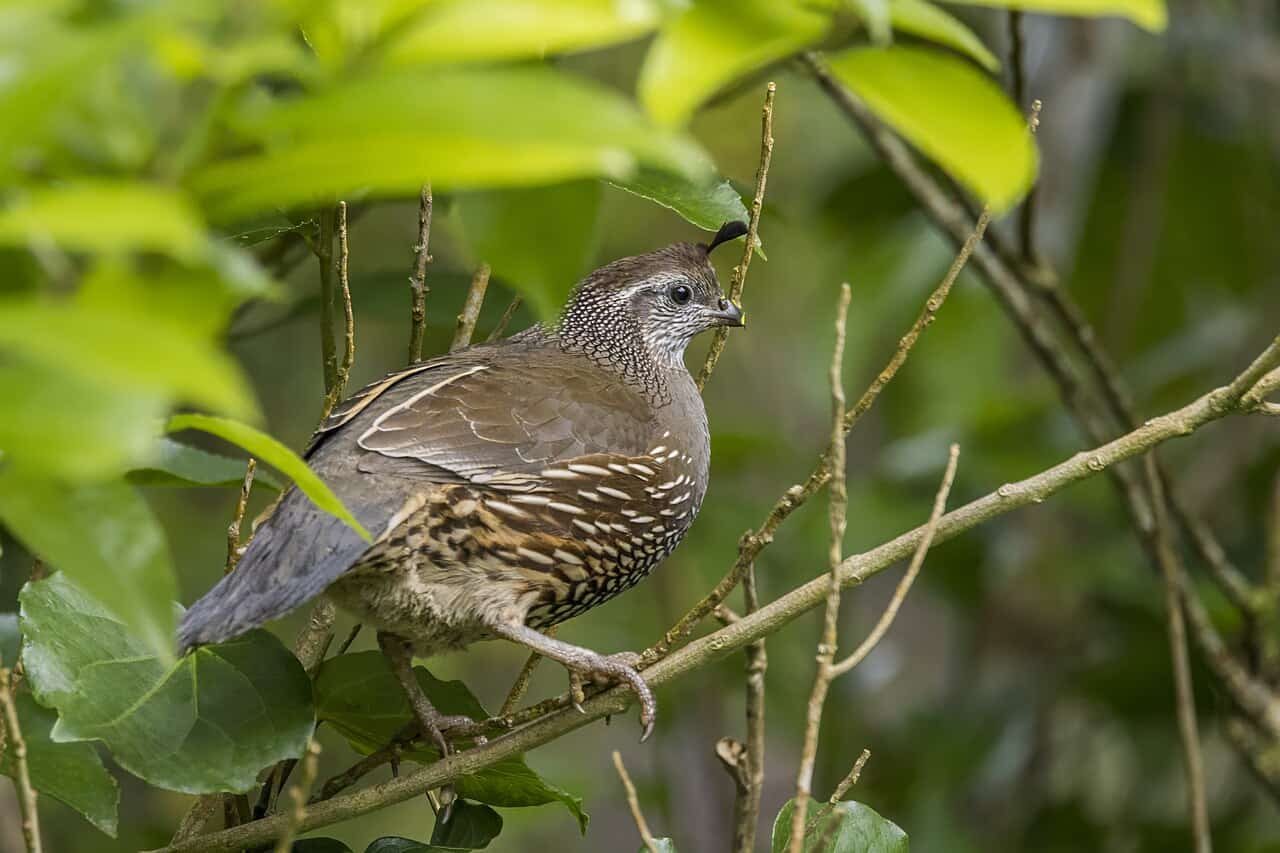
California Quail (State Bird)
California’s official state bird, designated in 1931. California Quail are plump, ground-dwelling birds with a distinctive forward-curving black topknot (or ‘plume’). Males have black faces with white outlines, scaly gray-and-brown bodies, and a black belly patch. Females are plainer brown but share the topknot. Highly social, often in coveys of 10-40 birds.
Range in California: Statewide except dense forests, especially common in chaparral and edges.
Habitat: Brushy areas, chaparral, gardens with cover, edges of agriculture.
Key ID: Forward-curving black topknot + plump body + ground-dwelling + covey behavior. The topknot is unique among California birds.
Where to see: Ground feeding, scatter cracked corn and millet on the ground. Provide dense brush piles for cover. Coveys arrive at dawn and dusk.
Oak Titmouse
A subtle but common California oak woodland bird. Oak Titmice are uniformly plain gray-brown with a small crest, black eye, and pale underparts. Lacking the bright colors of eastern titmice (no orange flanks, no white face), they rely on shape and crest for ID. Often in mixed flocks with chickadees, nuthatches, and bushtits.
Range in California: Oak woodlands throughout the state, including suburbs with mature oaks.
Habitat: Oak and oak-pine woodlands, parks, mature gardens.
Key ID: Small crest + plain gray-brown + black eye. No bold markings, the lack of color combined with the crest is diagnostic.
Where to see: Common at backyard feeders with sunflower seed, peanuts, and suet. Will use small nest boxes.
Bushtit
A tiny, hyper-social California specialty. Bushtits are uniformly plain pale gray overall with a long tail. Their key identifier is behavior, they ALWAYS arrive in flocks of 10-40 birds, twittering constantly as they work through shrubs and trees. A solo Bushtit is almost unheard of.
Range in California: Statewide.
Habitat: Shrubby areas, oak woodlands, suburban gardens with shrubs.
Key ID: Tiny + plain pale gray + long tail + always in flocks. Easy to overlook individuals but flocks are unmistakable.
Where to see: Will visit suet feeders in noisy flocks. Plant native shrubs (toyon, coffeeberry, ceanothus) for foraging habitat.
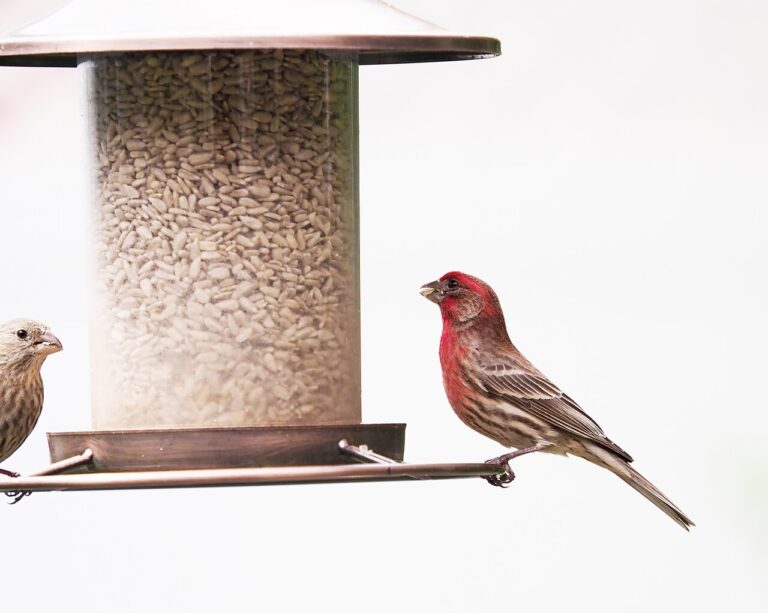
House Finch
A common California yard bird native to the West. Male House Finches have red wash over the head, breast, and rump with brown-streaked flanks and belly. Females are uniformly brown-streaked without red. They often nest on hanging baskets, light fixtures, and porch eaves.
Range in California: Statewide year-round.
Habitat: Urban, suburban, agricultural, anywhere with human-modified landscapes.
Key ID: Red on head/breast (male) + brown-streaked flanks + conical bill. Smaller than cardinals (which don’t occur in CA).
Where to see: Tube feeders with nyjer or sunflower seed. Often in small flocks.
Lesser Goldfinch
California’s most common goldfinch (more abundant than American Goldfinch in most of the state). Male Lesser Goldfinches have bright yellow underparts and an olive-green or black back (two color forms exist). Females are duller yellow-olive. Smaller than American Goldfinch with a less melodic song.
Range in California: Statewide year-round.
Habitat: Open habitat with weedy edges, gardens, parks, suburban yards.
Key ID: Yellow underparts + green or black back (depending on form) + small size. The two color forms can both occur in California.
Where to see: Nyjer (thistle) feeders. Will also visit sunflower feeders. Often in mixed flocks with American Goldfinch and House Finch.
Western Bluebird
California’s resident bluebird species. Male Western Bluebirds have deep royal-blue heads, throats, and backs with rust-orange on the breast AND flanks (extending down the sides). Females are paler with brown-blue tints. Cavity nesters that readily use nest boxes, a major focus of conservation in California.
Range in California: Statewide except deserts. Common in oak woodlands and adjacent open habitat.
Habitat: Open woodlands with scattered trees, ranchlands, parks, suburbs with old trees.
Key ID: Blue head + rust on breast AND flanks. Eastern Bluebirds (rust only on breast, white belly) don’t occur in California.
Where to see: Install NABS-approved bluebird nest boxes. Provide mealworm feeders. Plant native berry-producing shrubs.
Dark-Eyed Junco
California’s most common junco form is the ‘Oregon’ Junco, distinct from the eastern ‘Slate-Colored’ form. Oregon Juncos have a dark black hood (head), warm brown back, pinkish-brown sides, and white belly. They breed in California mountains and become widespread at lower elevations in winter (‘snowbirds’).
Range in California: Mountains in summer; statewide in winter (October-April).
Habitat: Forests in summer; backyards, gardens, and edges in winter.
Key ID: Dark hood + brown back + pinkish sides + white belly + pink bill. Ground-feeding flocks in winter yards.
Where to see: Winter feeders, ground-feeding birds prefer platform feeders or scattered seed. Mixed seed with millet.
Northern Mockingbird
An adaptable bird increasingly common throughout California. Northern Mockingbirds are gray-white with darker wings, bold white wing flashes visible in flight, and a long tail often held cocked upward. Famous for mimicking other birds, California mockingbirds may imitate 200+ other species plus mechanical sounds.
Range in California: Statewide year-round.
Habitat: Suburban yards, parks, edges of natural habitat.
Key ID: Gray-white + white wing flashes + long tail. Singing from prominent perches, often at night during breeding season.
Where to see: Plant native berry-producing shrubs (toyon, elderberry). Will visit mealworm and fruit feeders. Bird baths help retain them.
Mourning Dove
California’s most widespread dove. Mourning Doves have sleek tan-brown bodies, small heads, and long pointed tails with white edges. Their distinctive whistling wing sound on takeoff is one of the most recognizable bird sounds in California yards.
Range in California: Statewide year-round.
Habitat: Open habitat, suburbs, parks, agricultural areas.
Key ID: Tan-brown + long pointed tail + small head. Whistling wing-sound in flight.
Where to see: Ground feeders or platform feeders with mixed seed, sunflower, or cracked corn. Often in pairs.
Regional Variations Across California
California’s geographic extremes mean backyard bird communities differ dramatically by region. Coastal residents in Los Angeles or San Francisco see Allen’s Hummingbird alongside Anna’s, plus Hutton’s Vireo and Chestnut-Backed Chickadee. Central Valley yards (Sacramento, Fresno) host Yellow-Billed Magpies, found nowhere else in the world, plus Swainson’s Hawks in summer.
Foothill and oak woodland yards (Sierra foothills, Coast Ranges) maximize species diversity: Acorn Woodpeckers, Oak Titmice, California Towhees, and Western Scrub-Jays are abundant. Mountain residents (Tahoe, Yosemite, San Bernardino Mountains) add Mountain Chickadee, Steller’s Jay, White-Headed Woodpecker, Cassin’s Finch, and Pine Siskin to their lists.
Desert yards in Palm Springs, Joshua Tree, and the Mojave host completely different species: Verdin, Phainopepla, Black-Throated Sparrow, Costa’s Hummingbird, and Greater Roadrunners. The Salton Sea region adds shorebirds and wetland species not seen elsewhere in southern California backyards.
The California Quail: A Closer Look
The California Quail (Callipepla californica) was designated California’s official state bird on June 12, 1931. The choice reflected the species’ historical abundance and importance to California ecology, quails were once a staple food for indigenous peoples and early settlers.
California Quail are highly social. Family groups (called coveys) form in late summer and persist through winter, sometimes growing to 30-40 birds. Coveys forage together, roost together, and post sentinels who watch for predators while the rest feed. The distinctive ‘Chi-CA-go’ call is heard year-round.
Despite their state-bird status, California Quail populations have declined significantly in urban areas due to outdoor cats (their primary predator) and habitat loss. Suburban yards with extensive native shrub cover, gravel paths, and limited cat access can still host robust quail populations. The reward, a covey of 20+ quail walking single-file through your yard, is one of the most rewarding California backyard birding experiences.
How to Attract California Backyard Birds
California’s Mediterranean climate (cool wet winters, hot dry summers) creates specific attraction opportunities. Year-round water is the single biggest factor, California birds are highly dependent on consistent water sources because natural sources dry up during summer drought.
Provide a quality bird bath with daily fresh water. Consider a dripper or fountain feature, moving water doubles or triples bird visitation. In summer drought, your bird bath may be the only reliable water for half a mile.
Native plant gardening is California’s most powerful birding tool. California native salvias (S. clevelandii, S. spathacea, S. apiana) bloom with red and purple flowers that fuel Anna’s Hummingbirds year-round. Toyon, ceanothus, and manzanita produce berries that feed mockingbirds, scrub-jays, and thrushes.
Avoid lawn, California lawns require massive water inputs and support virtually no birds. Replace lawn with native plant beds. Even small native gardens (250 sq ft) measurably increase yard bird diversity within 12 months.
Hummingbird feeders are essential. Use 4:1 water-to-sugar ratio. Never use red dye (potentially harmful). Multiple feeders reduce male territorial fighting. Year-round feeding supports overwintering Anna’s Hummingbirds.
Plant native oaks (Coast Live Oak, Valley Oak, Engelmann Oak) if you have space. Oak trees are California’s most productive bird habitat, supporting Acorn Woodpeckers, Oak Titmice, scrub-jays, plus countless caterpillars that feed nesting songbirds.
Top Native California Plants for Backyard Birds
**Toyon (Heteromeles arbutifolia):** California’s iconic native shrub. Produces clusters of bright red winter berries that feed Northern Mockingbirds, American Robins, and Cedar Waxwings (in years they visit). Drought-tolerant once established.
**California Lilac (Ceanothus species):** Native shrubs and small trees with brilliant blue flowers in spring. Attract bushtits, scrub-jays, and provide cover for sparrows and towhees.
**Coffeeberry (Frangula californica):** Native shrub with dark berries that ripen progressively. Long fruiting period feeds mockingbirds, robins, and thrushes from late summer through winter.
**Hummingbird Sage (Salvia spathacea):** Native salvia with deep pink flowers that bloom February through May. Critical food for Anna’s Hummingbirds during the lean late-winter period.
**Manzanita (Arctostaphylos species):** Native shrubs with bell-shaped pink-white flowers in late winter. Important early-season nectar source for Anna’s Hummingbirds. Also produces berries for thrushes and waxwings.
**Coast Live Oak (Quercus agrifolia) or Valley Oak (Quercus lobata):** California’s keystone tree species. Each mature oak supports hundreds of insect species which feed nesting birds. Acorns feed Acorn Woodpeckers and scrub-jays. Most productive single planting for California yards.
Related reading: Backyard Birds of New York.
Related reading: Backyard Birds of Ohio.
Related reading: Backyard Birds of Michigan.
Related reading: Backyard Birds of Massachusetts.
Related reading: Backyard Birds of Virginia.
Frequently Asked Questions
What’s the most common backyard bird in California?
House Finch is the most numerically common backyard bird across California, found in essentially every suburban yard year-round. Anna’s Hummingbird is the most common hummingbird (year-round resident). California Towhee and Western Scrub-Jay are the most distinctly Californian, you’ll see them in California yards but not in eastern states.
Why don’t I see Blue Jays in my California yard?
Blue Jays don’t occur naturally in California, they’re an Eastern US species. The blue bird in your California yard is almost certainly a Western Scrub-Jay (no crest, gray belly) or Steller’s Jay (in mountains, has prominent crest). California’s official state bird is the California Quail, not a jay.
Do hummingbirds stay in California all winter?
Yes, Anna’s Hummingbirds are year-round residents throughout most of California. This makes California one of the few US states where you can have hummingbirds at feeders in January. Keep hummingbird feeders maintained year-round (change sugar water every 2-3 days in summer, weekly in cool winter). During cold snaps, bring feeders inside overnight to prevent freezing.
What is the small gray bird at my California feeder?
Most likely an Oak Titmouse (small crest, plain gray-brown), a Bushtit (tiny, in flocks, plain gray, long tail), or a Dark-Eyed Junco of the Oregon form (dark hood, brown sides, white belly, pink bill, in winter). California Towhees are larger and have rusty undertails.
Why do California Quails walk single-file through my yard?
California Quail coveys (family groups) follow a strict single-file traveling order, usually led by a male sentinel. This behavior reduces the risk of any individual being targeted by hawks, the group looks like a single moving line, harder to single out. Coveys can have 30-40 birds in good habitat.
What’s the loud bird with the red head and clown face in California oaks?
Acorn Woodpecker, found in California oak woodlands. The combination of red crown, white face with black mask, and clown-like appearance is unique. They live in family groups of up to 12 birds and famously store acorns in ‘granary’ trees with thousands of single-acorn holes. Found throughout California’s oak country.
How do I attract Western Bluebirds to my California yard?
Install a NABS-approved bluebird nest box (1.5 inch entrance hole) on a pole 5-6 feet high in an open area. Provide mealworms in a shallow dish (Bluebirds prefer live or freeze-dried mealworms over seed). Plant native berry shrubs like toyon and coffeeberry. Western Bluebirds prefer open habitat with scattered trees, not dense forest.
When is the best time of year to see backyard birds in California?
Year-round, but peak diversity is fall through spring (October-April). California’s Mediterranean climate means many species winter here (juncos, Yellow-Rumped Warblers, Cedar Waxwings, sparrows). Summer drought reduces yard activity since water becomes the limiting factor. Provide consistent water year-round for maximum visitation.