Backyard Birds of Michigan: 15 Common Species (2026 Identification Guide)
Michigan’s unique geography, two peninsulas surrounded by four Great Lakes, with extensive forests, wetlands, and agricultural land, creates one of the most distinctive backyard bird communities in the United States. The state hosts 400+ recorded bird species, with 30-40 commonly visiting suburban yards depending on region and season. Michigan’s harsh winters (especially in the Upper Peninsula) test backyard birds, but the state’s position on the migratory flyway makes spring and fall migration spectacular. Lake effect weather creates microclimates that influence bird behavior dramatically. This guide covers the 15 most common backyard birds across Michigan with field marks, regional ranges (UP vs Lower Peninsula vs Detroit metro), and proven attraction strategies for surviving Michigan’s brutal winters and thriving in its mild summers.
Quick Reference: 15 Common Backyard Birds of Michigan
| Species | Size | Key ID Feature | When in MI |
|---|---|---|---|
| American Robin (state bird) | 10″ | Rust-orange breast + gray-brown back | Year-round (most leave winter) |
| Black-Capped Chickadee | 5.25″ | Black cap + white cheeks + black bib | Year-round |
| Northern Cardinal | 8.5″ | All red (male) + crest + black face mask | Year-round (Lower Peninsula) |
| Blue Jay | 11″ | Blue crest + black necklace + white below | Year-round |
| American Goldfinch | 5″ | All yellow (summer male) + black wings | Year-round |
| House Finch | 5.5″ | Red head/breast (male) + streaky belly | Year-round |
| Mourning Dove | 12″ | Tan + long pointed tail + small head | Year-round |
| Tufted Titmouse | 6.5″ | Gray crest + buff flanks + black eye | Year-round (LP) |
| White-Breasted Nuthatch | 5.75″ | Gray back + black cap + walks down trees | Year-round |
| Downy Woodpecker | 6.75″ | Small + short bill + checkered wings | Year-round |
| Dark-Eyed Junco | 6″ | Slate-gray + white belly + pink bill | Winter (Oct-Apr) |
| Red-Bellied Woodpecker | 9.25″ | Red cap + zebra back + tan belly | Year-round (LP) |
| House Sparrow | 6.25″ | Gray crown + black bib (male) | Year-round |
| Common Grackle | 12.5″ | Iridescent + keel tail + yellow eye | March-November |
| Baltimore Oriole | 8.75″ | Brilliant orange + black head (male) | Summer (May-Sep) |
Species Identification
American Robin (State Bird)
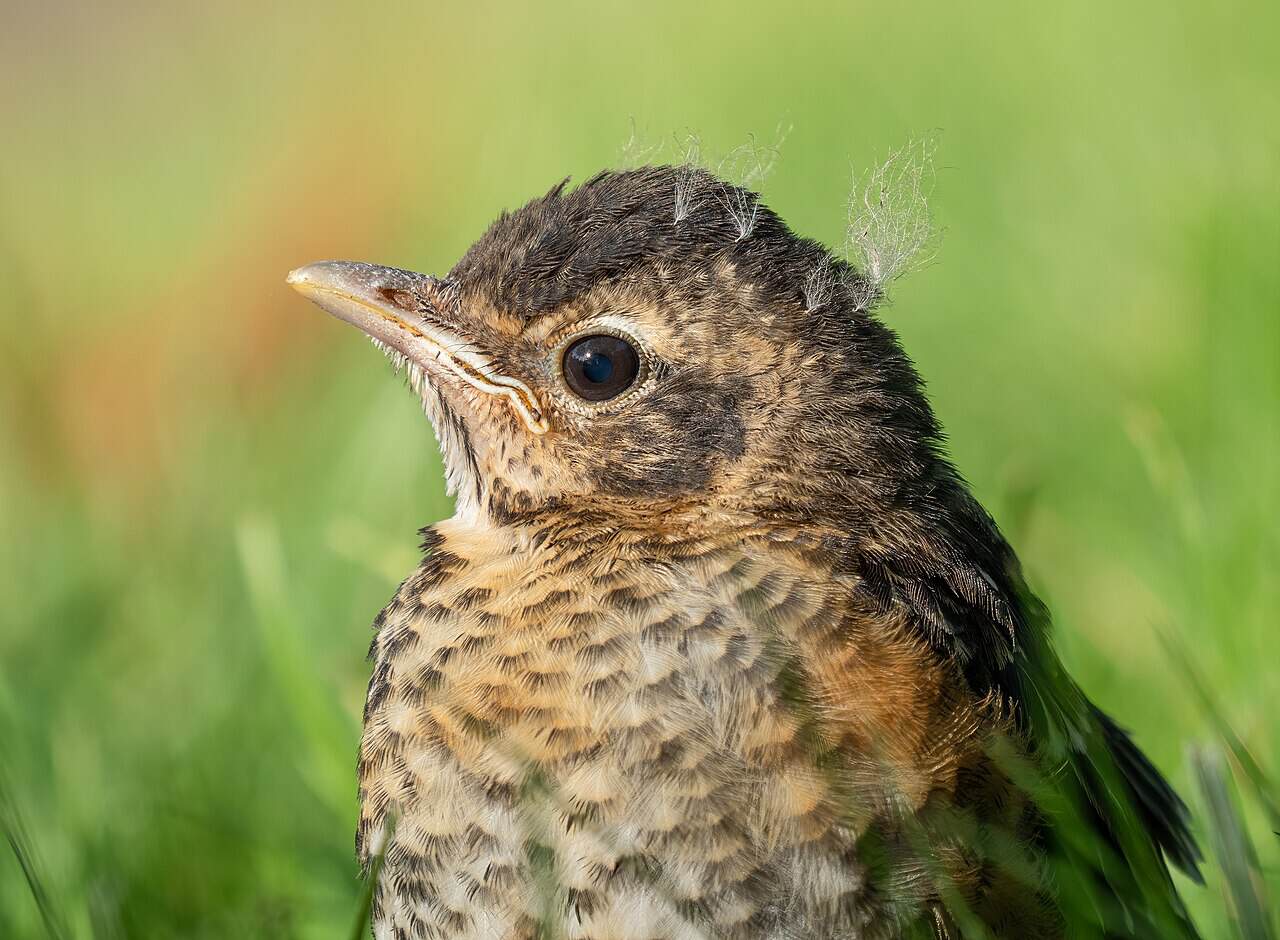
Michigan’s official state bird, designated in 1931. American Robins have warm rust-orange breasts and bellies, gray-brown backs, dark heads, and white throats. The state’s choice celebrates the robin as a symbol of Michigan spring, robins are considered the unofficial first sign that winter is ending in Michigan.
Range in Michigan: Statewide year-round, but the bulk of the population migrates south for winter. Some hardy individuals overwinter, especially in Lower Peninsula urban areas.
Habitat: Lawns, parks, gardens, suburban yards. Forests during breeding.
Key ID: Orange breast + gray-brown back + upright posture + lawn-hunting behavior.
Where to see: Common on lawns hunting earthworms. Will visit mealworm feeders. Plant native berry-producing shrubs (serviceberry, hawthorn, viburnum). Robins love water, provide a quality bird bath.
Black-Capped Chickadee
Michigan’s most beloved year-round small bird. Black-Capped Chickadees have a distinctive black cap, black bib (throat), white cheeks, gray back and wings, and buffy flanks. Their cheerful ‘chick-a-dee-dee-dee’ call carries through Michigan yards year-round. Among the bravest birds during winter snowstorms.
Range in Michigan: Statewide year-round, including both peninsulas.
Habitat: Forests, parks, suburban yards with mature trees.
Key ID: Black cap + black bib + white cheeks + small size. The chickadee species across all of Michigan.
Where to see: Common at backyard feeders. Will eat sunflower seed, peanuts, and suet. Will use small nest boxes (1.125 inch hole).
Northern Cardinal
Michigan’s beloved year-round red bird. Male Northern Cardinals are brilliant red overall with a pointed red crest, black face mask, and thick orange-red bill. Females are tan-brown with red highlights. Once rare in Michigan, Cardinals have expanded their range northward dramatically and are now common in the Lower Peninsula.
Range in Michigan: Statewide in Lower Peninsula year-round. Spreading into southern Upper Peninsula in recent decades.
Habitat: Yards with shrubby cover, parks, woodland edges, urban areas with brush.
Key ID: Brilliant red + pointed crest + black face mask + thick orange-red bill (male).
Where to see: Hopper or platform feeders with sunflower or safflower seed. Cardinals prefer dawn/dusk feeding. Plant native shrubs (red-twig dogwood, native viburnums) for nesting cover.
Blue Jay
Michigan’s familiar crested blue bird. Blue Jays have bright blue heads, wings, and backs (with black markings), white chests, and a prominent blue crest. Loud, intelligent, and dominant at feeders. Michigan Blue Jays cache thousands of acorns each fall.
Range in Michigan: Statewide year-round, including both peninsulas.
Habitat: Forests, parks, suburban backyards with mature trees.
Key ID: Blue + black necklace + prominent crest + white below. The largest common blue bird in Michigan.
Where to see: Platform feeders with peanuts in shell, sunflower seed, and corn. Bird baths regularly.
American Goldfinch
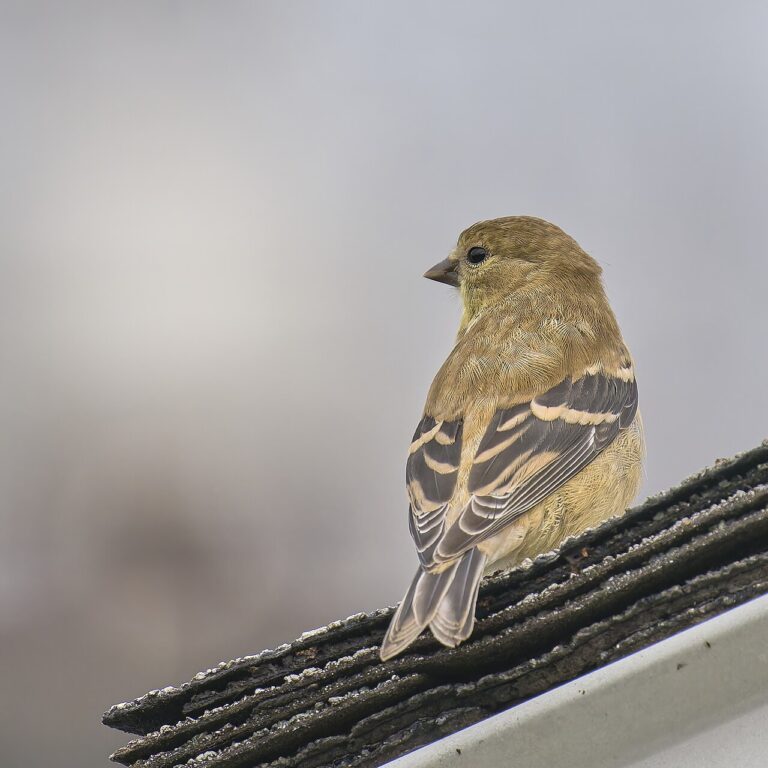
Michigan’s brightest summer bird. Summer male American Goldfinches are brilliant lemon-yellow overall with jet-black wings and a black cap. Females and winter birds are duller olive-brown with pale yellow wash. Goldfinches breed late (July-September) to coincide with peak thistle and weed seed availability.
Range in Michigan: Statewide year-round.
Habitat: Open habitat with weeds, gardens, parks, suburban yards.
Key ID: Brilliant yellow (summer male) + black wings + black cap. Winter birds duller olive-brown.
Where to see: Nyjer (thistle) feeders. Will also visit sunflower feeders. Often in flocks throughout winter.
Baltimore Oriole (Summer Visitor)
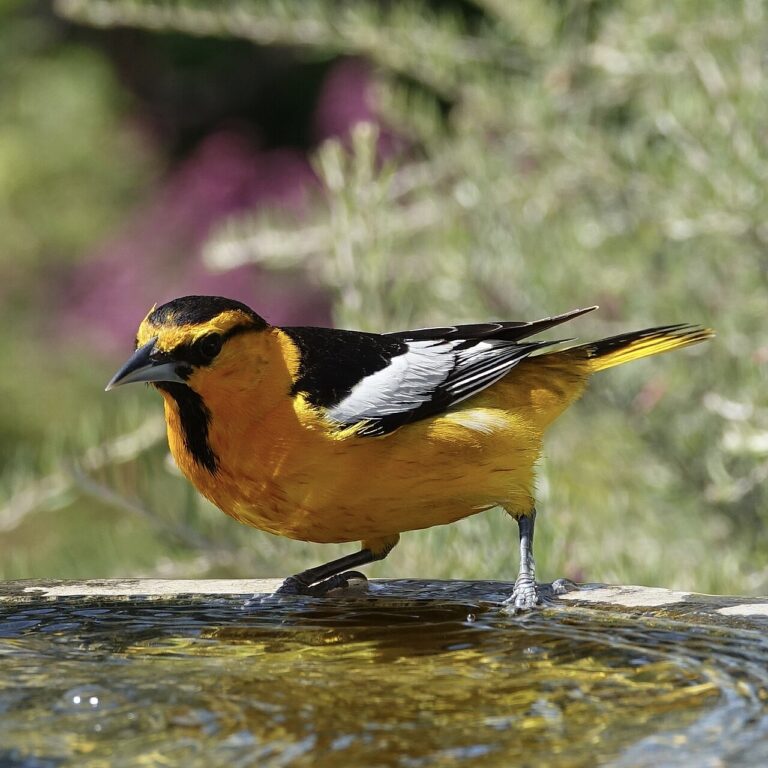
Michigan’s spectacular summer-only bright orange bird. Male Baltimore Orioles have brilliant orange chests, bellies, and rumps contrasted with jet-black heads, wings, and tails. Females are paler orange-yellow with brownish backs. Migrate to Central America for winter, returning to Michigan in May.
Range in Michigan: Lower Peninsula in summer (May-September). Less common in Upper Peninsula.
Habitat: Open woodland edges, parks, suburban yards with large trees (especially American Elms historically; now various tall trees).
Key ID: Brilliant orange + black head and wings (male). Females duller. Distinctive woven hanging nest in tall trees.
Where to see: Oriole feeders with orange halves, grape jelly, and sugar water (5:1 ratio). Plant native flowering trees and shrubs. Spring arrivals: have feeders up by early May.
Mourning Dove
Michigan’s most widespread dove. Mourning Doves have sleek tan-brown bodies, small heads, and long pointed tails with white edges. Their distinctive whistling wing sound on takeoff is recognizable in every Michigan yard.
Range in Michigan: Statewide year-round (more concentrated in Lower Peninsula during winter).
Habitat: Open habitat, suburbs, parks, agricultural areas.
Key ID: Tan-brown + long pointed tail + small head. Whistling wing-sound in flight.
Where to see: Ground feeders or platform feeders with mixed seed, sunflower, or cracked corn. Often in pairs.
Tufted Titmouse
Michigan’s perky crested feeder companion. Tufted Titmice have a clean gray back, white underparts with buff flanks, a pointed gray crest, large black eyes, and a small black forehead patch. Loud ‘peter-peter-peter’ calls. Range has expanded northward into Michigan dramatically over the past 50 years.
Range in Michigan: Lower Peninsula year-round. Less common in Upper Peninsula but expanding.
Habitat: Mature deciduous forests, parks, suburban yards.
Key ID: Gray crest + buff flanks + black eye + small size. Distinctive crest separates from chickadees.
Where to see: Common at backyard feeders with sunflower seed, peanuts, and suet. Often in mixed flocks with chickadees and nuthatches.
White-Breasted Nuthatch
Michigan’s ‘upside-down bird.’ White-Breasted Nuthatches have a blue-gray back, black cap (males) or gray cap (females), pure white face and underparts, and chestnut on the lower belly/undertail. They walk DOWN tree trunks headfirst, opposite of woodpeckers.
Range in Michigan: Statewide year-round, including both peninsulas.
Habitat: Mature deciduous forests, parks, mature suburban trees.
Key ID: Gray back + black/gray cap + white face + walks down trees headfirst.
Where to see: Common at sunflower and suet feeders. Often in mixed flocks with chickadees and titmice.
Downy Woodpecker
Michigan’s smallest and most common backyard woodpecker. Downy Woodpeckers have a clean black-and-white checkered pattern on the wings, a white back stripe, white underparts, and males have a small red patch on the back of the head.
Range in Michigan: Statewide year-round, including both peninsulas.
Habitat: Forests, parks, backyards with mature trees.
Key ID: Small size (6.75 inches) + short bill (1/3 head length) + checkered pattern + small red nape (male).
Where to see: Common at suet feeders. Will also eat sunflower seed and peanuts at platform feeders.
Dark-Eyed Junco
Michigan’s classic winter sparrow, called ‘snowbirds’ for their winter arrival. Michigan hosts the ‘Slate-Colored’ form: uniformly slate-gray above (males darker than females), clean white belly, and a pink conical bill. Some breed in the Upper Peninsula and northern Lower Peninsula.
Range in Michigan: Statewide in winter. Some breed in Upper Peninsula and far north LP.
Habitat: Forests in summer (boreal Michigan areas); backyards, gardens, and edges in winter.
Key ID: Slate-gray + clean white belly + pink bill + white outer tail. Ground-feeding flocks in winter yards.
Where to see: Winter feeders, ground-feeding birds prefer platform feeders or scattered seed. Mixed seed with millet works well.
Red-Bellied Woodpecker
Michigan’s medium woodpecker, expanding range northward. Red-Bellied Woodpeckers have a red cap and nape (males) or just red nape (females), a barred black-and-white (zebra-pattern) back, and tan-buff underparts. Once rare in Michigan, now common in southern Lower Peninsula.
Range in Michigan: Lower Peninsula year-round (expanding northward). Rare in Upper Peninsula.
Habitat: Wooded yards, parks, forests with mature trees.
Key ID: Red cap/nape + zebra-pattern back + tan belly. The red is on the HEAD, not the belly.
Where to see: Common at suet feeders. Will also eat peanuts and sunflower seed at platform feeders.
Regional Variations Across Michigan
Michigan’s two-peninsula structure creates dramatically different backyard bird communities. The Upper Peninsula (Marquette, Sault Ste. Marie, Houghton) hosts boreal-influenced species: Boreal Chickadee, Black-Backed Woodpecker, Gray Jay, Spruce Grouse, Common Raven, plus winter irruptions of Pine Grosbeaks, Common Redpolls, Bohemian Waxwings. Winters are extreme, temperatures regularly drop below -20°F. Year-round feeding is essential for resident species.
Northern Lower Peninsula (Traverse City, Petoskey, Cheboygan) shares many UP characteristics but milder. Bald Eagles common along lake shores. Sandhill Cranes increasingly common. Pine Grosbeaks possible in winter irruption years. Excellent migration corridor.
Southern Lower Peninsula (Detroit metro, Grand Rapids, Lansing, Kalamazoo) shares characteristics with Indiana and Ohio. Cardinals, Tufted Titmice, Red-Bellied Woodpeckers are common, these species are rare or absent in the UP. Suburban yards see 25-35 species annually. Lake Erie shoreline (Detroit area) experiences spectacular spring migration.
Great Lakes shorelines (all four Great Lakes border Michigan) host coastal specialists during migration: gulls, terns, waterfowl, plus warblers concentrating before lake crossings. Whitefish Point on Lake Superior is one of America’s premier migration hawkwatch sites.
Lake-effect winters dramatically affect feeder activity. West Michigan (Lake Michigan shore) gets extreme lake-effect snow. East Michigan (Lake Huron shore) is generally drier and less snowy in winter.
The American Robin: Michigan’s Sign of Spring
The American Robin (Turdus migratorius) was designated Michigan’s official state bird on April 8, 1931. Michigan was the first state to choose this species; Connecticut and Wisconsin later followed. The selection celebrated the robin as the unofficial first sign of Michigan spring, robins traditionally return as winter ends.
American Robins occupy a unique position in Michigan ecology. While many Michigan birds either stay year-round (chickadees, jays) or completely migrate (most warblers, tanagers), robins occupy a middle ground. The bulk of Michigan robins migrate south for winter, but increasing numbers, especially urban populations, overwinter, particularly in southern Michigan and in years with abundant winter fruit on ornamental trees.
Robin spring arrivals follow a predictable pattern: early-arriving males (often as early as February in southern Michigan) establish territories before females return. This sex-segregated migration creates the appearance of ‘all-male’ arrival flocks that puzzle observers. The full migration is complete by April.
Michigan robins typically raise 2-3 broods per year. The classic ‘three robin’s eggs’ nest (sky-blue color is named ‘robin’s egg blue’) is found in many Michigan yards each summer. Pairs cooperate in raising young.
Robins primarily eat earthworms and other invertebrates in spring/summer, switching to fruits and berries in fall/winter. The shift in diet drives migration, when ground freezes solid, earthworms become inaccessible, forcing migration to milder climates with available fruit.
Plant native berry-producing trees and shrubs to support both summer and overwintering robins: serviceberry, hawthorn, viburnum, dogwood, Eastern Red Cedar, crabapple, mountain ash. Provide a quality bird bath, robins are particularly fond of water for both drinking and bathing.
How to Attract Michigan Backyard Birds
Michigan’s harsh four-season climate creates dramatic seasonal patterns. Winter (December-March) is the most rewarding feeder-watching season, natural food sources are scarce and birds rely heavily on backyard feeders to survive Michigan’s brutal cold.
Winter feeding strategy is critical in Michigan. Black oil sunflower seed in tube and hopper feeders (universal favorite). Suet (in cage feeders) delivers maximum energy per gram, critical when winter temperatures drop below zero. Peanuts (shelled, raw) for Blue Jays, chickadees, and nuthatches. Nyjer (thistle) seed for goldfinches and Pine Siskins. Refill feeders consistently, winter birds may travel 20+ miles between known reliable food sources.
Heated bird baths are essential Michigan equipment. Water freezes daily from November through March across most of the state. A heated bath becomes a reliable water source that attracts birds from a much wider radius than feeders alone. Birds need water in winter as much as food.
Spring migration (mid-April through May) brings warblers, vireos, thrushes, tanagers, and orioles through Michigan. Whitefish Point and Tawas Point are world-class migration hotspots. Have oriole feeders up by early May, the first orange and grape jelly attracts arriving Baltimore Orioles.
Summer (June-August) is breeding season. Provide nest boxes for cavity nesters: Eastern Bluebirds (1.5 inch hole, in open areas), House Wrens (1.25 inch), chickadees (1.125 inch), Tree Swallows. Suet consumption drops but continues year-round.
Native plant landscaping is the highest-impact long-term strategy. Michigan-native plants (oaks, native viburnums, dogwoods, serviceberries, Eastern Red Cedar) support 10-100x more caterpillars than non-native landscaping.
Manage squirrels with baffles on pole-mounted feeders. Eastern Gray Squirrels and Fox Squirrels are abundant Michigan feeder raiders. Weight-activated ‘squirrel-proof’ feeders work well for high-traffic stations.
Avoid pesticides if possible. Pesticides reduce insect populations supporting nesting birds. Most lawn ‘pests’ (grubs, caterpillars) are actually critical food for nesting Michigan birds.
Year-round feeding sustains Michigan’s resident bird population through harsh winters. Many Michigan birders maintain feeders even during summer (when birds need them less) to keep birds habituated to your yard year-round.
Top Native Michigan Plants for Backyard Birds
**Northern Red Oak (Quercus rubra) or White Oak (Q. alba):** Michigan’s native oaks support hundreds of caterpillar species, the most productive single plantings for Michigan yards. Acorns feed Blue Jays, woodpeckers, and many other species.
**Serviceberry (Amelanchier species):** Native small tree producing dark purple berries in early summer. Feeds American Robins (state bird!), Cedar Waxwings, Northern Cardinals, and 30+ other species. Spectacular early spring white flowers.
**Eastern Red Cedar (Juniperus virginiana):** Native conifer producing blue-gray berries that feed Cedar Waxwings (named for them), American Robins, Yellow-Rumped Warblers, and many other species. Provides essential winter cover, critical in Michigan winters.
**Native Sumac (Rhus species):** Native shrubs producing red berry clusters that feed dozens of bird species through fall and winter. Smooth Sumac (R. glabra) and Staghorn Sumac (R. typhina) both native to Michigan.
**Hawthorn (Crataegus species):** Native small trees producing red berries persistent into winter. Critical late-winter food for American Robins, Cedar Waxwings, Eastern Bluebirds. Among the best plants for overwintering robins.
**American Highbush Cranberry (Viburnum trilobum):** Native shrub producing bright red berries that persist into winter. Feeds Cedar Waxwings, robins, and various overwintering species. Among the best ‘winter food’ plants for Michigan birds.
Frequently Asked Questions
What’s the most common backyard bird in Michigan?
Black-Capped Chickadee, American Robin (state bird), Northern Cardinal (Lower Peninsula), Mourning Dove, House Finch, House Sparrow, Blue Jay, and American Goldfinch are all extremely common in Michigan. In winter, Dark-Eyed Juncos become abundant ground feeders. The exact most-common varies by region and season.
Do robins stay in Michigan all winter?
Some do, but the bulk of Michigan robins migrate south for winter. Increasing numbers, especially urban populations, overwinter in southern Michigan in years with abundant winter fruit. Winter robins typically form roving flocks and concentrate on remaining fruit/berries (crabapple, hawthorn, juniper). Spring arrivals begin February-March.
When do hummingbirds arrive in Michigan?
Ruby-Throated Hummingbirds typically arrive in southern Michigan in early May, reaching the Upper Peninsula by mid-to-late May. They breed across Michigan and stay through September-October before migrating to Central America for winter. Have feeders up by May 1 in the Lower Peninsula.
Are there Northern Cardinals in Michigan’s Upper Peninsula?
Increasingly yes, especially in the southern Upper Peninsula and along the south shore of Lake Superior. Cardinals have expanded their range northward dramatically over the past 50 years. Throughout the Lower Peninsula they’re common; in the UP they’re now found in many communities though less reliable than in the Lower Peninsula.
When do juncos arrive in Michigan?
Dark-Eyed Juncos typically arrive in Michigan backyards in mid to late October as winter visitors (from breeding grounds in Canada and the Upper Peninsula). They stay through March-early April. Many Michigan birders consider their arrival the official start of winter bird-feeding season.
How do I attract Baltimore Orioles to my Michigan yard?
Have oriole feeders ready by early May, first arrivals appear around May 1-10 in the Lower Peninsula. Offer orange halves (cut and hung), grape jelly (in small dishes), and sugar water (5:1 water-to-sugar ratio, no red dye) in oriole-specific feeders. Plant native flowering trees and shrubs. Provide nesting cover in tall trees.
What native plants attract the most Michigan birds?
Northern Red Oak and White Oak are the single most productive plantings for Michigan yards, supporting hundreds of caterpillar species. Other top natives: Serviceberry, Eastern Red Cedar, native viburnums, Hawthorn, and native dogwoods. Plant native, not non-native ornamentals, native plants support 10-100x more bird food.
Why do I see so many birds at my Michigan feeder during snowstorms?
During Michigan snowstorms, natural food sources (insects, seeds on snow-covered ground, berries on shrubs) become unavailable. Birds depend on reliable backyard feeders to survive. Energy demands also spike during cold weather, birds may eat 30% of their body weight in food daily during severe cold. Always maintain consistent feeder supply during Michigan winters, especially before, during, and after major storms.