Red-Bellied Woodpecker: Complete Identification, Diet, and Behavior Guide (2026)
The Red-Bellied Woodpecker (Melanerpes carolinus) is one of North America’s most familiar, and confusingly-named, woodpeckers. Despite its name, the most striking feature is the brilliant RED CAP and nape on males, not the belly (the ‘red belly’ is actually a faint pinkish wash that’s rarely visible). With its distinctive black-and-white ‘zebra’ patterned back, tan-buff underparts, and loud rolling ‘churr’ call, the Red-Bellied Woodpecker is one of the most common woodpeckers at eastern backyard feeders. The species has expanded its range dramatically northward over the past century. This comprehensive guide covers Red-Bellied Woodpecker identification (and why the name is misleading), range, diet, behavior, breeding, vocalizations, and proven strategies for attracting them to your backyard.
Red-Bellied Woodpecker: Key Facts at a Glance
| Attribute | Detail |
|---|---|
| Scientific Name | Melanerpes carolinus |
| Family | Picidae (Woodpeckers) |
| Size | 9-10.5 inches (23-27 cm) length |
| Wingspan | 13-16.5 inches (33-42 cm) |
| Weight | 2-3.2 oz (56-91 g) |
| Lifespan | 1 year average; up to 12 years recorded |
| Diet | Omnivore, insects, nuts, seeds, fruit, occasional small vertebrates |
| Habitat | Forests, parks, suburban yards with mature trees |
| Range | Eastern and central US, expanding north and west |
| Population Status | Common, 16 million estimated North American population |
| Conservation Status | Least Concern (IUCN) |
| Distinctive Feature | Red cap (male) + zebra-pattern back + tan-buff belly |
| Misleading Name | Red ‘belly’ is barely visible, red is actually on HEAD |
| Call | Rolling ‘churr’ or ‘kwirr’ |
| Migration | Non-migratory, year-round residents |
Red-Bellied Woodpecker Identification
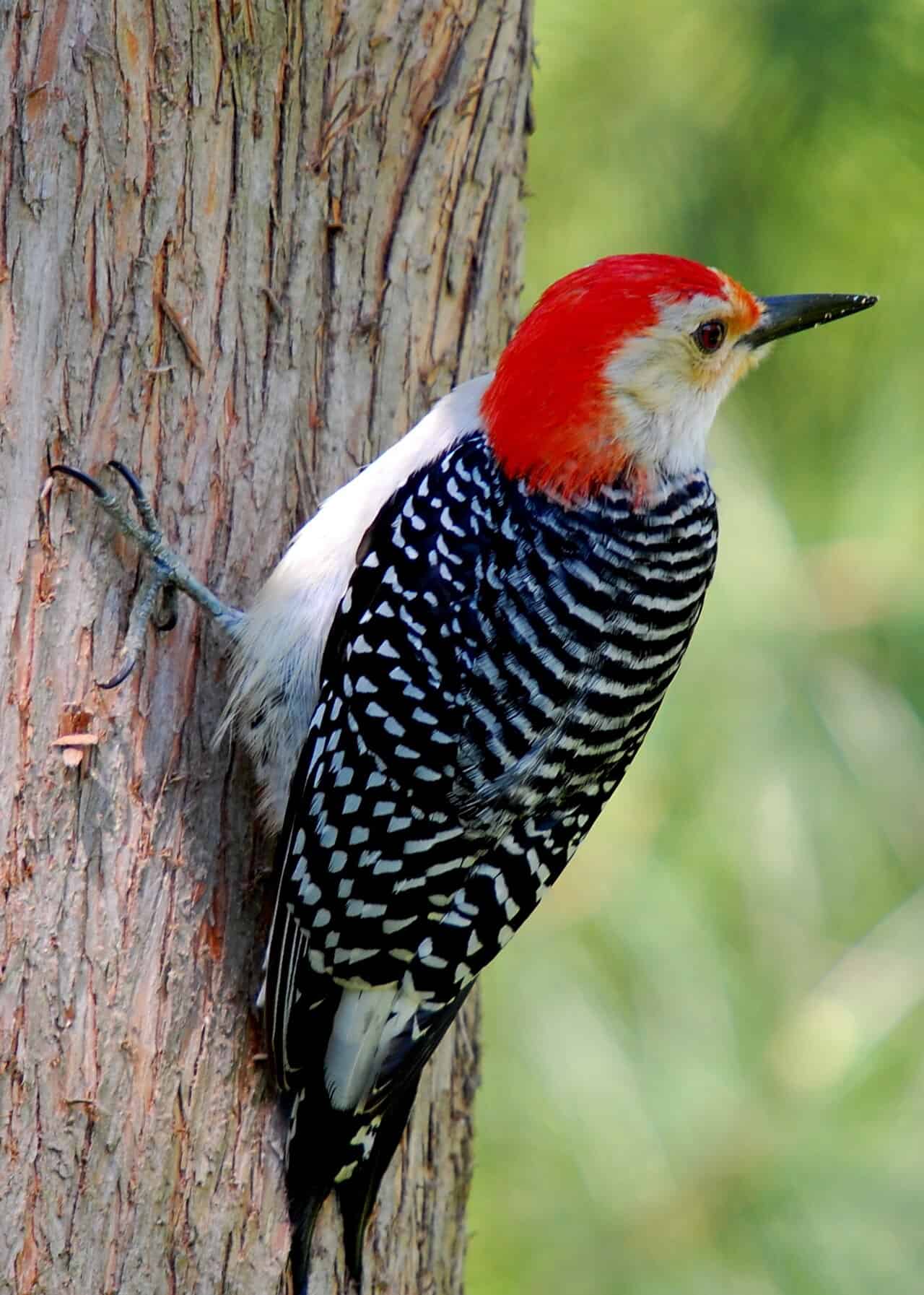
Red-Bellied Woodpeckers are striking medium-sized woodpeckers: red cap and nape (males) or red nape only (females); a barred black-and-white ‘zebra’ pattern across the back and wings; tan-buff face, chest, and belly; a hint of pink-red on the lower belly (rarely visible, and the source of the misleading name); and a black bill.
Male vs Female: Adult males have RED extending from the crown all the way back to the nape (back of head). Adult females have red only on the NAPE (back of head), with a gray-buff crown. The difference is the easiest way to distinguish sexes in the field.
The ‘red belly’ problem: The species is named for a faint pinkish-red wash on the lower belly between the legs. This ‘red belly’ is virtually invisible unless you’re holding the bird in hand or have an extraordinary view. The far more visible RED CAP on males is what most people see. The name is one of the most confusing in North American ornithology, but it’s well-established and unlikely to change.
Juveniles look duller, gray-brown head without the bright red, less distinct zebra pattern, and overall washed-out appearance. They develop adult plumage by their first fall.
Size: Red-Bellied Woodpeckers are 9-10.5 inches long, medium-sized for woodpeckers. Larger than Downy (5.5-7 inches) and Hairy Woodpeckers (7-10 inches), but smaller than Pileated Woodpeckers (16.5 inches). Roughly comparable in size to Blue Jays (11 inches).
Common confusion: Red-Bellied Woodpeckers are often confused with Red-Headed Woodpeckers, but the two species look quite different. Red-Headed Woodpeckers have an ENTIRELY RED HEAD (both crown and face), with a clean separation between the red head and the black-and-white body. Red-Bellied Woodpeckers have red only on the cap/nape and have a buff face.
Red-Bellied Woodpecker Range and Habitat
Red-Bellied Woodpeckers occupy a vast range across eastern and central North America. Their range extends from Florida and Texas north through southern Canada (Ontario, Quebec), west to the eastern edges of the Great Plains, and east to the Atlantic coast. The species covers the eastern half of the United States.
Dramatic range expansion: Red-Bellied Woodpeckers have expanded their range remarkably northward and westward over the past 50-100 years. Historically a Southern bird, they now breed in southern Ontario, Quebec, New England, and the Upper Midwest, regions where they were unknown a century ago. The expansion is attributed to climate change, the proliferation of bird feeders providing reliable winter food, mature suburban tree growth, and possibly other factors.
Habitat: Red-Bellied Woodpeckers prefer mature deciduous forests, mixed forests, woodland edges, parks, and suburban yards with mature trees. They’re cavity-dependent, requiring large mature trees for nesting. They avoid open habitats without trees and pure coniferous forests.
Suburban adaptation: Red-Bellied Woodpeckers thrive in mature suburban yards. They use yards with adequate large trees as both feeding and breeding habitat. The expansion of suburban tree cover across the eastern US has supported their range expansion.
Nonmigratory: Red-Bellied Woodpeckers are non-migratory throughout their range. The same individuals stay in your yard year-round. They establish territories that they may use for multiple years. Banded birds have been documented visiting the same feeders for 8+ years.
Red-Bellied Woodpecker Diet
Red-Bellied Woodpeckers are omnivores with an extraordinarily diverse diet. They eat insects, seeds, nuts, fruit, sap, and occasionally small vertebrates (other birds’ nestlings, lizards, small frogs). Their dietary flexibility is part of why they’re so adaptable.
Natural diet: Caterpillars, beetles, ants, wasps, spiders, acorns, beech nuts, hickory nuts, native berries (mulberry, sumac, native viburnum berries, Virginia Creeper berries), and sap from trees.
Hoarding behavior: Red-Bellied Woodpeckers cache food in bark crevices, knot holes, and other hiding spots across their territory. They cache acorns, nuts, and even fragments of larger food items. They retrieve cached food during winter when fresh food is scarce.
Tongue adaptations: Red-Bellied Woodpeckers (like all woodpeckers) have remarkably long, sticky, barbed tongues that they use to extract insects from deep crevices. Their tongues can extend nearly 2 inches beyond the bill tip, long enough to reach insects in deep bark crevices.
At feeders: Red-Bellied Woodpeckers are reliable feeder visitors year-round. Top food choices include suet (favorite), shelled peanuts (preferred over in-shell), black oil sunflower seed, peanut butter (in cool weather), and even oranges and grape jelly (especially during summer migration). They typically prefer hopper feeders, platform feeders, suet cages, or large-perched tube feeders.
Behavior at feeders: Red-Bellied Woodpeckers usually grab one piece of food at a time and fly off to a tree branch to eat or cache. They don’t typically eat at the feeder. This behavior means they visit feeders multiple times per hour to take individual food items.
Red-Bellied Woodpecker Behavior
Red-Bellied Woodpeckers are intelligent, vocal, and often dominant at feeders. They’re more social than some woodpecker species and often communicate vocally throughout the day.
Pair bonds: Red-Bellied Woodpecker pairs maintain territories year-round and remain together for multiple breeding seasons. Pair bonds are strong but not as life-long as some species. Both members of a pair work together during nest excavation and offspring care.
Territorial behavior: Red-Bellied Woodpeckers defend territories of 5-25 acres. They drum loudly on dead branches or other resonant surfaces to advertise territory boundaries. Multiple pairs may have neighboring territories in suburban areas.
Drumming: Red-Bellied Woodpeckers produce loud, rapid drumming sounds (rapid succession of taps on resonant surfaces). They prefer surfaces that resonate loudly, dead branches, hollow stumps, and sometimes human structures (rain gutters, metal vents, wooden siding). Drumming peaks in spring during breeding season.
Mixed-species flocks: Less commonly join mixed-species winter flocks than smaller species (chickadees, titmice, nuthatches). Red-Bellied Woodpeckers tend to forage individually or in pairs.
Hand-feeding potential: Less commonly trained to hand-feed than chickadees or titmice. However, with extensive patience over months, some Red-Bellied Woodpeckers will accept peanut bits from outstretched hands.
Lifespan: Wild Red-Bellied Woodpeckers have been recorded surviving 12 years. Typical lifespan is 1-2 years for first-year birds, with higher survival in subsequent years. Major mortality factors: predation by Cooper’s Hawks (major predator), Sharp-Shinned Hawks, owls, snakes, and window strikes.
Red-Bellied Woodpecker Breeding and Nesting
Red-Bellied Woodpecker breeding begins in March-April across most of their range. Most pairs raise 1-2 broods per year. Southern populations may have second broods more reliably.
Nest excavation: Both male and female participate in excavating nest cavities. They typically excavate cavities in dead trees, dead branches, or dead portions of live trees. Excavation takes 1-2 weeks. The cavity is typically 5-12 inches deep with a 2-inch round entrance.
Site selection: Red-Bellied Woodpeckers prefer cavities 10-30 feet above ground in dead deciduous trees. Aspen, willow, dead oak, and other deciduous trees are common nest sites. They sometimes use buildings, telephone poles, and other artificial structures.
Eggs: Each clutch contains 3-8 eggs (typically 4-5). Red-Bellied Woodpecker eggs are pure white (typical for cavity-nesting birds). Incubation takes 12-14 days, with both parents participating, males typically take nighttime shifts, females take daytime shifts.
Nestling period: Both parents feed nestlings. Nestlings remain in the nest cavity for 24-27 days. After fledging, juveniles remain with parents for several weeks while learning to forage.
Cavity importance: Red-Bellied Woodpecker nest cavities are critical resources for many other species after the woodpeckers abandon them. Secondary cavity users include Eastern Bluebirds, Tree Swallows, House Wrens, screech owls, and various other species. Red-Bellied Woodpeckers are crucial ‘ecosystem engineers’ creating nesting habitat for many other species.
Yard nesting: Red-Bellied Woodpeckers will nest in yards with appropriate large trees containing dead branches. They typically need at least one large mature tree (oak, maple, beech, sycamore) with dead branches suitable for excavation.
Red-Bellied Woodpecker Vocalizations
Red-Bellied Woodpeckers are notably vocal, much more so than many other woodpecker species. They produce a wide variety of calls and drumming patterns.
Primary call: ‘Churr’ or ‘kwirr’, a loud rolling call, often given in series of 1-3 notes. The call is distinctive and easy to learn. It carries far through forests and serves multiple functions: territory advertisement, pair contact, and alarm.
Variations of the basic call: Different contexts produce different versions. Quick rolling ‘churr-churr-churr’ may indicate territorial defense; softer ‘churrr’ may be a contact call between mates.
Other calls: A loud ‘cha-cha-cha’ alarm call; soft contact calls between paired birds; rasping calls between family members.
Drumming: Loud, rapid drumming bursts on resonant surfaces, typically 1-2 second bursts, 15-25 strikes per second. Drumming peaks in spring during breeding season. Red-Bellied Woodpecker drumming is louder than Downy or Hairy Woodpecker drumming, partly because of their larger body size and harder bills.
Pair communication: Mated pairs communicate through low contact calls, often barely audible to humans. The constant vocal communication helps maintain pair coordination.
Red-Bellied Woodpecker Subspecies and Regional Variations
Red-Bellied Woodpeckers are currently considered monotypic, no widely-recognized subspecies. However, the species shows some regional variation in size and coloration.
Northern populations: Birds at the northern range edge tend to be slightly larger than southern birds. This reflects Bergmann’s Rule, larger body size in colder climates for better heat retention.
Florida populations: Florida Red-Bellied Woodpeckers tend to be slightly smaller and paler than birds further north.
Range expansion: Red-Bellied Woodpeckers expanding northward into Quebec, New England, and Wisconsin are encountering new habitats and conditions. Future studies may reveal how the species is adapting to expanded range conditions.
Western expansion: Range is also expanding westward in some areas, though more slowly than the northward expansion. Western range edge birds may differ subtly from eastern populations.
Hybridization: Red-Bellied Woodpeckers don’t typically hybridize with other woodpecker species, although their range overlaps with Red-Headed, Hairy, Downy, and other species.
How to Attract Red-Bellied Woodpeckers to Your Backyard
Red-Bellied Woodpeckers are reliably attracted with a few key strategies. Most yards with mature trees can attract Red-Bellied Woodpeckers within days of adding the right feeders.
1. Offer suet in a cage feeder. Suet is the universal Red-Bellied Woodpecker attractant. Use cage-style suet feeders accessible from multiple sides. Hang or pole-mount 5-6 feet above ground.
2. Provide shelled peanuts. Shelled peanuts (not in-shell) are a top Red-Bellied food. They grab whole peanuts and fly off to crack them open or cache them. Use peanut feeders or scatter on platform feeders. Whole peanuts in shell are less attractive, they prefer pre-shelled.
3. Black oil sunflower seed. Use hopper feeders, platform feeders, or large tube feeders with sturdy perches. Red-Bellied Woodpeckers need a stable perching surface, tiny perches on small tube feeders don’t work well.
4. Try fruit during summer. Sliced oranges, grape jelly, and other fruit can attract Red-Bellied Woodpeckers, especially during late summer migration. Some Red-Bellied Woodpeckers regularly visit oriole feeders.
5. Plant native deciduous trees. Mature native oaks, maples, beeches, sycamores, hickories provide both insect food and nesting cavities. A single mature oak supports more Red-Bellied food than years of feeder visits.
6. Leave dead branches if safe. Red-Bellied Woodpeckers excavate nest cavities in dead branches. Leaving safe dead branches (those that don’t pose human safety risks) provides natural nesting habitat.
7. Provide a nest box. Boxes with 2-inch entrance holes can attract Red-Bellied Woodpeckers for nesting, especially in yards with limited natural cavities. Mount on tree trunks 12-20 feet above ground.
8. Provide year-round water source. Red-Bellied Woodpeckers visit bird baths regularly. Use a shallow bath; heated bath in winter for year-round water access.
9. Avoid pesticides. Pesticides reduce the insect populations Red-Bellied Woodpeckers eat. Native plant landscaping supports the insect community that supports Red-Bellied foraging.
10. Manage outdoor cats. Outdoor cats kill many Red-Bellied Woodpeckers, especially during nesting season when adults are vulnerable while excavating. Keeping cats indoors substantially improves Red-Bellied survival.
Once Red-Bellied Woodpeckers discover your yard, they typically become reliable daily visitors. The same individual pair may visit your yard for 5-10 years, often nesting in the same area year after year.
Related reading: what do woodpeckers eat.
Frequently Asked Questions
Why is it called Red-Bellied Woodpecker if the red is on the head?
The species is named for a faint pinkish-red wash on the lower belly between the legs. This ‘red belly’ is virtually invisible unless you’re holding the bird in hand. The far more visible RED CAP on males is what most people see. The name is one of the most confusing in North American ornithology, but it’s well-established. Red-Bellied Woodpeckers were named in the 1800s by ornithologists who examined specimens in hand, where the red belly is more apparent than in field views.
What’s the difference between Red-Bellied and Red-Headed Woodpecker?
They look quite different. Red-Headed Woodpecker: ENTIRELY RED HEAD (both crown and face) with clean color separation between red head and black-and-white body. Red-Bellied Woodpecker: red only on CAP and nape (males) or nape only (females), with a buff face and chest. Red-Headed have solid black backs and bold white wing patches; Red-Bellied have zebra-pattern (barred black-and-white) backs. Despite name confusion, the two species look very different.
How do I tell male from female Red-Bellied Woodpecker?
Males have RED extending from the crown all the way back to the nape (back of head). Females have red ONLY on the NAPE, with a gray-buff crown. The difference is the easiest way to distinguish sexes in the field. Both sexes have the same zebra-pattern back and tan-buff body, the head/crown coloring is what differs.
Do Red-Bellied Woodpeckers migrate?
No, Red-Bellied Woodpeckers are non-migratory throughout their range. The same individual birds stay in your yard year-round. They establish territories and may use the same area for multiple years. Banded birds have been documented visiting the same feeders for 8+ years.
Why are Red-Bellied Woodpeckers expanding northward?
Red-Bellied Woodpeckers have expanded dramatically northward over the past 50-100 years. Reasons include: climate change (warmer winters extending suitable range), proliferation of bird feeders providing reliable winter food, mature suburban tree growth providing habitat, and possibly other factors. Historically a Southern bird, they now breed in southern Canada and New England, areas where they were unknown a century ago.
What do Red-Bellied Woodpecker calls sound like?
The primary call is a loud, rolling ‘churr’ or ‘kwirr’, distinctive and easy to learn. The call carries far through forests and serves multiple functions: territory advertisement, pair contact, and alarm. Variations include quick rolling ‘churr-churr-churr’ (territorial defense) and softer ‘churrr’ (contact calls). They also produce ‘cha-cha-cha’ alarm calls and various other vocalizations.
How long do Red-Bellied Woodpeckers live?
Wild Red-Bellied Woodpeckers have been recorded surviving 12 years. Typical lifespan is 1-2 years for first-year birds (high mortality), with adults surviving to 5-7 years. Major mortality factors include predation by Cooper’s Hawks, Sharp-Shinned Hawks, owls, snakes, outdoor cats, and window strikes.
Do Red-Bellied Woodpeckers use nest boxes?
Yes, they will use nest boxes with 2-inch entrance holes, mounted on tree trunks 12-20 feet above ground. However, they more commonly excavate their own cavities in dead trees and dead branches. Nest boxes work best in yards with limited natural cavity options. Provide a sawdust layer in the bottom for natural cavity feel.