Western Screech Owl Sound: The Bouncing Ball Song
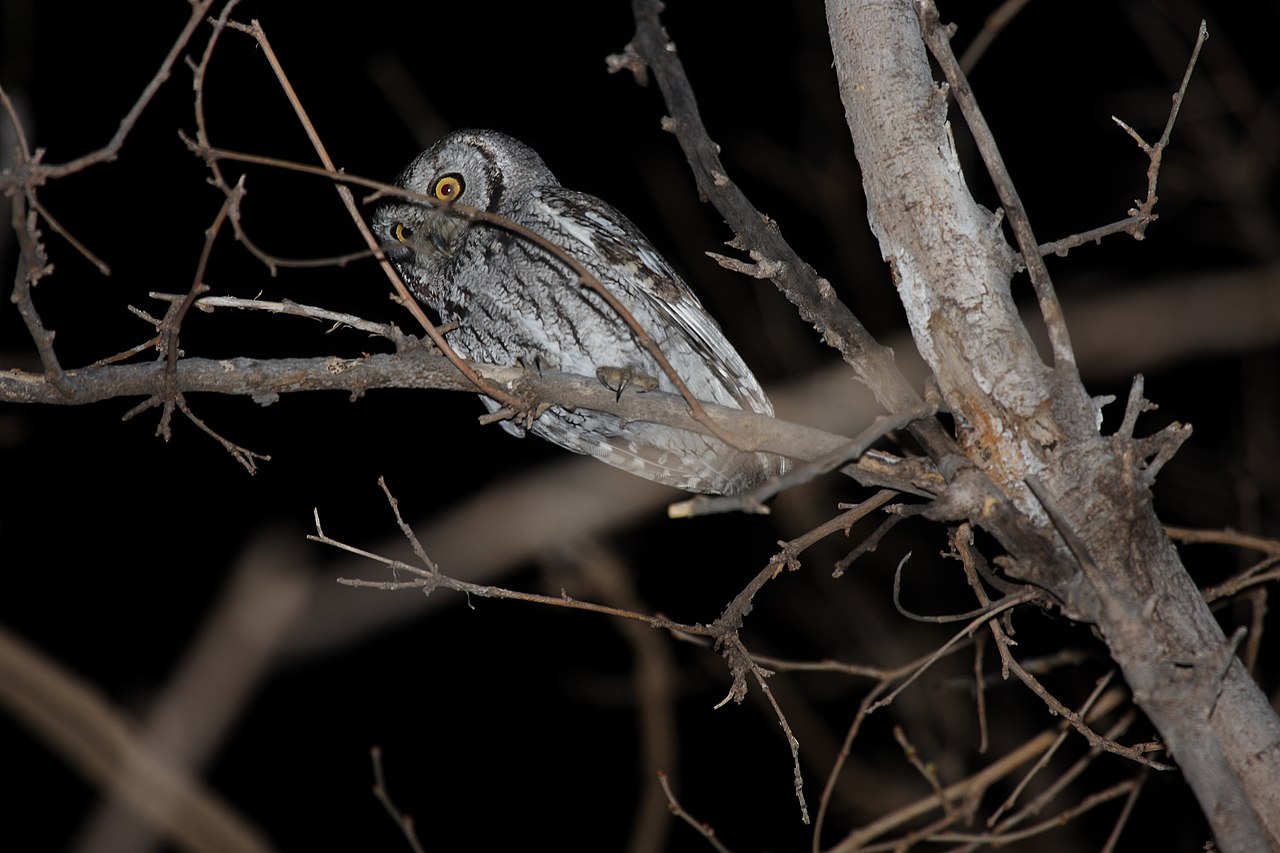
The western screech owl sound is a series of short, hollow whistles that speed up at the end like a rubber ball bouncing to a stop. Birders call it the bouncing ball song, and it is nothing like the shriek the name promises. A Western Screech-Owl (Megascops kennicottii) rarely screeches at all.
Most people meet this owl by ear long before they see one, because a bird the size of a soda can hides easily in a cottonwood or a saguaro. Learning the two main calls settles almost every nighttime mystery sound in the West, from suburban Seattle to the Sonoran Desert.
A Western Screech-Owl gives a bouncing ball song: six to fifteen short, evenly pitched whistled notes that accelerate toward the end. Pairs also perform a two part trill, a short trill from one bird overlapping a longer one from its mate. Both calls are soft, low and mellow rather than shrill.
| Sound | What you hear | When |
|---|---|---|
| Bouncing ball song | Accelerating series of hollow whistles | Year round, peak January to April |
| Double trill | Short trill answered by a longer one | Pairs at the nest site |
| Sharp bark | Single harsh note, often repeated | Alarm, predator near nest |
| Bill snapping | Dry clicking | Close threat, cornered bird |
| Begging young | Rasping, insistent hiss | May to July |
| Eastern Screech-Owl | Descending horse like whinny | Different species, eastern range |
What a Western Screech Owl Sounds Like
The song is a run of short whistles on one pitch, starting slowly and accelerating into a tight cluster at the end. The whole thing lasts about two seconds and carries perhaps 300 ft (90 m) through open woodland. The tone is soft and wooden, closer to a toy flute than a whistle.
Volume is the reason people miss it. This owl is quiet enough that traffic noise or a running creek can hide a bird calling from the next tree, so the sound often registers as something distant when the owl is directly overhead.
The Double Trill, the Sound of a Pair
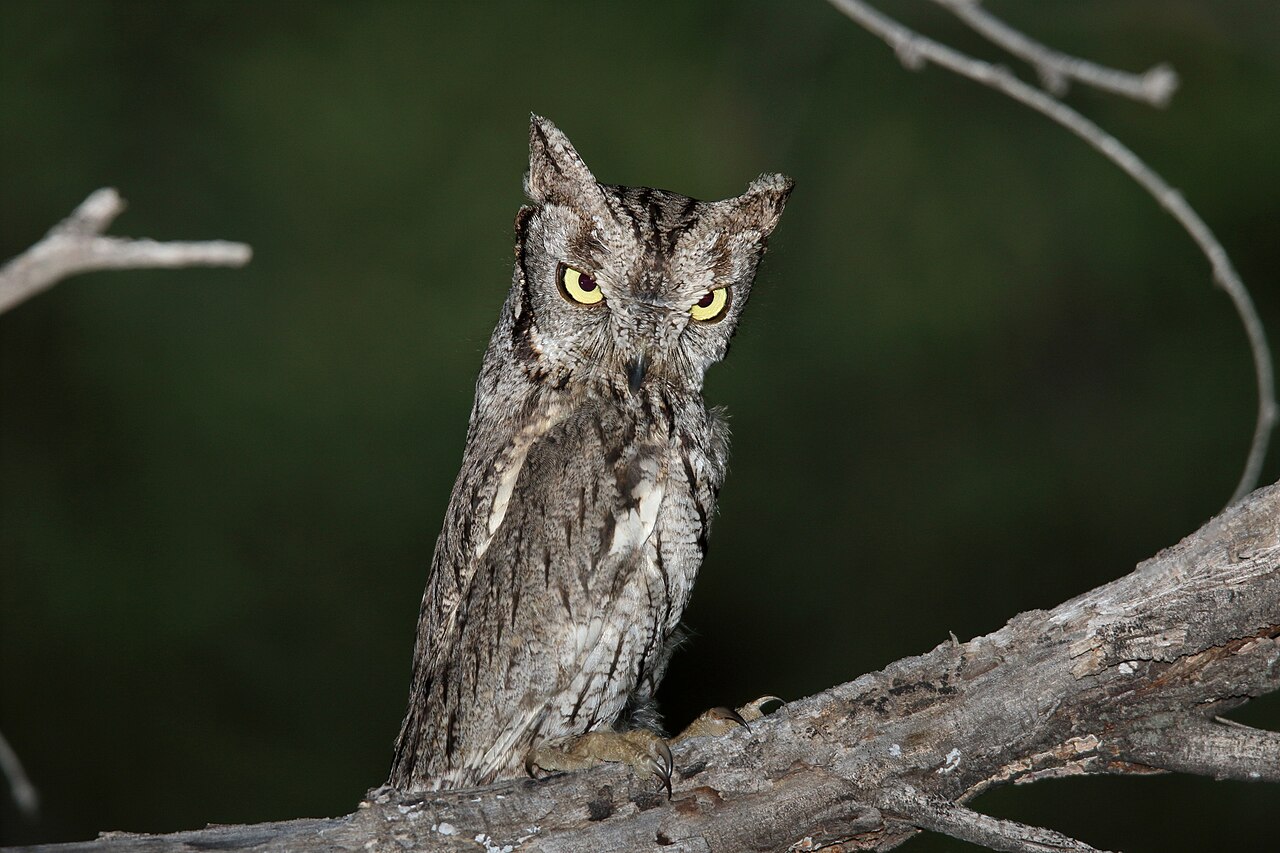
Paired birds give a two part trill that works as a duet. One bird, usually the female with her slightly higher voice, delivers a short trill while the male answers with a longer one, and the two overlap. Hearing it means a bonded pair holds that territory.
The duet peaks near the nest cavity in late winter, when pairs inspect holes and nest boxes together. If you hear it repeatedly from the same block of trees across several nights, the nest is almost certainly within 200 ft (60 m).
What Noise Does a Screech-Owl Make at Night?
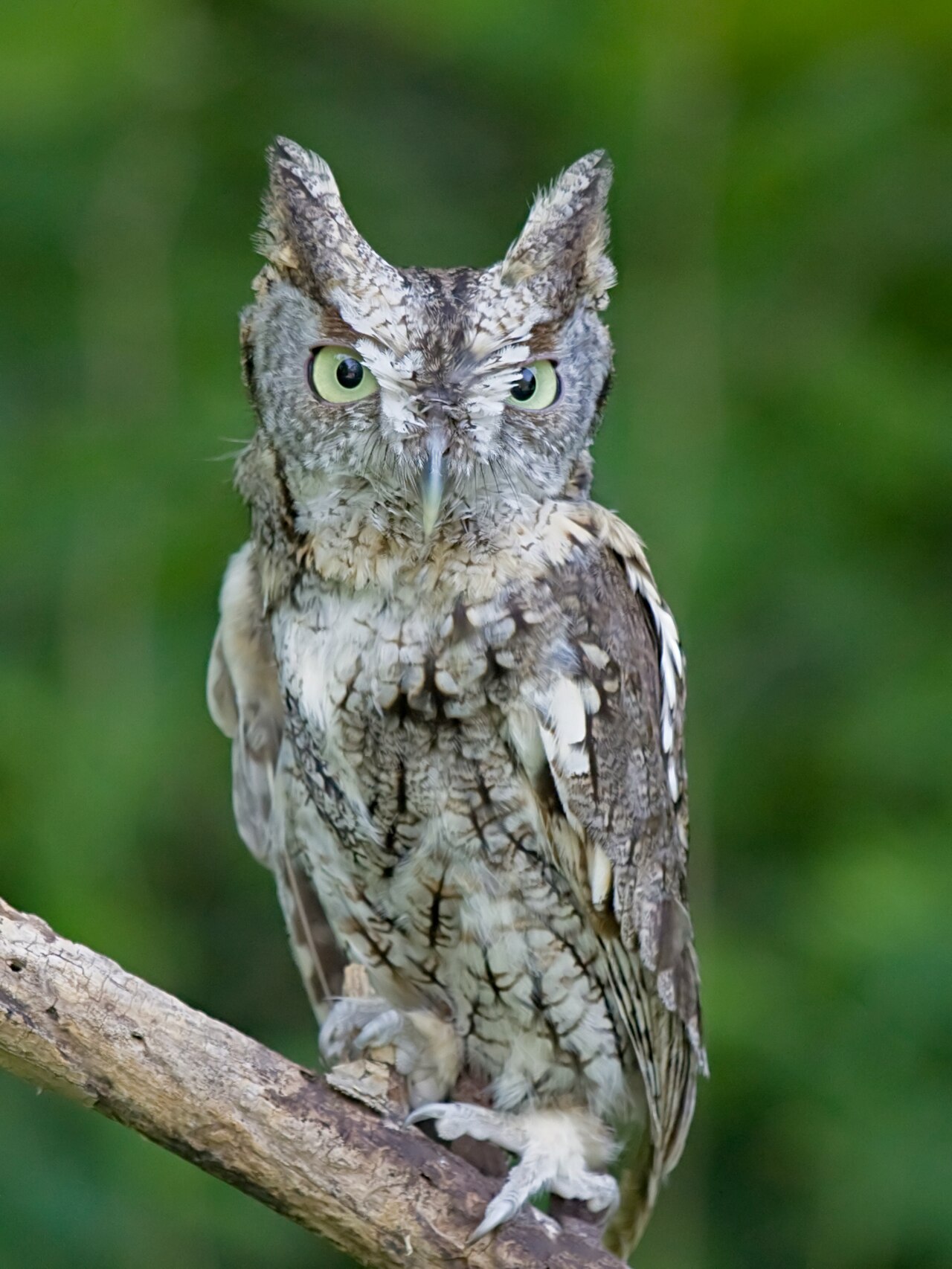
At night a Western Screech-Owl makes the bouncing ball song, the paired double trill, and occasional sharp barks when something disturbs it. Calling starts around dusk, runs hardest in the first two hours of darkness, and picks up again before dawn. Between bouts the bird hunts in complete silence.
Anything genuinely screeching in the dark is usually something else. Barn Owls produce a harsh scream, foxes and rabbits scream when threatened, and young raccoons make remarkable noises, which is why the barn owl scream gets blamed for so many unexplained yard sounds.
Western Versus Eastern Screech Owl Sound
The two species sound completely different, which is the easiest way to keep them straight. The Eastern Screech-Owl (Megascops asio) gives a descending whinny like a small horse, plus a long monotone trill; the western bird gives the accelerating bouncing ball. Neither sounds remotely like the other.
Their ranges barely overlap, meeting only in a narrow zone along the Rio Grande and the eastern Great Plains. West of the Rockies, any screech owl is a Western Screech-Owl. Detailed comparisons of the eastern bird are in our guide to Eastern Screech-Owl calls.
What Is the Difference Between a Screech-Owl and a Hoot Owl?
The difference between a Screech-Owl and a hoot owl is size, voice and cavity use. Hoot owl usually means a Great Horned Owl or a Barred Owl, both far larger birds with deep, spaced hoots that carry half a mile. Screech owls are palm sized cavity nesters with whistled or trilled songs.
Judge the tempo and pitch rather than the word hooting. A rhythmic five note phrase deep enough to feel in your chest belongs to a Great Horned Owl, while a fast, light, bouncing series belongs to the screech owl.
What Does It Mean When You Hear a Screech-Owl at Night?
When you hear a Screech-Owl at night it means a territorial bird is advertising its patch or contacting its mate, nothing more. Calling intensity tracks the breeding calendar, not events in the neighborhood. A burst of song in February is a male defending a nest cavity he intends to use.
Folklore across many cultures treats owl calls near a house as an omen, and that belief is the reason the question comes up so often. Biologically the message is mundane: the yard has mature trees, cover and rodents, which is a good sign for the habitat.
When and Where to Listen
Peak calling runs from January through April, when pairs form and defend cavities, with a second round of noise in early summer from begging fledglings. The best hour is the one right after full dark, on calm nights, since wind above about 10 mph buries a call this soft.
Habitat is broad: oak and riparian woodland, desert washes with mesquite and saguaro, orchards, parks and older suburbs with big trees. Listen near water, since streamside corridors hold the highest densities across most of the range.
Are Western Screech-Owls Rare?
Western Screech-Owls are not rare overall, but they are thinly spread, hard to see and declining sharply in parts of the Pacific Northwest. In coastal British Columbia and western Washington the expansion of Barred Owls has driven populations down steeply, and some historic areas are now silent.
Elsewhere the species remains fairly common wherever cavities survive. Removal of dead limbs and snags matters more than anything else, because this owl cannot excavate its own hole and depends on woodpeckers and natural rot.
Other Sounds You Might Hear
Alarmed birds give a sharp bark, repeated at irregular intervals, and a cornered owl snaps its bill in a dry, hard clicking that carries surprisingly well. Both mean the bird has seen you. Back away rather than pressing closer for a photo.
From May through July, fledglings produce a rasping, insistent begging hiss that people often mistake for an injured animal or an insect. It comes from a branch rather than the ground, and it runs for minutes at a time. A general comparison of owl calls by species helps sort these out.
How to Listen Without Disturbing the Birds
Playback works far too well on small owls and stresses them, so use it sparingly if at all. Standard birding ethics call for a minute or less of song, never in the same spot twice, and never during nesting or where the species is in decline. Simply standing still for twenty minutes usually produces the bird anyway.
A phone recording is the better tool. Reference cuts of every Western Screech-Owl call are at All About Birds, and the Audubon field guide gives the range detail you need to rule out the eastern bird.
What Is an Owl’s Worst Enemy?
For a Western Screech-Owl the worst enemy is a bigger owl. Great Horned Owls kill screech owls regularly, and Barred Owls both hunt them and take over their territory, which is exactly what has happened along the Northwest coast. Raccoons take eggs and nestlings from cavities.
That pressure shapes the soundscape. Screech owls fall silent when a large owl calls nearby, so a yard that goes quiet after a barred owl starts calling has not lost its small owls permanently, only for that night.
Frequently Asked Questions
What does it mean when you hear an owl hooting outside your house?
It means a territorial owl has included your property in its range, usually because mature trees and rodents are present. Hooting peaks in late winter during pair formation. There is no evidence behind the superstition that owl calls near a home predict misfortune.
Can an owl pick up a 20 lb dog?
No owl in North America can carry a 20 lb (9 kg) dog. A Great Horned Owl weighs about 3 lb (1.4 kg) and can lift only a fraction of that in flight, and a Western Screech-Owl weighs 4 to 11 oz (110 to 310 g). Its prey is mice, large insects and small birds.
Are any owls friendly to humans?
Owls are not friendly in any meaningful sense, and tame behavior in a wild bird usually signals illness, injury or improper hand rearing. Education birds at raptor centers tolerate handlers because of years of conditioning. A wild owl that lets you approach closely needs a licensed rehabilitator, not company.
What if an owl stares at you?
A staring owl is simply tracking a large animal it considers a possible threat, since owls must turn the whole head to look at anything. Hold still, keep your distance and it will usually resume hunting. Persistent staring plus refusing to fly suggests an injured bird.
What is the Western Screech-Owl mating call?
The mating season sound is the same bouncing ball song, delivered more frequently and answered by the female, plus the double trill that pairs perform at a chosen cavity. Late January through March is the noisiest stretch. Males also bring food to the female while calling softly nearby.
Where can I hear a Western Screech Owl sound mp3?
Free recordings are available from the Macaulay Library and xeno-canto, both searchable by species and region, and both licensed for personal listening. Compare several cuts before deciding, because tempo varies between individuals. For broader nighttime identification, our roundup of Western Screech-Owl biology covers the bird behind the voice.