Gray Bird: Species Identification Guide
A gray bird at a feeder or in a treetop covers more ground than almost any other color category, since gray shows up across songbirds, doves, jays, and shrikes alike, each with a completely different size, shape, and behavior underneath the shared color. Getting past the color itself to these other details is usually the fastest route to a confident identification.
This guide covers the gray birds most commonly reported across the US, how to separate them by size, shape, and habitat, and what a few specific patterns, a black cap, a long tail, a masked face, tend to point to once you know what to look for.
Common gray birds in US yards include the gray catbird, northern mockingbird, mourning dove, tufted titmouse, dark-eyed junco, and loggerhead shrike, distinguished mainly by size, tail length, and whether a black cap, mask, or white outer tail feathers are present.
| Species | Key Feature |
|---|---|
| Gray Catbird | Slate gray overall with a black cap and rusty patch under the tail |
| Northern Mockingbird | Pale gray with white wing patches visible in flight |
| Mourning Dove | Soft gray-brown, plump body, long pointed tail |
| Tufted Titmouse | Small gray bird with a pointed crest |
| Dark-Eyed Junco | Slate gray hood over a white belly, common at winter feeders |
| Loggerhead Shrike | Gray with a black mask and hooked beak |
| Canada Jay | Fluffy gray plumage, found in northern boreal forest |
| Blue-Gray Gnatcatcher | Tiny, thin-billed, active tail-flicking behavior |
How to Tell Gray Birds Apart
Size is the fastest starting filter, ranging from the tiny blue-gray gnatcatcher to the much larger mockingbird and dove. Tail shape and length narrow things further, a long, pointed tail suggests a dove or catbird, while a short, active tail flick suggests a gnatcatcher. Facial markings do the rest of the work: a black mask points to a shrike, a black cap points to a catbird, and no distinctive marking at all often points to a mockingbird or dove. Behavior is a useful final check, ground-feeding and flocking habits differ noticeably between species that otherwise look similar in color alone. Smaller gray species in particular often need this behavioral check more than the larger ones, since size and color alone leave more overlap between species at that end of the range. Voice is worth listening for too, since several of these species have calls distinctive enough to confirm an identification long before a clear visual is possible.
Gray Catbird
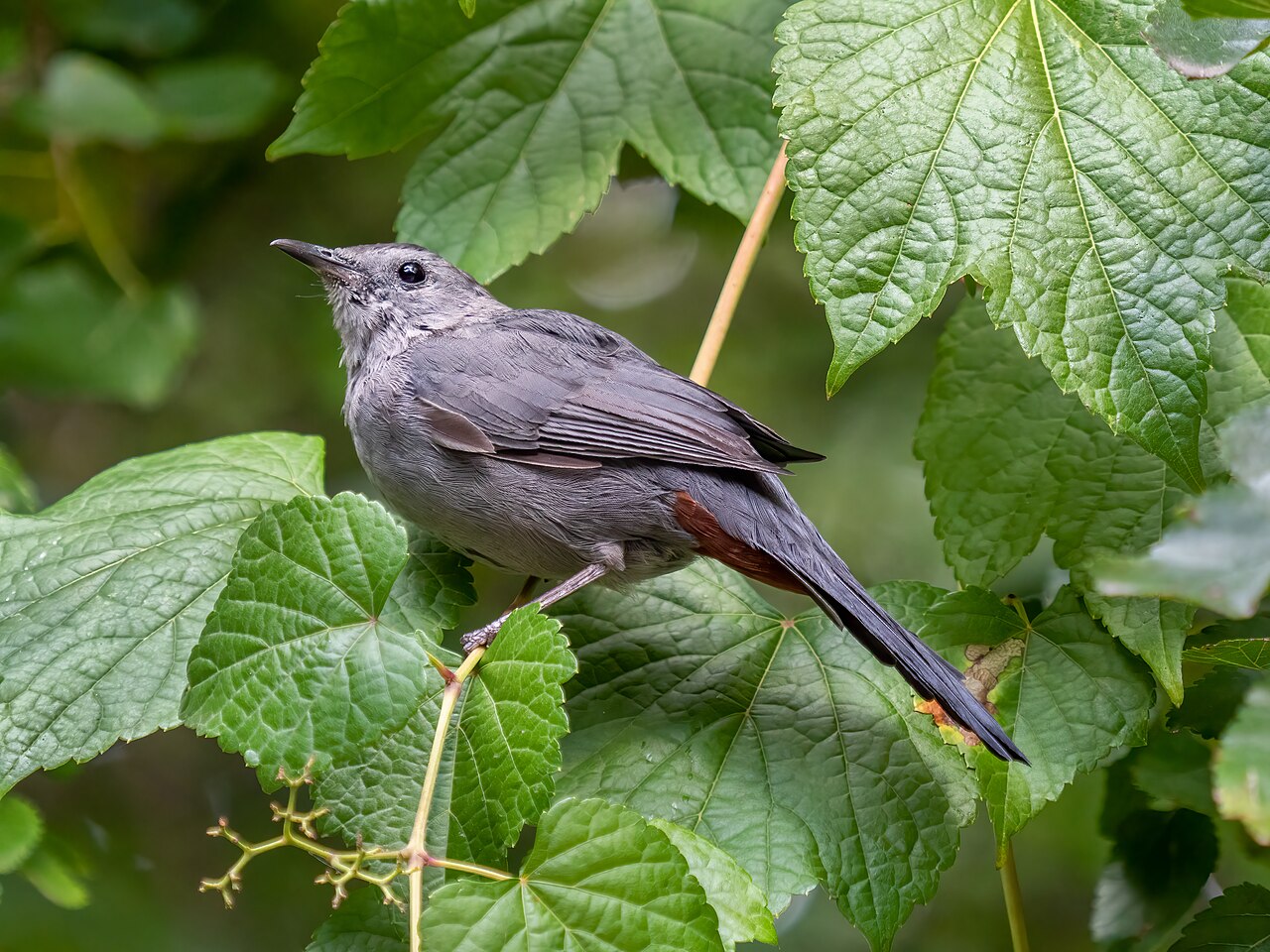
The gray catbird is a slate-gray songbird with a distinctive black cap and a rusty-orange patch tucked under the tail, visible mainly when the bird flicks or raises its tail. It’s named for its unusual call, a nasal mewing sound closely resembling a cat, and it’s a skilled mimic capable of stringing together phrases borrowed from other bird species. Catbirds favor dense shrubby cover over open lawn, and they’re often heard well before they’re seen, calling from inside a thicket rather than perching in the open. A catbird’s song can run on for minutes at a time without an obvious repeating pattern, unlike the more structured, repetitive phrases typical of a mockingbird.
Northern Mockingbird
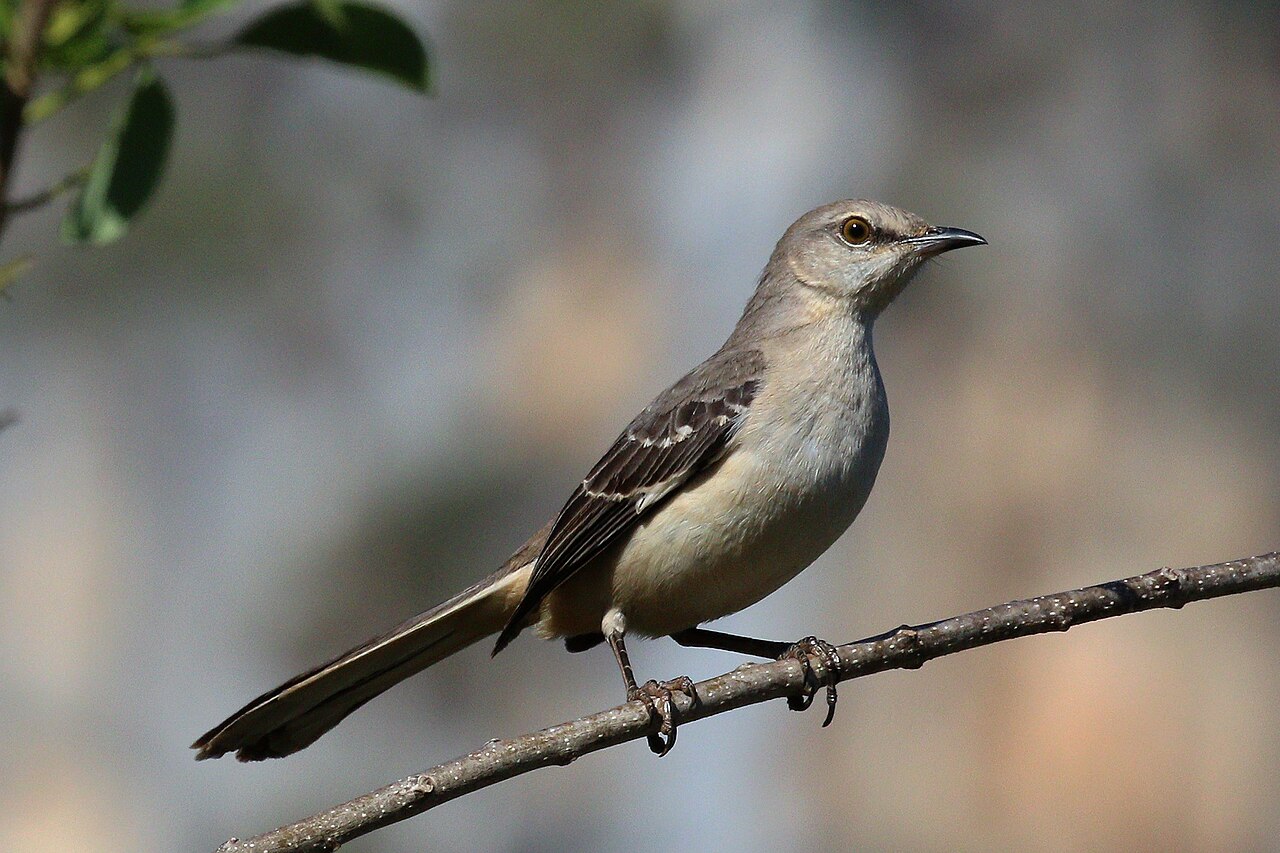
The northern mockingbird is a pale gray bird with bold white patches on the wings and outer tail feathers, most visible in flight or during a wing-flashing display used to startle insects into moving. It’s famous for an extensive vocal repertoire, capable of mimicking dozens of other species’ songs along with car alarms and other mechanical sounds, and a persistent singer will often repeat the same song several times before switching to a new one. Mockingbirds are also notably territorial, sometimes aggressively defending a feeding area against birds, cats, or even people who wander too close to an active nest, a boldness that seems disproportionate to the bird’s relatively modest size.
Mourning Dove
The mourning dove is a soft gray-brown bird with a plump body, small head, and a long, pointed tail edged in white, easily one of the most common birds at US feeders. Its name comes from its call, a low, mournful cooing that’s often mistaken for an owl by people unfamiliar with the sound. Mourning doves feed almost entirely on seed, both at feeders and directly off the ground beneath them, and their wings make a distinctive whistling sound on takeoff that’s often the first clue one has been startled nearby. Other dove species found across the US share the same general body shape and soft coloring, though the mourning dove remains by far the most widespread and frequently seen.
Tufted Titmouse
The tufted titmouse is a small gray bird with a pointed crest, a black patch above the beak, and rusty-orange flanks that add a touch of color to an otherwise gray palette. It’s a common feeder visitor, especially fond of sunflower seeds, which it typically carries off to a perch to crack open individually rather than eating on the spot the way some other species do. Titmice are also known for a clear, whistled song that carries well through open woodland, often one of the first bird sounds heard on a quiet morning, and the species is bold enough that individuals sometimes learn to take seed directly from a person’s hand at well-stocked feeding stations.
Dark-Eyed Junco
The dark-eyed junco shows a slate-gray hood over a crisp white belly, a pattern so consistent it’s sometimes nicknamed the snowbird for how reliably it appears at feeders once cold weather sets in. Juncos are ground feeders, hopping and scratching beneath feeders for spilled seed rather than perching directly on them, and their white outer tail feathers flash noticeably when the bird takes flight, a useful field mark even at a distance. Their arrival each fall is reliable enough in some regions that longtime feeder watchers use it as an informal seasonal marker, much the way others might note the first frost.
Loggerhead Shrike
The loggerhead shrike is a gray songbird with a bold black mask and a sharply hooked beak, an unusual combination for a bird its size that hints at its surprisingly predatory habits. Shrikes hunt insects, small reptiles, and even small birds and rodents, famously impaling prey on thorns or barbed wire to store it for later, a behavior that’s earned it the nickname butcher bird. Its populations have declined significantly in parts of its range, making a confirmed sighting more notable than it might first appear for a bird this plain in color, and researchers still aren’t entirely certain what’s driving the decline in every region where it’s occurred.
Canada Jay
The Canada jay, also called the gray jay, is a fluffy, uniformly gray bird found in northern boreal forest, notably tame around people and known for boldly taking food directly from an outstretched hand at established campsites. It caches food in enormous quantities using sticky saliva to glue small food items to tree bark, a strategy that lets it survive entirely on stored food through the harshest parts of winter without needing to migrate south. The Cornell Lab of Ornithology notes that this caching behavior is so effective the species rarely leaves its breeding territory year-round, unlike most other birds found this far north, and a single bird may store thousands of food items across its territory over the course of a season.
Blue-Gray Gnatcatcher
The blue-gray gnatcatcher is a tiny, active bird with a thin, needle-like beak and a long tail it flicks constantly while foraging for small insects among tree branches. Its blue-gray back and white eye-ring give it a delicate look very different from the larger, plainer gray species on this list, and its near-constant motion, combined with a thin, wheezy call, is often the fastest way to locate one in dense foliage before getting a clear visual. The species builds an unusually neat, cup-shaped nest decorated with lichen on the outside, camouflaging it so effectively against tree bark that it’s often mistaken for a knot in the branch itself.
Why Some Birds Stay Gray Year-Round
Unlike species that molt into brighter breeding plumage each spring, most of the gray birds on this page keep the same coloring throughout the year. Gray offers effective camouflage across a wide range of backgrounds, tree bark, overcast skies, winter branches, without needing the seasonal color change that species relying on breeding displays require. This is part of why gray species tend to rely more heavily on song and behavior for mate attraction and territory defense rather than the bright plumage changes seen in species like orioles or warblers. It’s also a practical advantage for year-round residents specifically, since a bird that doesn’t migrate benefits more from consistent camouflage across all four seasons than from a brief burst of color timed only to breeding season.
Attracting Gray Birds to Your Yard
A yard that attracts a good mix of gray species usually combines a reliable seed feeder with some ground-level feeding space and dense shrubby cover nearby, since catbirds and shrikes both favor thick vegetation over open lawn. Feeder placement matters too, doves and juncos will readily feed from platform feeders or the ground beneath a hanging one, while titmice and gnatcatchers are more likely to visit if suet or mixed seed is offered at a slightly higher perch height matching their tree-canopy habits. Leaving a section of yard slightly unmanicured, with some brush or dense shrub cover left intact, does more for catbird and shrike visits than any feeder alone ever could.
Frequently Asked Questions
What kind of bird is grey?
Many common US species are gray, including the gray catbird, northern mockingbird, mourning dove, and dark-eyed junco, each distinguished by size, tail shape, and any additional markings like a black cap or mask.
What does it mean when you see a gray bird?
There’s no factual significance beyond the ordinary, gray is simply one of the most common bird colors in North America, so a sighting typically just reflects which species happen to be active in a given season and habitat.
What bird looks like a dove but is grey?
The mourning dove itself is the gray-brown bird most people mean by this description, though its plump body, small head, and long pointed tail set it apart from other gray species entirely.
What kind of bird resembles a blue jay but is grey?
The Canada jay, also called the gray jay, shares a similar overall shape and boldness with a blue jay but shows uniform gray plumage instead of blue, and it’s found much farther north in boreal forest habitat.
What attracts gray birds like doves and juncos to a yard?
Scattered seed on the ground or a low platform feeder works well for both, since these species strongly prefer ground-level feeding over perching directly on a hanging feeder port, and a consistent supply tends to keep them returning through the season.
Is it rare to see a loggerhead shrike?
It’s becoming less common in parts of its range due to population declines, so a confirmed sighting is genuinely more notable than spotting most other gray birds covered here, and reporting it to a local birding group or citizen science project can help track the trend.