Frog Poop vs Rat Poop: One Wet Mass or Many Dry Pellets
Frog droppings and rat droppings are both dark and both turn up on patios and in garages, but they fail the same test in opposite directions. Frog poop is a single large, glossy, soft mass that smears when touched. Rat poop is a scatter of firm, dry capsules that hold their shape.
The surprise for most people is size. A frog voids a dropping up to a quarter of its own body length, so a 3 in (7.6 cm) treefrog can leave something as long as a Norway rat pellet. That is why the two get confused despite coming from completely different animals.
Frog droppings are single dark, moist, cylindrical masses up to 1 in (25 mm) long, soft and glossy when fresh, packed with insect fragments, found near water, planters or porch lights. Rat droppings are firm dry capsules 1/4 to 3/4 in (6 to 19 mm) long, found scattered in groups along walls and in attics, with gnaw marks nearby.
| Feature | Frog droppings | Rat droppings |
|---|---|---|
| Length | Up to 1 in (25 mm), one piece | 1/4 to 3/4 in (6 to 19 mm), many pieces |
| Texture | Soft, wet, glossy, smears | Firm, dry, holds shape |
| Number | One or two, isolated | Groups of 10 to 50 along a route |
| Contents | Shiny insect wings, legs, beetle shells | Ground food, paper, insulation fiber |
| Where | Near water, planters, patios, porch lights | Attics, behind appliances, wall bases |
| Other signs | None, no damage | Gnaw marks, grease rubs, ammonia odor |
Do frogs leave droppings you would actually notice?
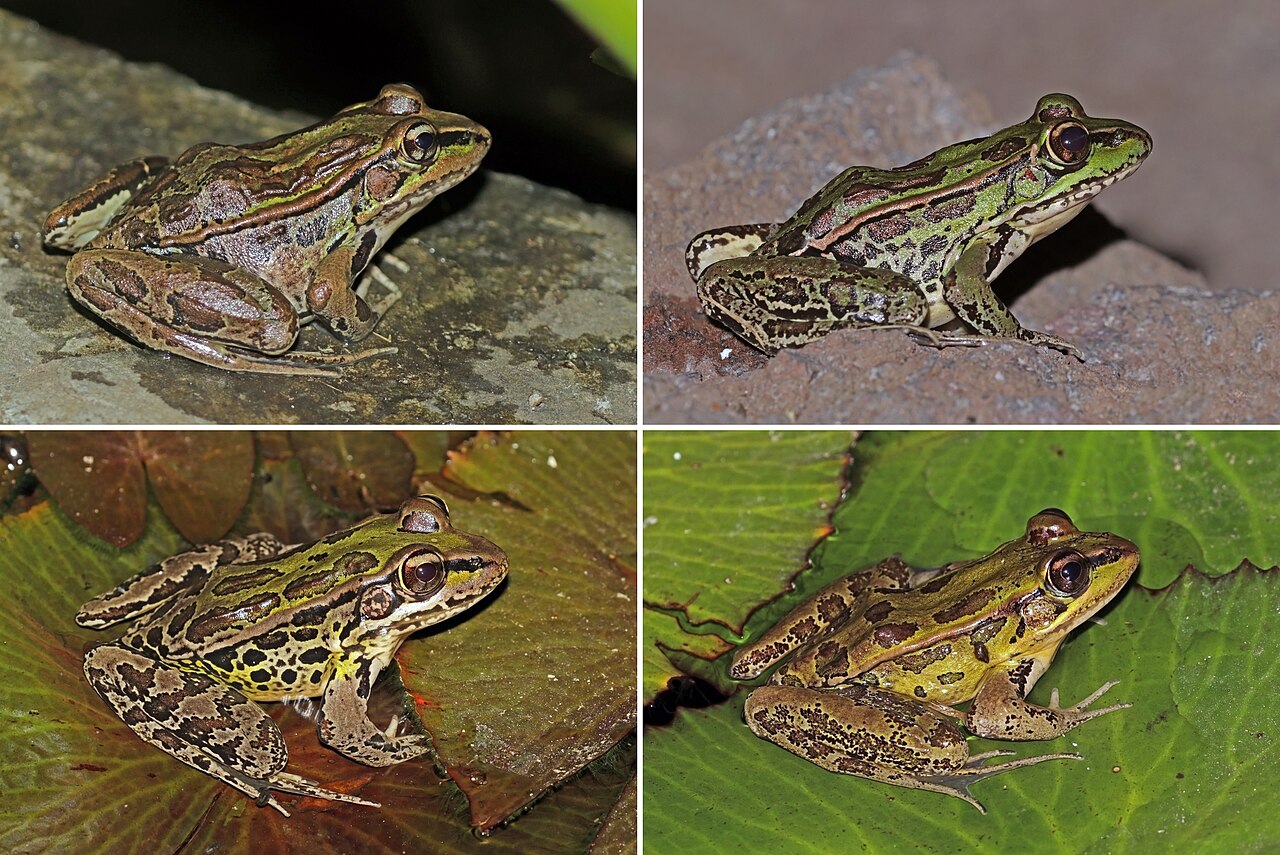
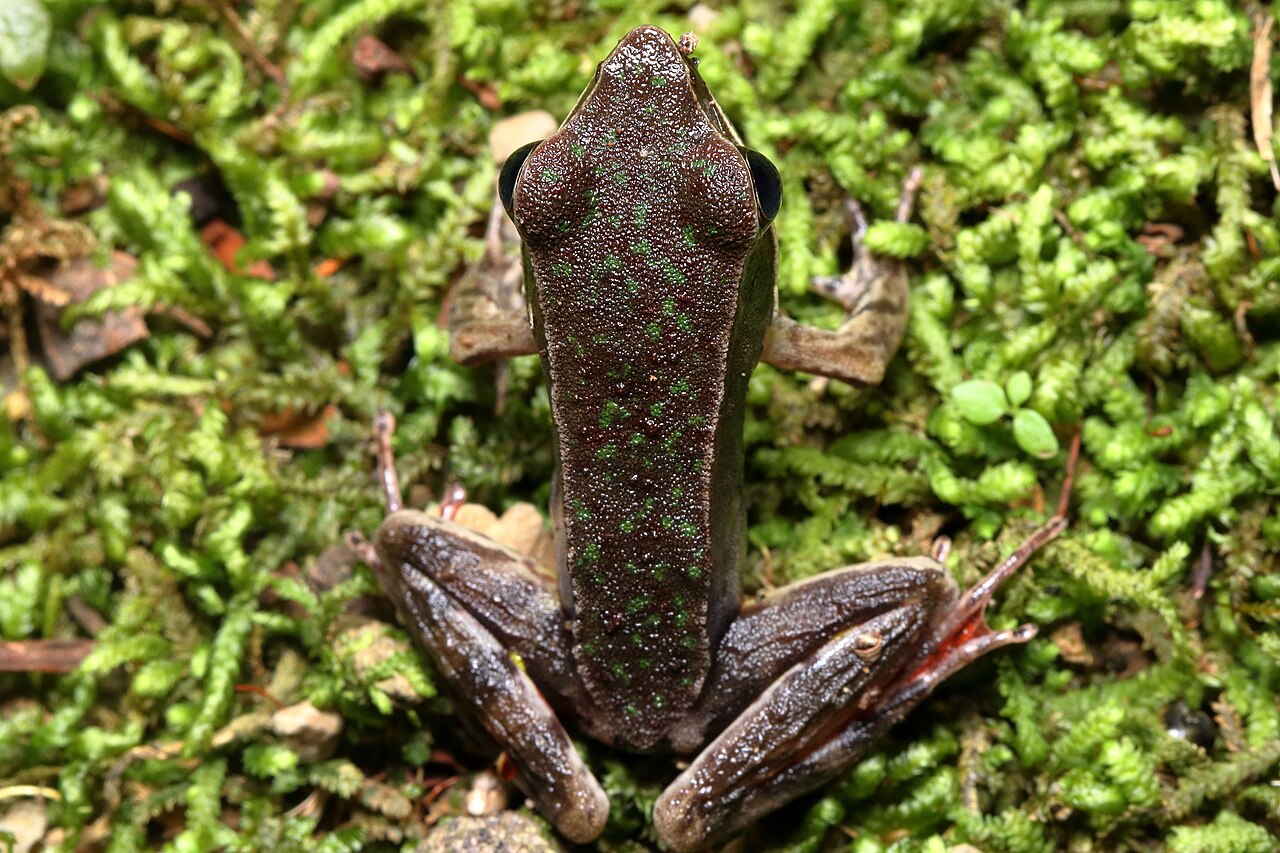
Yes, and they are far larger than people expect for the animal. American bullfrogs (Lithobates catesbeianus) and green treefrogs (Dryophytes cinereus) both produce a single thick, dark, sausage-shaped mass rather than a series of pellets. A treefrog sitting on a window screen overnight can leave a deposit most homeowners assume came from a rodent.
Frequency is low. A frog eats large meals and defecates every few days, so you find one deposit, not a trail. That isolation is the first thing that argues against rats, which leave 30 to 50 droppings per animal per night.
What rat droppings look like
Norway rat (Rattus norvegicus) droppings are 1/2 to 3/4 in (12 to 19 mm) long, dark brown to black, roughly the shape and thickness of a large grain of brown rice with blunt, squared-off ends. Roof rat (Rattus rattus) droppings are smaller at 1/4 to 1/2 in (6 to 13 mm), curved and spindle shaped with tapered ends.
Fresh droppings are dark and slightly soft for about a day, then dry hard, dull and gray. They are never wet or glossy for long, and they never smear. You will find them in groups wherever the animal travels. The identification details are in our guide to rat droppings.
Frog poop vs rat poop: size, shape and sheen
Shape separates them before size does. Frog droppings are one continuous mass, often slightly curled, with no segmentation and no distinct ends. Rat droppings are discrete capsules, each one a separate unit with defined ends, lying in a loose cluster.
Sheen is the second test. A fresh frog dropping has a wet, varnished look from the mucus coating that passes with it, and a toothpick pulls a smear out of it. A fresh rat dropping is matte within hours and the same toothpick just rolls it. Dry both for two days and the frog deposit crumbles to a flaky crust while the rat pellet stays hard.
Where you find them
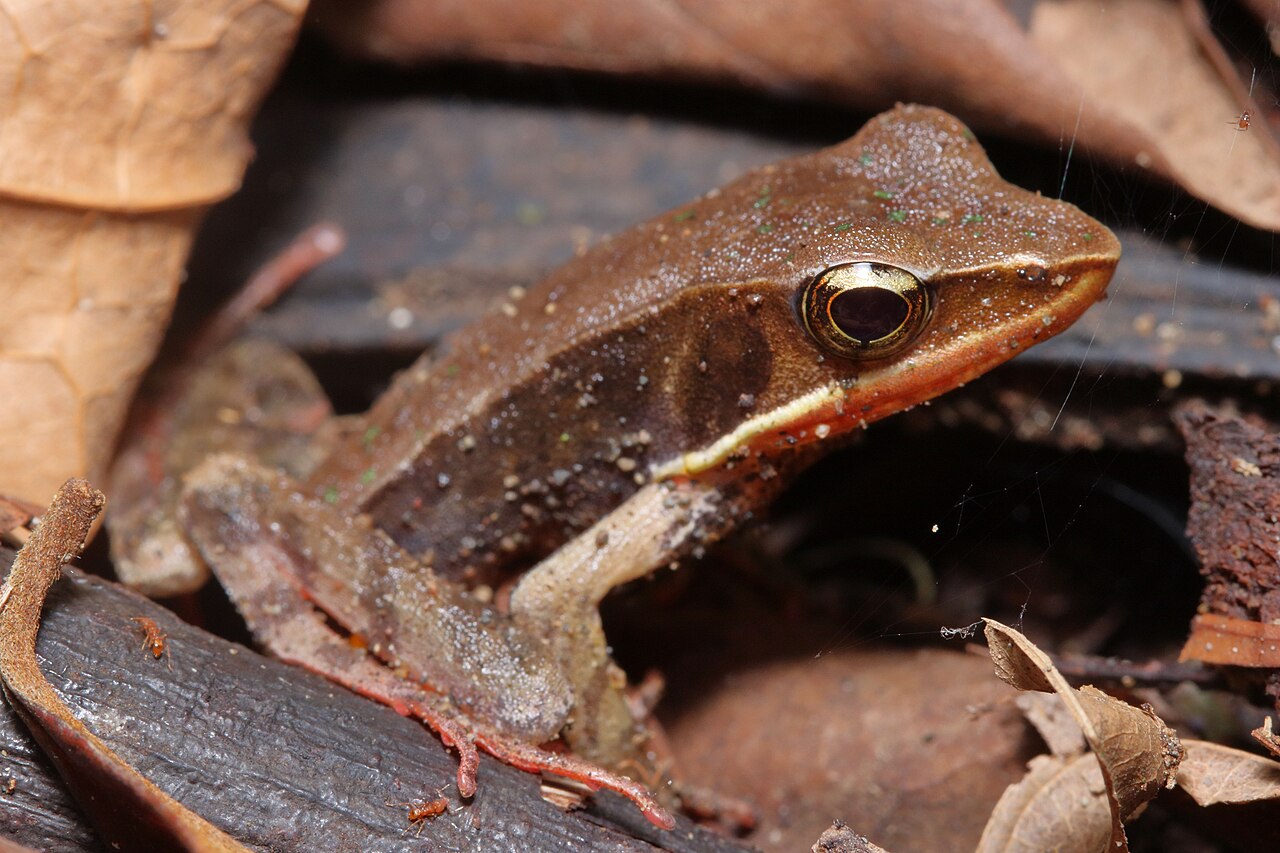
Frogs need moisture and insects. Their droppings turn up on patio stones near a pond or pool, on the rim of planters, on outdoor furniture under a porch light, on window screens and inside damp garages and crawl spaces. The deposit usually sits in the open, right where the frog was perched.
Rats work covered routes. Their droppings line the base of walls, fill attic insulation, collect behind the stove and refrigerator, sit in the back of low cabinets and spill inside stored cardboard. A dropping in the middle of an open patio is unlikely to be rat, while a dropping in the corner of a pantry shelf almost certainly is.
What is inside: insect parts vs gnawed debris
Break the deposit apart with a stick and the diet answers the question. Frogs are obligate carnivores that swallow prey whole, so their droppings are dense with chitin: beetle elytra, moth wings, cricket legs, ant heads, often still recognizable and catching the light.
Rats are omnivores that chew everything thoroughly. Their droppings are a uniform ground paste of grain, pet food, fruit and whatever packaging they shredded, with no shine and no identifiable body parts. Insect fragments in a dropping rule out rats almost on their own.
Frog poop vs lizard poop
These two are much harder to tell apart than frog and rat, because both animals eat insects and both leave a dark deposit with glittering chitin. The deciding feature is the white tip. Lizards excrete uric acid, which dries into a chalky cream-colored cap on one end of the pellet. Frogs excrete urea in liquid urine, so their droppings have no white cap at all.
Texture backs it up: lizard droppings are firm and dry fast, frog droppings stay soft and wet for hours. Size also differs, with gecko pellets at 1/8 to 1/4 in (3 to 6 mm) against the single larger frog mass. The side-by-side is in frog droppings vs lizard droppings, and frog droppings covers species variation.
Do mouse and rat poop look the same?
They are the same color and the same general shape, which is why the question comes up constantly, but length separates them cleanly. House mouse (Mus musculus) droppings run 1/8 to 1/4 in (3 to 6 mm) and taper to a point at both ends. Rat droppings start where mouse droppings end, at 1/4 in (6 mm), and run up to three times longer.
A dime makes a quick ruler. A mouse pellet covers about a third of its diameter, a roof rat pellet about two thirds, and a Norway rat pellet spans nearly the whole coin. Full photos and measurements are in rat droppings vs mouse droppings.
Squirrel poop vs rat poop
Squirrel droppings are the genuine near miss for roof rat droppings, both in size and in where they land. Eastern gray squirrel pellets measure about 3/8 in (8 to 10 mm), are barrel shaped with rounded rather than tapered ends, and bleach from dark brown to pale tan after a week outdoors.
Rat droppings keep their dark color and taper or square off at the ends. Timing helps too: squirrels are active in daylight and the noise overhead comes in the morning, while rats run after dark. The detailed comparison is in squirrel droppings vs rat droppings.
How can you tell if you have rats or mice?
Start with dropping length, then check the damage. Rats leave gnaw marks about 1/8 in (3 mm) wide on wood edges, wiring and plastic pipe, plus greasy dark rub marks along walls from oils in their fur. Mice gnaw smaller, cleaner holes, roughly the size of a dime, and leave far less grease.
Burrows outside the foundation, holes 2 to 4 in (5 to 10 cm) across under decks or sheds, point to Norway rats. Shredded nesting material inside a drawer or appliance housing points to mice. Both can be present at once, in which case the rats usually displace the mice over time.
Health risks and safe cleanup
Frogs and rats both carry pathogens, but the odds differ sharply. Amphibians shed Salmonella, which is why the CDC advises handwashing after any contact with a frog or its habitat. Rat droppings and the urine soaked into the same material carry Salmonella, Leptospira, rat-bite fever organisms and, in Norway rats, occasionally Seoul virus.
The cleanup rule is identical for both: nothing dry. Spray the area with disinfectant or 1 part bleach to 10 parts water, wait five minutes, pick it up with paper towels while wearing disposable gloves, bag it and wash your hands. In attics and crawl spaces with accumulated droppings, add an N95 respirator, because sweeping or vacuuming aerosolizes the particles.
What month are rats most active?
Indoor sightings peak from October through December across most of the United States, when the first cold nights push rats from burrows and woodpiles into basements, garages and wall voids. A second, smaller spike follows in spring when litters born over winter disperse.
Outdoor activity runs year round in the South. Rats do not hibernate, so a mild January in Florida or Texas produces the same pressure as a November in Ohio. If droppings appear in a season you did not expect, the calendar is not evidence against rats.
Frequently Asked Questions
What is the 5 day rule with mice?
There is no official rule, and pest professionals use the phrase two different ways. Some mean that a bait or trap line should run at least five days before you judge it, since mice need time to accept new objects. Others mean that droppings still appearing after five days of exclusion work prove the entry point is still open.
Which is harder to get rid of, rats or mice?
Rats, by a wide margin. Mice are curious and investigate a new trap within hours, while rats show neophobia and avoid unfamiliar objects for three to seven days, so traps often have to sit unset and baited before they catch anything. Rats also burrow outdoors, which means exclusion work has to extend past the building.
How many rats do I have if I see one?
Daytime sightings suggest a population large enough that competition is pushing animals out of cover, often ten or more. A single nighttime sighting is weaker evidence. Count droppings instead: one rat produces 30 to 50 per night, so a hundred fresh pellets in one spot points to two or three animals.
What is a rat’s biggest enemy?
Owls, especially barn owls, take more rats than any other wild predator in North America, and a single nesting pair can remove well over a thousand rodents in a breeding season. Rat snakes, foxes, bobcats and hawks add to the pressure, and outdoor cats kill rats far less reliably than their reputation suggests.
Which smell do rats hate?
Peppermint oil, ammonia and naphthalene all repel rats in short laboratory tests, but the effect fades within days once the animal learns the smell carries no real threat. Treat scent repellents as useless on their own. Sealing entry points and removing food is the only approach that holds.
Do frogs in the garage mean I have a moisture problem?
Usually yes. Frogs need damp skin, so a garage that holds them has standing water, a leaking hose bib, a damp slab or a drain that stays wet. Fixing the moisture removes the frogs and also removes the insects drawing them in. Tree frog droppings covers what the deposits look like indoors.