Great Egret Spiritual Meaning: Is Seeing One a Good Omen?
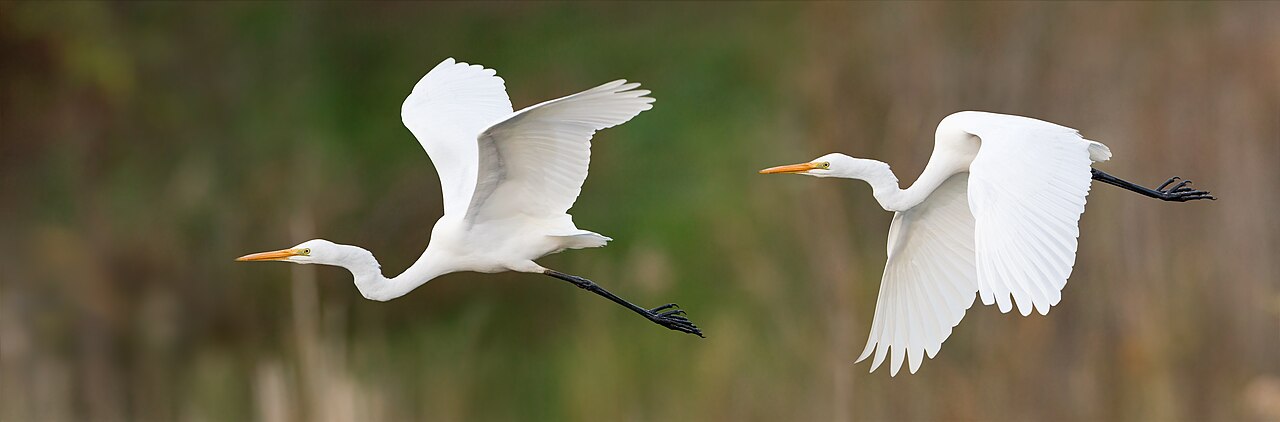
The great egret spiritual meaning centers on patience, clarity, independence and renewal, and seeing one is widely read as a good omen. The great egret (Ardea alba) is the tall white wading bird of American marshes, ponds and tidal flats, and its message depends on where you see it and what it is doing.
Seeing a great egret is a good omen. The bird stands for patience, clear intention and a fresh start that comes from waiting for the right moment. A sighting near water marks a quiet turning point, and an egret far from water or appearing again and again carries extra weight.
What Does a Great Egret Mean Spiritually?
A great egret means patience, clarity, independence, renewal and balance. Each of the five meanings comes from something the bird does in plain view. Patience comes from its long, motionless hunts. Clarity comes from its all-white plumage, and independence from the way it fishes alone.
Renewal and balance come from its address. The egret lives where water meets land, and it moves between that edge and the open sky. Together the five meanings make a calm, positive sign with no reading of misfortune.
The great egret is one of several white egrets in North America, and each carries its own shade of meaning. Egrets as a group stand for grace, purity and good fortune, with the snowy egret (Egretta thula) and the cattle egret (Bubulcus ibis) adding their own notes. The great egret is the largest and most deliberate of them, so its message leans hardest on patience.
| Behavior you notice | Typical spiritual reading | Reflection question |
|---|---|---|
| Standing motionless in shallow water | Patience as active attention | What am I rushing that needs one more week? |
| Spearing a fish in one quick strike | Decisive action after preparation | Am I ready to act when the opening comes? |
| Showing long, lacy breeding plumes | Beauty and a season of display | What part of me is ready to be seen? |
| Roosting with other egrets at dusk | Belonging without losing yourself | Who is my safe group at the end of the day? |
| Preening its white feathers | Self-care and clean intentions | What do I need to clear away? |
| Giving its harsh, croaking call | A blunt message that breaks the calm | What truth have I avoided saying out loud? |
Great Egret or Great White Heron? How to Tell Them Apart
A great egret is all white with a yellow bill and black legs, while a great white heron is a white form of the great blue heron (Ardea herodias) with paler legs. The great white heron (Ardea herodias occidentalis) is a heavier, bulkier bird. It lives only in South Florida and the Keys, so a true great white heron is rare anywhere else, and a large white wader with black legs is almost always a great egret.
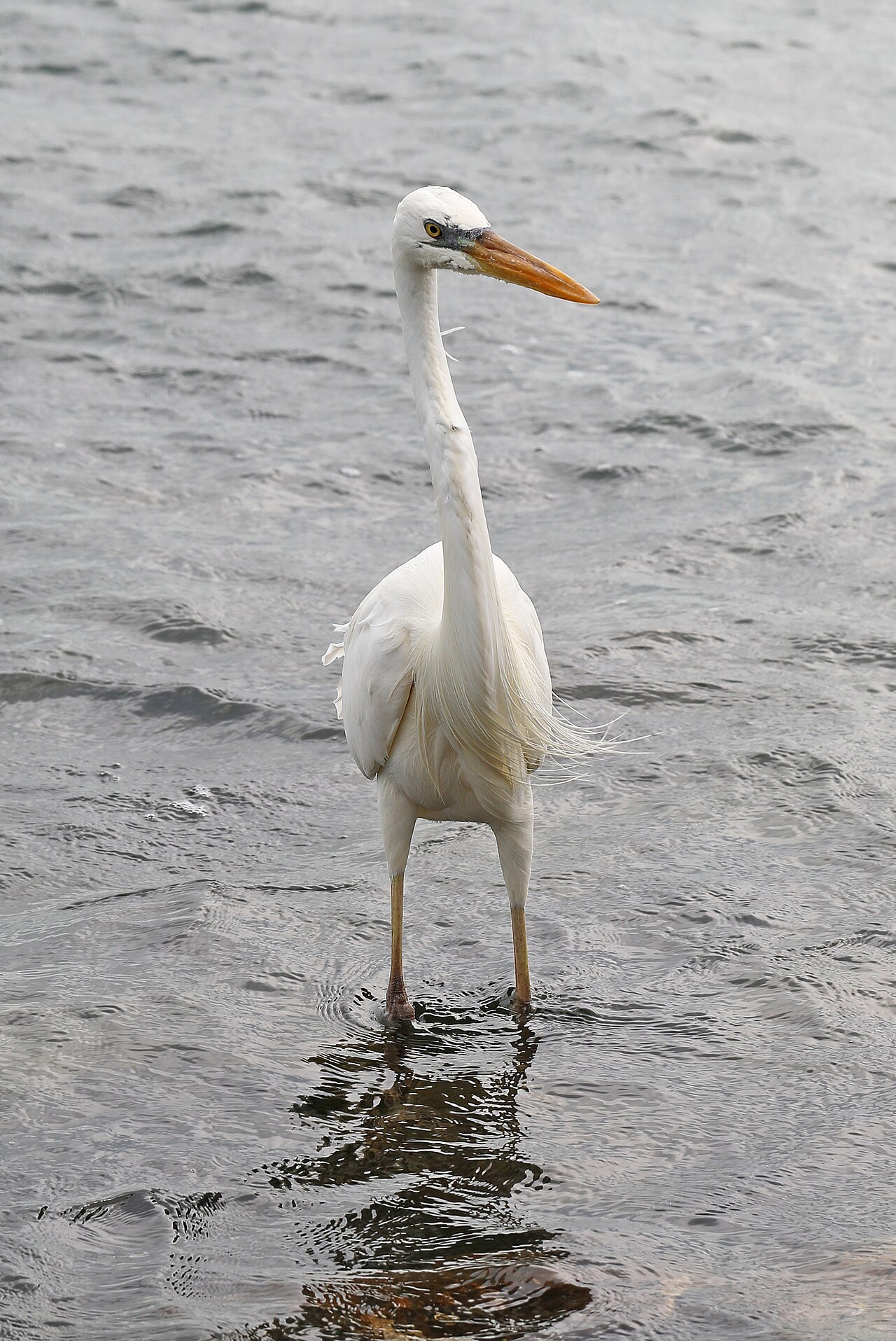
Check the legs first. Black legs mean great egret. Yellowish or pale legs on a big, thick-billed white bird in the Florida Keys point to the great white heron. The heron also carries a heavier bill and a stockier neck.
The symbolism splits along the same line. The egret stands for lightness and grace. The great blue heron, including its white form, stands for endurance and steady self-reliance.
Patience and Perfect Timing
The great egret teaches that patience is a skill, not a delay. It stands motionless in shallow water for minutes at a time, then strikes with its neck in a single fast thrust. The stillness is the work. Without it, the strike would miss.
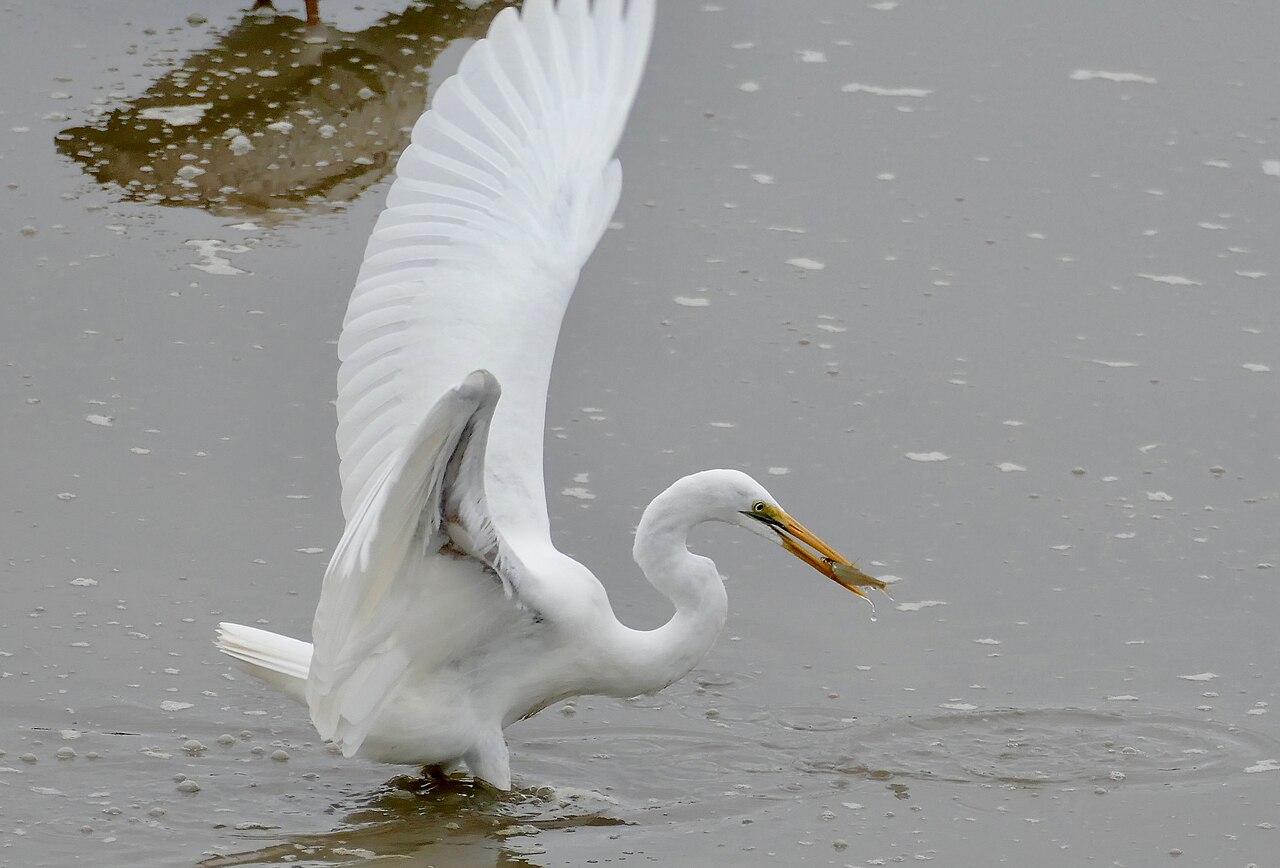
Waiting here means active attention, with eyes open and body ready. It is the opposite of giving up. If you feel stuck, the egret asks whether you are idle or simply early.
Apply it to whatever has not ripened yet. A job application still in review, a decision with missing facts and a relationship that needs time to settle all reward the egret’s approach. Hurry has the opposite effect. A splashing wader scares the fish away, and pressure on a fragile situation drives the chance off just as fast.
White Plumage: Purity, Clarity and Spiritual Light
White plumage makes the great egret a symbol of purity, honesty and clear sight. The color has no pattern to hide behind. What you see is what the bird is, and that plainness stands for truthfulness.
Clarity in this sense is an assignment. The egret asks you to name your real intention, plainly and without spin. Write it down if it helps. A goal you can state in one honest sentence is easier to pursue than one wrapped in excuses.
The strongest image is the white bird standing in mud. Egrets feed in murky marshes and drainage ditches, yet their feathers stay bright. That contrast stands for staying clean in a hard setting, at work, in a family or in a season of grief. The black swan stands for the hidden and the unexpected, the shadow to the egret’s light.
Independence and Self-Control
The great egret stands for independence because it often hunts alone and may defend a feeding spot from other egrets. Watch a feeding egret and you may see it chase off a rival that drifts too close. It claims space without apology.
Yet the same bird nests in colonies, alongside herons and other wading birds. Independence here does not mean isolation. The egret fishes on its own terms and still returns to a shared rookery when it raises young.
Self-control is the second lesson. One precise strike beats a dozen hasty jabs, and the egret saves its energy for the attempt that counts. The message fits anyone on an unusual path.
Renewal and Balance at the Water’s Edge
The great egret signals renewal and balance because it lives between water, land and sky. It wades in one element, nests above another and crosses the third in flight. A creature at home in all three makes a fitting image of a life held in balance.
Shorelines are thresholds. They mark where one world ends and the next begins, so a bird that lives on them carries the meaning of endings that open into beginnings. An egret appearing after a loss, a move or a breakup fits this reading closely. It points to a fresh start that is already underway, even if it does not feel that way yet.
The stork stands for birth and new arrivals, while the egret marks the quieter renewal that follows an ending.
Seeing a Great Egret: What Each Sighting Means
Where and how you see a great egret shapes its message. The bird is the same, but its position and behavior shift the emphasis.
Crossing Your Path. An egret that crosses your path, on foot or in low flight, asks you to pause before a decision. Something in front of you deserves one more look. Do not cancel the plan. Slow it down by a day and check your footing.
In Your Yard or at Your Pond. An egret in your yard or at a backyard pond brings calm and protection to the home. It also means your water holds fish or frogs, so the visit is practical as much as symbolic. Take it as a sign that your home is a place where good things can feed and rest.
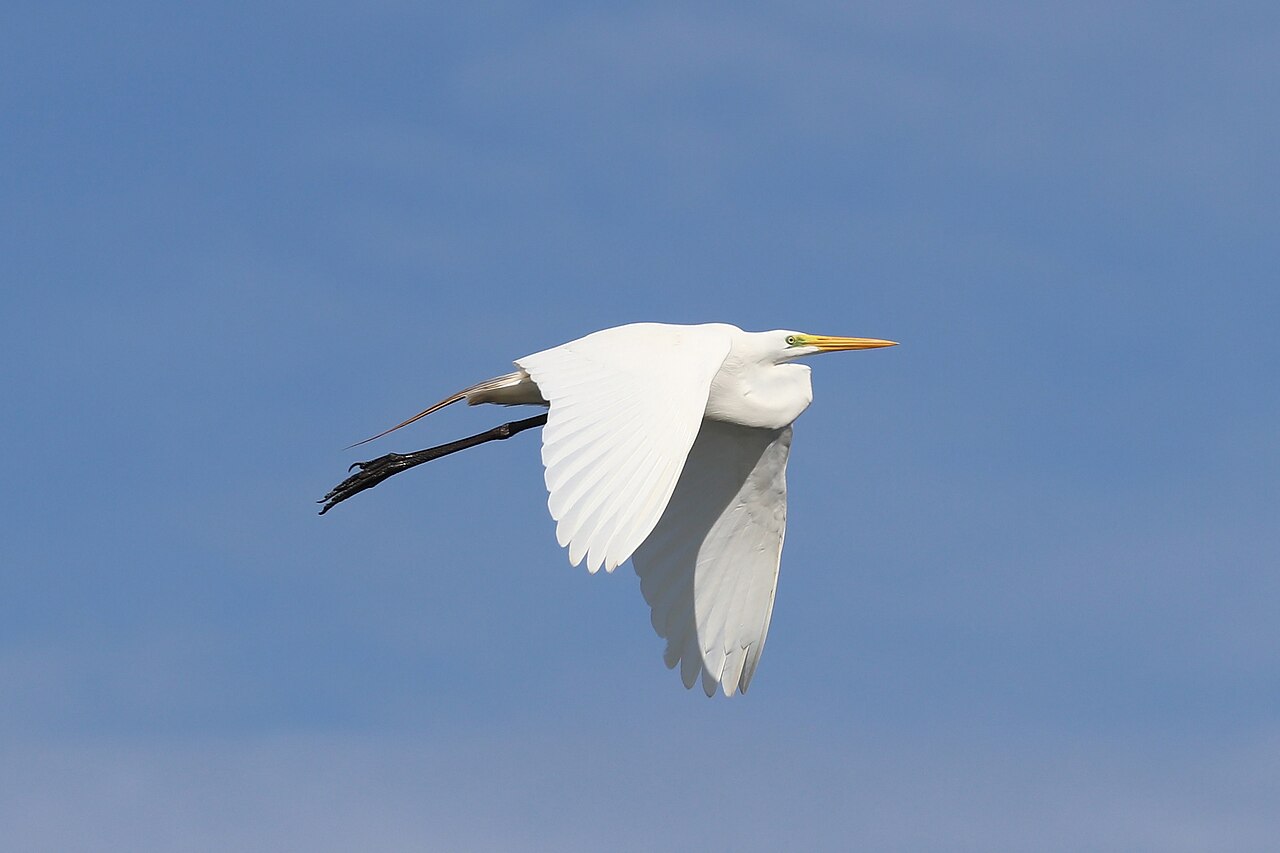
Flying Overhead. A great egret flying overhead tells you to gain distance. In flight the bird folds its neck into an S and sees the marsh from above. Step back from a problem and look at the whole map before you choose a route.
When It Keeps Appearing. Repeated sightings add weight. The message has not landed yet, or you have not acted on it. Ask which of the five meanings fits your week and give it a real answer.
In a Dream. A great egret in a dream points to inner clarity. A calm, standing egret means you already know the answer. An egret taking off means it is time to move on what you know. An egret catching a fish in a dream means a chance you waited for is about to pay off. A white egret flying toward you signals good news on its way.
A Sick or Dead Egret. A sick or dead egret stands for closure and letting go. Something has run its course. Do not touch or move the bird. H5N1 bird flu is present in wild birds worldwide according to the USDA Animal and Plant Health Inspection Service, so report the bird to your state wildlife agency instead.
Is a Great Egret a Good Omen, and Is It Rare?
Yes, a great egret is a good omen, and it carries the most weight before a new beginning. A sighting on the eve of a move, a new job or a first date lands as encouragement. The bird tells you to go in calm and alert.
Great egrets are common in wetlands across much of the United States, so rarity is not where the meaning lives. Timing is. Seeing one at the moment you are deciding something matters more than seeing one at all. An egret far from water, on a city street or in a dry field, weighs more. So does one that turns up outside its season in your area.
Herons count as a good omen too, built on patience and self-reliance.
The Great Egret as Spirit Animal and Totem
As a spirit animal, totem or power animal, the great egret stands for patience, observation and economy of energy. People who feel drawn to it watch before they speak. They spend effort where it counts and do not waste a move.
The shadow side is hesitation. The same patience can stretch into waiting forever for the perfect moment, and the egret that never strikes goes hungry. If this bird is your totem, watch for the point where caution turns into avoidance.
Call on the egret during exams, negotiations and stretches of deep focus. Picture the still bird in the shallows before a hard conversation. The personal spirit animal is a modern New Age idea rather than an Indigenous teaching.
Indigenous Stories: Aztlán and the Māori Kōtuku
The Mexica, the people later called Aztecs, traced their origin to Aztlán, a name often read as place of the herons or place of the white egrets, from the Nahuatl word aztatl. In that reading the white egret marks the homeland a people sets out from, a fitting image for departure and new beginnings.
The Māori of New Zealand call the great egret kōtuku. Only about 100 to 200 live there, breeding at a single colony on the Waitangiroto River near Ōkārito, so a sighting is rare and prized. The proverb he kōtuku rerenga tahi, the kōtuku of a single flight, honors a rare visitor or a once in a lifetime event, and the bird appears on the New Zealand two dollar coin.
North American nations keep their own traditions, so no single Native American egret meaning exists, and the best source for a tribal reading is that nation’s own cultural office or museum.
Egrets in Chinese and Japanese Art
In Chinese art the egret is a visual pun for career success. The Chinese word for egret, lu, sounds like the word for road or path, so a painted egret stands for a smooth way forward in an official career.
Paired with lotus, the egret becomes a wish for exam success. The combination spells out passing the imperial examinations one after another, and it appears on paintings, porcelain and gifts for students.
In Japan, Himeji Castle carries the nickname Shirasagi-jo, the White Egret Castle, often translated White Heron Castle, for its white walls and roofs that seem to spread like wings. Woodblock prints by Ohara Koson show herons and egrets in rain and snow, still and patient against the weather. The crane is a separate symbol in both cultures. It stands for long life, while the egret stands for progress and grace.
From Fashion Plume to Conservation Icon
The great egret is a lasting symbol of American bird conservation. The long, lacy plumes it grows in breeding season once made it a target, because hat makers paid well for them and hunters shot adults at their nesting colonies.
Public outrage over that slaughter helped launch the bird protection movement in the United States, and the great egret in flight became the Audubon emblem it still is.
Today the egret stands for return. A bird once hunted for its feathers now stalks marshes in plain view, and that comeback ties its meaning to wetland protection and to hope after loss. Great egret numbers have recovered across North America, and the IUCN lists the species as Least Concern.
Frequently Asked Questions
Is the great egret mentioned in the Bible?
No. The King James Version does not name the egret. It lists the heron in Leviticus 11:19 and Deuteronomy 14:18 among the unclean birds, alongside the stork, the lapwing and the bat. Many modern versions give hoopoe where the KJV has lapwing. Christian readers who look for egret meaning in scripture draw on the heron passages instead.
Is a white heron visit the same sign as a great egret?
Yes, in most cases. Herons and egrets belong to the same family, Ardeidae, and in New Zealand and Australia the great egret is commonly called the white heron. A white heron visit carries the egret’s message of patience, clear intention and a calm fresh start.
Is finding a great egret feather a good sign?
Yes. A white egret feather stands for clarity and a clean start. Leave it where it lies: under the Migratory Bird Treaty Act, keeping a great egret feather without a federal permit is illegal in the United States.
Does a great egret after a death mean a loved one is near?
Yes, in a widely shared modern reading. A white egret that appears after a loss, at a grave or at a place the person loved, is taken as a sign of peace and of a soul that has moved on calmly.
Can you get sick from seeing or being near a great egret?
No, not from seeing one. Wild water birds, egrets included, are natural hosts of bird flu, but people rarely catch it, and when they do it is most often after close, unprotected contact with infected birds or other animals. The CDC rates the current risk to the general public as low. Keep your distance and never handle a sick bird.
Do great egrets mate for life?
No. Great egrets form a new pair bond each breeding season, so the bird stands for devoted partnership in the present moment rather than lifelong union.
Sources
- CDC, How Bird Flu Spreads
- Audubon, the Great Egret and the Plume Trade
- Cornell Lab of Ornithology, All About Birds: Great Egret
- New Zealand Department of Conservation, White Heron/Kōtuku
- Encyclopaedia Britannica, Aztlán
- U.S. Fish and Wildlife Service, Migratory Bird Treaty Act of 1918