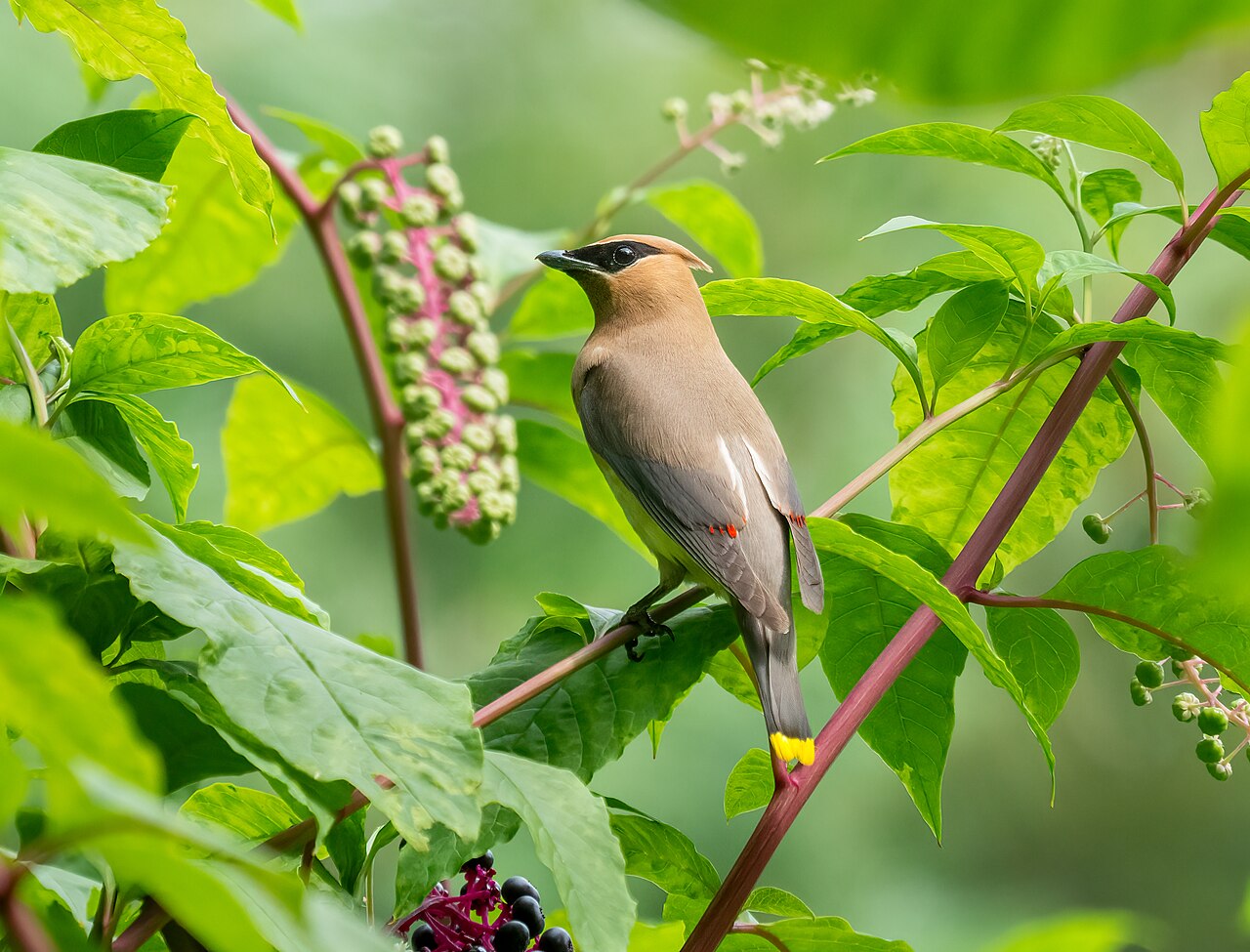
Cedar Waxwing Sounds: What the Buzzy Trill and High Whistle Mean
A cedar waxwing sounds like a thin, high, buzzing whistle, a short “bzeee” that most people hear coming from a treetop long before they spot the bird. Cedar waxwing sounds sit so high in pitch, roughly 4,000 to 7,000 Hz, that anyone with age related hearing loss in the high range may miss a flock of 40 birds passing directly overhead. The species has no real song at all, just two simple calls repeated constantly.
That makes the cedar waxwing (Bombycilla cedrorum) one of the easiest North American birds to learn by ear and one of the easiest to overlook. This guide covers each call, the time of day and year you hear it, what gets mistaken for it, and how to bring calling flocks into a yard.
Cedar waxwings make two main sounds: a buzzy high trill written as “bzeee” and a higher, clearer whistle written as “sree” or “see.” Both sexes call year round, in flight and while perched, at pitches near 7,000 Hz. Waxwings have no complex song and no drumming or mechanical sounds.
| Sound | What it sounds like | When you hear it | What it means |
|---|---|---|---|
| Buzzy trill | Thin vibrating “bzeee,” about 1 second | Year round, perched and in flight | Contact call holding the flock together |
| High whistle | Clear “sree” or “see,” shorter and sharper | Year round, often in bursts | Excitement, fruit found, flock lifting off |
| Flight chorus | Dozens of overlapping thin whistles | Any month, usually high overhead | A moving flock, the most common encounter |
| Alarm burst | Rapid, higher, more insistent “sree sree sree” | Hawk overhead, cat near a fruiting shrub | Predator warning, flock scatters |
| Courtship calls | Soft trills between two perched birds | Late May to July | Pair bonding during berry passing |
| Begging calls | Very thin, insistent rasping notes | June to September | Nestlings or fledglings asking for fruit |
What Does a Cedar Waxwing Sound Like?
A cedar waxwing sounds like escaping air or a tiny electronic beep, never like a melody. The buzzy “bzeee” is the sound people remember, and when 30 birds give it at once from one fruiting tree the effect is a steady hiss, as if the tree itself were humming. Birders call a waxwing flock an ear full for exactly that reason.
The pitch is the defining feature. Most calls fall between 4 and 7 kHz, above the range where human hearing stays sharp with age, which is why experienced birders sometimes stop detecting waxwings in their fifties and sixties while younger companions hear them constantly.
Nothing about the sound is loud. Individual calls carry maybe 100 to 200 ft, but a flock calling together is audible much farther and is usually the first clue that waxwings are in the neighborhood.
The Buzzy Trill: “bzeee”

The buzzy trill is the cedar waxwing’s contact call and the sound you will hear 90 percent of the time. It lasts about half a second to one second, holds a single high pitch with a fast vibrating quality, and is given by both sexes at every season. Written versions include “bzeee,” “zeee” and “bzzzt,” all pointing at the same insect like buzz.
Its job is cohesion. Waxwings move in tight nomadic flocks that follow ripening fruit, and the trill keeps birds in contact when they cannot see each other inside dense foliage or over distance in flight.
Volume and urgency change with the situation. A relaxed flock stripping a crabapple gives slow, spaced trills, while birds preparing to move give them faster and higher, often with a few seconds of warning before the whole group leaves.
The High Whistle: “sree”
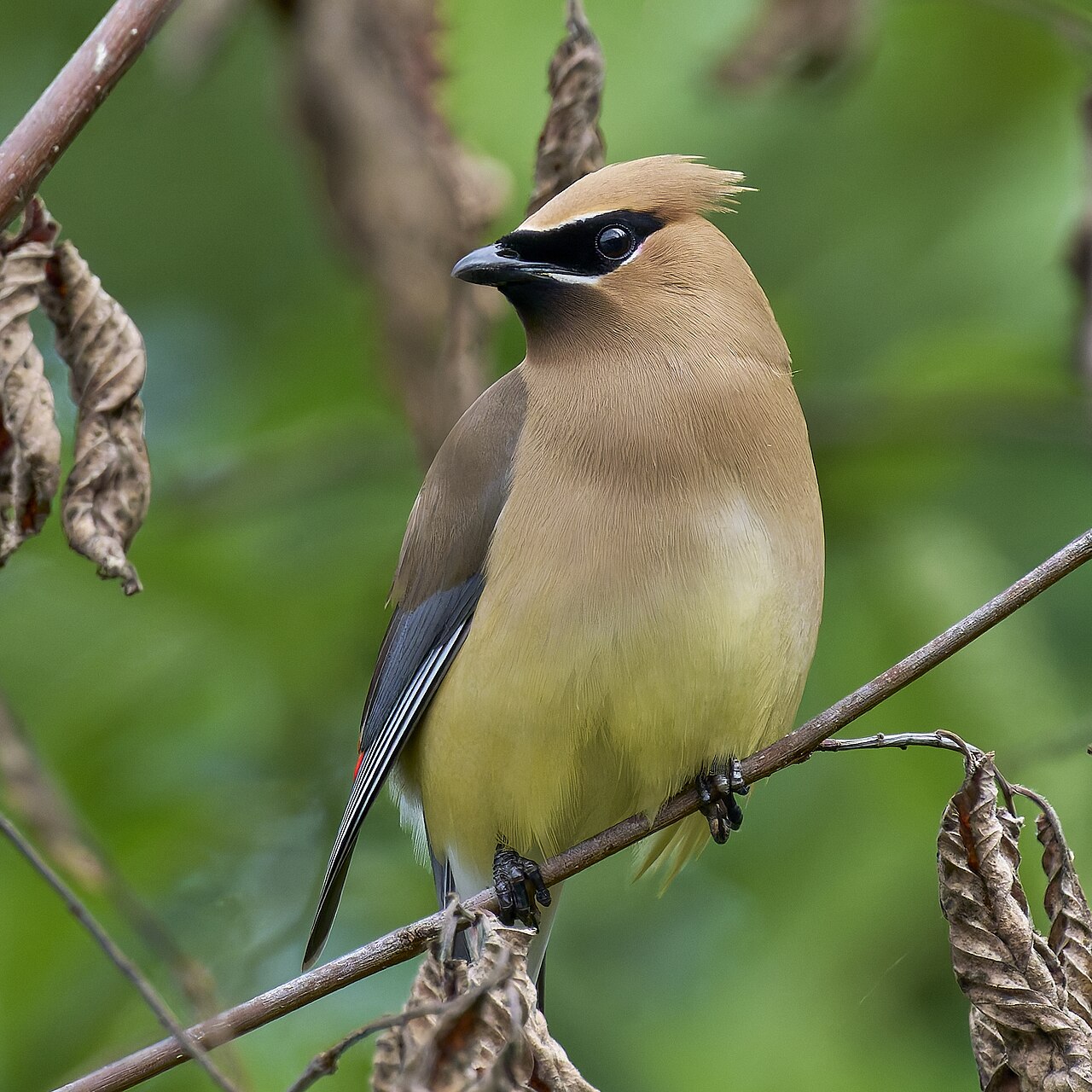
The high whistle is shorter and purer than the trill, a thin “sree” or “see” without the buzzy vibration. It signals arousal: a new fruit source, a disturbance, the moment before takeoff. In a yard, a sudden shift from buzzing to sharp whistling usually means the flock is about to lift.
The two calls blend into each other, and recordings show individuals giving intermediate versions, so do not try to split them too finely in the field. The useful distinction is buzzy and steady versus clear and clipped.
The All About Birds sound library for the cedar waxwing has both calls side by side, which is the fastest way to separate them before your next flock.
Why Cedar Waxwings Have No Song

Cedar waxwings have no song because their social system never required one. Most songbirds sing to defend a territory, and waxwings barely hold territory: they nest loosely, sometimes within a few yards of other pairs, and they feed in flocks on fruit that is abundant where it exists. With nothing to defend by sound, no elaborate song evolved.
That makes them unusual among North American passerines. The nightingale’s 180 to 260 song phrases exist to hold a hedgerow against rivals, and the waxwing is the clean opposite case: same songbird lineage, almost no vocal repertoire.
Both sexes also sound identical, so unlike most songbirds you cannot separate male from female by voice. Sex identification in waxwings comes down to the black chin patch, and even that is unreliable in the field.
Flock Calls in Flight

Flight calling is how most people encounter the species. A flock of 10 to 100 birds crosses the sky in a tight, fast moving ball, calling the whole way, and the sound arrives as a wash of overlapping thin whistles rather than as individual notes. Look up when you hear it: the silhouette is short tailed, pointed winged and starling like.
Flocks call continuously during these moves, which is the opposite of the mostly silent travel of a bald eagle. Constant noise is the point when the group must stay together.
Winter flocks are the loudest. Outside the breeding season waxwings join into groups of several hundred, sometimes mixed with American robins and Bohemian waxwings in the north, and a settled flock in a fruiting tree can be heard a block away.
Alarm and Distress Calls
The alarm call is the ordinary whistle delivered faster, higher and more insistently, and the flock reacts within a second or two. There is no separate harsh scold note of the kind jays and wrens use, so waxwing alarm is a matter of tempo rather than a different sound. A sharpening of the whistles means a hawk, a cat or a person has come too close.
Held birds and birds caught by a predator give a thin squealing distress note, rarely heard in the wild. Rehabilitators report it most often from window strike victims.
Waxwings do not mob predators with sound the way smaller songbirds do. Their response is to go silent, freeze, then leave as a unit, which is why a noisy tree can empty into near silence in seconds.
Courtship Sounds and Berry Passing
Courtship sounds are soft, close range trills exchanged between two perched birds, and they go with the behavior the species is famous for. A pair sits side by side and passes a berry or a flower petal back and forth several times before one finally eats it, calling quietly through the exchange. The display is the quietest thing waxwings do.
Males also hop toward and away from females along a branch, trilling at each approach. Both sexes call during nest building, and the pair stays vocal around the nest without ever producing anything that could be called a song.
Timing is late. Cedar waxwings are among the last North American songbirds to nest, waiting for summer fruit, so courtship calling peaks in June and July when most species have finished.
Nestling and Fledgling Calls
Nestling calls are extremely thin rasping notes, pitched even higher than the adult whistle and almost inaudible from the ground. They come in bursts when a parent arrives with fruit, which for waxwings happens frequently because berries pass through young birds fast. Nests are usually 6 to 20 ft up in an open fork.
Fledglings are much more obvious. For weeks after leaving the nest, usually July into September, they follow adults through fruiting trees begging continuously, and that persistent thin noise is often what reveals a local breeding pair.
If you hear high begging in August from a serviceberry or mulberry, check for the yellow tail tip. Juvenile waxwings are streaky and lack the clean mask, but the tail band is already there.
When You Hear Cedar Waxwings: Time of Day and Season
You can hear cedar waxwings in any month and at any hour of daylight, which separates them from most vocal birds. There is no dawn chorus peak because there is no song, and calling tracks feeding activity instead: most of it happens mid morning and again in the afternoon, wherever fruit is ripe.
Season changes the volume, not the sound. Winter and early spring bring the largest, noisiest flocks as birds roam for juniper and crabapple, while July and August bring scattered pairs and begging young.
Waxwings are not night callers. Unlike the barn owl’s nocturnal shrieking, any high thin whistling you hear outdoors after dark is something else, most often migrating thrushes or warblers passing overhead in spring and fall.
Birds and Sounds Mistaken for Cedar Waxwings
The closest match is the Bohemian waxwing (Bombycilla garrulus), a northern species whose call is rougher, lower and more rattling than the cedar waxwing’s clean buzz. Where they mix in winter flocks across Canada and the northern states, the harsher quality is the split, along with the Bohemian’s rusty undertail.
Golden crowned kinglets, brown creepers and blackpoll warblers all give very high thin “see see see” notes that fool people regularly. Kinglets deliver theirs in accelerating series, creepers sound sibilant and wispy, and waxwings keep each note separate and buzzy.
Mechanical sounds cause the rest of the confusion: squeaky garden gates, electric fences, hearing aid feedback and some insects all produce a similar buzz. For the full plumage and behavior picture, see our cedar waxwing identification guide, and note that any flapping or scratching inside a wall is never a waxwing but more likely a bat in the structure.
How to Get Cedar Waxwings Calling in Your Yard
Fruit attracts cedar waxwings; seed does not. They almost never use a seed feeder, so the way to hear them is to plant what they eat: serviceberry, eastern red cedar and other junipers, winterberry, dogwood, hawthorn, crabapple, mulberry and highbush cranberry. One mature fruiting tree will out perform any feeder you can buy.
Water is the second lever. Waxwings drink and bathe often, and a birdbath with moving water pulls flocks down from passing flights, especially in winter when open water is scarce.
You can also leave fruit out directly: raisins, chopped apple or leftover berries on a platform feeder work in hard weather. Skip the viral advice about putting raw potato in a feeder. Waxwings are fruit specialists that ignore it, and raw or greening potato contains solanine, which is a bad idea to offer any bird. For a bird that does take feeder food, the contrast with a barred owl hunting your yard at night is total: waxwings eat berries, owls eat the rodents your berries attract.
Frequently Asked Questions
What bird makes a high pitched sound like a thin whistle?
Cedar waxwings are the usual answer in North America, at 4,000 to 7,000 Hz. Golden crowned kinglets, brown creepers and blackpoll warblers reach similar pitches. If the note is buzzy rather than pure and comes from a flock in a fruiting tree or passing overhead, it is a waxwing.
What attracts cedar waxwings to my yard?
Fruit and water. Plant serviceberry, juniper or eastern red cedar, winterberry, dogwood, hawthorn, crabapple or mulberry, and keep a birdbath with moving water. They rarely visit seed feeders, so a platform of raisins or chopped apple works better than sunflower in winter.
How can you tell if a cedar waxwing is male or female?
Not reliably in the field. Males average a larger, blacker chin patch and females a smaller, browner one, but the difference overlaps heavily and sources disagree on how usable it is. Voice gives you nothing, since both sexes make identical calls. Banders rely on in hand measurements instead.
What is a flock of waxwings called?
The traditional collective nouns are an ear full of waxwings and a museum of waxwings. Both are folk terms rather than scientific ones. The ear full version comes directly from the sound: a settled flock produces a continuous high buzzing that carries much farther than any single bird’s call.
Why do people put a potato in a bird feeder?
It is a social media trend, not established practice, usually sold as a cheap winter food or water source. Most birds ignore raw potato, cedar waxwings certainly do, and raw or greening potato contains solanine. Chopped apple, raisins or suet deliver real calories without the risk.
How rare is it to see a cedar waxwing?
Not rare, but unpredictable. Cedar waxwings are common across most of the United States and Canada and their population is stable or rising, yet they wander in nomadic flocks chasing fruit, so a yard can go months without one and then host 60 birds for three days. Listen for the buzz overhead.