What Is a Group of Ducks Called? Raft, Paddling, and Flock
A group of ducks is called a raft when the birds are on water, a paddling or a team when they are swimming, a brace or a flock when they are in flight, and a badling or a waddle when they are on land. What is a group of ducks called therefore depends entirely on where the ducks are, which makes duck vocabulary the most location-specific of any bird in English. Birders use raft and flock constantly, and the other terms belong mostly to older hunting language and trivia lists.
This is unusual. Most species get one collective noun regardless of what they are doing, but ducks acquired separate terms for water, air, and land because English hunters needed to distinguish those situations. A raft of ducks sitting far out on a lake is a completely different shooting proposition from a flock passing overhead at dawn. This guide sorts out which terms are genuinely used today, which are archaic curiosities, why gaggle belongs to geese and not ducks, and what a group of ducklings is called.
A group of ducks is called a raft on the water, a paddling or team when swimming, and a flock or brace in flight. On land they may be called a badling or a waddle. Birders mainly use raft and flock. A group of ducklings is a brood, and gaggle applies to geese rather than ducks.
| Situation | Term |
|---|---|
| On the water | Raft (most used by birders) |
| Swimming together | Paddling or team |
| In flight | Flock, brace, or skein |
| On land | Badling or waddle |
| Ducklings with a hen | Brood |
| Male duck | Drake |
| Female duck | Hen or duck |
Why Does a Group of Ducks Have So Many Names?
Ducks have multiple collective nouns because English hunting vocabulary distinguished between birds on water, in the air, and on land, and each situation mattered practically. The terms come mainly from the medieval and early modern lists known as terms of venery, compiled for the English gentry as both a practical hunting vocabulary and a display of education. Waterfowl were the most important quarry for many hunters, so they attracted the most detailed vocabulary.
The distinctions were not decorative. A raft of ducks resting on open water behaves nothing like a flock coming in to land at dusk, and the words let a hunter describe the situation precisely. The same logic gave geese two terms, gaggle on the ground and skein in the air, and gave swans a bevy on water and a wedge in flight. Only waterfowl received this treatment, because only waterfowl regularly present themselves in three distinct settings.
Modern birders have kept the terms that stayed useful and dropped the rest. Raft is in constant use because it describes something a birder actually needs to report: a dense group of ducks sitting on water, often at distance, that has to be scanned species by species. Flock covers everything else. Badling, paddling, and brace survive in dictionaries and quizzes but are almost never spoken. If someone asks what a group of ducks is called and expects one answer, raft is the best single response.
What Is a Raft of Ducks?
A raft of ducks is a group of ducks floating together on open water, and it is the term birders and waterfowl biologists use most. The word describes the visual impression precisely: a dense mass of birds on the surface that from a distance looks like a single dark object drifting on the water. Rafts can range from a few dozen birds to many thousands, and on large lakes, reservoirs, and coastal bays in winter they are the standard way diving ducks spend the day.
Rafting is a real behavior with a purpose, not just a name. Ducks raft in open water where they can see approaching danger from all directions and where they are far from shoreline predators such as foxes and coyotes. Birds in a raft take turns sleeping, often with one eye open and half the brain awake, a phenomenon called unihemispheric sleep that is well documented in ducks. The birds on the outer edge of a raft keep both eyes open more often than those in the center.
Mixed-species rafts are common and are one of the best birding opportunities of the winter. A single raft on a reservoir may hold scaup, canvasbacks, redheads, ring-necked ducks, and buffleheads together, and picking through it with a scope is how many birders build their waterfowl skills. The types of ducks guide covers the species you are most likely to sort out of a raft, and the difference between the diving ducks that raft in open water and the dabbling ducks that stay in the shallows.
What Is a Paddling of Ducks?
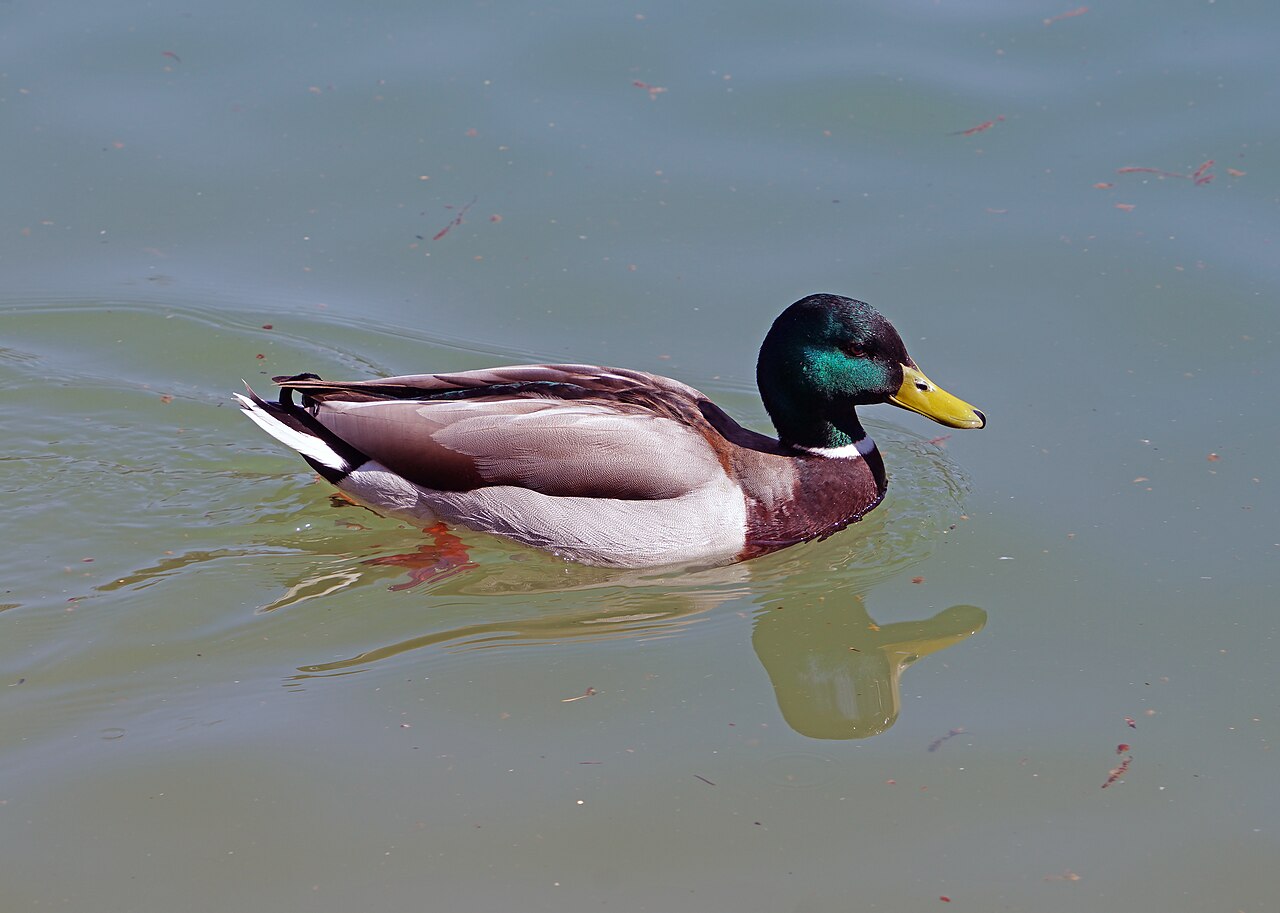
A paddling of ducks refers to a group of ducks swimming together, and it is one of the more commonly cited collective nouns in trivia lists. The word is self-explanatory, describing the propulsion, and it overlaps heavily in meaning with raft. The distinction some sources draw is that a raft is stationary or drifting while a paddling is actively moving, but this is a fine line and neither term is defined tightly enough for the difference to be enforceable.
A team of ducks is a closely related term with an older sense. Team appears in hunting literature for ducks moving together on water or in flight, and it may derive from the same root as the team of horses, meaning animals that move as a coordinated unit. Some sources restrict team to ducks in flight, others to ducks on water, which is a good illustration of how loosely these archaic terms are actually defined.
The honest summary is that paddling, team, and raft are three names for roughly the same thing, and only raft is in living use. If you want to describe ducks swimming in a park pond, saying a group of ducks or a flock of ducks is entirely normal and nobody will consider it wrong. The elaborate vocabulary is a historical inheritance rather than a set of rules anyone enforces.
Is a Group of Ducks Called a Gaggle?
No, a group of ducks is not called a gaggle. Gaggle belongs to geese and specifically to geese on the ground or on water, and it comes from the cackling, gabbling noise a flock of geese makes while feeding. The word is imitative in origin, related to cackle and gabble, and it has been applied to geese since at least the fifteenth century. Applying it to ducks is one of the most common errors in collective noun usage.
The confusion is easy to understand. Ducks and geese are both waterfowl, both are found on the same ponds, and gaggle is one of the few collective nouns most people can name without thinking. But the terms developed separately, and geese have their own second term for flight, skein, which ducks do not share. The guide to what geese eat and the Canada goose guide cover the species behind the gaggle.
The same rule applies to other misapplied terms. A group of ducks is not a covey, which belongs to quail and grouse, and it is not a rafter, which belongs to turkeys. A group of ducks in flight is sometimes called a skein by people extending the goose term, which is understandable but not traditional. Flock is always safe for ducks in the air, and it is what almost every birder says.
What Is a Group of Baby Ducks Called?
A group of baby ducks is called a brood, and this is a genuine working term used by biologists, wildlife agencies, and duck breeders rather than a fanciful collective noun. A brood consists of one hen and her ducklings, and brood counts are a standard measure in waterfowl population surveys. Mallard broods typically start at 8 to 13 ducklings, and biologists track how many survive to fledging as an index of habitat quality.
Ducklings are precocial, meaning they hatch covered in down with their eyes open and are able to walk, swim, and feed themselves within a day. The hen does not feed them; she leads them to food, broods them for warmth, and defends them. This is why you see a hen mallard with a line of ducklings behind her rather than a nest full of helpless chicks. Duckling mortality is high, often 50 percent or more in the first two weeks, from predation by fish, turtles, herons, gulls, and mammals.
Brood amalgamation is common in some species, where ducklings from different hens join a single brood, producing the occasional startling sight of one mallard hen leading twenty or thirty ducklings. Common mergansers and eiders take this furthest, forming crèches supervised by a few adult females. The baby duck guide covers the first weeks in detail, including what to do if you find ducklings that appear to have lost their mother.
What Are Male and Female Ducks Called?
A male duck is called a drake and a female is called a hen or simply a duck. This creates a small confusion in English: duck refers both to the species generally and to the female specifically, which is why hen is often preferred for clarity. A group of drakes has no special term, and neither does a group of hens; both are simply a group or a flock.
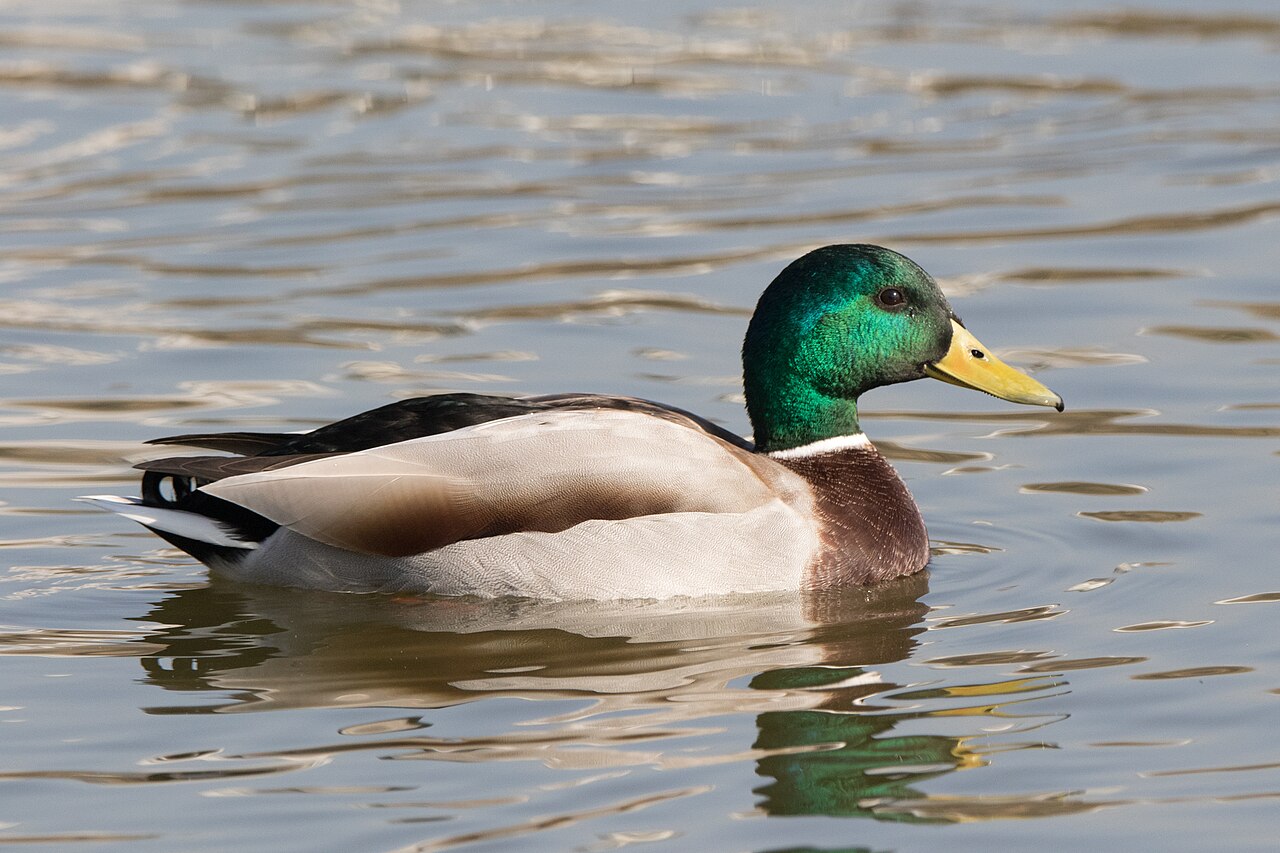
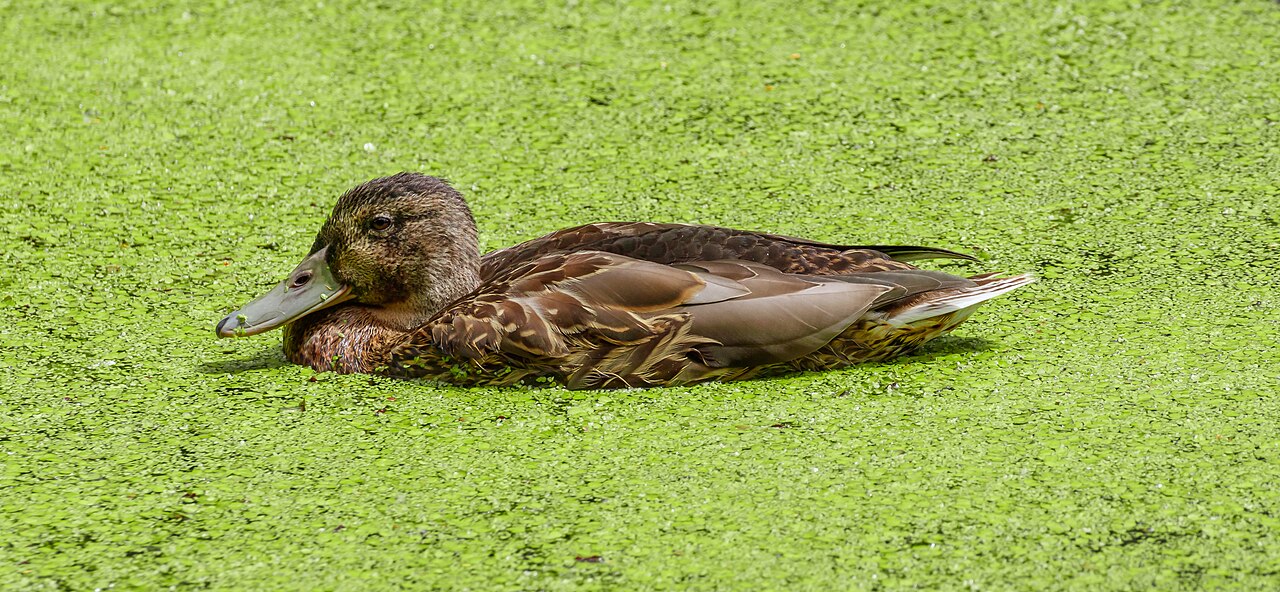
Telling drakes from hens is straightforward in most North American species during the breeding season, because males are far more colorful. A drake mallard has an iridescent green head, a white neck ring, and a chestnut breast, while the hen is mottled brown for camouflage on the nest. This pattern of a bright male and a cryptic female holds across most dabbling ducks. The female duck guide covers identification of the harder brown females.
Summer complicates things. After breeding, drakes molt into eclipse plumage, a dull female-like appearance that they hold for several weeks while they replace their flight feathers and are temporarily unable to fly. A pond full of what looks like all hens in July is usually a mix of hens and eclipse drakes, distinguishable by bill color: the drake mallard keeps a yellow bill while the hen’s is orange with dark blotches. By early autumn the drakes are back in full color.
How Big Are Duck Flocks?
Duck flock size varies enormously by species and season, from a pair on a park pond to rafts of hundreds of thousands on major wintering grounds. Dabbling ducks such as mallards, teal, and wigeon form flocks of dozens to a few thousand on marshes and flooded fields. Diving ducks, especially greater and lesser scaup, form the largest concentrations, and rafts of over 100,000 scaup have been recorded on the Great Lakes and on Chesapeake Bay during migration.
The biggest waterfowl concentrations in North America occur along the four major flyways, the Atlantic, Mississippi, Central, and Pacific, where migrating birds funnel into wetland complexes. The Central Valley of California, the rice country of Arkansas and Louisiana, and the prairie pothole region of the Dakotas and prairie Canada all hold spectacular numbers at peak migration. The U.S. Fish and Wildlife Service (fws.gov) conducts annual breeding population surveys that have tracked continental duck numbers since 1955, typically estimating 30 to 50 million breeding ducks depending on wetland conditions.
Flocks shrink dramatically in the breeding season. Ducks pair up on the wintering grounds or during migration, and by late spring most species have dispersed to individual territories or nesting cover, so a marsh that held 5,000 birds in November may hold 50 pairs in June. This seasonal swing is normal and does not indicate any change in the population, which is why waterfowl surveys are conducted at consistent times each year.
Duck Flight Formations and Flocking Behavior
Ducks in flight form loose lines, curved arcs, and irregular clusters rather than the tight V formations associated with geese, though some species including mergansers and eiders do fly in lines. Dabbling ducks such as mallards and teal usually travel in compact, fast-moving flocks that twist and turn as a unit, and small teal flocks in particular are known for sudden coordinated swerves that make them difficult targets and impressive to watch.
The purpose of formation flight is aerodynamic. A bird flying slightly behind and to the side of another catches the upwash from its wingtip vortex, reducing the energy needed to stay aloft, and studies of large birds have measured energy savings of 10 to 20 percent. Geese benefit most because of their size and long migrations; smaller, faster ducks gain less, which is part of why their formations are looser. Coordination also improves navigation and predator detection.
Flocking on the water follows different rules. Ducks in a raft maintain individual distance and shuffle constantly as birds dive, surface, and preen, and the raft as a whole drifts with wind and current. When alarmed, diving ducks tend to swim away or dive rather than flush, while dabbling ducks explode off the water almost vertically, which is why the two groups are so easy to separate at a distance even when the species cannot be identified.
Collective Nouns for Ducks and Other Waterfowl
Waterfowl have the richest collective noun vocabulary of any bird group, and comparing them shows how consistently the water, air, and land distinction was applied. Geese are a gaggle on the ground and a skein, wedge, or team in flight. Swans are a bevy or a herd on water and a wedge in flight. Ducks are a raft, paddling, or team on water, a flock or brace in the air, and a badling or waddle on land. Coots, unusually, get a covert or a raft.
Other water birds picked up their own terms. Herons form a siege, cormorants a gulp, pelicans a squadron or a pod, and grebes a water dance, which describes their remarkable courtship display. Most of these come from the same medieval tradition and share its mix of the descriptive and the arbitrary. Only raft, gaggle, and skein see genuine regular use.
For anyone building a birding vocabulary, the practical advice is to learn raft and flock, recognize gaggle and skein for geese, and treat the rest as trivia. The distinctions that matter in the field are biological rather than lexical: diving versus dabbling, breeding versus eclipse plumage, and which species are mixed into the raft. The guide to what ducks eat covers the feeding differences that determine where each group spends its time, and the group of geese guide handles the gaggle side of the family.
Frequently Asked Questions
What is a group of ducks called?
A group of ducks is called a raft on water, a paddling or team when swimming, a flock or brace in flight, and a badling or waddle on land. Birders mainly use raft and flock; the other terms are archaic.
Is a group of ducks a gaggle?
No. Gaggle belongs to geese on the ground or water, and the word imitates their cackling calls. Ducks have their own terms, chiefly raft and flock. Calling a group of ducks a gaggle is a common but incorrect usage.
Is it a waddle of ducks?
A waddle, or badling, is listed in some sources as the term for ducks on land. It appears in collective noun lists but is not used by birders, who say flock or simply a group of ducks.
What is a group of ducks in flight called?
A flock, and in older usage a brace or a team. Skein is sometimes borrowed from geese but is not traditional for ducks. Flock is always correct and is what birders use.
What is a group of baby ducks called?
A brood. This is a genuine biological term for a hen and her ducklings, used in waterfowl surveys. Mallard broods typically start at 8 to 13 ducklings, though mortality in the first two weeks is high.
What is a group of mallards called?
The same as any duck: a raft on water, a flock in flight. There is no mallard-specific collective noun, though mallards are the species most often forming the flocks people see on park ponds and city lakes.
What is a male duck called?
A drake. Females are called hens or simply ducks. Drakes are brightly colored in the breeding season but molt into dull, female-like eclipse plumage in summer, when bill color is the easiest way to tell them apart.