Crow Sounds: What Caws, Rattles, and Clicks Mean
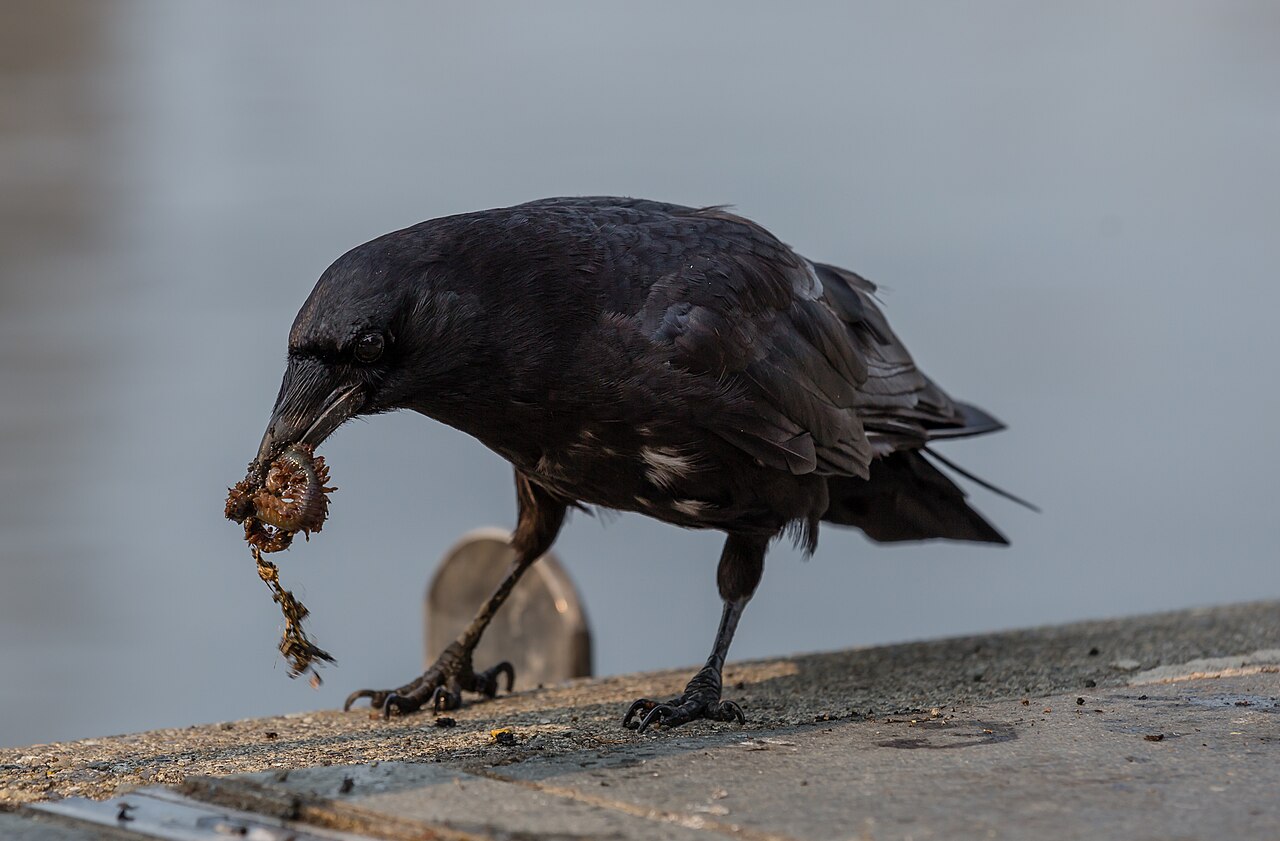
Crow sounds go far beyond the familiar caw. American crows use a vocabulary of at least 20 distinct calls, including rattles, clicks, coos, growls, and remarkably accurate imitations of other birds, machines, and even human words. The caw itself is not one sound but a system: its number, rhythm, and tone change the message, from a two-caw location check to the frantic, overlapping caw storm of a mob attacking an owl. Crows are among the most intelligent birds on Earth, and their soundtrack is where that intelligence is easiest to hear.
This guide decodes what each crow sound means: how to read caw counts and rhythms, what the strange rattle and the soft coo signal, what a contented crow sounds like, why crows scream at dawn, how baby crows beg, and how to separate a crow from a raven by ear alone. There is also a section on the old death-omen folklore, because no bird’s voice carries more superstition than this one.
| The caw | All-purpose call; count and rhythm carry the message |
| Rattle | Woodpecker-like clatter, often female, close-range social |
| Coo and murmur | Soft contentment and courtship sounds |
| Scolding chorus | Mobbing a predator, usually an owl or hawk |
| Juvenile begging | Nasal, whiny “waah” from fledglings all summer |
| Mimicry | Can copy other birds, machines, and human speech |
The Caw: Counting the Message
The caw is the crow’s public channel, loud, harsh, and built to carry a mile, and crows organize it the way we organize sentences. Researchers who study American crow calling distinguish structured sequences: short bursts of two or three evenly spaced caws often function as contact and location calls, essentially “I am here, where are you,” answered in kind by family members out of sight. Longer, faster, more emphatic series signal escalating alarm, and the tempo tracks the urgency.
Listen for rhythm more than raw number. A relaxed crow caws in unhurried, evenly spaced sets, pausing for replies; the yard conversation has a back-and-forth cadence. An agitated crow compresses the spacing, raises the pitch, and stacks caws into runs of five to ten with hard emphasis, and other crows arriving to join shift the sound from conversation to alarm chorus. Total silence carries meaning too: a suddenly quiet crow neighborhood usually means a predator is airborne and everyone has said all they need to.
Individual recognition runs underneath it all. Crows within a family recognize each other’s voices, and structured caw sequences differ measurably between individuals, which is how a foraging pair keeps track of specific relatives across a wooded block. That is worth remembering when a crow seems to caw “at” you: it likely recognizes you too. Crows demonstrably remember individual human faces for years, and regular visitors get announced. Our guide to what it means when crows visit you covers that uncanny personal side.
Rattles, Clicks, Coos, and Growls: The Rest of the Vocabulary
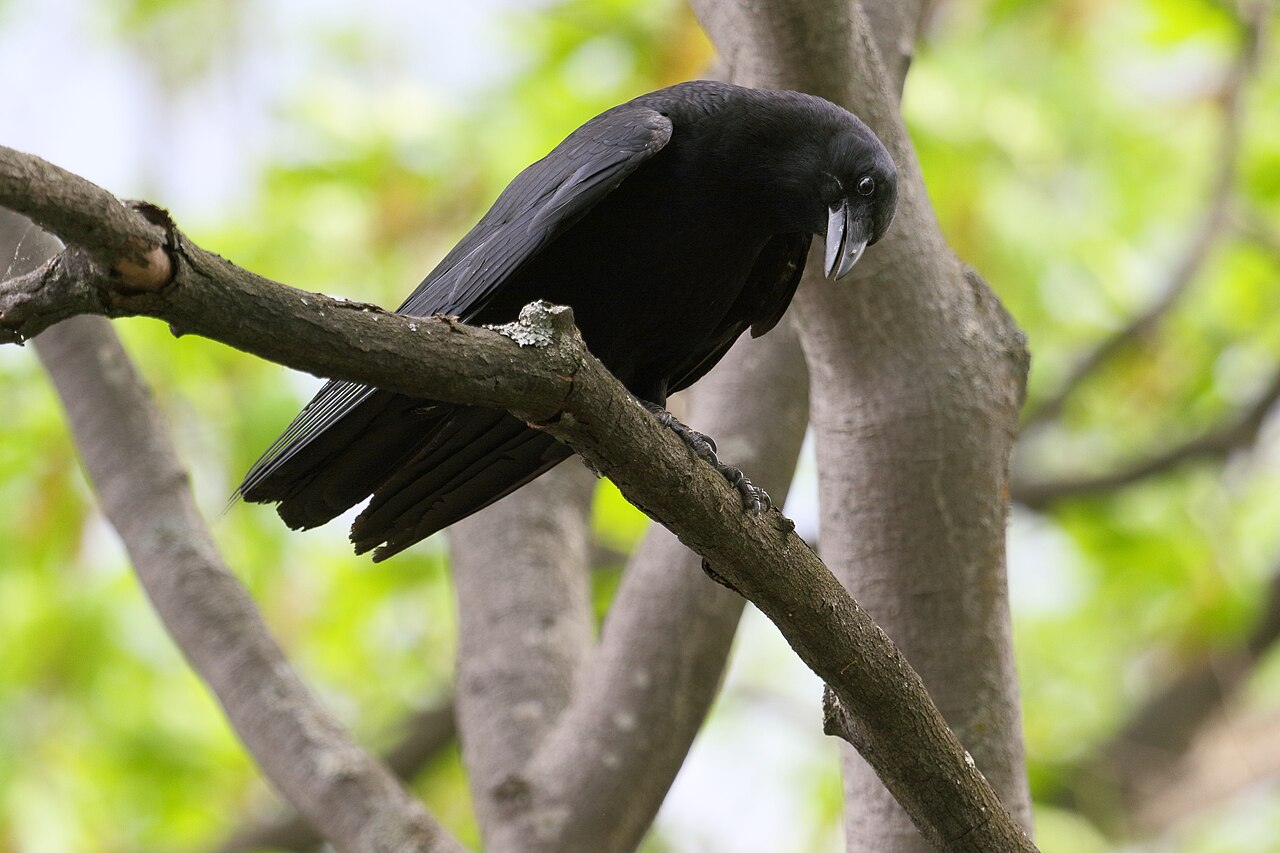
Spend time near a crow family and the caw becomes background to stranger sounds. The rattle is the one that startles people: a rapid, hollow, woodpecker-like “rat-tat-tat-tat” made deep in the throat, often delivered with a little bowing display. Rattles are heard most from females and function at close range within the family group, in courtship exchanges and social check-ins. A crow rattling on your fence is not malfunctioning; it is talking to someone it trusts nearby.
Quieter still are the intimate sounds. Paired crows exchange soft coos, murmurs, and gurgles during preening sessions, sounds so low you need to be within a few yards to catch them. Growls and harsh, low “arrr” notes surface in disputes over food or perch space, a grumbling channel between family members that never needs the volume of a public caw. Young birds practicing produce rambling, half-voiced medleys, like a musician noodling, called subsong, usually from a hidden perch on a lazy afternoon.
Then there are the structural calls with jobs. A sharp, short “kos” repeated precisely often marks territorial announcement at boundaries. The “wow” or dipped double-note appears in long-distance exchanges between family groups. Ornithologists at the Cornell Lab of Ornithology (allaboutbirds.org) note that the American crow’s full repertoire of calls remains only partly decoded, with at least 20 categories described and meanings confirmed for just a handful, which is a remarkable admission about the most-watched bird in America.
Happy Crow Sounds: What Contentment Sounds Like
People searching for “happy crow sounds” usually just watched a crow do something inexplicable and cheerful-sounding, and yes, contentment has a sound. Relaxed, well-fed crows in family company produce soft chuckling caws, throaty gurgles, musical “coo-uh” notes, and quiet rattles, delivered at low volume with loose, fluffed posture. The tone difference from alarm calling is unmistakable once heard: rounder, lower, lazier, with none of the hard edge a caw carries when it means business.
Play behavior comes with its own soundtrack. Crows sliding down snowy windshields, dangling upside down from branches, or teasing a sleeping cat frequently narrate the game with excited, squeaky, un-crowlike notes and short soft caws, the corvid equivalent of kids on a playground. Juveniles are the biggest talkers, mixing begging whines with experimental squawks, bill clacks, and mimicked fragments in long babbling sessions that sound like nothing else in the yard.
The most reliable happiness tell is the murmur exchange between mates. Bonded pairs sit shoulder to shoulder, preen each other’s head feathers, and trade continuous soft gurgles and coos, sometimes for many minutes. Crows mate for life and family groups stay together for years, with older siblings helping raise the new brood, so these quiet channels get daily use. If your resident crows murmur and rattle around you at close range instead of alarm-cawing, congratulations: you have been filed under “harmless, possibly useful.”
Alarm Calls and Mobbing: When Crows Scream
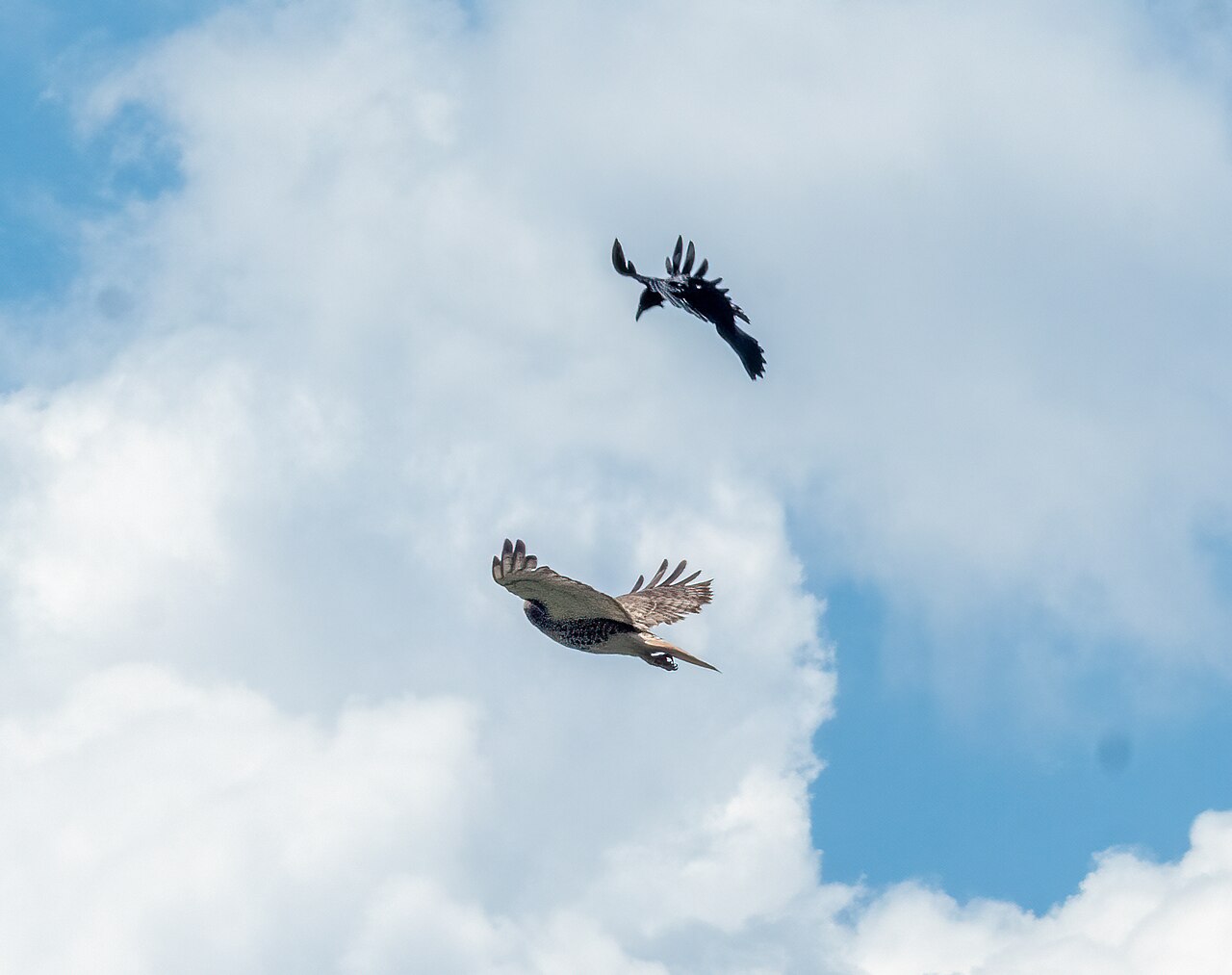
Nothing in the backyard soundscape matches a crow mob at full volume. The trigger is a discovered predator, a perched hawk, a fox, a cat, and above all an owl, and the response is a recruiting scream: harsh, rapid, high-intensity caws stacked on top of each other as every crow within earshot converges. The chorus is deliberately chaotic, dozens of birds circling and diving while screaming, and it can run for an hour until the predator gives up and leaves.
Mobbing is education as much as harassment. Young crows attending a mob learn what danger looks like, and studies famously showed crows teach each other to recognize specific threatening humans, with mobs forming around a person years after, and miles away from, the original offense. The alarm scream also has a distinct “scolding” variant aimed at ground threats, more rasping and rhythmic, which birders use as a cue: follow a persistent crow racket and you will very often find a hidden great horned owl, the crow’s most hated enemy, trying to sleep.
Crows even distinguish danger levels by call structure. Studies of corvid alarm systems show more urgent threats compress call intervals and add harsh, noisy overtones, and other crows respond proportionally, looking up for hawk-style alarms and approaching for mob-style scolds. Dawn and dusk amplify everything, because crows commute between roosts and territories at those hours and announce every discovery along the way. A screaming crow front moving through the neighborhood at 6 a.m. is a predator report traveling in real time.
Baby Crow Sounds and Begging Calls
From late spring through midsummer, one crow sound dominates all others: the fledgling begging call, a nasal, whiny, rising “waaah… waaah” repeated with the persistence of a car alarm. Fledged young crows are as big as their parents but follow them around for months demanding food, wings quivering, mouth open, whining continuously. Homeowners regularly report an “injured” or “weird” crow in July that turns out to be a healthy teenager complaining about service.
Nestling sounds are quieter and mostly hidden: soft rasping cheeps from the nest that strengthen weekly, becoming audible from the ground in the final days before fledging. Fledglings on the ground, which is normal for a few days as they finish flight training, add a sharper distress scream when genuinely frightened, a sound that summons the entire family plus neighbors instantly. If you approach a grounded young crow, expect a screaming adult escort within seconds; the correct move is almost always to leave it exactly where it is.
The begging phase is also when crow families are easiest to count and know. A typical group is the breeding pair, this year’s two to four whining fledglings, and often a yearling or two from last season helping deliver food. Their exchanges, beg, soft parental gurgle, beg again, run all day along a repeated circuit of the territory. By September the whine finally fades as juveniles start finding their own food, and their voices drop into the adult register, though young crows keep a squeakier, less polished caw well into fall.
Crows Mimicking Humans and Other Sounds
Crows are accomplished mimics, and this is where their soundtrack turns genuinely strange. Wild American crows copy the calls of other birds, red-tailed hawk screams, barred owl hoots, turkey gobbles, and ambient machinery: car alarms, backup beepers, squeaky gates, barking dogs. The talent comes from the same flexible vocal machinery songbirds use to learn song; crows are technically songbirds, the largest ones in North America, they just spend the ability on impressions instead of melody.
Captive and human-habituated crows take it further, learning human words and phrases with raspy, parrot-like clarity: “hello,” their caretaker’s name, laughter. No vocal cords are involved, birds produce sound with a two-sided organ called the syrinx, and crows can control each side independently, which is how one bird produces layered, complex sounds. There are well-documented wild cases of crows greeting regular humans with learned words picked up from a neighborhood talker, feral vocabulary passing crow to crow.
Why mimic at all? Some cases look strategic, a hawk scream that scatters competitors from a food source is useful theft, while much of it appears social or simply exploratory, practiced in the same lazy subsong sessions where young crows rehearse everything. Mimicry is also a fast way to tell corvids apart from lookalikes by ear: if a “crow” in your yard produces a perfect hawk scream, check twice, because blue jays run the same scam constantly, and the jay’s hawk impression fools more people than any crow does.
Crow vs Raven Sounds: Telling Them Apart by Ear
The fastest way to separate North America’s two big black corvids is voice, not size. The American crow’s signature is the caw: clear, sharp-edged, relatively high, delivered in even series. The common raven does not caw; it croaks, a deep, resonant, gravelly “gronk” or “cr-r-ruck” that sounds like it comes from a much larger animal, because it does. Once you have heard both side by side, the difference is as obvious as a trumpet versus a tuba.
Ravens also carry a wider, weirder catalog: hollow knocking sounds, water-drop “gloops,” bell-like toots, and long conversational mutterings, delivered slowly and often in flight. Crow vocal energy is faster, harsher, and more social, tuned for a species that lives in family gangs and mobs its enemies in crowds. Raven pairs, by contrast, mostly travel in twos, and their soundscape is a long, low duet rather than a neighborhood argument.
Voice then gets confirmed by the visual checklist, wedge-shaped raven tail versus the crow’s fan, the raven’s shaggy throat and heavier bill, soaring flight versus steady rowing wingbeats, all covered in detail in our raven vs crow guide. One audio trap worth knowing: fish crows, common along the East and Gulf coasts, sound like American crows with a head cold, giving a short nasal “uh-uh” that people mistake for a young crow. The two-note denial, like the bird is saying no, is the fish crow’s tell.
Crow Sounds and Superstition: The Death Omen Question
No treatment of crow sounds is complete without the folklore, because for centuries a cawing crow was read as a message, and often a grim one. European tradition linked crows and ravens to battlefields and gallows, counting rhymes assigned fortunes to the number of crows seen, and a crow calling persistently near a house was widely held to foretell a death. Echoes survive in the search data to this day: people still ask whether crow sounds mean someone is going to die.
The biology behind the omen is refreshingly mundane. Crows are carrion eaters that historically followed armies and gathered at gallows because that is where food was, and they call loudly near houses because houses mean garbage, pet food, compost, and roost trees. A crow cawing at your window is running a food and threat assessment, not a prophecy. Even the famous crow “funerals,” where crows gather quietly around a dead crow, turn out to be danger-learning sessions: researchers showed crows use these gatherings to study what killed one of their own.
Not all the folklore is dark, and much of it is affectionate: many traditions read crow calls as messages from ancestors, warnings from a watchful guardian, or simple news arriving, with the meaning shifting by count and direction. Our crow symbolism guide walks through those traditions culture by culture. The honest summary: a crow’s caw has plenty of meaning, and every bit of it is addressed to other crows. Getting to overhear it, and slowly learn the language, is the actual gift.
Frequently Asked Questions
What does it mean when a crow caws at you?
Usually that it recognizes you and is announcing or assessing you. Crows remember individual human faces for years, alarm-call at people who have threatened them, and give relaxed contact calls around familiar, harmless humans, especially ones who feed them.
Why do crows caw over and over?
Long, evenly spaced caw series are contact and territory announcements; fast, harsh, stacked caws mean escalating alarm, often recruiting a mob against a predator. Rhythm and tempo carry the message more than the raw count.
What is the rattle sound a crow makes?
A rapid, hollow, woodpecker-like clatter made in the throat, used at close range within the family, most often by females, in courtship and social exchanges. It signals comfort, not aggression.
Can crows really talk like parrots?
Yes. Crows control each side of their syrinx independently and can learn human words with raspy clarity. Talking is most common in captive or human-habituated birds, but wild crows routinely mimic hawks, owls, machines, and dogs.
Why are crows so loud in the early morning?
Crows commute at dawn between large communal roosts and family territories, exchanging contact calls and announcing every predator and food find along the route. The morning racket is rush-hour traffic reporting.
Do crow sounds mean death is coming?
No. The death-omen tradition grew from crows scavenging battlefields and gallows. A crow calling near your home is assessing food and threats; even crow “funerals” are danger-learning gatherings, not mourning rituals.
How do crow and raven sounds differ?
Crows caw, clear, sharp, and social; ravens croak, a deep gravelly “gronk,” plus knocks and gurgles. Coastal fish crows add a nasal two-note “uh-uh” that sounds like a congested crow saying no.