Puffin Sounds: 7 Calls and What Each One Means
A puffin sounds nothing like it looks. The main call of the Atlantic puffin (Fratercula arctica) is a low, rumbling groan, usually written as arr-arr-arr, that most listeners compare to a small chainsaw starting, a creaking door or a cow at a distance. It comes from inside a burrow more often than from the open air, which is why visitors to a puffin colony often hear the ground before they hear the birds.
Puffins are also silent for most of the year. They spend roughly eight months alone on the open ocean, where they make no sound at all, and vocalize only during the breeding season on land. This guide covers each call type, what triggers it, when and where you can actually hear it, and which colony neighbors get credited with the puffin’s voice by mistake.
Puffins make a deep, growling arr-arr-arr call that sounds like a distant chainsaw or a creaking hinge, produced mostly from inside the nesting burrow. The call runs in a series of three to five pulses, each slightly lower than the last. Pufflings peep thinly. Puffins are silent at sea from roughly August through March.
| Sound | What it sounds like | What it means | Where you hear it |
|---|---|---|---|
| Burrow growl | Low arr-arr-arr, chainsaw or creaking door | Territory held, pair contact | Underground, May to July |
| Short single groan | One drawn out aaarr | Mild alarm or mild threat | Burrow entrance |
| Rapid stutter growl | Faster, harsher pulses | Fight over a burrow | Colony slopes |
| Bill clattering | Dry knocking, no voice | Courtship billing between pairs | On rocks, in view |
| Puffling peep | Thin high cheep, repeated | Chick begging for fish | Deep in burrow, June to August |
| Flight | Silence, wingbeat only | Nothing; puffins rarely call in flight | Over water |
| Winter at sea | No vocalizations | Solitary non-breeding period | Open North Atlantic |
What Sound Does a Puffin Make?
The characteristic puffin sound is a growl, not a call in the songbird sense. It is low pitched, grating and delivered in a series of pulses that drop slightly in pitch across the sequence, so arr-ARR-arr-arr fades rather than ends. A single series lasts two to four seconds and is often answered by a neighbor a few yards away.
The texture is the surprising part. There is no whistle or tone in it, only a rough buzzing rumble, and people routinely assume the first one they hear is a mammal or a piece of machinery. Visitors to Maine colonies commonly describe it as a chainsaw two valleys over.
Puffins have no song and no elaborate repertoire. Ornithologists generally recognize only a handful of distinct vocalizations for the species, which is unusual for a bird this well studied. Almost everything a puffin communicates on land is done with posture, bill contact and foot stamping rather than voice.
Why the Call Comes From Underground
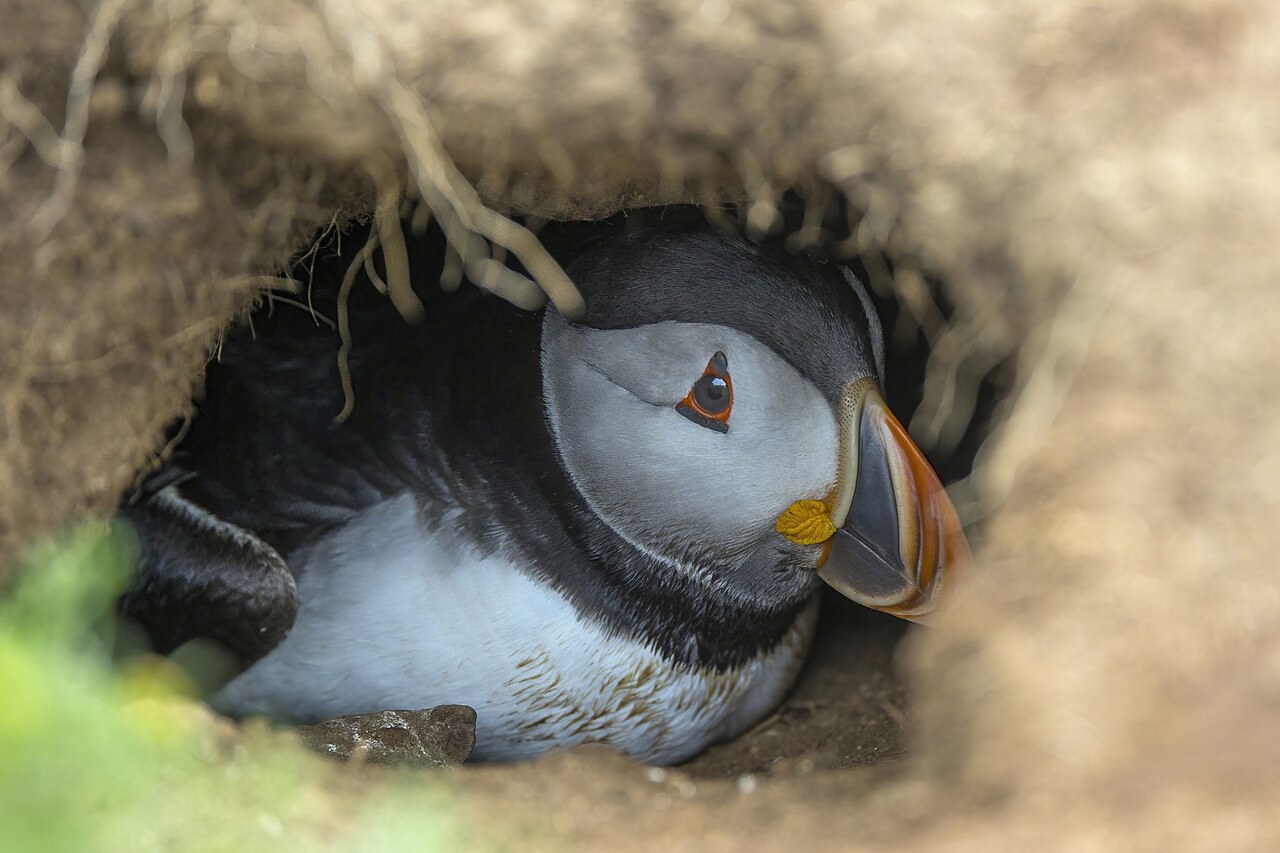
Atlantic puffins nest in burrows, either dug into turf on a slope or tucked into crevices between boulders. The burrow runs 2 to 3 ft (0.6 to 0.9 m) back from the entrance and ends in a nesting chamber, and the growl is usually produced from that chamber.
Soil and turf filter out the higher frequencies, which is exactly what gives the call its muffled, mechanical quality. The same bird growling in the open sounds noticeably rougher and brighter, and recordings made at burrow entrances rarely match what visitors hear standing on the surface above.
That underground delivery also explains the strangest part of a puffin colony: the ground appears to be vocalizing. On Machias Seal Island or Skellig Michael in the right week, the turf under your feet rumbles while most of the birds in sight stand silently on the rocks.
What Is the Puffin Sound Called?
There is no formal single name. Field guides and research papers call it the growl, the arr call, or simply the puffin call. “Groan” and “grumble” appear in older British accounts, and Icelandic descriptions often use words closer to a moan.
Avoid the word song here. Birders distinguish songs, which are learned, patterned and used in territory and mate attraction, from calls, which are shorter, innate and functional. A puffin has calls only, and the growl functions as both a territorial signal and a contact signal depending on context.
If you want to compare the two categories back to back, listen to a structured warble such as bluebird sounds against a puffin growl. The difference between a learned song and a simple innate call is more obvious in that pairing than in any written description.
Courtship Sounds and Billing

Puffin courtship is largely silent and visual. Pairs perform billing, knocking and rubbing their bills together while facing each other, often while other puffins gather around to watch. The sound produced is a dry clattering knock rather than a vocalization, and it carries about 30 ft (9 m).
Billing is most frequent in the first weeks after birds return to the colony in April and May, when pairs reunite after a winter spent apart at sea. The growl often accompanies it from inside the burrow, with one bird underground and the other at the entrance.
Head flicking, gaping and a slow stiff walk round out the display vocabulary. None of these makes much noise, which is a running theme with puffins: a crowded colony of 10,000 birds can be considerably quieter than a gull colony a tenth the size.
Aggressive and Territorial Growls
Burrow disputes produce the loudest and harshest sounds puffins make. The growl speeds up, loses its pulsing rhythm and becomes a continuous grating stutter while two birds lock bills and tumble downhill, sometimes rolling several yards before separating.
These fights peak in late April and May, when returning birds contest nest sites against rivals and against competitors such as rabbits and Manx shearwaters. Established pairs reclaim the same burrow year after year, and the growl at the entrance is the first level of defense before physical contact.
The rapid stuttering quality here is what leads to confusion with mechanical sounds and with other wildlife growls entirely. People who have heard the grunting of large mammals, including the low frequency rumbles described in bison sounds, often reach for a mammal comparison before they reach for a bird.
Baby Puffin Sounds: What a Puffling Sounds Like
A puffling gives a thin, high, repeated cheep that sounds nothing like the adult growl. It is a conventional chick begging call, and it intensifies whenever an adult lands at the burrow entrance with a load of sand lance or herring crosswise in its bill.
Because the chick sits at the end of a long burrow, the sound reaches the surface faint and filtered. Researchers monitoring colonies often use it to confirm an active burrow without disturbing the nest, since a quiet burrow in July usually means a failed one.
Pufflings call for about 38 to 44 days before fledging, then leave the burrow alone at night and walk or flutter to the sea without their parents. In Iceland, where streetlights disorient fledglings, children run an annual rescue collecting misdirected pufflings and releasing them at the shore.
Do Puffins Migrate, and When Do They Go Silent?
Yes. Atlantic puffins leave the colonies in August and spend the winter dispersed across the open North Atlantic, with birds from Maine tracked as far as the mid ocean waters south of Greenland and off the continental shelf edge. They do not form flocks of any size out there.
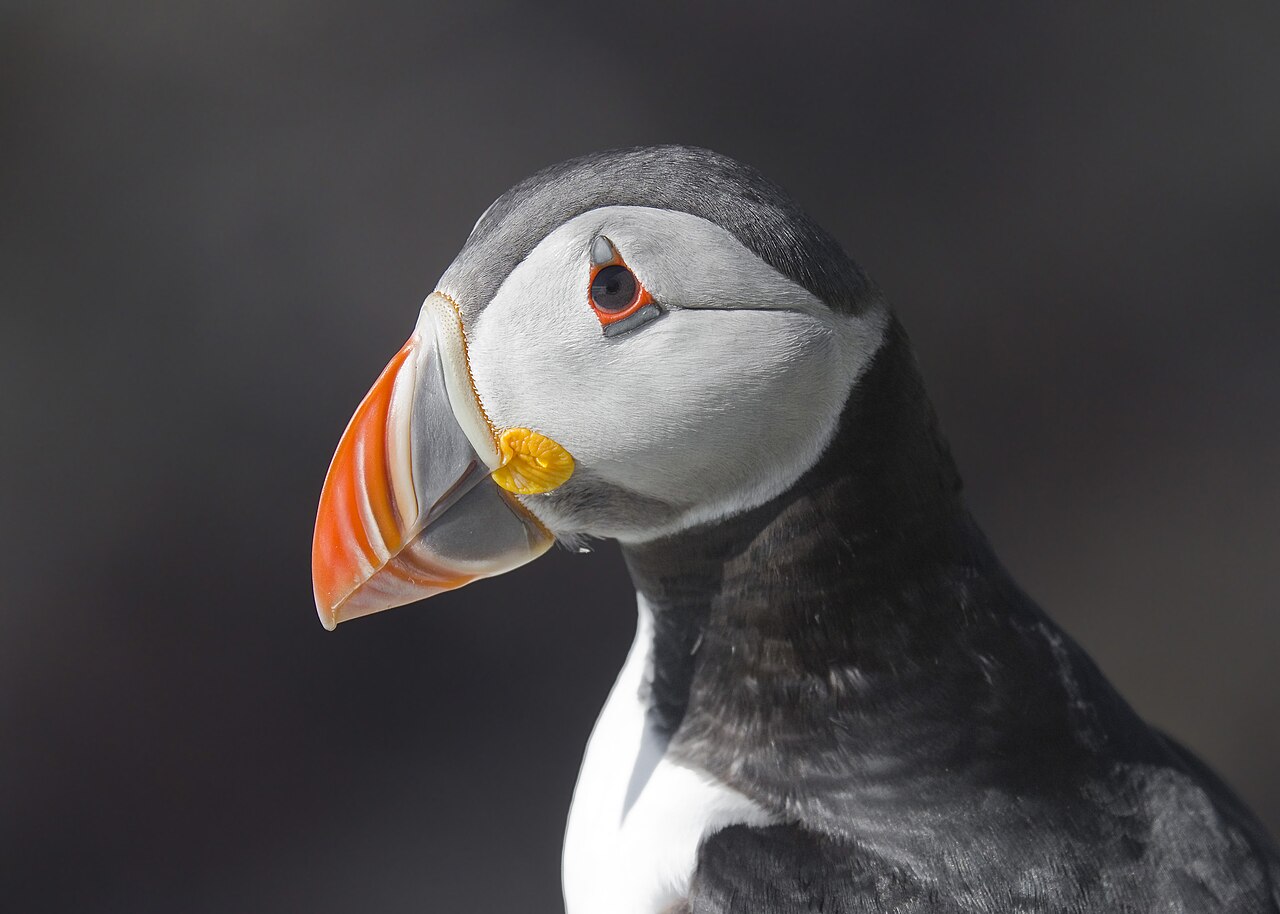
During those months they are effectively silent. There is no reason to call: no burrow to defend, no mate at hand and no chick to feed. Puffins also shed the bright orange bill plates in winter, so the bird that leaves the colony in August is duller and quieter than the one that arrives in April.
Vocal activity resumes within days of the spring return. Birds arrive at colonies in late March and April, often circling offshore in rafts for a week before landing, and the first growls of the season come from birds inspecting old burrows.
Best Time of Day and Season to Hear Puffins
Mid June through late July is the reliable window, when chicks are in the burrows and adults are commuting constantly with fish. Early morning and the two hours before dusk produce the most activity, with a noticeable midday lull when many adults are out foraging.
Weather dominates everything. A puffin growl competes directly with wind and breaking surf, and on an exposed headland in a 20 mph wind you will hear nothing at all. Calm, overcast mornings with light fog are the best conditions, which happens to describe much of the Maine coast in June.
Boat tours that circle a colony without landing rarely deliver the sound, since the engine and the water between you and the turf cancel it out. Landing tours to Eastern Egg Rock or Machias Seal Island, which are limited and weather dependent, are where people actually hear puffins.
Sounds Mistaken for Puffins at a Seabird Colony
Most puffin colonies are shared, and the loudest voices there belong to other species. Black-legged kittiwakes produce the ringing three note cry that gives them their name, herring and great black-backed gulls contribute the familiar harsh laughing calls, and razorbills give a low grating croak that genuinely resembles a puffin growl.
Common murres add a deep rolling murmur from dense ledges, often described as a crowd groaning in unison. Leach’s storm-petrels, active at night in burrows on some of the same islands, produce bizarre chattering and purring sounds that confuse nearly everyone hearing them for the first time.
Among the land birds along the same coast, the harsh calls of blue jays and the carrying screams used by gulls overlap in frequency with puffin growls at a distance. For a cleaner comparison of a rattling seabird-like delivery, the pattern described in machine gun bird sounds is closer in rhythm than anything else on the colony.
What US State Has Puffins and Where to Hear Them
Maine is the only US state with breeding Atlantic puffins. The population nests on a handful of offshore islands including Eastern Egg Rock, Seal Island, Matinicus Rock, Petit Manan and Machias Seal Island, all restored or protected after hunting eliminated the birds from most of the state by 1900.
Eastern Egg Rock holds a special place as the site of the first successful seabird translocation, begun in 1973, which reestablished puffins where they had been gone for nearly a century. Alaska holds the other two US species, the tufted and horned puffin, in far larger numbers along the Aleutians and the Gulf of Alaska.
Recordings and distribution details are published by the Cornell Lab at All About Birds. For visitors who make the trip and find the puffins quiet, there is usually compensation overhead, since the Maine islands also host nesting eagles whose calls are covered in bald eagle sounds.
Frequently Asked Questions
Is a puffin a duck?
No. Puffins are auks, family Alcidae, a group of diving seabirds that also includes murres, razorbills and guillemots. Ducks belong to the family Anatidae and are only distantly related. The resemblance is convergent: both groups evolved compact bodies and waterproof plumage for life on water, but puffins swim using their wings rather than their feet.
What is the sound of birds called?
Bird sounds divide into songs and calls. Songs are longer, patterned, usually learned and used for territory and mate attraction, and are produced mostly by males in the breeding season. Calls are shorter, innate and functional, covering alarm, contact, begging and flight. Puffins have calls only. The collective term for both is vocalizations.
Where do puffins go at night?
During the breeding season, adults sleep in or near the burrow, or raft on the water close to the colony. Chicks remain underground around the clock. Outside the breeding season, puffins spend day and night at sea, sleeping on the surface in open ocean hundreds of miles from land.
Are puffins aggressive to humans?
No. Puffins show little fear of people and generally ignore observers in established blinds, which is why colony photography is so productive. They will bite if handled, and the bill is strong enough to break skin. Aggression is directed at other puffins over burrows, not at visitors.
What is the lifespan of a puffin?
Atlantic puffins typically live 20 to 25 years, and banded birds have exceeded 35 years in the wild. They do not breed until 4 to 6 years old and raise just one chick per year, so the species depends on adult longevity. That slow reproduction is why colony losses take decades to reverse.
Can you hear puffins from a boat?
Rarely. The growl is low volume and comes mostly from underground, so engine noise, wind and surf cancel it well before it reaches a vessel offshore. Hearing puffins reliably requires a landing on the island or a blind at the colony edge on a calm morning.