Northern Mockingbird Sound: The Three-Repeat Rule Explained
A northern mockingbird sound is never one bird’s sound. The Northern Mockingbird (Mimus polyglottos) strings together imitations of cardinals, jays, wrens, frogs, car alarms and squeaky gates, repeating each borrowed phrase several times before moving to the next. That repetition is the fingerprint that identifies the species by ear.
A single male can carry 100 to 200 distinct phrases and keeps learning new ones for life. Here is what each phrase type means, why the bird sings at 2 a.m., and how to separate it from the thrashers and catbirds that use the same trick.
Northern Mockingbirds sing long sequences of copied phrases, repeating each one three to six times before switching. The song is loud, clear and delivered from an exposed perch, often for hours. They also give a harsh chack alarm note, a dry chew call, and unmated males sing through the night in spring.
| Sound | Description | When |
|---|---|---|
| Mimic song | Copied phrases, each repeated 3 to 6 times | February through August, all day |
| Night song | Same song, delivered after dark | Unmated males, March through June |
| Chack alarm | Harsh, sharp single note | Cat, snake or person near the nest |
| Chew call | Dry, nasal contact note | Year round, between pair members |
| Wing flash | Silent white wing patches flashed open | Foraging, territory display |
| Frog and insect copies | Trills and croaks that sound nothing like a bird | Woven into any long song |
What Do Northern Mockingbirds Sound Like?
The song is a loud, endless medley of other species’ phrases, each one repeated in a tight run before the bird jumps to something new. A typical sequence might be three cardinal whistles, four jay screams, five wren trills, then a car alarm, all inside 20 seconds.
Tone matters as much as content. A mockingbird sings clearly and loudly from a rooftop, wire, antenna or bare treetop, not from cover, and the volume is startling for a bird of 1.7 oz (48 g). If a mimic is performing in the open and repeating itself, this is the species.
The Three-Repeat Rule That Identifies the Species
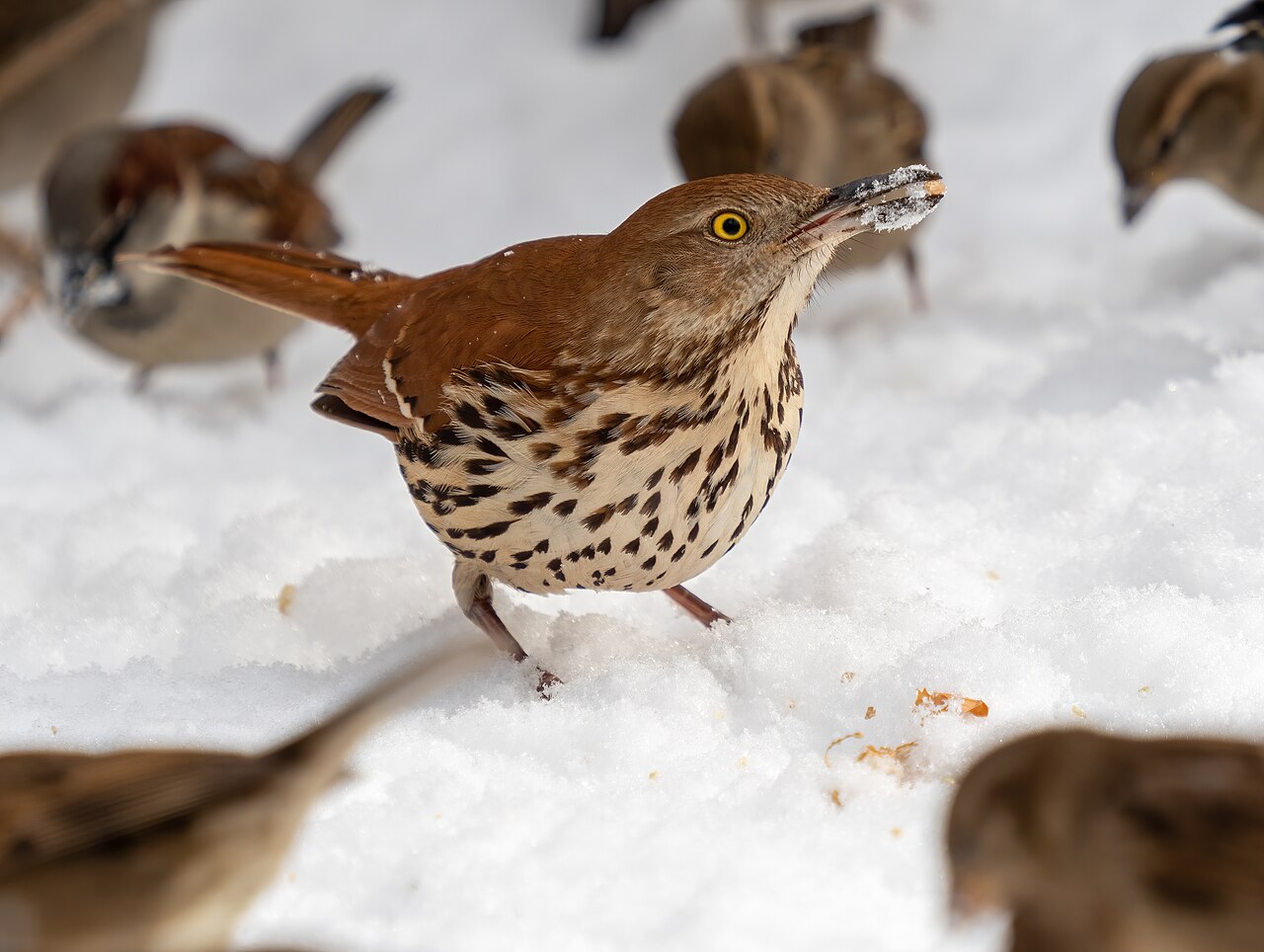
Count the repeats and the identification is finished. Mockingbirds repeat each phrase roughly three to six times. Brown Thrashers repeat each phrase twice. Gray Catbirds usually say each phrase once and add a cat-like mew.
The rule holds even when the bird copies something absurd, and it separates mockingbirds from starlings, which mimic constantly but almost never repeat a copied phrase in a run. Our side by side comparison of mockingbird and thrasher covers the visual differences as well.
Why Do Mockingbirds Sing at Night?

Night singing comes from unmated males. A male without a female keeps advertising after dark, often from a streetlight or antenna where artificial light extends the display, and he can continue past midnight from March into June.
It stops when he pairs up. The behavior peaks during full moons and near bright lighting, and the same individual will usually fall silent within days of attracting a mate, which is why the noise rarely lasts the whole season in one yard.
Female Northern Mockingbird Sounds
Females do sing, which surprises people, but quietly and much less often. Their song tends to come in fall while defending a winter feeding territory, and it is softer, shorter and delivered from lower cover rather than a rooftop.
Females also give the full range of calls: the harsh chack, the nasal chew, and the begging notes used between pair members. A loud male-style performance from an exposed perch in May is a male advertising, not a pair singing together.
The Northern Mockingbird Frog Sound
Mockingbirds copy more than birds. Tree frog trills, cricket chirps, dog barks, squeaky clothes lines and reversing trucks all enter the repertoire, and a bird raised near a pond may produce a run of frog calls convincing enough to stop a listener.
These non-bird copies follow the same repeat rule, so a frog-like trill delivered four times in a row from a rooftop at noon is a mockingbird. An actual bullfrog calls from water, at ground level, and mostly at night.
What Birds Are Mistaken for Mockingbirds?
By sound, the confusion set is Brown Thrasher, Gray Catbird, European Starling and Blue Jay. The first three are fellow mimics separated by the repeat rule; the jay matters because both birds scream harshly and share the same suburbs, as explained in our notes on jay calls.
By sight, Loggerhead Shrike is the real trap. It is gray, white and black at a distance, roughly the same size and posture, and sits on the same wires. The black mask and the hooked bill give it away, and shrikes do not deliver long mimic songs.
How to Identify a Northern Mockingbird
Look for a slim gray bird with a long tail, a pale belly and two thin white wing bars, showing bold white flashes in the wings and white outer tail feathers in flight. It runs and hops on lawns with the tail cocked upward.
Watch for the wing flash: the bird spreads its wings in a jerky, two-stage motion while walking, exposing the white patches. No other backyard songbird does this, and it is diagnostic even when the bird is silent.
How Rare Are Northern Mockingbirds?
Not rare at all. Population estimates put the species around 32 million birds, and it is one of the most common yard birds across the southern and central United States. Seeing one in Texas, Florida or California is an everyday event.
Scarcity depends entirely on latitude. In northern New England, Minnesota and the northern plains the bird is uncommon and localized, and sightings there draw attention. The range has crept north over recent decades along with ornamental fruit plantings.
What States Have Northern Mockingbirds?
All of the Lower 48 hold them at least seasonally, with year round residents across the southern two-thirds of the country and northward along both coasts. They also reach southern Canada in small numbers and occur throughout Mexico and the Caribbean.
The bird is the official state bird of five states: Texas, Florida, Tennessee, Mississippi and Arkansas. Range maps and verified recordings are available from the Cornell Lab of Ornithology.
What Does It Mean When a Northern Mockingbird Visits You?
Biologically, it means you are inside a defended territory. A pair holds the same half acre to two acres for the breeding season, and many hold a separate winter territory around a fruiting shrub, so the bird on your fence is a resident rather than a visitor.
Culturally the bird carries associations with protection, boldness and voice, drawn from its willingness to attack hawks and cats many times its size. Both readings point at the same trait, and our broader catalog of recorded mockingbird calls covers each vocalization in detail.
How to Record a Mockingbird Song for Identification
Record at least 60 seconds. Identification apps fail on this species constantly because a 10 second clip may contain only a copied cardinal phrase, and the app returns Northern Cardinal with high confidence.
Stand 25 to 40 ft (8 to 12 m) away and keep the phone still. Longer recordings capture the phrase switching that makes the identification obvious, and they also reveal which local species the bird has been listening to, from Carolina Wrens to sirens.
Related reading: Northern Flicker Sounds.
Frequently Asked Questions
What is a flock of mockingbirds called?
An echo, which is the collective noun in general use and a fitting one for a mimic. Mockingbirds are not truly flocking birds, though, since they are territorial year round, so any group larger than a family party in late summer is unusual.
How rare is it to see a mockingbird?
Common in the South and the Southwest, where you can expect one on most suburban blocks. Uncommon in the northern tier of states and southern Canada, where a single bird may stay for weeks and attract local birders. Winter sightings in the north often center on a holly or crabapple.
What is the friendliest wild bird to humans?
Chickadees and Black-capped Chickadees in particular, since they will take seed from an open hand within a few sessions. Mockingbirds are bold rather than friendly. They tolerate people at close range and remember individual faces, but the boldness is territorial defense, not sociability.
Do mockingbirds sing all year?
Almost. Song peaks from February through August, drops during the late summer molt, then returns at lower volume in fall when birds set up winter feeding territories. Deep winter is the quietest stretch, with mostly chack and chew calls rather than full song.
How many songs can a mockingbird learn?
Males typically hold 100 to 200 phrase types and add new ones throughout life, so older males have larger repertoires than yearlings. Repertoire size appears to influence mating success, which is the working explanation for why the singing is so relentless.
What sounds like a mockingbird at night?
Very little, which is why night song is such a reliable clue. The realistic alternatives after dark are owls and nightjars, and both sound completely different: Eastern Whip-poor-will chants its own name on repeat, while Barred Owls give the familiar hooting series. A varied mimic song at 2 a.m. is a mockingbird.