Northern Flicker Sounds: 4 Calls and What Each One Means
The northern flicker call most people hear is a long, ringing kikikikiki that runs for seven or eight seconds without changing pitch, carried from the top of a dead snag in early spring. It is the sound of a woodpecker claiming a territory, and it is loud enough to cross a quarter mile of open woodland. The same bird also makes a single piercing kleeyer, a soft wicka wicka wicka, and a mechanical drum roll on whatever resonates best nearby.
The northern flicker (Colaptes auratus) has a small vocabulary, but each sound means something specific and each one belongs to a season and a time of day. Learning the four main sounds is enough to tell what the bird is doing without seeing it, and it also settles the two calls that get misidentified most often.
Northern flickers make four main sounds: a long rolling kikikikiki that lasts 7 to 8 seconds and announces territory, a single loud kleeyer given in flight or alarm, a soft wicka wicka wicka exchanged between two birds at close range, and a one second drum roll of about 25 taps used as a signal rather than for feeding.
| Sound | In words | Season and time | What it means |
|---|---|---|---|
| Long call | kikikikiki, 7 to 8 seconds | March to June, first three hours of light | Territory and mate attraction |
| Kleeyer call | klee-yer, single sharp note | Year round, any hour | Contact and alarm, often in flight |
| Wicka call | wicka wicka wicka, soft | April to June, close encounters | Courtship or a boundary dispute |
| Drumming | mechanical roll, about 1 second | February to May, dawn | Signal, not foraging |
| Nestling begging | buzzing hum from a cavity | May to July, all day | Young demanding food |
| Squeal and chatter | harsh short notes | Year round | Close range aggression |
What Does a Northern Flicker Sound Like?
A northern flicker sounds like a woodpecker that will not stop. The signature long call is a single pitch repeated 20 to 25 times at a steady machine like pace, bright and ringing rather than harsh, and it comes from an exposed perch high in a dead tree. People describe it as a flicker laughing, and once you have matched it to the bird it is unmistakable.
The flicker is also one of the loudest common yard birds for its size, at 11 to 12 in (28 to 31 cm) long. Volume is the reason the long call gets reported as something larger and more alarming, and it is the reason a flicker drumming on a metal chimney cap wakes an entire street. Full recordings of every call are posted by the Cornell Lab at All About Birds.
The Long Call: Kikikikiki
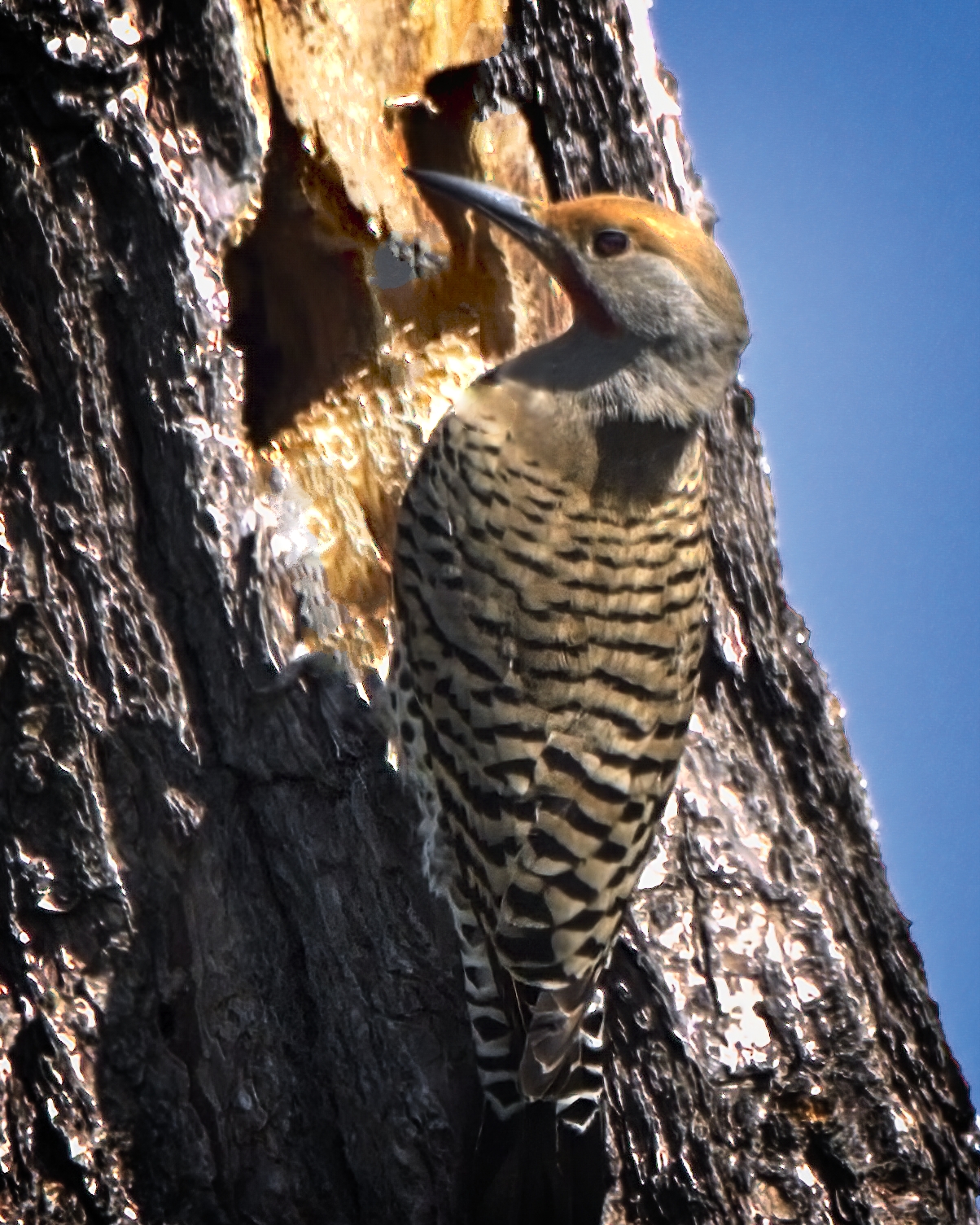
The long call, also written wik-wik-wik-wik, is the one that defines the spring soundscape in flicker country. It runs 7 to 8 seconds, holds one pitch, and does not slow down or trail off at the end. Both sexes give it, though males call far more often, and a calling bird usually sits upright on the highest dead limb available.
Its function is advertisement. The bird is telling rivals the territory is occupied and telling unpaired birds it is available, which is why the call peaks in the two weeks before nesting and nearly stops once eggs are laid. A sudden return of long calling in July often means a failed nest and a second attempt. The female northern flicker gives the same call, so the sound alone does not identify the sex.
The Kleeyer Call

The kleeyer is a single loud note with a falling second half, given once or in a short series, and it is the call you hear year round. Flickers use it when flushing off the ground, when crossing open country, and when something approaches the nest tree. It is sharper and more urgent than the long call and carries just as far.
This is the call most often confused with another species, because a falcon makes something very similar. If you hear a single ringing note from a bird that then flies away in a flashing, undulating pattern with a white rump patch, it is a flicker. The same note repeated rapidly from a hovering bird on a wire is not.
The Wicka Call and the Courtship Dance
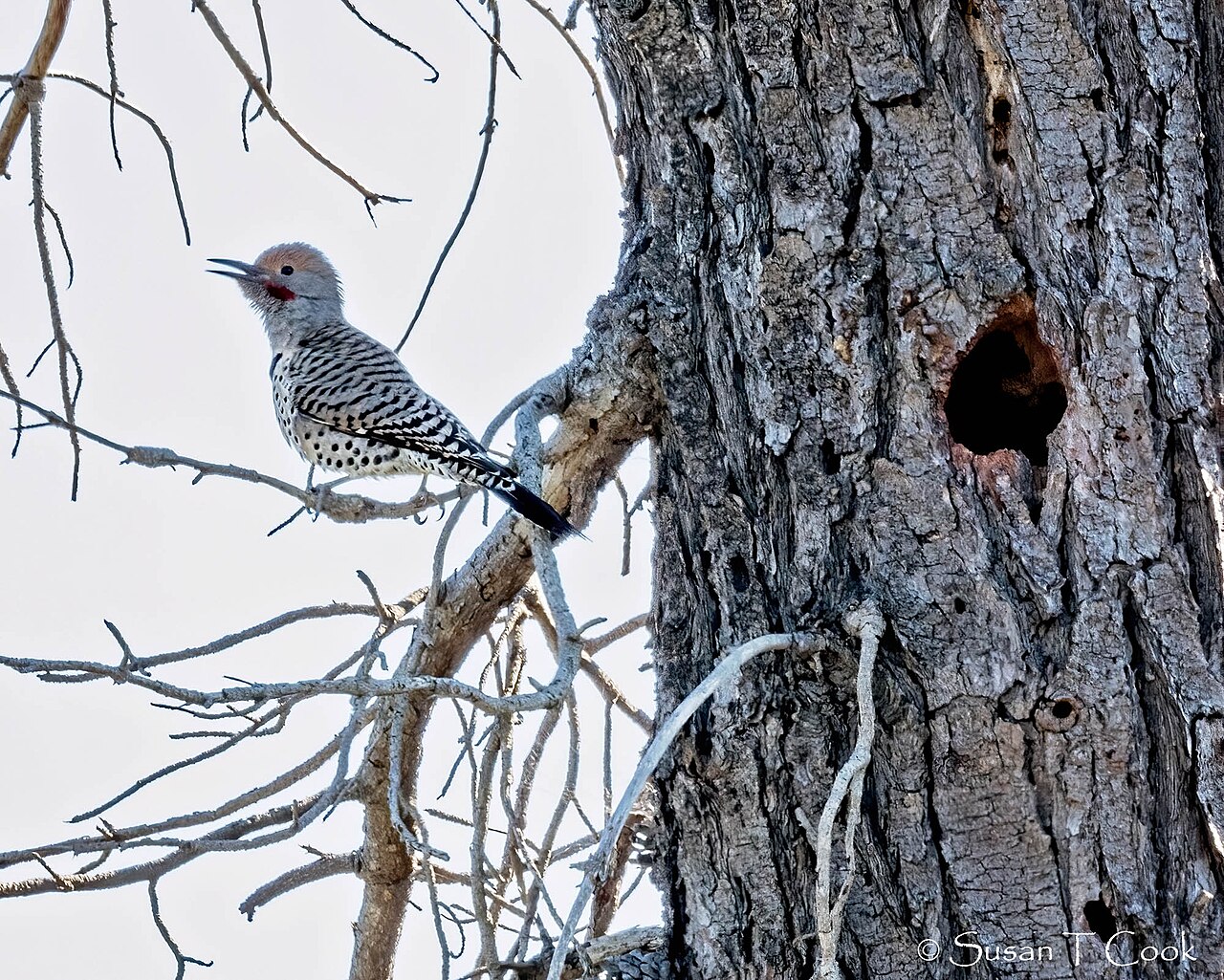
The wicka wicka wicka call is soft, lower, and more conversational than the other two, and you only hear it when two flickers are within a few feet of each other. It accompanies a display in which both birds bob their heads, sway their bills in wide figures, and flick their tails while clinging to the same branch or trunk.
The display works for two completely different situations. Between a pair it is courtship, often repeated at the nest cavity entrance for days. Between two males or two females it is a boundary dispute, and the same bobbing can continue for several minutes without either bird striking. Watching which bird eventually leaves tells you which of the two you are hearing.
Drumming: Why Flickers Hammer on Metal
Flicker drumming is a burst of about 25 taps in roughly one second, even in speed and volume, repeated every few minutes. It is a signal, not feeding, and the bird chooses the surface for how far the sound travels rather than for what lives inside it. A hollow snag works, and a metal chimney cap, gutter, vent, or satellite dish works better.
That preference is why drumming becomes a human problem in March and April. The bird is not damaging the metal and is not looking for insects in it; it is broadcasting. Drumming is shorter and faster than the irregular tapping of a bird actually excavating, which is the practical way to tell whether your siding is being signaled on or dug into.
Alarm and Contact Calls
Beyond the three main calls, flickers use a set of short harsh notes at close range. A sharp repeated kee-yer or a rapid chatter signals a predator near the nest, and it often brings both adults to the same branch. A quieter version keeps a pair in contact while they feed on the ground out of sight of each other.
Flickers also hiss. A bird inside a cavity that feels threatened produces a snake like hiss amplified by the hollow trunk, a defense shared with several cavity nesters. The effect is convincing enough that it deters raccoons and squirrels, and it is nothing like the owl calls covered in the barred owl call guide.
Begging Calls of Nestling Flickers
Young flickers in the cavity make a continuous buzzing hum that most people compare to a swarm of bees inside a wall. It rises sharply whenever an adult lands at the entrance and drops to a low murmur between feedings. From late May through July this is the sound that makes homeowners believe they have insects in the siding.
The begging noise is also how biologists locate active nests without climbing. It is audible from 30 to 50 ft (9 to 15 m) in quiet conditions and continues for about four weeks until the young fledge. Once they leave the cavity, fledglings follow the adults around the yard giving a thinner version of the kleeyer for several more weeks.
Why Do Northern Flickers Call?
Northern flickers call for three reasons: to hold a territory, to find or keep a mate, and to warn. The long call and drumming cover the first two, the kleeyer and the harsh chatter cover the third, and the wicka call handles negotiation at close range. Nothing in the repertoire is used for foraging, which sets flickers apart from woodpeckers that tap to find insects.
Timing follows that function. Calling and drumming both surge in late winter and early spring, collapse during incubation, and return briefly if a nest fails. Outside the breeding season flickers are comparatively quiet and give mostly single contact notes, so a noisy flicker almost always means a nesting decision is in progress.
When You Hear Each Sound: Time of Day and Season
The first three hours after sunrise carry nearly all the long calling and drumming. Flickers start at or just before first light, which in April means 5:30 to 6:00 a.m. across much of the United States, and they taper off by mid morning. A second smaller peak comes in the last hour before dark.
By season, drumming starts first, often in February, followed by long calling in March and April, the wicka display in April and May, and nestling noise from late May into July. Calls at night are rare and usually mean the bird was disturbed at a roost cavity, unlike the genuinely nocturnal species in barn owl sounds.
What Bird Sounds Like a Northern Flicker?
The American kestrel (Falco sparverius) is the closest match and the most common misidentification, because its klee-klee-klee has the same ringing quality as the flicker kleeyer. The kestrel version is faster, delivered in bursts of three to five notes, and comes from a bird perched on a wire or hovering over a field rather than from a tree trunk.
The pileated woodpecker (Dryocopus pileatus) gives a similar long call, but it is lower, louder, and uneven, rising and falling instead of holding one pitch. The hairy woodpecker rattle is much shorter, under two seconds. For an unrelated bird that copies other species outright, see the northern mockingbird.
Flicker Noise on Your House: Siding, Gutters and Attic Vents
Three household situations produce flicker complaints. Dawn drumming on metal is the most common and is harmless to the structure. Excavation in cedar, redwood, or stucco siding is real damage, and it means the bird is attempting a nest cavity. Entry through a gable or attic vent means a cavity attempt that succeeded, and that one needs attention before young hatch.
For drumming, dampen the surface with closed cell foam behind the metal or hang reflective tape nearby, and the bird usually moves within days. For excavation, cover the area with hardware cloth and mount a flicker sized nest box with a 2.5 in (6.4 cm) hole on the same wall. Flickers are protected under the Migratory Bird Treaty Act, so an active nest with eggs or young cannot legally be removed; federal guidance on that is published by the U.S. Fish and Wildlife Service.
Frequently Asked Questions
What does it mean when you see a Northern Flicker?
Practically it means there are ants nearby, since flickers feed on the ground on ants and beetles more than any other North American woodpecker. In folk interpretation the bird is read as a sign of renewal and rhythm, partly because of its drumming. Those traditions are collected in northern flicker symbolism.
How rare is it to see a Northern Flicker?
Not rare at all. Northern flickers breed across nearly all of the United States and Canada and are among the most widespread woodpeckers on the continent, though populations have declined by roughly a third since the 1960s. Yellow shafted birds dominate in the East, red shafted in the West, and they interbreed on the Great Plains.
What attracts Northern Flickers to your yard?
Ants in the lawn, bare or sparsely mulched ground to forage on, dead limbs left standing, and a water source. Suet and shelled peanuts work at feeders, but flickers come mainly for ground insects. Removing every dead snag is the fastest way to lose them, since they need soft wood for cavities.
What is the loudest northern flicker call?
The long kikikikiki is the loudest and the farthest carrying, audible to a person about a quarter mile away in still conditions. The single kleeyer is sharper and sounds louder up close because of its abrupt attack. Drumming on metal beats both for perceived volume inside a house, though the bird is producing no more sound than usual.
What does the northern flicker mating call sound like?
The mating call is the same long kikikikiki used for territory, given from a high exposed perch, plus the softer wicka wicka wicka exchanged once a pair is close together. There is no separate song. The wicka call with head bobbing at a cavity entrance is the clearest sign of an established pair.
Do northern flickers call at night?
Rarely. Flickers are strictly diurnal and roost in cavities after dark, so a call at night usually means a predator disturbed the roost or a migrating bird gave a flight note. Repeated nighttime calling from one spot is more likely another species; compare the carrying daytime calls in bald eagle sounds.