Blue Birds: 12 Common Blue Birds in North America with Identification (2026)
Blue is one of the rarest colors in nature, and one of the most striking when it appears on a bird. From the sky-blue Mountain Bluebird to the deep navy of an Indigo Bunting, blue birds catch the eye instantly against any background. Importantly, most blue feathers don’t contain blue pigment at all, the color comes from microscopic structures in the feathers that scatter light, which is why blue birds appear different shades depending on lighting conditions. This guide helps you identify the blue bird you’ve spotted by combining shade of blue, body size, geographic range, habitat, and distinguishing field marks.
Quick Reference: 12 Blue Birds at a Glance
| Species | Size | Key ID Feature | Range |
|---|---|---|---|
| Eastern Bluebird | 7″ | Blue back + rust-orange breast | Eastern US |
| Western Bluebird | 7″ | Blue back + rust on breast + flanks | Western US |
| Mountain Bluebird | 7″ | Sky-blue overall (male) | Western mountains |
| Blue Jay | 11″ | Bright blue + black necklace + crest | Eastern US |
| Steller’s Jay | 11.5″ | Dark blue + black hood/crest | Western forests |
| California Scrub-Jay | 11″ | Blue + gray back, no crest | California, SW |
| Indigo Bunting | 5.5″ | Vivid all-blue (male) | Eastern US |
| Lazuli Bunting | 5.5″ | Blue head + orange breast + white belly | Western US |
| Blue Grosbeak | 6.5″ | Deep blue + rust wing bars + thick bill | Southern US |
| Cerulean Warbler | 4.5″ | Sky-blue back + white below + dark streaks | Eastern forests |
| Black-Throated Blue Warbler | 5″ | Blue back + black face + white belly | Eastern forests |
| Tree Swallow | 5.5″ | Iridescent blue-green back + white below | Continent-wide |
Species Identification
Eastern Bluebird
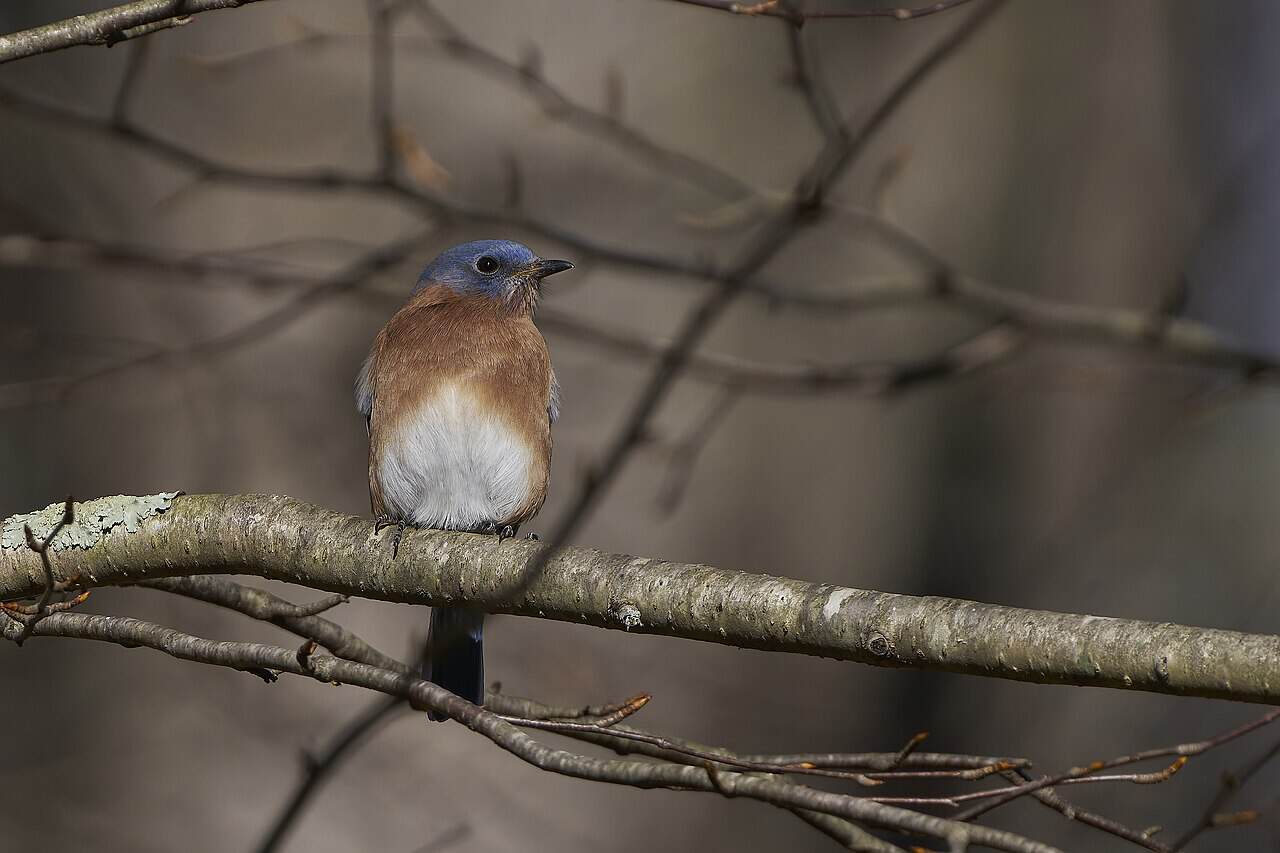
The Eastern Bluebird is the iconic blue bird of the Eastern US, featured on countless paintings, magazine covers, and state-bird emblems (official state bird of Missouri and New York). Males have a bright royal-blue back, wings, and tail contrasted with a rust-orange breast and throat. Females are duller blue overall with paler orange.
Range: Eastern US year-round, with some northward migration in summer.
Habitat: Open habitat with scattered trees, fields, orchards, golf courses, parks.
Key ID: Blue back + orange breast = Eastern Bluebird. Female is the duller version of the same pattern.
Where to see: Install a bluebird house with NABS-approved dimensions. Mealworm feeders attract bluebirds reliably.
Western Bluebird
The western counterpart to Eastern Bluebird. Western Bluebirds have a deep blue head and back with rust-orange on the breast AND flanks (extending down the sides), versus Eastern Bluebird which has orange only on the throat and chest.
Range: Western US year-round.
Habitat: Open woodlands, especially pine-oak forests.
Key ID: Blue overall with extensive rust on breast and flanks. Throat is blue (in Eastern Bluebird, throat is rust).
Where to see: Western forests and adjacent open habitat. Will use bluebird nest boxes.
Mountain Bluebird
Perhaps the most stunning of the three bluebird species. The male Mountain Bluebird is sky-blue overall, no rust, no contrasting colors. Just pure, brilliant blue from head to tail. Females are gray-blue with brighter blue wings and tail.
Range: Western mountains, especially open grasslands and meadows at higher elevations.
Habitat: Open grasslands, meadows, fields with scattered trees, high-elevation valleys.
Key ID: All-blue body (no rust) = Mountain Bluebird male. The brightest blue of any bluebird species.
Where to see: Open mountain habitat in the West. Often hovers while hunting insects. Uses nest boxes readily.
Blue Jay
Among the most familiar backyard birds in eastern North America. Blue Jays are bright blue above with a white chest and belly, plus a distinctive black necklace, black wing markings, white wing bars, and a prominent crest. Voice is loud and varied, jays mimic hawks and other birds.
Range: Eastern and central US year-round.
Habitat: Forests, parks, suburban backyards. Strongly attracted to oak trees (eat acorns).
Key ID: Bright blue + crest + black necklace. The largest common blue bird in the East.
Where to see: Backyard feeders, especially platform and hopper feeders. Will eat sunflower seed, peanuts in shell, and corn.
Steller’s Jay
Western counterpart to Blue Jay. Steller’s Jay has a dark, almost black head and crest contrasted against a bright blue body. The forehead and crest are jet-black, and there are distinct streaks/marks on the face.
Range: Western mountains, especially coniferous forests.
Habitat: Coniferous and mixed forests at higher elevations.
Key ID: Black hood and crest distinguishes from Blue Jay (which has all-blue head). Body is similar bright blue.
Where to see: Western mountain campgrounds and forests. Visits feeders for peanuts and sunflower seed.
California Scrub-Jay
A common backyard jay in California and the Southwest. California Scrub-Jays are bright blue on the head, wings, and tail with a gray-brown back. Unlike Blue Jays and Steller’s Jays, they have no crest. Bold and inquisitive.
Range: California, Oregon, southwestern US.
Habitat: Oak woodlands, chaparral, suburban yards.
Key ID: Blue + brown-gray back + NO crest. Pale gray throat with bluish necklace.
Where to see: California and Southwest backyards. Visit feeders for peanuts, sunflower seed, and dried mealworms.
Indigo Bunting
A small but spectacular bird. Male Indigo Buntings in breeding plumage are vivid blue overall, like a flying piece of sky. Females are warm brown with subtle blue tint on wings and tail. Smaller than a sparrow.
Range: Eastern and central US in summer. Migrates to Mexico and Central America for winter.
Habitat: Brushy fields, forest edges, roadsides with shrubs.
Key ID: Small all-blue bird (males in breeding plumage). Conical seed-eating bill. Often sings from exposed perches.
Where to see: Summer in shrubby habitats. Listen for their bouncy, paired song. May visit feeders for nyjer or millet.
Lazuli Bunting
Western counterpart to Indigo Bunting, but with a different color pattern. Male Lazuli Buntings have a bright sky-blue head, throat, and back; orange-rust breast; and white belly with white wing bars. A unique combination of blue + orange + white.
Range: Western US in summer. Migrates to Mexico for winter.
Habitat: Brushy areas, especially riparian (streamside) habitats.
Key ID: Blue + orange + white = Lazuli Bunting (unique combination).
Where to see: Western brushy habitat in summer. Visits feeders for millet and nyjer.
Blue Grosbeak
A chunky blue bird with a heavy seed-eating bill. Male Blue Grosbeaks are deep navy-blue overall with two distinct rust-orange wing bars. The thick conical bill is distinctive. Females are warm brown with similar wing bars.
Range: Southern US in summer. Migrates to Mexico and Central America for winter.
Habitat: Brushy fields, roadsides, hedgerows.
Key ID: Deep blue + rust wing bars + thick bill. Larger and heavier than Indigo Bunting.
Where to see: Open brushy habitat in summer. Will visit feeders for sunflower and millet.
Cerulean Warbler
A small, sky-blue warbler of mature deciduous forests. Male Cerulean Warblers have a bright sky-blue back, head, and tail contrasted with a white belly and a fine dark band across the chest. Smaller and brighter than most warblers.
Range: Eastern US in summer (mostly Appalachian region). Migrates to South America for winter.
Habitat: Mature deciduous forest canopy.
Key ID: Sky-blue back + white below + chest band. Stays high in tall trees.
Where to see: Mature forest canopy in summer. Difficult to spot without binoculars. Conservation concern (declining).
Black-Throated Blue Warbler
A small, striking warbler. Male Black-Throated Blue Warblers have a deep blue back, jet-black face and throat, and clean white belly. A small white wing patch is often visible. Females are olive-brown overall.
Range: Eastern US and Canada in summer. Migrates to the Caribbean for winter.
Habitat: Mature deciduous and mixed forests.
Key ID: Blue back + black face/throat + white belly. Often in lower forest understory.
Where to see: Forest understory during summer breeding season. One of the easier blue warblers to spot.
Tree Swallow
Not always recognized as a blue bird, but Tree Swallows have iridescent blue-green backs that catch the light beautifully. Underparts are clean white, creating a striking contrast in flight.
Range: Continent-wide in summer. Migrates south for winter.
Habitat: Open habitat near water. Often nests in dead trees and nest boxes.
Key ID: Iridescent blue-green back + white below + forked tail in flight. Aerial insectivore, graceful flight.
Where to see: Wherever there’s open water and air space for insect-catching. Will use nest boxes designed for bluebirds or swallows.
How to Attract Blue Birds to Your Yard
Different blue birds have different attraction strategies:
Bluebirds (Eastern, Western, Mountain): Install NABS-approved bluebird houses with proper dimensions. Offer mealworms in a tray or specialty bluebird feeder.
Blue Jays: Offer peanuts in shell, sunflower seed, and corn on platform feeders. They love water, provide a bird bath.
Scrub-Jays: Similar to Blue Jays, peanuts and sunflower seed.
Buntings (Indigo, Lazuli): Offer nyjer and millet in finch-style feeders. They prefer brushy yards with native plants.
For all blue birds: Native plants and water sources are key. Bluebirds and swallows feed almost exclusively on insects, so pesticide-free yards are essential.
Frequently Asked Questions
What are the three bluebird species in North America?
Eastern Bluebird, Western Bluebird, and Mountain Bluebird. Eastern has orange throat/breast. Western has more extensive orange on breast and flanks. Mountain Bluebird is all-blue (no orange).
Why do blue birds look different in different lighting?
Most blue feathers don’t contain blue pigment. The color comes from microscopic structures in feathers that scatter light, similar to how the sky appears blue. The appearance changes dramatically with lighting angle and quality.
Is a Blue Jay actually blue?
Blue Jays appear bright blue but their feathers don’t contain blue pigment, they’re brown. The blue appearance comes from microscopic feather structures that scatter light. If you grind up a blue jay feather, it appears brown.
Are blue birds rare?
No. Blue Jays and Eastern Bluebirds are very common in their ranges. Some blue species like Cerulean Warblers are declining (conservation concern) but most blue birds are abundant where they occur.
What’s the difference between a Blue Jay and a Steller’s Jay?
Blue Jay has a blue head and crest (no black). Steller’s Jay has a black hood and crest. Blue Jays live in Eastern North America; Steller’s Jays live in Western North America.
Will bluebirds use Blue Jay nest boxes?
No. Bluebirds require specific NABS-approved nest box dimensions with 1.5 inch (Eastern) or 1 9/16 inch (Western/Mountain) entrance holes. Blue Jays don’t nest in nest boxes, they build open cup nests in trees.
Do blue birds visit feeders?
Yes, Blue Jays, scrub-jays, and Steller’s Jays are common feeder visitors (peanuts, sunflower, corn). Bluebirds visit mealworm feeders. Buntings visit nyjer feeders.
Related reading: Orange Birds.
Related reading: Small Grey Birds.