Birds with Crests: 12 Common Crested Birds in North America (2026)
A crest is one of the quickest ways to identify a bird. In North America the crested birds you are most likely to see are the Northern Cardinal, Blue Jay, Steller’s Jay, Tufted Titmouse, Cedar Waxwing, and a few surprises like the Pileated Woodpecker. Here are twelve crested birds and how to tell them apart at a glance.
A crest, a tuft of erectile feathers on top of the head, is one of the most striking and recognizable features in birds. Crests serve multiple functions: visual display for mate attraction, communication of mood or aggression, and species recognition. Some birds (Northern Cardinal, Tufted Titmouse) have prominent crests at all times. Others (some kinglets, sapsuckers) raise crests only when agitated. This guide covers 12 common North American crested birds, from the everyday cardinal to the spectacular Hooded Merganser, helping you distinguish similar species through crest shape, body coloration, and habitat.
A bird crest is a raisable tuft of feathers on the crown, used mainly for signalling mood. In North America the crested birds you are most likely to see are the Northern Cardinal, Blue Jay, Steller’s Jay, Tufted Titmouse, Cedar Waxwing and Pileated Woodpecker.
Quick Reference: 12 Birds with Crests at a Glance
| Species | Size | Crest Description | Range |
|---|---|---|---|
| Northern Cardinal | 8.5″ | Pointed red crest (male) or tan (female) | Eastern US |
| Blue Jay | 11″ | Pointed blue crest with black markings | Eastern US |
| Steller’s Jay | 11.5″ | Tall dark blue/black crest | Western forests |
| Tufted Titmouse | 6.5″ | Pointed gray crest with buff sides | Eastern US |
| Black-Crested Titmouse | 6.5″ | Solid black crest (male) on gray body | Texas, Mexico |
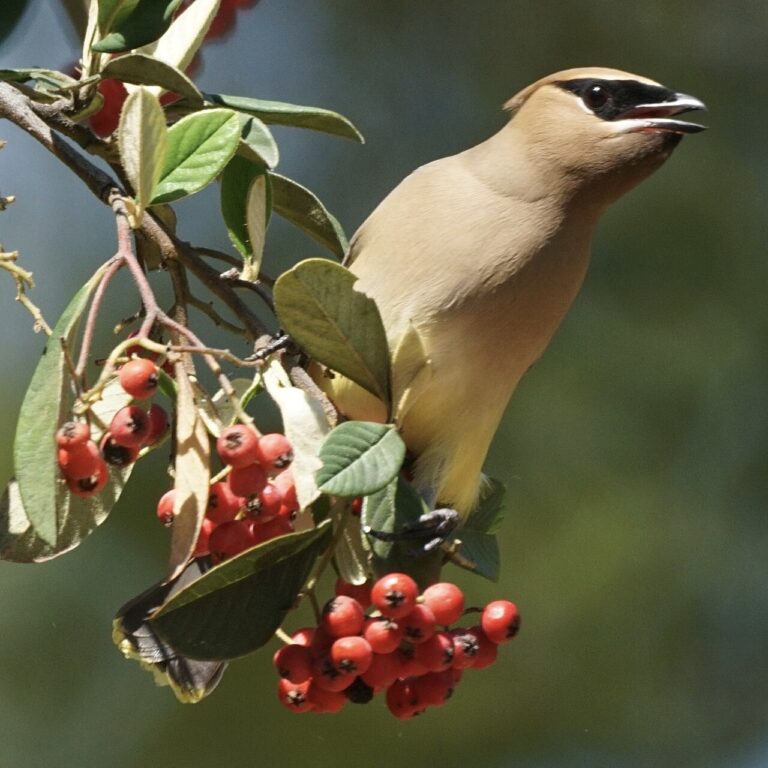
| Cedar Waxwing | 7″ | Sleek pointed crest + yellow tail tip | Continent-wide |
| Bohemian Waxwing | 8.25″ | Subtle crest + larger than Cedar Waxwing | Northern winters |
| Pileated Woodpecker | 16.5″ | Bright red prominent crest | Eastern + NW US |
| Belted Kingfisher | 13″ | Shaggy ragged crest + blue-gray body | Continent-wide |
| Hooded Merganser | 18″ | Large fan-shaped white crest (male) | Continent-wide |
| Phainopepla | 7.75″ | Pointed crest + silky black (male) or gray (female) | Southwest deserts |
| Pyrrhuloxia | 8.5″ | Pointed gray crest + red highlights | Southwest desert |
Species Identification
Northern Cardinal
The most familiar crested bird in North America. Male Northern Cardinals have a pointed bright red crest matching the body color. Females have a tan-brown crest with red wash. The crest is held up most of the time and is one of the most identifiable features.
Range: Eastern and central US year-round.
Habitat: Backyards, woodland edges, parks, gardens.
Key ID: Pointed red crest + black face mask + thick orange bill. Female has tan body with red crest tip.
Where to see: Backyard feeders with sunflower or safflower seed. Hopper and platform feeders preferred.
Blue Jay
A common eastern backyard bird with a prominent crest. Blue Jays have a tall pointed blue crest with black markings, bright blue back and wings, white chest and belly, and a black necklace. Crest height varies with mood, flat when relaxed, fully raised when alert.
Range: Eastern and central US year-round.
Habitat: Forests, parks, suburban backyards. Strongly attracted to oak trees.
Key ID: Pointed blue crest + bright blue back + black necklace + crested head. The largest common blue bird in the East.
Where to see: Backyard feeders, especially platform and hopper feeders. Will eat sunflower seed, peanuts in shell, and corn.
Steller’s Jay
Western counterpart to Blue Jay. Steller’s Jays have a tall, prominent dark blue-to-black crest contrasted against bright blue body. The crest is even more pronounced than Blue Jay’s and often appears more dramatic.
Range: Western mountains year-round.
Habitat: Coniferous and mixed forests at higher elevations.
Key ID: Tall dark crest + black hood + bright blue body. Crest is taller and pointier than Blue Jay’s.
Where to see: Western mountain campgrounds and forests. Visits feeders for peanuts and sunflower seed.
Tufted Titmouse
A small, perky eastern bird with a prominent crest. Tufted Titmice have a clean gray back, white underparts with buff flanks, a pointed gray crest, large black eyes, and a small black forehead patch.
Range: Eastern US year-round.
Habitat: Mature deciduous forests, parks, suburban yards.
Key ID: Gray crest + buff flanks + black eye + small size. Smallest common crested bird in the East.
Where to see: Common at backyard feeders. Sunflower seed, peanuts, and suet. Often in mixed flocks with chickadees and nuthatches.
Black-Crested Titmouse
Texas counterpart to Tufted Titmouse. Black-Crested Titmice have the same general body shape but with a solid black crest (vs gray) and white forehead patch. Where their ranges overlap in central Texas, hybrid birds occur.
Range: Texas and Mexico.
Habitat: Mature woodlands, parks, yards.
Key ID: Solid black crest + white forehead + gray body. Replaces Tufted Titmouse in Texas.
Where to see: Texas backyard feeders. Same preferences as Tufted Titmouse.
Cedar Waxwing
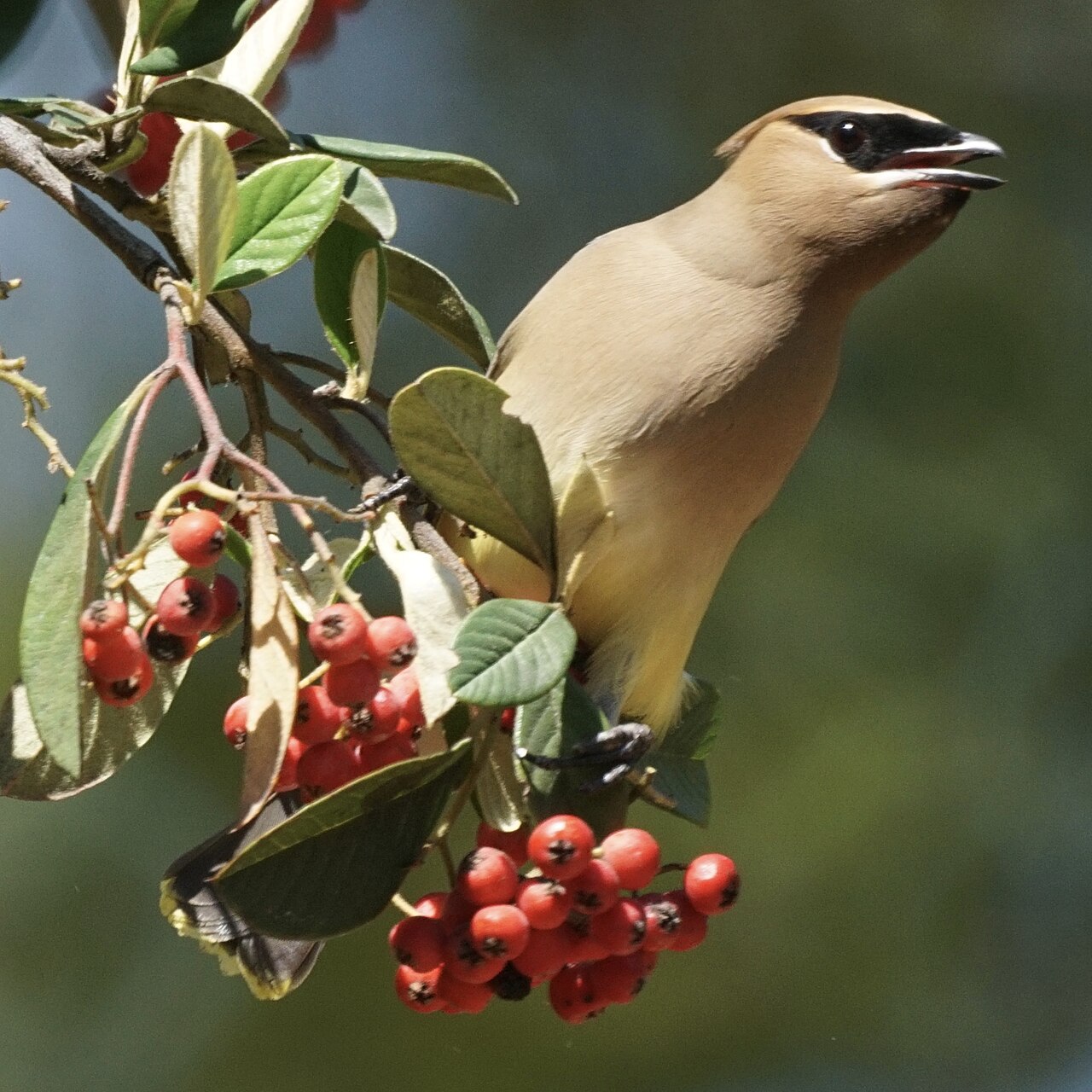
An elegant social songbird with a sleek crest. Cedar Waxwings have a smooth pointed crest, soft brown-and-gray plumage with yellow on the belly, a black mask, and a yellow tail tip. The red ‘waxy’ wing tips give the family its name.
Range: Continent-wide. Nomadic, follows fruit crops.
Habitat: Forests, parks, neighborhoods with fruit-bearing trees.
Key ID: Sleek crest + black mask + yellow tail tip + red wing markings. Often in flocks.
Where to see: Wherever there’s fruit. Mountain ash, cherry, juniper, and crabapple trees. Won’t visit feeders but visits bird baths.
Bohemian Waxwing
Larger northern cousin of Cedar Waxwing. Bohemian Waxwings have similar appearance but are larger, with chestnut-brown undertail coverts and a more subtle crest. Winter visitor in much of the lower 48 during irruption years.
Range: Northern coniferous forests in summer; irruptive in lower 48 in winter.
Habitat: Boreal forests in summer; mixed habitats in winter.
Key ID: Larger than Cedar Waxwing + chestnut undertail + slightly bolder crest. Best distinguished by size and undertail color.
Where to see: Winter visitor in northern US during irruption years. Visits fruit-bearing trees in flocks.
Pileated Woodpecker
The largest woodpecker in North America has a brilliant red crest as its most distinctive feature. Pileated Woodpeckers are crow-sized with black bodies, white wing flashes, and a tall pointed red crest visible from great distance.
Range: Eastern US, Northwest US, parts of California.
Habitat: Mature forests with large trees.
Key ID: HUGE size (16.5 inches) + tall red crest + black body. The most prominently crested woodpecker.
Where to see: Mature forests. Visits large suet feeders. Their rectangular excavations in trees are diagnostic.
Belted Kingfisher
A distinctive waterside bird with a shaggy, ragged crest. Belted Kingfishers have a blue-gray back, white belly, blue-gray chest band (and rust band in females), and a large bill. The crest gives them a ‘punk hairstyle’ appearance.
Range: Continent-wide year-round.
Habitat: Lakes, ponds, rivers, anywhere with water and small fish.
Key ID: Shaggy ragged crest + waterside habitat + blue-gray plumage + chest band. Females have an additional rust band.
Where to see: Watch over open water. Often perch on branches over water, then dive for fish. Won’t visit feeders.
Hooded Merganser
A small diving duck with the most spectacular crest in North America. Male Hooded Mergansers have a large fan-shaped white crest bordered with black that they can raise or lower dramatically. Females have a rufous crest that’s smaller but still distinctive.
Range: Continent-wide. Breeds in eastern and northwestern North America, winters across most of the US.
Habitat: Wooded ponds, swamps, slow-moving rivers.
Key ID: Fan-shaped white crest (male) or rufous crest (female) + small duck size + woodland habitat.
Where to see: Forested wetlands. Will use wood duck nest boxes for breeding.
Phainopepla
A unique Southwestern bird related to silky-flycatchers. Male Phainopeplas are entirely glossy black with a tall pointed crest and bright red eyes. Females are gray with the same crest shape. The white wing patches flash in flight.
Range: Southwestern US (deserts).
Habitat: Desert scrub, especially with mistletoe plants (their primary food).
Key ID: Tall pointed crest + glossy black (male) or gray (female) + red eye + desert habitat.
Where to see: Southwest desert habitats. Often perched on mesquite trees with mistletoe.
Pyrrhuloxia
The ‘desert cardinal’ has a prominent crest similar to Northern Cardinal but on a gray-and-red body. Male Pyrrhuloxias have a gray body with red wash on face/crest/breast and a yellow bill. The crest is similar to Cardinal’s.
Range: Southwestern deserts (Arizona, New Mexico, southern Texas).
Habitat: Desert scrub, mesquite thickets.
Key ID: Pointed crest + gray body with red highlights + yellow bill + desert habitat. Distinguished from Cardinal by gray body and yellow bill.
Where to see: Desert habitats in the Southwest. Will visit cardinal-friendly feeders in their range.
How to Attract Crested Birds to Your Yard
Different crested birds respond to different attractants:
Northern Cardinal: Hopper or platform feeders with sunflower or safflower seed. Native shrubs for nesting cover.
Blue Jay, Steller’s Jay: Platform feeders with peanuts in shell, sunflower seed, and corn. They love water, provide a bird bath.
Tufted/Black-Crested Titmouse: Common at virtually any feeder. Sunflower seed, peanuts, suet. Will use nest boxes with 1.25 inch entrance holes.
Waxwings (Cedar, Bohemian): Don’t visit seed feeders. Plant fruit-bearing trees (mountain ash, cherry, crabapple, juniper). Provide bird baths.
Pileated Woodpecker: Large suet feeders with tail-prop designs. Mature forest habitat.
Belted Kingfisher: Won’t visit feeders. Need open water with small fish.
Hooded Merganser: Won’t visit feeders. Provide wood duck nest boxes near water.
Phainopepla: Desert habitat with mistletoe plants. Won’t visit standard feeders.
Pyrrhuloxia: Cardinal-friendly feeders in their Southwest range. Sunflower and safflower seed.
What Is a Bird Crest and What Is It For?
A crest is a tuft of elongated feathers on the crown that the bird can raise and lower at will. It is not a fixed structure like a bill or a wing, which is why the same bird can look sharply crested one moment and smooth-headed the next. A cardinal with its crest flat and a cardinal with its crest up can genuinely look like two different birds to a beginner.
The function is communication. Birds raise the crest when alarmed, aggressive or courting, and flatten it when relaxed or trying to stay inconspicuous. That is why an incomplete or half-raised crest is so common in photographs: you are seeing a mood, not a field mark. If a bird looks like it has a partial crest, watch it for a minute and the crest will usually resolve one way or the other.
Small Gray Birds With a Crest
The small gray crested bird at a feeder in eastern North America is almost always a Tufted Titmouse. It is roughly sparrow-sized, plain gray above and pale below, with a peach wash on the flanks, a black patch just above the bill and a pointed gray crest it raises constantly.
Two lookalikes are worth knowing. The Blue Jay is far larger and obviously blue, and the Northern Cardinal female is warm brown rather than gray with a red-orange bill. In the Southwest, the Bridled Titmouse and Juniper Titmouse fill the same niche, the first with a bold black-and-white face pattern and the second plainer and grayer. Audubon’s Tufted Titmouse account covers the range boundaries where these species meet.
Frequently Asked Questions
What’s the most common crested backyard bird?
Northern Cardinal in the East, Steller’s Jay in the West, and Tufted Titmouse throughout the East. All three are familiar feeder visitors with prominent crests. Blue Jays are also very common in the East.
Why do birds have crests?
Crests serve multiple functions: sexual display (longer or brighter crests attract mates), mood communication (raised when alert or aggressive, lowered when relaxed), species recognition (distinct crest shapes help birds identify their own kind), and visual display in social interactions.
What bird has the biggest crest?
The Hooded Merganser male has the most spectacular crest, a large fan-shaped white-and-black structure that can be raised dramatically. Pileated Woodpecker has the largest and most visible crest among songbirds and woodpeckers. Phainopepla has a tall pointed crest.
Do all jays have crests?
Most jays do, Blue Jay, Steller’s Jay, Gray Jay, and Pinyon Jay. The Scrub-Jays (California, Woodhouse’s, Florida) do NOT have crests. The Green Jay has a small crest. So ‘jay with no crest’ is a useful identification clue, most likely a scrub-jay.
Can birds raise and lower their crests?
Yes. Almost all crested birds have erectile feathers that can be raised (when alert, aggressive, or displaying) or lowered (when relaxed or trying to look smaller). Cedar Waxwings, kingfishers, and titmice all show notable crest movement. Northern Cardinals keep their crests up most of the time.
What’s the difference between Tufted and Black-Crested Titmouse?
Tufted Titmouse has a gray crest. Black-Crested Titmouse (Texas only) has a solid black crest. Both have similar gray bodies with buff flanks. Range mostly determines which you’re seeing, Black-Crested replaces Tufted in Texas.
Do female birds have crests too?
Often yes, though sometimes smaller or less dramatic than males. Female Northern Cardinals have crests (tan colored). Female Tufted Titmice have crests. Female Pileated Woodpeckers have red crests (slightly smaller than males’). Female Hooded Mergansers have rufous crests (smaller than males’ white fans).
Related reading: Birds with Long Tails.
Related reading: Birds with Striped Heads.