Birds That Look Like Sparrows: 12 Common Look-Alikes (2026)
Many small brown birds look enough like sparrows that even experienced birders pause for a second look. The ‘sparrow-like’ template, small, brown, streaky, ground-feeding, has been adopted independently by birds in multiple families. Female finches, immature blackbirds, longspurs, and pipits all share the basic LBJ (Little Brown Job) appearance. This guide covers 12 common North American birds that look like sparrows but actually belong to different bird families, with the specific features (bill shape, tail length, posture, behavior) that reveal their true identity. Learning these look-alikes is one of the most useful skills for backyard birders.
The birds most often mistaken for sparrows are House Finches, Purple Finches, female Indigo Buntings, female Red-winged Blackbirds, longspurs and pipits. Bill shape decides it fast: a thick blunt cone means finch, a fine pointed bill means pipit, wren or warbler.
Quick Reference: 12 Sparrow Look-Alikes at a Glance
| Species | Size | Key ‘Not Sparrow’ Feature | Range |
|---|---|---|---|
| Pine Siskin | 5″ | Yellow wing/tail edges + thin pointed bill | Continent-wide |
| House Finch (female) | 5.5″ | Plain face + smaller bill than sparrows | Continent-wide |
| Purple Finch (female) | 6″ | Strong face pattern + white eyebrow | Northern US |
| Common Redpoll | 5.25″ | Red cap + small black chin patch | Northern winters |
| Indigo Bunting (female) | 5.5″ | Plain warm brown + faint wing bars | Eastern US |
| Painted Bunting (female) | 5.5″ | Olive-green (not brown) + plain face | Southeast US |
| Brown-Headed Cowbird (female) | 7.5″ | Larger than sparrows + uniform gray-brown | Continent-wide |
| Red-Winged Blackbird (female) | 8.5″ | Larger + heavy streaking + long bill | Continent-wide |
| Dickcissel | 6.25″ | Yellow breast + black V (male) or pale (female) | Central US |
| Bobolink (female) | 7″ | Buffy with crown stripes + sparrow shape | Northern grasslands |
| American Pipit | 6.5″ | Tail-pumping + slender bill + ground walker | Continent-wide |
| Lapland Longspur | 6.25″ | Winter only + bicolored bill + sparrow-like | Winter US |
Species Identification
Pine Siskin
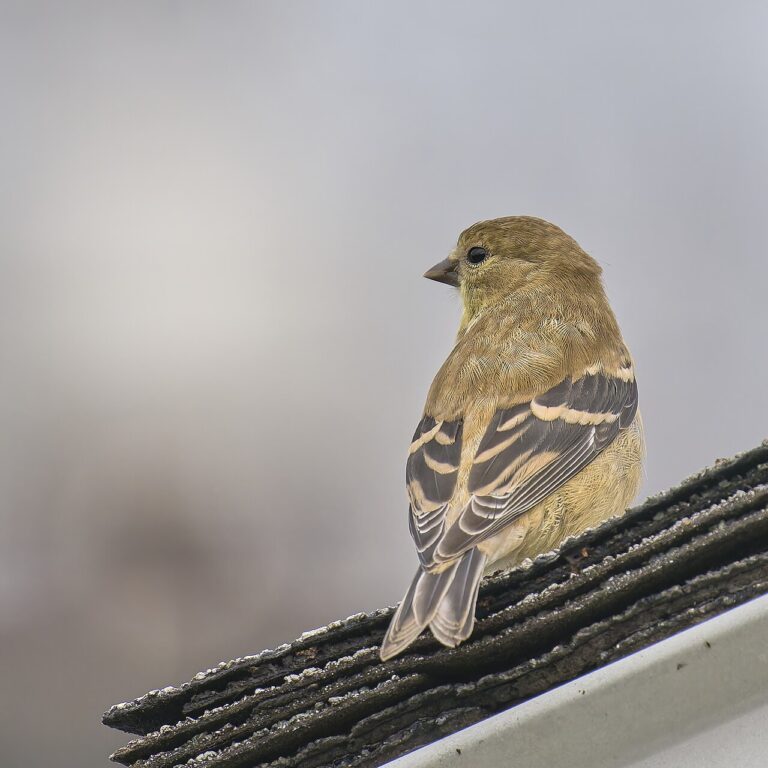
A common feeder finch frequently mistaken for a sparrow. Pine Siskins are heavily streaked brown overall but show distinctive yellow edges on the wings and tail, visible in flight or when wings spread. The thin pointed bill (vs sparrows’ conical bill) distinguishes them.
Range: Continent-wide; irruptive winter visitor in southern US.
Habitat: Coniferous forests in summer; feeders and weedy areas in winter.
Key ID vs Sparrow: Yellow wing edges (visible in flight) + thin pointed bill + nyjer-feeder preference. Sparrows have conical bills and no yellow.
Where to see: Common at nyjer feeders, often with goldfinches. Acrobatic feeders that hang upside-down.
House Finch (Female)
Probably the most commonly mistaken ‘sparrow.’ Female House Finches are heavily brown-streaked overall with a plain face, no bold stripes or markings. They lack the distinctive features that separate sparrow species (no central breast spot, no rufous cap, no clean breast).
Range: Continent-wide year-round.
Habitat: Urban and suburban areas, parks, residential neighborhoods.
Key ID vs Sparrow: Plain face (no eye-stripe, no eye-ring, no crown pattern) + smaller bill than most sparrows + often with red-headed males. Streaks are blurrier and less defined than Song Sparrow’s.
Where to see: Tube feeders with nyjer or sunflower seed. Often in flocks with male House Finches.
Purple Finch (Female)
More distinctive than House Finch female. Female Purple Finches have a strong face pattern with a bold white eyebrow stripe, white throat/cheek mustache, and crisp brown streaks on white underparts. The strong face pattern is the key feature.
Range: Northern US and Canada; winters south.
Habitat: Coniferous and mixed forests, edges.
Key ID vs Sparrow: Bold white eyebrow stripe (more prominent than any sparrow’s) + crisp streaks on white background + finch-shaped bill. The face pattern is the giveaway.
Where to see: Winter feeders in the southern US. Sunflower and nyjer seeds.
Common Redpoll
An irruptive northern finch. Common Redpolls are small and streaky-brown overall with two distinctive features: a small red cap on the forehead and a small black chin patch. Males have additional pink wash on the breast.
Range: Far northern North America; irruptive winter visitor in lower 48.
Habitat: Open habitats with weeds, birches.
Key ID vs Sparrow: Red cap + black chin patch = redpoll, not sparrow. Smaller and more compact than sparrows.
Where to see: Winter feeders during irruption years. Often with goldfinches and Pine Siskins.
Indigo Bunting (Female)
Female Indigo Buntings are uniformly warm brown with subtle blue tint on wings and tail (often very faint). They have a plain face, faint wing bars, and a small conical bill, looking like a uniform brown sparrow without distinguishing marks.
Range: Eastern US in summer.
Habitat: Brushy fields, forest edges with shrubs.
Key ID vs Sparrow: Plain warm brown + faint wing bars + sometimes blue tint visible in wings. Conical bill smaller than most sparrows.
Where to see: Brushy habitats in summer, often near singing males (which are vivid blue and easy to spot).
Painted Bunting (Female)
Female Painted Buntings are uniformly olive-GREEN, not brown, but their sparrow-like shape and behavior often leads to confusion. Plain face, no streaking, no bold markings.
Range: Southeast US (Texas, Louisiana, South Carolina coast).
Habitat: Brushy areas, woodland edges, suburban yards with cover.
Key ID vs Sparrow: Olive-green color (not brown) + uniform appearance + conical bill. The green color is unique among ‘sparrow-like’ birds.
Where to see: Southeast US feeders in summer. Visit feeders for millet.
Brown-Headed Cowbird (Female)
Female cowbirds look superficially sparrow-like but are actually much larger. Female Brown-Headed Cowbirds are uniform gray-brown overall, lacking any distinctive markings, no streaks, no stripes, no spots. The size and lack of patterning distinguishes them.
Range: Continent-wide year-round.
Habitat: Open habitat, agricultural fields, edges of forests.
Key ID vs Sparrow: Larger size (7.5 inches vs sparrow 5-6.75 inches) + uniform gray-brown + plain face. Often with male cowbirds (black body with brown head).
Where to see: Common backyard visitor. Often in flocks with other blackbirds.
Red-Winged Blackbird (Female)
Among the most commonly mistaken ‘sparrows.’ Female Red-Winged Blackbirds are heavily streaked brown overall with strong face pattern, looking exactly like an oversized sparrow. The clue: she’s larger than any sparrow (8.5 inches) and the bill is longer and more pointed.
Range: Continent-wide year-round.
Habitat: Wetlands, marshes, fields with cattails.
Key ID vs Sparrow: Larger size + longer pointed bill + often near wetlands where male Red-Winged Blackbirds are visible (jet black with red shoulder patches).
Where to see: Marsh habitats. Will visit feeders for sunflower and corn.
Dickcissel
A central US grassland bird. Male Dickcissels have a yellow breast with a black V (similar to Eastern Meadowlark but smaller). Females look more sparrow-like, pale below, brown-streaked above, but with a subtle yellow wash on the breast and a slightly heavier bill.
Range: Central US grasslands in summer.
Habitat: Hayfields, prairies, agricultural areas with weedy edges.
Key ID vs Sparrow: Heavier bill (between sparrow and grosbeak) + yellow wash on breast (subtle in females) + often singing from prominent perches.
Where to see: Central US grasslands in summer. Listen for their ‘dick-dick-dickcissel’ song.
Bobolink (Female)
Female Bobolinks look very sparrow-like. They have buffy underparts with subtle streaking, brown-streaked back, and crown stripes (dark stripes on the head). Males in breeding plumage are unmistakable (black body with white back and buff head) but non-breeding and females look sparrow-like.
Range: Northern US grasslands in summer.
Habitat: Hayfields, native prairies, wet meadows.
Key ID vs Sparrow: Crown stripes + buffy wash + longer body. Often in flocks. Males’ distinctive song helps locate them.
Where to see: Northern US grasslands during breeding season.
American Pipit
A slender, ground-walking ‘sparrow look-alike.’ American Pipits have brown-streaked plumage like sparrows, but their key ‘not sparrow’ behaviors are: walking (not hopping), constant tail-pumping, and slender pointed bill (not conical).
Range: Northern North America in summer; winters across most of US.
Habitat: Open lawns, fields, beaches, agricultural areas (winter).
Key ID vs Sparrow: Walks (sparrows hop) + tail-pumps + slender bill. The walking gait is the giveaway.
Where to see: Open lawns and fields, especially in winter. Often in flocks.
Lapland Longspur
A winter visitor to the lower 48. Lapland Longspurs are sparrow-shaped but with bicolored bills (dark upper, yellow lower), rust-edged wing feathers, and complex head patterns. Breeding males (rarely seen in lower 48) are dramatically marked with black face and chestnut nape.
Range: Far northern in summer; winter visitor to northern half of US.
Habitat: Open fields, agricultural areas, weedy edges (winter).
Key ID vs Sparrow: Bicolored bill + rust-edged wing feathers + often in flocks with Snow Buntings or Horned Larks.
Where to see: Winter agricultural fields in the northern US.
How to Tell Sparrows from Look-Alikes
Several key features separate true sparrows from look-alikes:
Bill shape: True sparrows have thick conical seed-eating bills. Pine Siskins and other finches have thinner pointed bills. Pipits have slender pointed insect bills. Blackbird females have longer, more pointed bills.
Behavior: Sparrows hop on the ground. Pipits walk. Cowbirds walk. Blackbirds walk.
Tail length and shape: Sparrows have medium-length tails with rounded edges. Pipits have longer slender tails. Pine Siskins have notched tails.
Size: True sparrows are typically 5-7 inches. Cowbirds are 7.5 inches. Female Red-Winged Blackbirds are 8.5 inches.
Flock behavior: Pine Siskins, redpolls, and goldfinches often flock together in winter. Blackbirds (cowbirds, Red-Winged) flock with their own kind.
Habitat: Pipits prefer open ground. Bobolinks prefer hayfields. Redpolls in winter prefer weedy areas with birches.
When in doubt, look at the bill shape, it’s the most reliable single feature for separating sparrows from look-alikes.
What Looks Like a Sparrow but Is Not One?
The single most common answer is the House Finch, and the giveaway is colour placement. A male House Finch has red or orange washed across the head, throat and upper breast with brown streaking down the flanks. No North American sparrow shows red like that. Female House Finches are harder, but they are plainly streaked below with a blank face lacking the crisp head pattern most sparrows carry.
Beyond the finches, the usual suspects are female Indigo Buntings, which are warm unstreaked brown with a faint wing pattern, female and juvenile Red-winged Blackbirds, which are heavily streaked and noticeably larger with a sharply pointed bill, and pipits, which walk rather than hop and bob their tails constantly. Female House Sparrows sit in a category of their own, since they are genuine sparrows but not closely related to the native American sparrows at all.
Birds That Look Like Sparrows but Bigger
A sparrow-patterned bird that is clearly too large is usually one of four things. A Song Sparrow itself surprises people at close range, but a bird noticeably bigger than that points elsewhere. Female Red-winged Blackbirds are the most frequent answer: streaky brown, sparrow-patterned, and roughly twice the bulk.
Thrashers are the next step up again, long-tailed and streaked below with a curved bill, and juvenile European Starlings in their brown plumage get reported the same way before they moult into glossy black. In open grassland, Lark Buntings, longspurs and female bobolinks fill out the list. When size is the only thing that seems wrong, check the bill first: a heavier or longer bill almost always means you have left the sparrows behind. Audubon’s House Finch account is the useful reference for the most common confusion of all.
Frequently Asked Questions
What bird is most often mistaken for a sparrow?
Female House Finch is the most commonly mistaken ‘sparrow’, brown-streaked plumage, sparrow-like size, ground-feeding habits. Pine Siskin is also frequently confused. Female Red-Winged Blackbirds are mistaken for very large sparrows. Lapland Longspurs in winter are sparrow look-alikes.
How do I tell a finch from a sparrow?
Bill shape is the most reliable feature. Sparrows have thick conical bills (designed for cracking seeds). Finches have similar but smaller, more delicate bills. Pine Siskins have thin pointed bills. Also: finches often show some color (red, yellow, or pink wash) even in females, while sparrows are usually purely brown-streaked.
Why are female birds often hard to identify?
Female plumage is typically muted brown for camouflage during nesting. Many species’ females look generically ‘sparrow-like’ compared to bright males. This is convergent evolution, multiple unrelated species have evolved similar female plumage for the same protective purpose.
What sparrow look-alike has a red cap?
Common Redpoll, a small streaky brown finch with a distinctive red cap on the forehead and a small black chin patch. Often confused with sparrows during winter at feeders.
How do I tell a Pine Siskin from a sparrow?
Yellow edges on the wings and tail (visible in flight or when wings spread) are diagnostic for Pine Siskin. Bill is thinner and more pointed than sparrows’. Plus Pine Siskins are usually with goldfinches at nyjer feeders, which sparrows don’t typically use.
What’s that big streaky brown bird that looks like a giant sparrow?
Most likely female Red-Winged Blackbird (8.5 inches, larger than any sparrow). Female Brown-Headed Cowbird is also larger (7.5 inches). Both are easy to mistake for oversized sparrows but are actually in the blackbird family.
What sparrow-like bird walks instead of hopping?
American Pipit walks (sparrows hop). The walking gait + constant tail-pumping + slender bill identify the Pipit. Often seen on open lawns and beaches.
Related reading: Birds That Look Like Robins.
Related reading: birds look like hummingbirds.
Related reading: bugs that look like silverfish.