Black-Capped Chickadee: Complete Identification, Diet, and Behavior Guide (2026)
The Black-Capped Chickadee (Poecile atricapillus) is one of North America’s most beloved backyard birds, a tiny, perky songbird with an outsized personality. With its black cap, white cheeks, black bib, gray back, and signature ‘chick-a-dee-dee-dee’ call, Black-Capped Chickadees are familiar fixtures at feeders across the northern United States and Canada. They’re remarkable for their winter survival adaptations, food caching behavior, complex vocalizations that convey detailed information about threats, and tameness, they’re often the easiest backyard birds to hand-feed. The Black-Capped Chickadee is the state bird of Maine and Massachusetts. This comprehensive guide covers Black-Capped Chickadee identification (including how to distinguish them from the nearly-identical Carolina Chickadee), range, diet, remarkable behavior, breeding, vocalizations, and proven strategies for attracting them to your backyard.
Black-Capped Chickadee: Key Facts at a Glance
| Attribute | Detail |
|---|---|
| Scientific Name | Poecile atricapillus |
| Family | Paridae (Tits and chickadees) |
| Size | 4.7-5.9 inches (12-15 cm) length |
| Wingspan | 6.3-8.3 inches (16-21 cm) |
| Weight | 0.3-0.5 oz (9-14 g) |
| Lifespan | 2-3 years average; up to 12 years recorded |
| Diet | Insects (50%) + seeds, berries, suet (50%) |
| Habitat | Deciduous and mixed forests, parks, suburban yards |
| Range | Northern US and most of Canada (south to Carolina line) |
| Population Status | Common, 41 million estimated North American population |
| Conservation Status | Least Concern (IUCN) |
| State Bird Of | Maine, Massachusetts |
| Distinctive Feature | Black cap + black bib + white cheeks |
| Song | ‘Fee-bee’ two-note whistle |
| Call | ‘Chick-a-dee-dee-dee’ |
| Special Adaptation | Can lower body temperature 10-12°F overnight to conserve energy |
Black-Capped Chickadee Identification
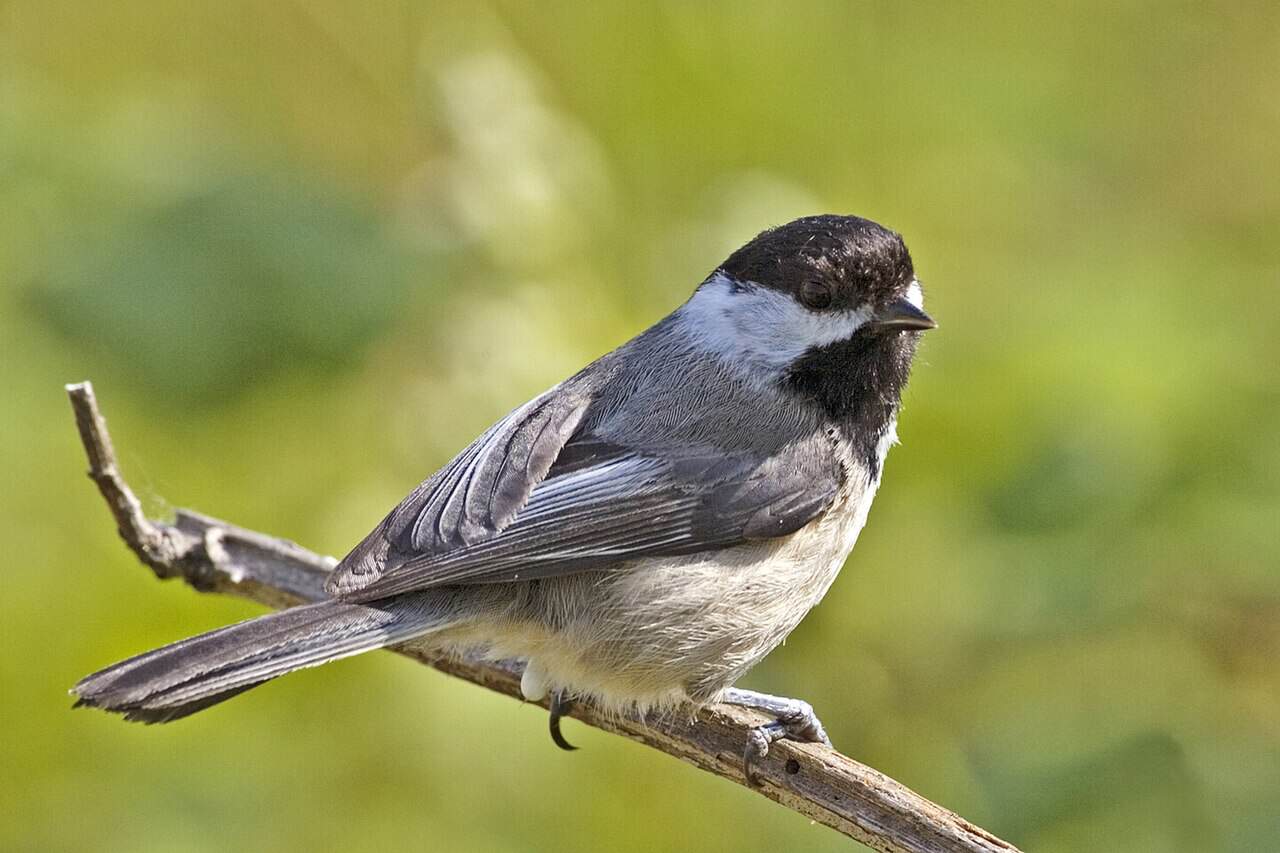
Black-Capped Chickadees have a clean, distinctive appearance: solid black cap, solid black throat/bib, bright white cheeks (creating the classic ‘masked’ look), gray back and wings, gray tail, and pale buff/gray flanks. The overall pattern is very neat and consistent across the species’ range.
Male and female Black-Capped Chickadees look essentially identical, there’s no significant sexual dimorphism. Both sexes have the same plumage pattern, body size, and coloring.
Juveniles look like duller versions of adults, with slightly browner tones. They develop full adult plumage by their first fall.
Size: Black-Capped Chickadees are tiny, only 4.75-5.25 inches long. Smaller than House Sparrows and significantly smaller than Tufted Titmice. They weigh just 0.3-0.5 oz, a remarkable mass given their winter survival challenges.
Black-Capped vs Carolina Chickadee, the classic identification challenge: These two species look nearly identical visually. Both have black caps, black bibs, white cheeks, and similar overall appearance. Key differences:
1) Song: Black-Capped sings a clear ‘fee-bee’ two-note whistle. Carolina sings a faster ‘fee-bee-fee-bay’ four-note pattern. Voice is the most reliable identifier.
2) Range: Black-Capped occupies the northern US and Canada. Carolina occupies the Southeast. The two species hybridize in a narrow contact zone across the central US.
3) Plumage subtleties: Black-Capped tends to have slightly buffier flanks; Carolina has grayer flanks. Black-Capped wings show more white edging on flight feathers; Carolina shows less.
4) Behavior: Voice differences are reliable; visual differences are subtle. Most birders identify by range and voice.
Range overlap zone: In central states (Ohio, Indiana, Missouri, etc.) where ranges overlap, hybrids occur. Hybrids may sing intermediate songs and show intermediate plumage.
Black-Capped Chickadee Range and Habitat
Black-Capped Chickadees occupy a vast range across the northern half of North America. Their range extends from Alaska through Canada, south through the northern United States to approximately the 40th parallel. The southern range edge is the boundary with Carolina Chickadees (roughly from southern Pennsylvania west to Missouri).
Habitat: Black-Capped Chickadees prefer deciduous and mixed forests, parks, suburban yards with mature trees, woodland edges, and stream-side forests. They thrive in both wilderness and suburban environments. The species is closely associated with deciduous trees, pure coniferous forests are less suitable.
Climate adaptation: Black-Capped Chickadees survive in some of the harshest winter climates of any small bird, including northern Canada and Alaska, where winter temperatures regularly drop below -40°F. Their winter survival adaptations are remarkable (see Behavior section).
Nonmigratory: Black-Capped Chickadees are non-migratory throughout their range. The same individuals stay in their breeding areas year-round. They establish family group territories and may use the same areas for multiple years.
Cyclic patterns: Black-Capped Chickadee populations show natural cyclic fluctuations. Some years bring excellent breeding seasons with high populations; other years show reductions. The fluctuations are linked to food availability (winter food, especially seed crops) and weather conditions.
Western expansion: Black-Capped Chickadees have shown range expansion into some southwestern regions where they were historically absent, though the expansion is less dramatic than that of Carolina Chickadees, Tufted Titmice, or Red-Bellied Woodpeckers.
Black-Capped Chickadee Diet
Black-Capped Chickadees are omnivores with strongly seasonal diets. Spring/summer breeding diet is roughly 70% insects; fall/winter diet is roughly 75% seeds, nuts, and berries.
Spring/summer diet: Caterpillars (the most important nestling food), spiders, beetles, flies, snails, and other invertebrates. Caterpillars provide the protein for rapid nestling growth. A single Black-Capped Chickadee pair may feed nestlings 6,000-9,000 caterpillars during the 16-day nestling period.
Fall/winter diet: Sunflower seeds, peanuts, suet, native berries (sumac, Eastern Red Cedar berries, native viburnum berries), Hemlock cones, birch seeds, and other plant material.
Hoarding behavior: Black-Capped Chickadees are remarkable food hoarders. They cache thousands of seeds each fall in scattered locations, bark crevices, knot holes, ground caches, dense vegetation. They remember cache locations with exceptional spatial memory and retrieve cached food during winter food scarcity. A single Chickadee may cache 50,000+ seeds in a single fall.
Memory adaptation: Black-Capped Chickadees actually grow new brain cells in the hippocampus during fall, increasing brain size to support food cache memory. The brain shrinks slightly during spring/summer when cache memory is less critical. This ‘hippocampal plasticity’ is one of the most remarkable adaptations in any small bird.
At feeders: Top food choices include black oil sunflower seed (universal favorite), peanut bits, peanut butter, suet, and mealworms. Black-Capped Chickadees prefer feeders that allow stable perching, tube feeders, hopper feeders, suet cages. Like other family members, they grab one seed at a time and fly off to a perch to eat or cache. A single Chickadee may visit your feeder 50+ times in a day during winter.
Black-Capped Chickadee Behavior
Black-Capped Chickadees are intelligent, social, brave, and curious, making them among the most interesting backyard birds to observe. Their winter survival adaptations are particularly remarkable.
Controlled hypothermia: Black-Capped Chickadees survive frigid winter nights by lowering their body temperature by 10-12°F (5-7°C) overnight. This ‘controlled hypothermia’ reduces their metabolic rate and energy use during cold nights. By morning, they raise their body temperature back to normal. This adaptation is critical, without it, they couldn’t survive northern winters.
Winter flocks: Black-Capped Chickadees form winter flocks with strict social hierarchies. The dominant pair leads the flock; subordinate birds (often young from the previous year) follow. Other species (titmice, nuthatches, woodpeckers) join Chickadee flocks during winter, creating mixed-species ‘foraging guilds.’
Vocal complexity and alarm calls: Black-Capped Chickadees produce remarkably complex vocalizations. Different alarm calls warn of different threat types. The number of ‘dee’ notes at the end of ‘chick-a-dee-dee-dee’ calls signals threat severity, more ‘dees’ indicates greater perceived danger. Different acoustic patterns warn of aerial vs ground threats.
Hand-feeding: Black-Capped Chickadees are perhaps the easiest backyard birds to hand-feed. Many backyard birders successfully train Chickadees to take sunflower seeds from outstretched palms within 1-3 weeks of consistent feeding. Their boldness around humans and intelligence make hand-feeding possible.
Lifespan: Wild Black-Capped Chickadees have been recorded surviving 12 years, exceptional. Average lifespan is 2-3 years for adults. First-year mortality is high (~50%) due to inexperience and winter challenges. Major mortality factors: predation by Cooper’s Hawks (major predator at feeders), Sharp-Shinned Hawks, owls, and outdoor cats.
Black-Capped Chickadee Breeding and Nesting
Black-Capped Chickadee breeding begins in April-May. Most pairs raise one brood per year, though occasional second broods occur in southern regions.
Cavity nesting: Black-Capped Chickadees are cavity nesters. They excavate their own cavities in soft, rotting wood (typically birch or aspen), a relatively unusual behavior since most Chickadee relatives use existing cavities. They also use natural cavities, old woodpecker cavities, and nest boxes.
Pair excavation: Both members of the pair excavate. Excavation takes 7-14 days. The cavity is typically 8-10 inches deep with a 1.125-inch entrance hole. Excavating their own cavity ensures fresh, predator-free housing.
Eggs: Each clutch contains 6-8 eggs (typically 7). Black-Capped Chickadee eggs are white with brown spotting. Incubation takes 12-13 days, performed primarily by the female. The male feeds the female during incubation.
Nestling period: Both parents feed nestlings, primarily caterpillars during the first days, then a mix of insects and seeds. Nestlings remain in the nest cavity for 16 days. After fledging, juveniles remain with parents for 3-4 weeks while learning to forage.
Nest box use: Black-Capped Chickadees readily use nest boxes with 1.125-inch entrance holes, mounted on tree trunks 5-15 feet above ground. Fill the box with wood shavings (1-2 inches deep) so the birds can excavate slightly, they prefer to create their own cavity even within a box.
Family group breakdown: After juveniles become independent (3-4 weeks post-fledging), they leave parental territory and disperse to find new territories. Most disperse within their first fall, joining winter flocks where they may travel several miles from their hatching site.
Black-Capped Chickadee Vocalizations
Black-Capped Chickadees have one of the most complex vocal repertoires of any backyard bird. Their vocalizations convey detailed information about threats, identity, and emotional state.
Song: The ‘fee-bee’ two-note whistle, clear, descending two notes. This song is given primarily during breeding season (February-July) and serves territory advertisement.
Chick-a-dee call: The signature ‘chick-a-dee-dee-dee’ call gives the species its name. The call serves multiple functions: contact between flock members, alarm signals about predators, and identity recognition. The NUMBER of ‘dee’ notes is informative, more ‘dees’ signals greater perceived threat. A call with 6+ ‘dees’ indicates a serious threat; 2-3 ‘dees’ is a normal contact call.
Variable alarm calls: Different acoustic patterns warn of different threats. Quick, sharp calls warn of aerial predators (hawks). Mobbing calls (rapid ‘chick-a-dee-dee-dee-dee-dee’) organize group defense against ground predators (cats, snakes). The specific call patterns are recognized by other species, mixed flocks share Chickadee alarm information.
Begging calls: Chickadee nestlings produce begging calls audible from outside the cavity. The calls intensify when the parents arrive with food.
Information density: Research has shown that Black-Capped Chickadee calls contain detailed information about predator type, distance, and movement. Other Chickadees and species in mixed flocks respond appropriately to specific call patterns, Chickadees are essentially providing detailed threat reports to nearby birds.
Black-Capped Chickadee Subspecies and Regional Variations
Black-Capped Chickadees are divided into nine recognized subspecies across their North American range. The variations are subtle and most birders identify all as ‘Black-Capped Chickadee.’
Eastern Black-Capped Chickadee (P. a. atricapillus): The most familiar subspecies across the northeastern US and adjacent Canada. Standard Black-Capped appearance.
Northwestern Black-Capped Chickadee (P. a. occidentalis): Pacific Northwest coast. Slightly darker overall than Eastern.
Long-Tailed Black-Capped Chickadee (P. a. fortuitus): Western Canada. Slightly longer-tailed than other subspecies.
Several other subspecies occur across the species’ range, with minor differences in plumage shade and body size.
Black-Capped vs Carolina hybridization: In the contact zone between the two species (central US, Pennsylvania to Missouri), hybrids occur. Hybrids may sing intermediate songs and show intermediate plumage. The contact zone is gradually shifting northward, possibly due to climate change.
Genetic adaptations: Recent research has documented genetic differences between Black-Capped Chickadee populations adapted to different climates. Birds in colder regions show genetic adaptations for greater cold tolerance and food caching.
How to Attract Black-Capped Chickadees to Your Backyard
Black-Capped Chickadees are among the easiest backyard birds to attract. A few key strategies dramatically increase Chickadee abundance, most northern yards can attract reliable Chickadee visitors within days of adding the right feeders.
1. Offer black oil sunflower seed. Universal Chickadee favorite. Use tube feeders, hopper feeders, or platform feeders with stable perches. Chickadees can use a wide variety of feeder types.
2. Provide suet, especially in winter. Black-Capped Chickadees rely heavily on suet during cold weather. Use cage-style suet feeders accessible from multiple sides. Suet provides the high-calorie food essential for winter survival.
3. Offer shelled peanuts. Peanuts are a top Chickadee food. They grab whole peanuts and fly off to crack them open or cache them. Use peanut feeders or scatter peanut bits on platform feeders.
4. Provide peanut butter (in cool weather). Spread peanut butter on tree bark or in feeder cups during cool weather. Chickadees love peanut butter as a high-calorie food. Don’t use in hot weather (above 80°F).
5. Plant native deciduous trees. Native oaks, maples, dogwoods, and birches provide both insect food and nesting cavities. Black-Capped Chickadees prefer native deciduous trees over conifers.
6. Install a nest box. Use a box with 1.125-inch entrance hole, mounted on a tree trunk 5-15 feet above ground. Fill with wood shavings so Chickadees can excavate slightly. Mount in early spring before breeding season.
7. Provide cover for escape routes. Black-Capped Chickadees are wary at feeders, they prefer feeders within 10 feet of dense cover (shrubs, evergreens, brush piles). They retreat to cover between feeder visits.
8. Train Chickadees to hand-feed. With consistent feeding from an outstretched palm over 1-3 weeks, many Chickadees will accept sunflower seeds from human hands. This is one of the most rewarding backyard birding experiences. Start by holding seeds near a feeder for several minutes daily; gradually move your hand closer to the feeding spot.
9. Provide year-round water. Black-Capped Chickadees visit bird baths regularly. Heated baths are valuable in winter when water freezes. They especially appreciate moving water (drippers or fountains).
10. Maintain feeders consistently. Black-Capped Chickadees rely on reliable winter food. Keep feeders filled through winter, Chickadees may have memorized your feeder location and depend on it.
Many Black-Capped Chickadees develop personal relationships with humans who feed them. The same individual Chickadee may visit your feeders for 5-8 years, recognizing you specifically and approaching when you’re in the yard. This personal connection is one of the most rewarding outcomes of dedicated backyard birding.
Related reading: what do chickadees eat.
Frequently Asked Questions
What’s the difference between Black-Capped and Carolina Chickadee?
Voice is the most reliable identifier. Black-Capped sings a clear ‘fee-bee’ two-note whistle. Carolina sings a faster ‘fee-bee-fee-bay’ four-note pattern. Range matters too: Black-Capped in the northern US and Canada; Carolina in the Southeast. The two species hybridize in a narrow contact zone across the central US (roughly from southern Pennsylvania to Missouri). Plumage is nearly identical, voice and range are the key distinguishers.
How do Chickadees survive cold winters?
Black-Capped Chickadees have remarkable adaptations: 1) Controlled hypothermia, they lower body temperature 10-12°F overnight to reduce energy use. 2) Food caching, they hoard 50,000+ seeds in fall and remember locations through winter. 3) Mixed-species flocks, they join chickadee-titmouse-nuthatch flocks for better predator detection. 4) Hippocampal plasticity, they grow new brain cells in fall to support cache memory. 5) Insulating plumage, their feathers provide excellent insulation. These adaptations allow them to survive temperatures down to -40°F.
Can I train Black-Capped Chickadees to take seeds from my hand?
Yes! Black-Capped Chickadees are perhaps the easiest backyard birds to hand-feed. With patient consistent feeding from an outstretched palm over 1-3 weeks, many Chickadees will accept sunflower seeds from human hands. Start by holding seeds near a feeder for several minutes daily; gradually move your hand closer to the feeding spot. Within a week or two, bolder Chickadees often accept seeds from your palm. This is one of the most rewarding backyard birding experiences.
Do Chickadees mate for life?
Most Black-Capped Chickadee pairs form lasting bonds. Many pairs remain together for multiple breeding seasons or until one bird dies. The bond is strong but not always lifelong, pair changes occasionally occur between breeding seasons. Within a pair, both birds participate in nest excavation, incubation (female does most of it), and feeding nestlings.
Why do Chickadees say ‘chick-a-dee’ more times when there’s danger?
The number of ‘dee’ notes in Chickadee calls actually signals threat severity. More ‘dees’ indicates greater perceived danger. A call with 6+ ‘dees’ indicates a serious threat (Cooper’s Hawk, owl); 2-3 ‘dees’ is a normal contact call. This information is so reliable that mixed-species flocks (titmice, nuthatches, etc.) respond appropriately to Chickadee threat-level signals.
How long do Black-Capped Chickadees live?
Wild Black-Capped Chickadees have been recorded surviving 12 years, exceptional. Average lifespan is 2-3 years for adults. First-year mortality is high (~50%) due to inexperience and winter challenges. Adults surviving their first year often live 4-6 years. The same individual Chickadee may visit your feeder for many years.
Do Black-Capped Chickadees use nest boxes?
Yes, they readily use nest boxes with 1.125-inch entrance holes, mounted on tree trunks 5-15 feet above ground. Fill the box with wood shavings (1-2 inches deep) so the birds can excavate slightly, they prefer to create their own cavity even within a box. Mount the box in early spring before breeding season (March-April).
Why are Chickadees so brave around humans?
Black-Capped Chickadees have evolved to thrive in environments with significant disturbance, they’re naturally curious and bold. Their small size (and ability to escape quickly) makes them less risk-averse than larger birds. They also seem to recognize that humans usually mean food. Many Chickadees recognize specific humans who regularly feed them and approach those humans more boldly than strangers.
More in this series: how to attract chickadees, chickadee nest boxes.
Related reading: types of chickadees.