American Green Tree Frog: Identification, Call, Range and Care
The American green tree frog (Hyla cinerea, also listed as Dryophytes cinereus) is a slender, bright green frog of the southeastern United States, 1.25 to 2.5 in (3 to 6 cm) long, marked by a crisp white or cream stripe down each side. It is the frog behind the nightly honking chorus around ponds from Delaware to Texas, and it is the state amphibian of both Georgia and Louisiana.
Americans encounter it more often than any other native tree frog because it thrives in exactly the places people build: retention ponds, cypress swamps behind subdivisions, cattle tanks and screened porches with a bug-attracting light. Everything else about the species follows from that habit of living close to permanent water and artificial light.
The American green tree frog is a 1.25 to 2.5 in (3 to 6 cm) native tree frog of the southeastern United States, identified by smooth green skin and a white stripe along each flank. It eats flies, crickets and moths, calls with a nasal honk on warm humid nights, and lives about 2 to 5 years wild and 6 years or more in captivity.
| Quick fact | Detail |
|---|---|
| Scientific name | Hyla cinerea (Dryophytes cinereus) |
| Adult size | 1.25 to 2.5 in (3 to 6 cm), females larger |
| Key marking | White to cream stripe from jaw along each flank |
| Range | Delaware south to Florida, west to central Texas |
| Lifespan | 2 to 5 years wild, 6 or more in captivity |
| Call | Nasal honk, about 75 calls per minute |
| Legal status | Common, not protected federally; state rules vary |
What Does the American Green Tree Frog Look Like?
Smooth bright green skin and a sharply defined pale stripe running from the upper jaw along each flank are the two features that settle the identification. The stripe may stop at the shoulder on some individuals or run all the way to the groin on others, and tiny gold flecks often dot the back. Toe pads are large and round, the belly is white to cream, and the eyes have a horizontal gold-brown iris.
Color is not fixed. A frog resting on a sunlit leaf sits emerald, while the same animal at 55 F (13 C) or under stress turns slate gray to olive brown, which sends a lot of people looking for a different species. Females run visibly larger than males, and adult males carry a wrinkled, slightly yellow-green throat from the stretching of the vocal sac. Broader family differences are laid out in the tree frog overview.
Where American Green Tree Frogs Live

The range covers the coastal plain from Delaware and Maryland south through Florida and west to central Texas, pushing up the Mississippi valley as far as southern Illinois. Within that area the species needs permanent or semi-permanent water with emergent vegetation: cypress swamps, marsh edges, farm ponds, ditches and slow river backwaters. It climbs cattails, buttonbush and saplings rather than tall canopy.
Suburbs suit it. Retention ponds provide breeding water, porch lights concentrate insects, and irrigated landscaping keeps humidity up, so populations often sit higher near houses than in nearby dry woods. The trade-off is road mortality and pesticide exposure, both of which hit local numbers hard in a single season.
What Do American Green Tree Frogs Eat?
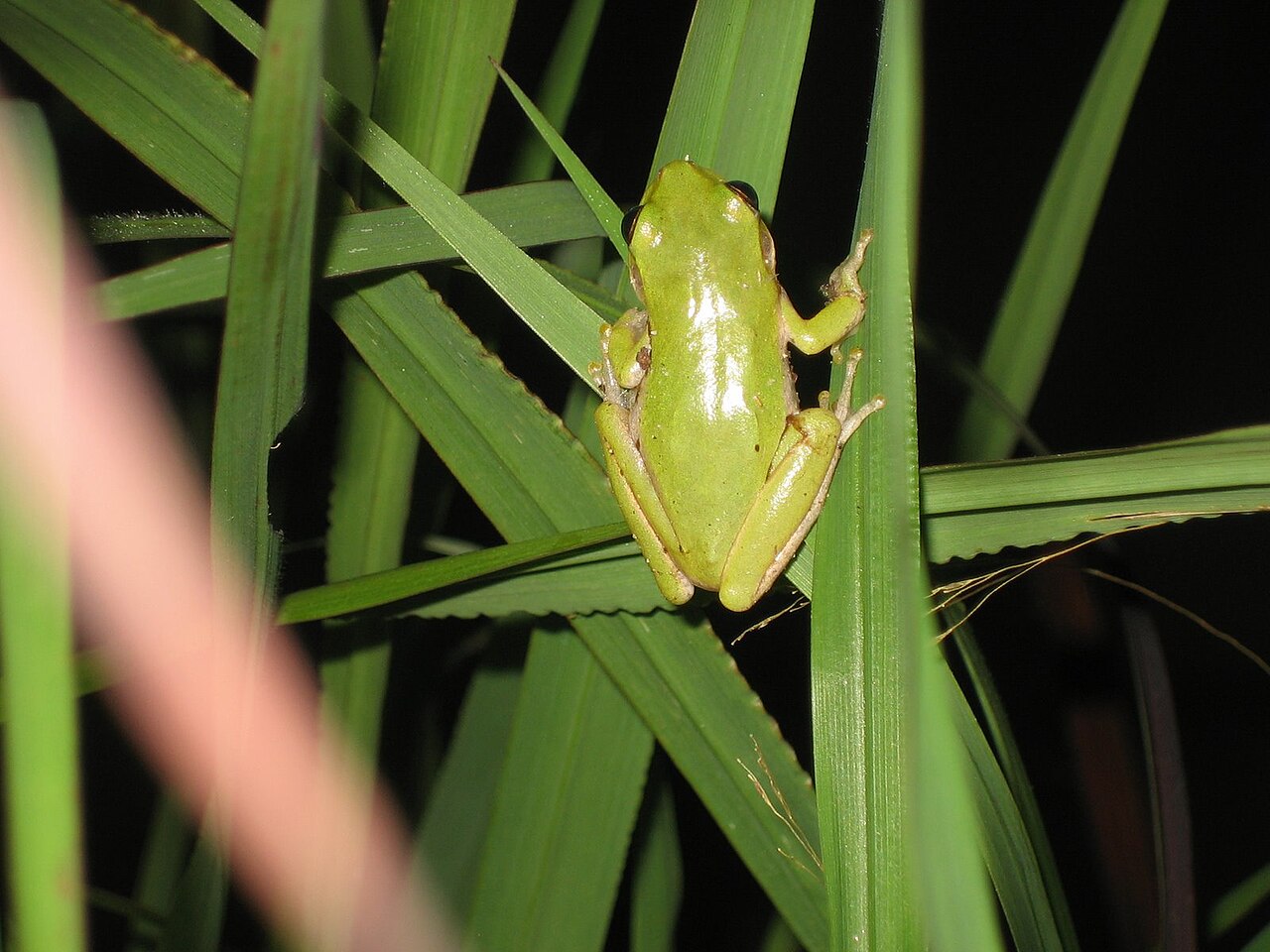
Adults take almost any moving invertebrate that fits in the mouth: flies, moths, mosquitoes, crickets, small beetles, spiders and the occasional small tree frog. Hunting is visual and opportunistic, which is why the frogs cluster on window screens and light fixtures after dark, waiting for insects to come to them rather than searching vegetation.
Tadpoles are different animals entirely, grazing algae and detritus off submerged surfaces with rasping mouthparts for 6 to 10 weeks before metamorphosis. In captivity the diet is crickets and small roaches dusted with calcium and vitamin D3 twice a week, three or four insects every other day for an adult.
What an American Green Tree Frog Sounds Like
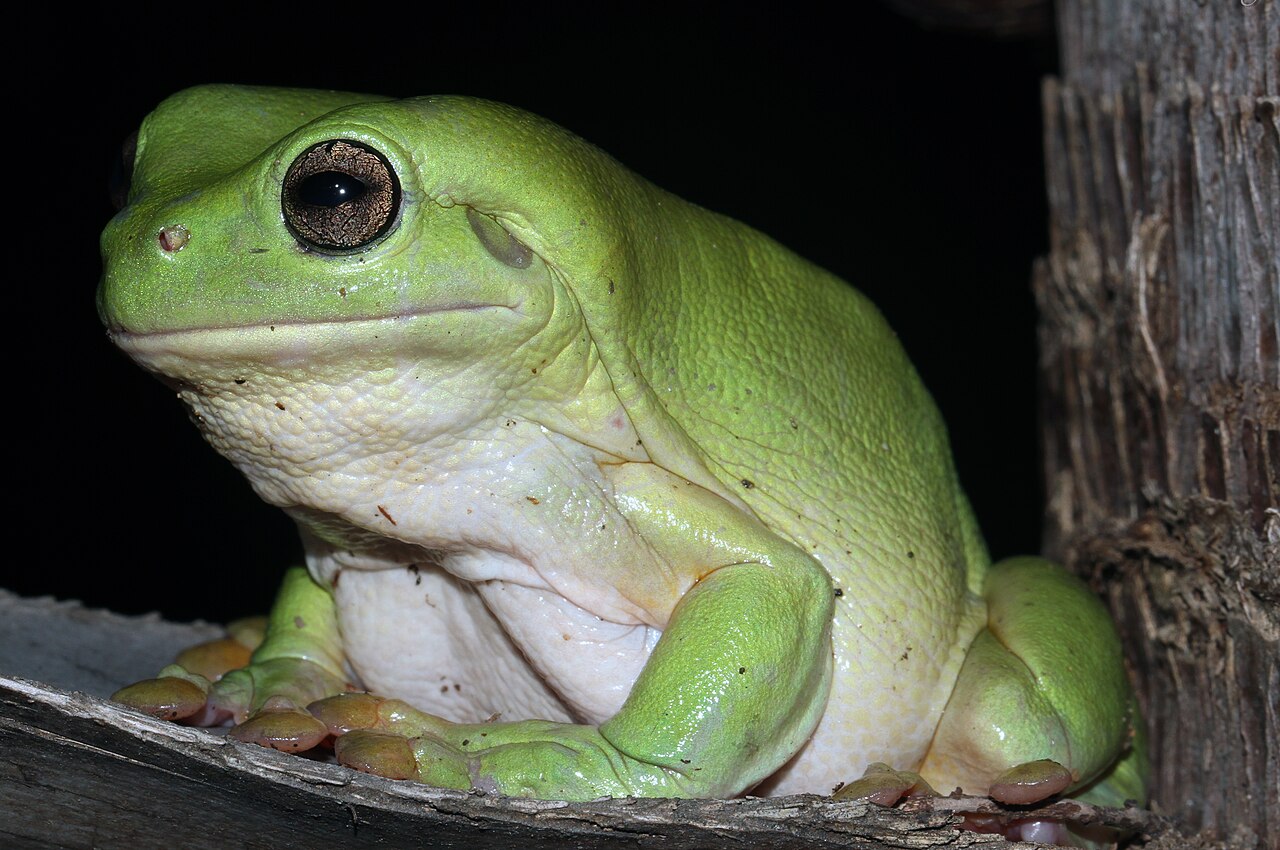
The advertisement call is a loud, nasal quonk repeated about 75 times a minute, often compared to a cowbell or a small dog barking at a distance. A hundred males calling together from one pond edge produce a wall of sound that carries well over a quarter mile, and the chorus peaks after warm rain from April into August.
Two other sounds matter for identification. A short rain call comes from frogs sitting well away from water on humid evenings, which confuses people who are looking for a pond. A high, sharp scream signals a frog that has been seized by a snake or a hand. Comparisons across species are collected in tree frog sounds, and the deeper barking call of the barking tree frog is the one most often mistaken for it.
Breeding, Eggs and Tadpoles
Breeding runs from March or April through August, triggered by warm nights and heavy rain. Males call from vegetation at the water’s edge, and a female that approaches is grasped behind the forelimbs in amplexus. She deposits 400 to 1,000 eggs in a loose film on the surface, usually attached to floating plants, and they hatch within a week.
Tadpoles need 6 to 10 weeks and permanent enough water to finish, which is why the species favors ponds over the ephemeral pools other frogs use. Newly transformed froglets leave the water at under 0.5 in (1.3 cm) and are heavily preyed on by fish, snakes, wading birds and even the larger Cuban tree frog where the two overlap in Florida.
What Is the Lifespan of a Green Tree Frog?
Wild American green tree frogs live about 2 to 5 years, and the median is lower than most people expect because froglets are eaten in enormous numbers during their first summer. A frog that reaches its second breeding season has passed the hardest part. In captivity, with predators removed and feeding steady, 6 years is normal and individuals have reached 10.
The limits on wild longevity are predation, road traffic and winter. Frogs in the northern part of the range shelter under bark, leaf litter and root cavities through cold months, a shutdown covered in more detail in do frogs hibernate. The much larger Australian green tree frog outlives this species by a factor of three, which is mostly a matter of body size and water-retentive skin.
Can I Keep an American Green Tree Frog as a Pet?
Yes, and it is one of the easier native amphibians to keep, though it is more nervous and less handleable than the Australian species sold as White’s tree frog. Two or three adults do well in an 18 in tall (45 cm) front-opening vertical enclosure with cork bark, sturdy live plants and a shallow dechlorinated water dish large enough to sit in.
Target 72 to 82 F (22 to 28 C) by day with a drop at night, humidity of 60 to 70 percent from a daily misting, and a low-output UVB and LED plant light on a 12-hour cycle. Buy captive-bred animals. Wild-caught green tree frogs arrive with heavy parasite loads and are a route for spreading chytrid fungus back into local populations.
How Much Does a Green Tree Frog Cost?
The frog itself is cheap: 10 to 25 USD for a captive-bred American green tree frog at a reptile show or from an online breeder, and sometimes under 10 USD at a chain store. That price is why the species is bought impulsively and why so many end up rehomed.
The real cost is the enclosure. A correct setup runs 150 to 300 USD once you add the tank, lighting, thermostat, hygrometer, substrate, plants and branches, plus roughly 10 to 20 USD a month for insects and supplements. Budget for a vet who treats amphibians before you buy, because there are fewer of them than there are frogs for sale.
Is It Illegal to Keep a Tree Frog?
There is no federal ban on keeping American green tree frogs, but state wildlife law decides whether you may collect one. Several states in the range require a fishing or hunting license to take native amphibians, set bag limits, or prohibit collection entirely, and rules differ between Florida, Georgia, Texas and the Carolinas. Selling wild-caught natives without a permit is a separate violation in most of them.
Check your state agency before picking a frog off a porch screen, and assume that a frog collected legally may still not be released once it has been in captivity. Regional species accounts and legal notes are maintained by university herpetology programs such as the Savannah River Ecology Laboratory.
Can I Touch an American Green Tree Frog?
Handle one only when you have to, with hands rinsed in plain water and no soap, lotion or sanitizer residue. Amphibian skin absorbs whatever it touches, so hand products go straight into the bloodstream, and the frog loses body moisture to dry human skin within a minute or two. Wet, clean hands or clean disposable gloves are the standard.
The risk to you is small but real. Green tree frogs are not venomous and are not dangerous to hold, but like most amphibians they can carry Salmonella, so wash thoroughly afterward and keep frogs and their water away from kitchens. Households with children under five are advised against amphibian pets for that reason.
Are American Green Tree Frogs Invasive?
Not within their native southeastern range, where they are an indigenous and locally abundant species. The invasive tree frog problem in that region runs the other way: the introduced Cuban tree frog eats native green tree frogs and displaces them across peninsular Florida, and populations of Hyla cinerea drop where it becomes established.
Outside the native range the picture changes. Green tree frogs have been recorded as introduced populations in places including Puerto Rico and parts of the Caribbean, moved around as hitchhikers in nursery plants. That is the standard route for amphibian introductions, and it is the argument against releasing any captive frog outdoors.
Frequently Asked Questions
Are green frogs aggressive?
Not toward people. American green tree frogs never bite defensively and their response to a threat is to jump, scream or urinate. Males do wrestle over calling positions during breeding season, and a large frog will eat a smaller tree frog, so housing different sizes together in captivity is a genuine problem.
Do frogs get attached to humans?
No. Frogs recognize routine, not people. A captive green tree frog will learn that the lid opening means food and will approach on schedule, which looks like recognition but is simple association. There is no evidence of social bonding in any tree frog, and handling for affection stresses the animal rather than reassuring it.
Can I pick up a green tree frog?
You can, briefly, with wet clean hands, cupping rather than gripping so the frog is not squeezed. Keep it low over a soft surface because a startled frog leaps hard and a fall from chest height onto tile can be fatal. Return it to the same spot you found it within a couple of minutes.
How do I tell a green tree frog from a squirrel tree frog?
Size and edges. The squirrel tree frog (Hyla squirella) is smaller, under 1.5 in (3.8 cm), and if it shows a side stripe at all the stripe is blurred and broken. An American green tree frog is longer-legged with a sharp, unbroken pale line. Voice separates them cleanly: a raspy chatter against a nasal honk.
Do American green tree frogs need a heat lamp?
Usually not. Most homes sit inside the 72 to 82 F (22 to 28 C) range this species wants, and overhead heat dries an enclosure fast. If a room drops below 68 F (20 C) at night, use a low-wattage ceramic heat emitter on a thermostat rather than a bright basking bulb, which would keep a nocturnal frog hidden all day.
Why do green tree frogs call in my yard at night?
Because there is breeding water within a few hundred feet and a light source pulling in insects. Males call from vegetation, walls and gutters near ponds, ditches and even pool enclosures on warm humid nights from spring through late summer. It is a sign of a functioning local wetland, and the chorus stops on its own once the season ends.