Osprey: Fish Hawk Specialist Guide
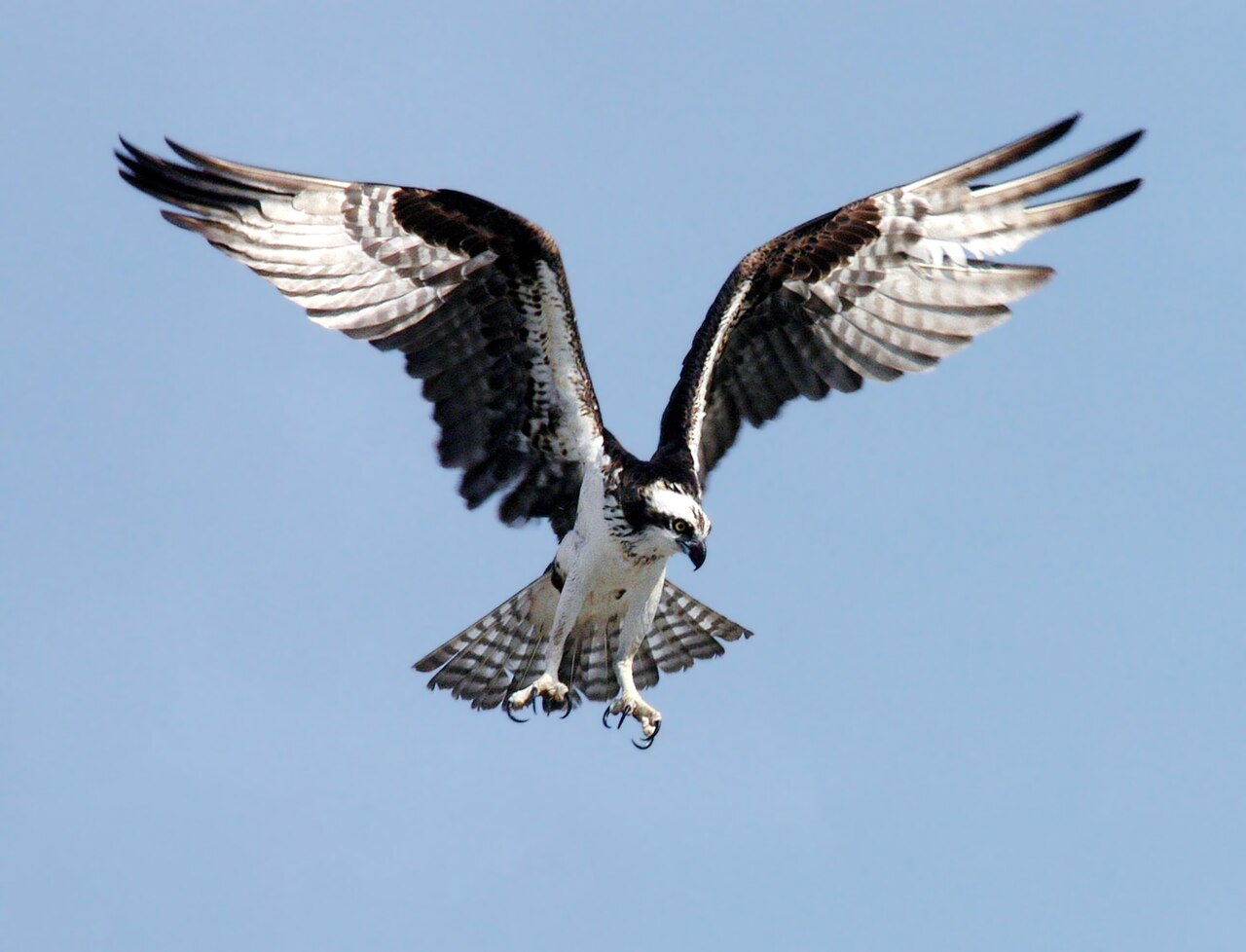
The osprey, often called the fish hawk, is a large raptor with a white head, dark eye stripe, and mostly white underside, and it is one of the very few birds of prey on Earth that feeds almost exclusively on live fish. Ospreys belong to their own distinct family, separate from hawks and eagles, and they are found on every continent except Antarctica, making them one of the most widely distributed raptors in the world. Their signature hunting move, a feet-first plunge into open water, is one of the most recognizable sights in North American birding.
| Fact | Detail |
|---|---|
| Wingspan | 4.5 to 6 ft |
| Weight | 2 to 4.5 lbs |
| Diet | Almost entirely live fish, caught by diving feet first |
| Range | Every continent except Antarctica |
| Nest | Large stick platform, often on poles or channel markers |
| Migration | Long-distance, some travel to South America each winter |
Is an Osprey a Hawk or an Eagle?
Despite the common nickname “fish hawk,” the osprey is neither a true hawk nor an eagle; it belongs to its own single-species family, Pandionidae, distinct enough from other raptors that scientists classify it in a category of its own. Ospreys share some traits with both groups, including a hooked beak and sharp talons, but their reversible outer toe, which lets them grip a fish with two toes forward and two back, is unique among North American raptors and a direct adaptation for handling slippery prey. That same distinct lineage is part of why an osprey looks a bit different from a red-tailed hawk or bald eagle up close, with a slimmer build, longer wings, and a more angular flight silhouette closer to some falcon species than to true eagles.
Size and Appearance
Ospreys are large for a raptor but noticeably smaller and slimmer than a bald eagle, with a wingspan of four and a half to six feet and a weight typically between two and four and a half pounds. The head is white with a bold dark stripe running through the eye, the back and wings are dark brown, and the underside is mostly white, a pattern that shows clearly whether the bird is perched or soaring. In flight, ospreys hold their long wings with a distinctive bend at the wrist, giving them an M shaped or gull-like silhouette that is one of the fastest ways to identify one at a distance, well before the eye stripe is visible, even to birders still building confidence with raptor identification in general.
Diet: The Original Fish Hawk
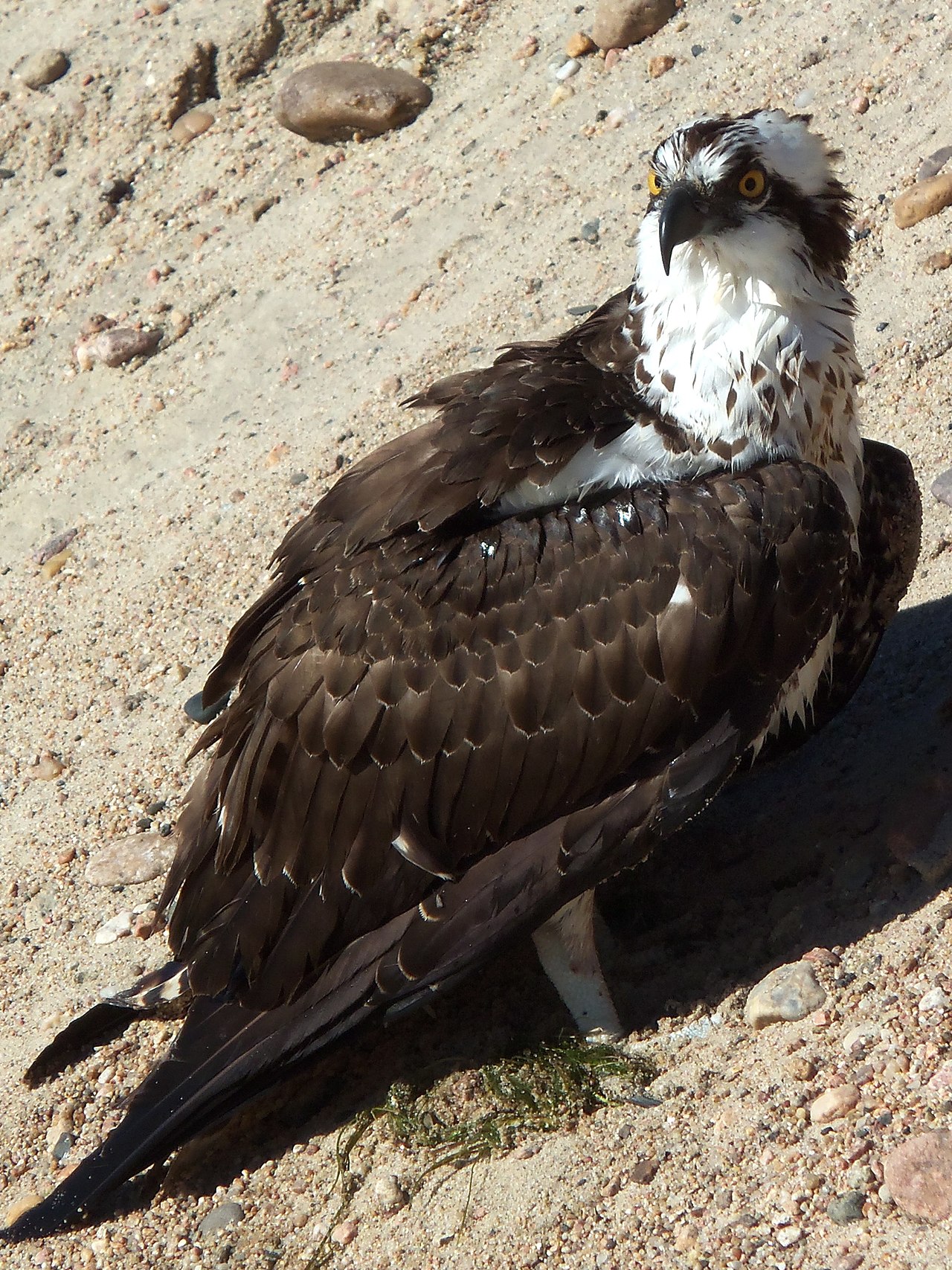
Fish make up more than 99 percent of a typical osprey’s diet, an unusually specialized diet compared to most raptors, which readily switch between prey types depending on availability. Ospreys hunt by hovering 30 to 100 feet above water, then diving feet first, sometimes submerging entirely, to seize a fish near the surface with their sharp, curved talons, a technique that takes young birds months of practice to master reliably. Once airborne again, an osprey characteristically rotates the fish in its grip so that it faces forward, reducing wind resistance during the flight back to a perch or nest, a small but energy-saving adjustment made almost instantly after each successful strike. Special barbed pads on the soles of their feet, along with that reversible outer toe, give ospreys an unusually secure grip on wet, slippery fish that other raptors lack. This same specialization is exactly what makes ospreys a frequent target of bald eagles, which will chase a successful osprey in flight until it drops its catch, a behavior discussed further in our bald eagle guide.
Nesting and Migration
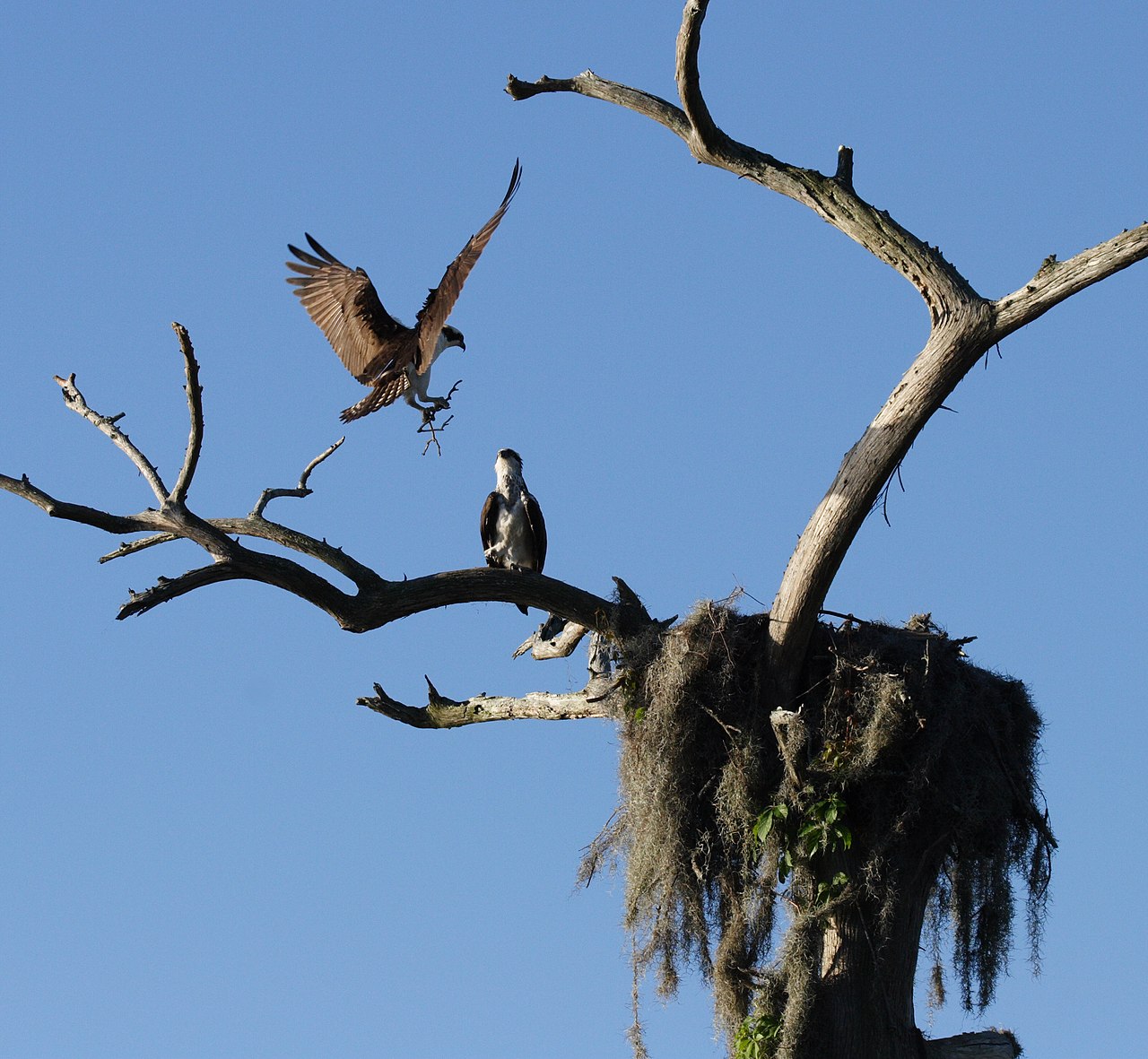
Ospreys build large stick nests, often reused and added to for years, typically on platforms, dead trees, utility poles, or purpose-built nesting platforms near water, since easy access to fishing grounds matters more to nest placement than height or concealment. Pairs are largely monogamous and often return to the same nest site year after year, with the male typically arriving first each spring to begin repairs before the female rejoins him. Most North American ospreys are long-distance migrants, traveling as far as South America for the winter and covering thousands of miles twice a year, and researchers have tracked individual birds using the same wintering territory for a decade or more, often along the same river mouth or stretch of coastline each single year.
Range and Where to See Ospreys
Ospreys have one of the widest natural distributions of any raptor, breeding on every continent except Antarctica and found near almost any body of water with a reliable fish supply, from coastal estuaries to inland reservoirs and rivers. In the US, ospreys are common along both coasts and around major lakes and rivers throughout the summer breeding season, with Florida hosting a substantial year-round population that does not migrate at all, a pattern also seen in a handful of other resident populations scattered across the warmer parts of the Gulf Coast. Their tolerance for nesting near human activity, including channel markers, docks, and utility poles, has made ospreys one of the more visible large raptors in developed coastal and lakeside areas, unlike more reclusive species such as the golden eagle. For the wider raptor picture, our guide to birds of prey and types of hawks cover related species that often share the same skies.
Conservation History
Like the bald eagle, osprey populations crashed through the mid twentieth century due to the pesticide DDT, which thinned eggshells and caused widespread nesting failure across much of their range, particularly in the northeastern United States. The ban on DDT in 1972, combined with the installation of artificial nesting platforms along coastlines and rivers, allowed osprey numbers to rebound strongly over the following decades, and today the species is considered stable and widespread across nearly all of its historic range. According to the Cornell Lab of Ornithology, ospreys are now one of the more reliable large raptors to spot in developed coastal and lakeside areas precisely because of this recovery, aided by their comfort nesting on artificial structures that would deter more reclusive species. Ongoing threats include habitat loss around wetlands and declining fish stocks in some regions, but the osprey’s global distribution and adaptability have made it one of the more resilient large raptors worldwide.
Behavior and Vocalizations
Ospreys are largely solitary hunters outside of the breeding season, though they will tolerate other ospreys fishing nearby when food is abundant, a contrast to the more territorial behavior typical of eagles and hawks defending a single hunting ground. Their call is a series of sharp, high-pitched whistled cheeps, often given repeatedly when a bird is disturbed near the nest or announcing a successful catch to its mate, quite different from the deeper calls of larger raptors. Ospreys are also notably tolerant of human activity compared to many birds of prey, regularly nesting on channel markers, athletic field light poles, and cell towers within sight of heavy foot and boat traffic, provided a reliable fishing spot is nearby. This tolerance, combined with a diet that rarely brings them into direct competition with land-hunting raptors, is a large part of why osprey populations have rebounded so successfully alongside expanding human development along coastlines and lakes, a recovery pattern that mirrors, and in some regions has outpaced, that of the bald eagle.
Frequently Asked Questions
Is an osprey a hawk?
No, despite the nickname “fish hawk,” an osprey belongs to its own distinct family, separate from true hawks and eagles, largely because of its unique reversible outer toe and near-total dependence on fish.
What do osprey eat?
Fish make up more than 99 percent of an osprey’s diet, caught by diving feet first into open water, making it one of the most specialized feeders among all birds of prey.
How big is an osprey?
An osprey has a wingspan of about 4.5 to 6 feet and weighs between 2 and 4.5 pounds, noticeably smaller and slimmer than a bald eagle.
Do osprey migrate?
Most North American ospreys migrate long distances, some traveling as far as South America for the winter, though populations in places like Florida often remain year-round.
Do osprey mate for life?
Osprey pairs are largely monogamous and frequently return to and reuse the same nest site together for many consecutive breeding seasons.
Is an osprey an eagle?
No, an osprey is not an eagle. It belongs to its own single-species family, Pandionidae, distinct from both true eagles and hawks.
What does an osprey sound like?
Ospreys make a series of sharp, high-pitched whistled cheeps and chirps, quite different from a bald eagle’s weak chatter or a red-tailed hawk’s descending screech.
How long do osprey live?
Ospreys typically live 15 to 20 years in the wild, and banded individuals have been documented returning to the same nesting and wintering territories for well over a decade.