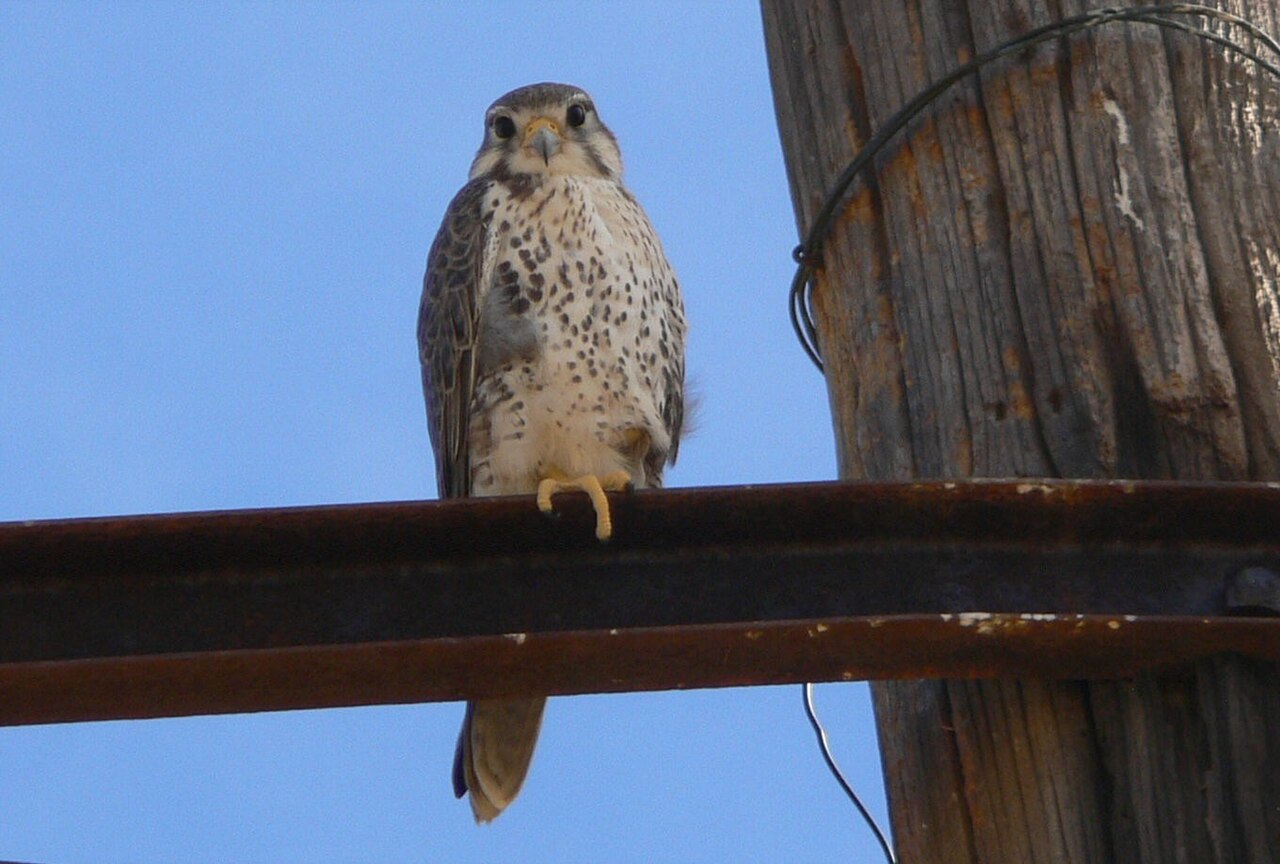
Prairie Falcon: Western Specialist
The prairie falcon is a pale, sandy-brown raptor of the open, arid American West, close in size to a peregrine falcon but built for a drier, more ground-squirrel-heavy diet across deserts, grasslands, and canyon country, terrain quite different from the coastal cliffs and wetlands many other falcons favor. Its washed-out coloring blends effectively into dry, exposed terrain, and dark patches under the wings near the body, called axillaries, are one of the clearest field marks separating it from a similarly sized peregrine falcon in flight overhead.
| Fact | Detail |
|---|---|
| Wingspan | 3.3 to 3.6 ft |
| Weight | 1 to 2.5 lbs (females larger) |
| Diet | Ground squirrels, small mammals, songbirds |
| Habitat | Arid grassland, desert, canyon country, western US |
| Key field mark | Dark axillaries (wing linings near the body) |
| Nest | Cliff ledges and canyon walls, no nest built |
Size and Appearance
A prairie falcon is close in size to a peregrine falcon, with a wingspan of roughly three and a half feet, but its overall coloring is far paler, a sandy or grayish brown above and cream colored below with scattered brown spotting rather than the peregrine’s crisp barring pattern seen at close range. The face shows a narrower, less bold dark mustache mark than a peregrine’s, and the overall impression in good light is a washed-out, dusty bird well camouflaged against dry soil and rock. The single most reliable field mark, especially useful in flight when color can be hard to judge in harsh desert light, is a dark patch of feathers under each wing near the body, called the axillaries, which contrast sharply against otherwise pale wing linings and are visible even at a considerable distance, often the deciding clue when a distant, backlit falcon is otherwise impossible to identify with confidence.
Prairie Falcon vs. Peregrine Falcon
Confusion between a prairie falcon and a peregrine falcon is common since both are similarly sized, fast-flying falcons that can appear in overlapping range across parts of the western United States. Color is the first clue: prairie falcons are noticeably paler and sandier overall, while peregrines show a darker slate-gray back and a bolder, more defined facial mustache mark. Habitat offers a second distinction, since prairie falcons favor dry, open interior terrain, deserts, grasslands, and canyon country, while peregrines are more tied to cliffs near water or, increasingly, tall city buildings, a habitat split that narrows down the likely identification substantially before any plumage detail is even considered. The dark axillary patches under a prairie falcon’s wings, absent on a peregrine, remain the most dependable mark in flight when lighting makes overall color difficult to judge accurately.
Diet and Hunting Behavior
Ground squirrels are the single most important prey for prairie falcons across much of their range, and the bird’s breeding season is often closely timed to periods of peak ground squirrel activity in a given area, since a reliable, abundant food source during incubation and chick rearing makes a substantial difference to nesting success in a given year. In years when ground squirrel populations crash due to drought or disease, prairie falcon breeding success in that area often declines noticeably as well, illustrating just how tightly the species’ fortunes are tied to a single prey group, far more so than most generalist raptors that can readily shift to alternative prey when one food source becomes scarce.
Prairie falcons hunt with a fast, low pursuit close to the ground, using terrain features like ridgelines and canyon walls for cover before bursting into the open to surprise prey, a style that differs from a peregrine’s more typical high-altitude stoop. Beyond ground squirrels, prairie falcons also take other small mammals and, especially outside the breeding season, songbirds caught in flight using tactics closer to a peregrine’s aerial pursuit, unlike the hovering style of a much smaller American kestrel. Their reliance on ground squirrel populations makes prairie falcon numbers in a given area sensitive to local rodent control programs and land use changes that affect squirrel colonies.
Range and Habitat
Prairie falcons are found almost entirely in the western United States, southwestern Canada, and northern Mexico, favoring arid and semi-arid open country, including grassland, sagebrush steppe, high desert, and canyon terrain largely absent from the wetter, more forested eastern half of the continent. This strong habitat preference means birders east of the Rockies are unlikely to encounter a prairie falcon at all outside of an escaped falconry bird, making it very much a specialty species tied to a specific regional landscape rather than a bird found broadly across the country. Nesting takes place on cliff ledges or canyon walls, often in the same general area used by generations of falcons, since suitable nesting cliffs near reliable ground squirrel colonies are a limited and valuable resource. Unlike more urban-adapted raptors, prairie falcons remain closely tied to remote, undeveloped terrain, making them a less frequently seen species than a red-tailed hawk or American kestrel despite a healthy overall population within their specific range, one of many birds of prey whose visibility depends heavily on habitat rather than population size alone. For related falcons found across similar territory, see our guides to the gyrfalcon and falcon species more broadly.
Nesting and Conservation
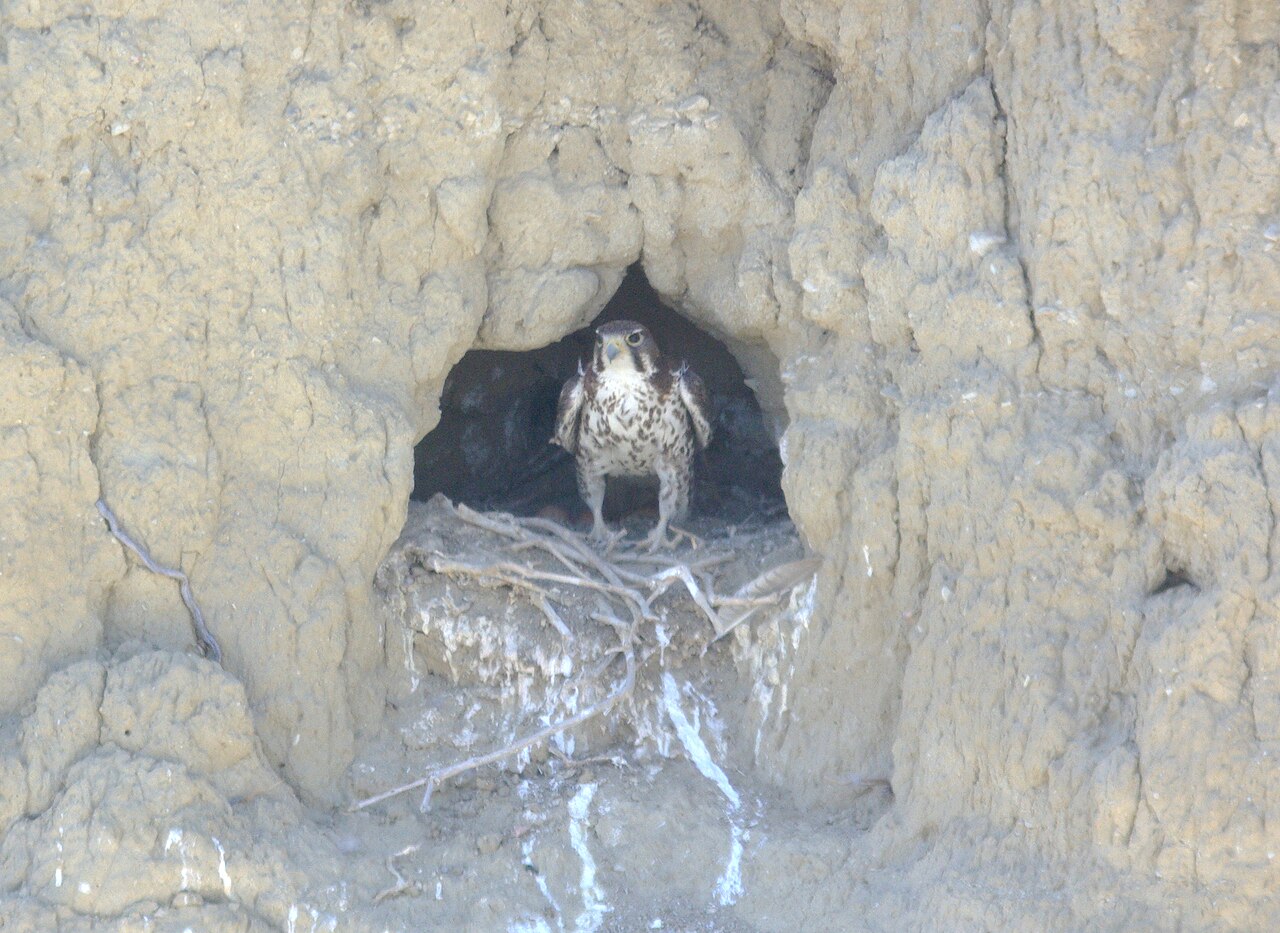
Prairie falcons build no nest of their own, instead laying eggs directly on a bare cliff ledge or in a scrape on a canyon wall, often reusing the same productive ledge across many years and even generations of falcons, a pattern that makes certain well-known cliff faces reliable falcon-watching spots for local birders year after year. A typical clutch runs three to five eggs, and incubation lasts around a month, with the female handling most of the sitting while the male supplies food throughout the nesting period. According to the Cornell Lab of Ornithology, prairie falcon populations have remained comparatively stable overall compared to some other raptors, though local numbers can fluctuate significantly with ground squirrel abundance and are vulnerable to disturbance near nesting cliffs during the breeding season. Rock climbing and other recreational activity near active nest sites is a growing concern in some popular canyon areas, prompting seasonal closures at a number of public lands sites to protect nesting falcons during the most sensitive weeks of the breeding cycle.
Sound and Behavior
Prairie falcons make a harsh, repeated kek kek kek call, quite similar in structure to a peregrine falcon’s alarm call, most often heard near the nest when a pair is defending territory or a mate approaches with food. Away from the nest, prairie falcons are largely silent, and much of their hunting behavior takes place low and fast over open ground where a burst of speed rather than sound is the primary hunting tool. Outside the breeding season, prairie falcons tend to be solitary hunters, ranging widely over large territories in search of ground squirrel colonies, and it is not unusual for an individual bird to cover many miles of open country during a single day’s hunting circuit, returning to a favored perch or roost site each evening once the day’s hunting is finished.
Frequently Asked Questions
How is a prairie falcon different from a peregrine falcon?
A prairie falcon is paler and sandier overall, with dark patches under the wings near the body that a peregrine falcon lacks, and it favors dry interior terrain rather than cliffs near water or cities.
What does a prairie falcon eat?
Ground squirrels are the primary prey across most of a prairie falcon’s range, supplemented by other small mammals and, at times, songbirds caught in flight.
Where do prairie falcons live?
Prairie falcons live almost entirely in the western United States, southwestern Canada, and northern Mexico, favoring arid grassland, desert, and canyon country.
How big is a prairie falcon?
A prairie falcon has a wingspan of roughly 3.3 to 3.6 feet, very close in size to a peregrine falcon, with females larger than males.
What is the best field mark for a prairie falcon?
Dark patches of feathers under each wing near the body, called axillaries, are the most reliable field mark, visible in flight and absent on a peregrine falcon.
Do prairie falcons migrate?
Prairie falcons are largely non-migratory or make only short-distance movements tied to prey availability, unlike some other falcon species that travel long distances seasonally.
Are prairie falcons rare?
Prairie falcons are not considered rare or threatened within their specific western range, but their reliance on remote, arid terrain makes them far less commonly seen than more adaptable raptors.
Do prairie falcons nest in the same place every year?
Prairie falcon pairs frequently reuse the same productive cliff ledge across many consecutive years, and some nesting cliffs have been used by generations of falcons over long periods.