Cricket Sounds: How They Chirp and What Each Song Means
Cricket sounds are made by males rubbing their front wings together, not their legs, and only males chirp. One wing carries a hardened scraper, the other a file of 50 to 300 tiny teeth, and drawing one across the other at high speed produces the chirp while the surrounding wing membrane amplifies it. Females have no file and are silent.
Crickets produce four distinct songs rather than one: a loud calling song to attract females from a distance, a quiet courtship song used within a few centimetres, an aggressive song between rival males, and a brief copulatory song. Learning to hear the difference between the pulsed chirp of a field cricket and the continuous trill of a tree cricket also tells you which insect you are actually listening to, since most of what people call cricket noise at night is not a field cricket at all.
| Feature | Detail |
|---|---|
| Sound production | Stridulation, forewing file against scraper |
| Who chirps | Males only, females have no file |
| Song types | Calling, courtship, aggressive, copulatory |
| Field cricket | Separated chirps in bursts |
| Tree cricket | Continuous even trill |
| Ears located | On the front legs, below the knee |
| Temperature link | Chirp rate rises with warmth |
How Crickets Make Sound
Stridulation is the mechanism, and the anatomy is precise. The male raises both forewings at roughly a 45 degree angle and draws the scraper on the edge of one wing across the file on the underside of the other. Each pass produces one pulse. A chirp is a short group of pulses, typically 3 to 5 in field crickets, delivered as one recognisable unit.
The wings themselves do the amplifying. A thin membrane called the harp resonates at the frequency the file produces, turning what would otherwise be a faint scratching into a sound audible across a field. Some species enhance this further by calling from the mouth of a burrow shaped to work as a horn, and mole crickets build burrows so effective that their calls can be heard hundreds of metres away.
Grasshoppers do it differently, rubbing a hind leg against a wing rather than wing against wing, which produces a rougher, buzzier sound. That difference in mechanism is one of the more reliable ways to separate the two groups by ear, and our guide to crickets versus grasshoppers covers the rest of the distinctions.
The Four Cricket Songs
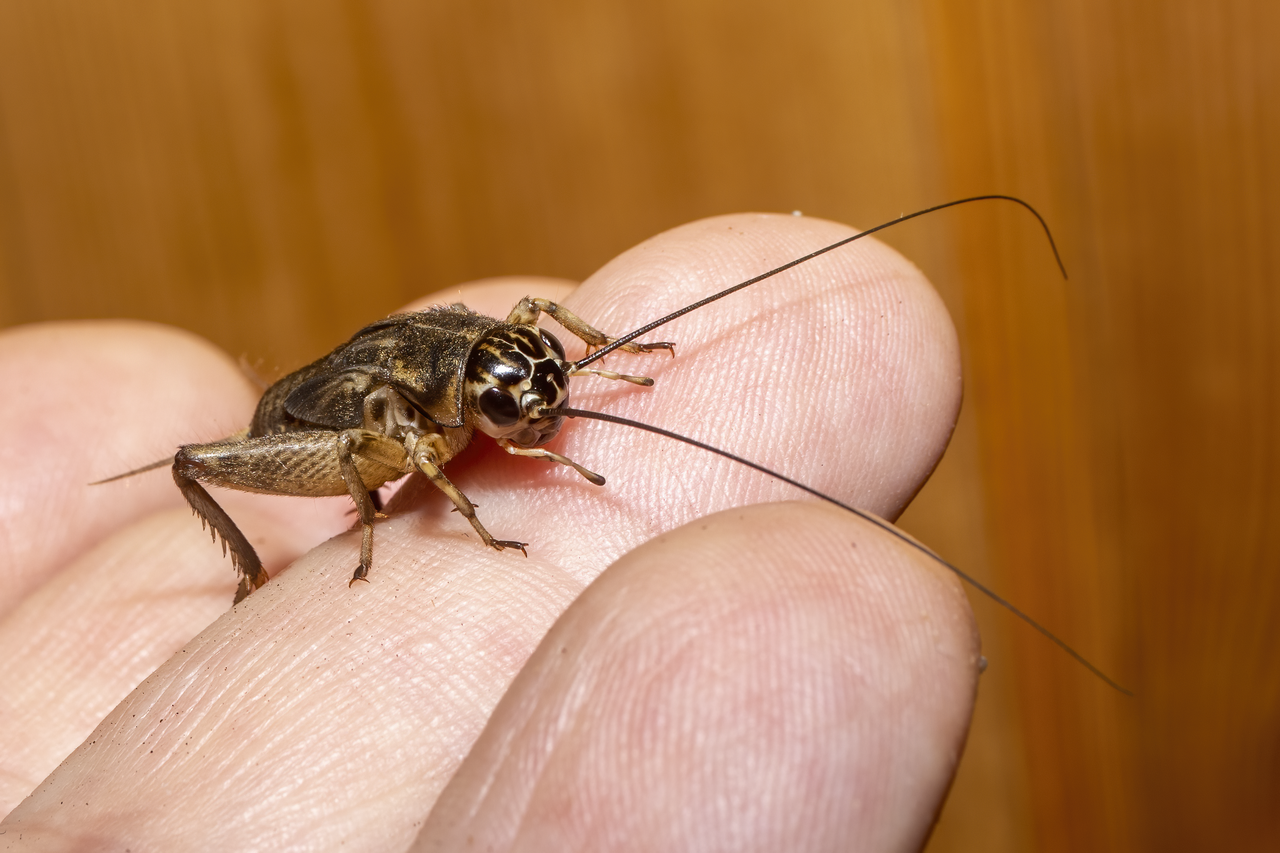
The calling song is what fills a summer night. It is the loudest of the four, given by an unpaired male from a fixed position, and it functions purely to attract a female from a distance. It is also the most dangerous song the male sings, because parasitic flies in the genus Ormia home in on it and deposit larvae on the caller.
The courtship song is almost the opposite. Once a female approaches, the male switches to a much quieter, higher, faster song audible only within a few centimetres. It is easy to miss entirely unless you are watching a pair at close range, and its function appears to be persuading the female to mount rather than to locate the male.
The aggressive song and the copulatory song complete the set. Rival males meeting produce a harsh, irregular chirping alongside physical sparring with the antennae and mandibles, and the winner frequently follows with a triumphal burst. The brief copulatory song occurs during mating itself. All four come from the same wings using different pulse rates and rhythms.
Why You Hear Crickets at Night
Predator avoidance is the main driver. A calling male is stationary, conspicuous, and advertising his exact position, which makes him an obvious target for birds, lizards, and spiders during daylight. Calling after dark removes most visually hunting predators from the equation, though it exposes crickets to bats instead.
Temperature is the second factor. Crickets are ectothermic and their muscle performance tracks ambient temperature directly, so on hot days many species call more in the cooler evening hours simply because midday heat is uncomfortable. In spring and autumn the pattern shifts and calling concentrates in the warmest part of the afternoon.
Humidity and moonlight also modulate it. Calling tends to drop on bright moonlit nights, consistent with the predator-avoidance explanation, and rises on warm humid evenings. The same nocturnal logic applies to other night callers, as our guide to why birds chirp at night explains for a very different group.
Cricket Chirps and Temperature
The link between chirp rate and temperature is close enough to be usable as a thermometer. Dolbear’s Law, published by Amos Dolbear in 1897, states that counting the chirps of a snowy tree cricket over 14 seconds and adding 40 gives the temperature in degrees Fahrenheit, and the approximation holds well between roughly 55 and 100 degrees.
The reason is straightforward biochemistry. The muscle contractions driving the wings depend on enzyme-catalysed reactions that speed up as temperature rises, so a warmer cricket simply moves its wings faster. Because the relationship is nearly linear over the normal activity range, the arithmetic works.
The law is species specific and works best for the snowy tree cricket, Oecanthus fultoni, which produces a clean regular trill that is easy to count. Field crickets follow the same underlying trend but with different constants, so the classic formula gives only a rough answer when applied to them.
Field Crickets vs Tree Crickets
These are the two sounds people most often confuse, and the difference is rhythm rather than pitch. Field crickets in the genus Gryllus produce discrete chirps with clear silence between them, giving the classic pulsed cricket sound heard from lawns, foundations, and inside houses.
Tree crickets in the genus Oecanthus produce a continuous even trill with no gaps, more like a soft electronic hum than a chirp, delivered from shrubs and low trees. The pervasive background trill of a late summer night is usually tree crickets, and most people who describe hearing crickets all night are actually hearing them.
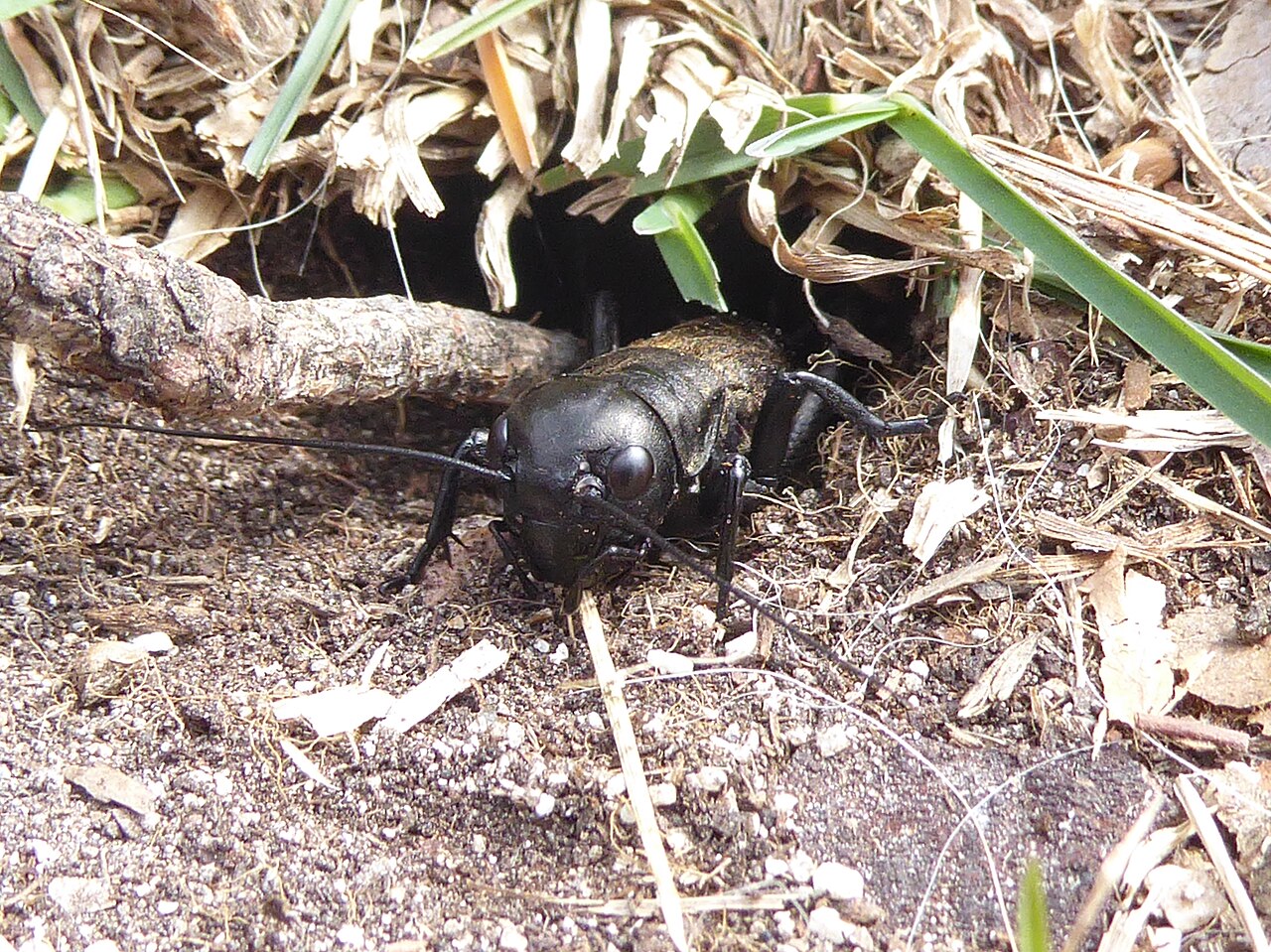
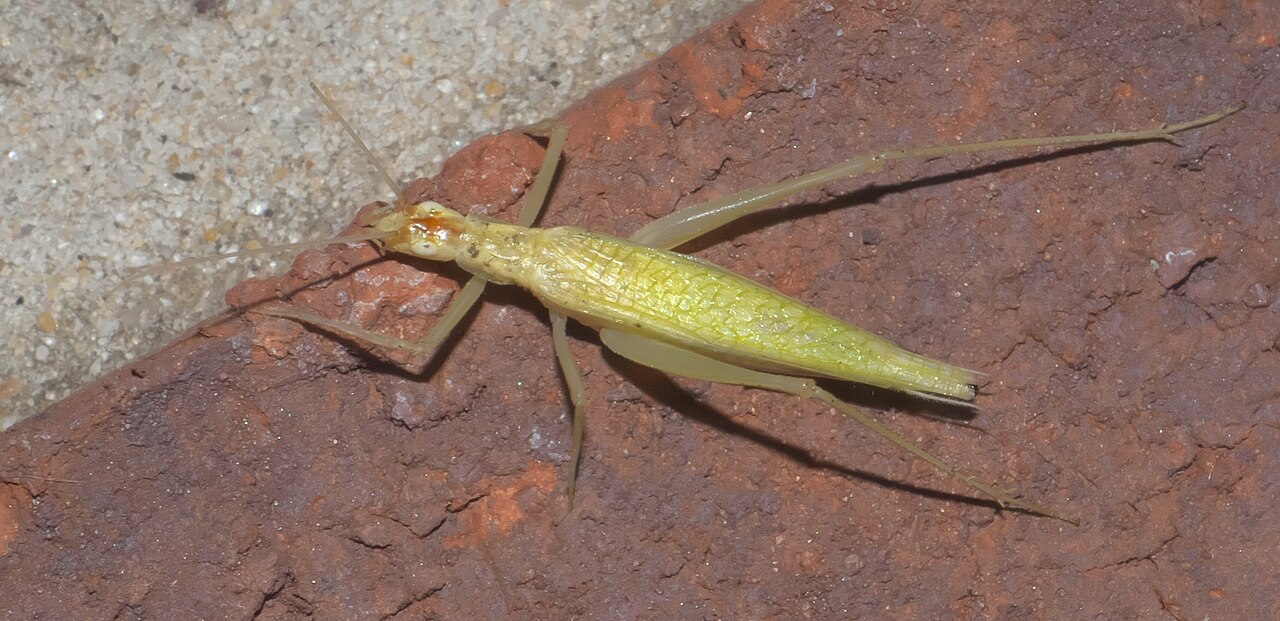
Body form matches the habitat. Field crickets are stout, dark brown to black, and ground dwelling. Tree crickets are slender, pale green, and almost translucent, and they are far harder to spot despite being the louder presence acoustically. Both eat plant material and small invertebrates, as covered in our guide to what crickets eat, and both overlap in diet with the group described in what grasshoppers eat.
What Sounds Like a Cricket but Is Not
Katydids are the most common mix-up. They belong to a related family and stridulate the same way, but their song is harsher, more rasping, and often given in a distinct rhythm that produced the name, a repeated ka-ty-did phrase. Katydids call from high in trees, while crickets call from ground level and shrubs.
Cicadas are the second, and time of day separates them cleanly. Cicadas call during daylight and in the early evening, producing a loud buzzing or whining that rises and falls, and they use tymbals, a completely different vibrating membrane organ, rather than wing stridulation. A daytime buzz is a cicada, a night-time chirp is a cricket. Moths are the other insect group heard around lights on the same evenings, and our guide to what moths eat covers what draws them there.
Spring peepers and other small tree frogs round out the list and fool a lot of people. Their calls are higher, more bell-like, and given in spring and early summer near water rather than through late summer across dry ground. Mole crickets produce a low continuous churring from lawns that many people take for a distant machine rather than an insect at all.
How Crickets Hear
Cricket ears sit on the front legs, just below the joint corresponding to the knee, as a thin tympanal membrane on each tibia. Sound reaches the membrane both from outside and, through an internal air-filled tube connecting the two legs, from the opposite side. Comparing arrival times at the two ears lets the insect determine direction.
Female crickets are tuned specifically to the calling song frequency of their own species, which is how they pick out a mate from a chorus containing several species calling at once. This tuning is sharp enough that a female will walk directly toward a speaker playing a recording of the correct species and ignore one playing a closely related call.
Crickets also detect ultrasound, which serves as bat detection. A calling male that hears bat echolocation frequencies stops singing immediately, which is why an entire lawn can fall silent within a second when a bat passes overhead. Our guide to bat sounds covers the calls that trigger it.
Silencing a Cricket in the House
A single cricket indoors is a genuinely difficult thing to locate because crickets stop calling when they detect vibration or light, and the sound is hard to place. The effective technique is to move a few steps, stand completely still until it resumes, then repeat, narrowing the position over several rounds rather than searching continuously.
Crickets get in through gaps around doors, foundation cracks, and utility penetrations, and they are drawn to warmth and moisture. Basements, laundry rooms, and the space behind appliances are the usual spots. Sealing entry points and reducing exterior lighting near doors does more over a season than any indoor measure.
Once located, the simplest removal is a glass and a piece of card, releasing the animal outside. Crickets do no damage to a house, do not bite meaningfully, and carry no disease of concern, so removal is a noise question rather than a pest control one. Products marketed as sonic cricket repellents have no reliable evidence behind them.
Related reading: Cicada Sounds.
Frequently Asked Questions
What are the sounds of a cricket?
Crickets produce four songs: a loud calling song to attract females from a distance, a quiet courtship song at close range, a harsh aggressive song between rival males, and a brief copulatory song. All four are made by rubbing the forewings together, and only males can produce them.
Do crickets chirp with their legs?
No, that is grasshoppers. Crickets rub a scraper on one forewing across a toothed file on the other, a process called stridulation, with the wing membrane acting as an amplifier. Grasshoppers rub a hind leg against a wing, which produces a rougher buzzing sound.
Why do you hear crickets at night?
Mainly to avoid visually hunting predators. A calling male is stationary and advertising his exact position, which is far safer after dark. Temperature plays a part too, since many species avoid midday heat. Calling drops noticeably on bright moonlit nights, which supports the predator explanation.
What sounds like a cricket but isn’t?
Katydids produce a harsher rasping song from high in trees, cicadas buzz during daylight using a completely different organ, and spring peepers and other small tree frogs give higher bell-like calls near water in spring. Mole crickets produce a low continuous churring from lawns that many mistake for machinery.
Can you tell the temperature from cricket chirps?
Roughly, yes. Dolbear’s Law says counting a snowy tree cricket’s chirps over 14 seconds and adding 40 gives the temperature in Fahrenheit, and it holds well between about 55 and 100 degrees. The relationship exists because muscle contraction speed rises with temperature. It is species specific and least accurate for field crickets.
Do female crickets chirp?
No. Females lack the file structure on the forewing entirely and cannot stridulate. They do hear extremely well, with ears on the front legs tuned specifically to the calling song frequency of their own species, which lets them pick a mate out of a mixed chorus.
Why does a cricket stop chirping when I get close?
Crickets detect ground vibration through sensitive organs in the legs and stop calling the instant they sense an approach, since a calling male is highly vulnerable. They also fall silent when they hear the ultrasonic frequencies of hunting bats, which is why a whole lawn can go quiet at once.