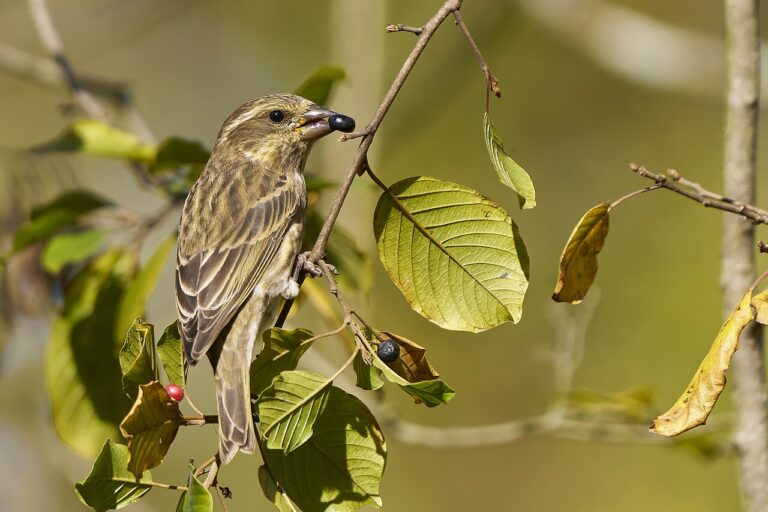
Crow Feather Meaning: What Finding One Means Spiritually
Crow feather meaning, read as a sign, leans toward protection and a nudge to pay attention, not toward bad luck. A black feather on your path is a small, quiet event, and that quietness is the point. You notice it because you were looking down. The feather asks you to look up.
Behind the symbol sits a real bird with real rules. The American crow (Corvus brachyrhynchos) sheds its feathers during the yearly molt, so a feather on the lawn in late summer is a common find. The bird is also protected under federal law, and that changes what you can do with the feather once you hold it.
Spiritually, a found crow feather can represent a good to neutral omen of protection and change. Its association with good or bad luck depends on the specific tradition. A single feather asks you to slow down. In the US, the American crow is a protected migratory bird, so leave the feather where it lies.
What Does Finding a Crow Feather Mean Spiritually?
Finding a crow feather points to change and protection, a prompt to notice what needs your attention. An archaeological study of Comanche rock art documents protective uses of crow feathers among Kiowa warriors and Comanche families. These uses concern protection rather than messages delivered by a chance discovery. The crow is a watchful bird that warns its group with loud calls, and the feather carries that alertness as a sign. It asks you to stay awake to what is happening around you, without fear. It also marks a turn, the end of a habit or the start of a plan you keep postponing.
Where the feather lands shifts the reading. A feather at a grave points to remembrance and to a bond that continues after a loss. A feather on your doorstep points to protection of the home and the people in it. A crow visiting you carries a separate reading, since the bird itself chose to stay near you.
Crow symbolism as a whole ties the bird to intelligence, memory and transformation, and the feather is the smallest piece of that picture. It is a trace, not the bird. That makes its message quieter and more personal. Read it against what was on your mind when you found it.
What Does Finding a Single Feather Mean?
A single feather means one message for one moment, a prompt to pause and check the direction you are heading. One feather is a quieter sign than several. It does not predict an event. It points to attention.
Several crow feathers in one spot read differently. A scatter of feathers often marks the place where a predator caught a bird, or where a crow preened during the molt. That is biology first. The theme of change still holds, but the scene asks for caution before you touch anything.
Mark the reading in a simple way. Note the date, the place and the question you were carrying that day. A feather that lines up with a decision you were weighing points to that decision. A feather on an ordinary walk is a reminder to look around.
Are Crow Feathers Good Luck?
A crow feather signifies good luck in one Welsh custom and bad luck in another. In Welsh Folk-Lore, Elias Owen records a lucky custom in Llanfihangel Glyn Myfyr: placing a found crow feather upright in the ground. His Montgomeryshire account instead associates picking one up with encountering a rabid dog that day.
Seeing a crow brings the bird’s behavior into the reading, while a found feather centers attention on the place and moment of discovery.
Owen’s records attach luck to particular actions and localities. They describe contrasting Welsh customs, rather than one meaning for every crow feather.
Can You Keep a Crow Feather You Find?
No, in the United States you generally may not keep a found wild crow feather without authorization. The American crow is protected under the Migratory Bird Treaty Act. The US Fish and Wildlife Service’s feather possession guidance explains that naturally molted feathers have no exemption. Specific exceptions and authorized uses exist, but finding a feather on the ground does not itself authorize keeping it.
Other countries set their own rules. Some protect all wild birds, others list only certain species, and the rules for found feathers differ. Check with the wildlife authority of the country where you found it before you take a feather home. This is general information, not legal advice.
Keepsakes, crafts and study are the common reasons to pick one up, and each runs into the same rule. Museums, schools and researchers work under permits issued by the US Fish and Wildlife Service. For a keepsake, a photograph is the lawful choice. If you do touch a feather, wash your hands with soap and water afterward, as the CDC advises after handling birds.
What Colors Are Crow Feathers?
Crow feathers are black with a blue, purple or green sheen that shows in direct light. The sheen is a structural color, made by the microscopic build of the feather rather than by pigment. It shifts as you turn the feather. In shade the same feather looks flat black.
Worn or sun-bleached feathers look brown. Months of sun and abrasion wear down the feather surface, and an old feather found in late summer often shows dull brown tips. Cornell’s American Crow guide describes the crow as all black, legs and bill included, with old feathers looking brownish next to glossy new ones.
Ravens and crows share the black color but differ in size and shape, and raven feathers run larger. A big black feather from open country or mountains deserves a second look. Size alone rarely settles it.
What Are the Seven Types of Feathers?
The seven types of feathers are wing feathers, tail feathers, contour feathers, semiplumes, down, filoplumes and bristles, following the Cornell Lab of Ornithology’s classification. Some guides merge wing and tail feathers into one group of flight feathers and count six.
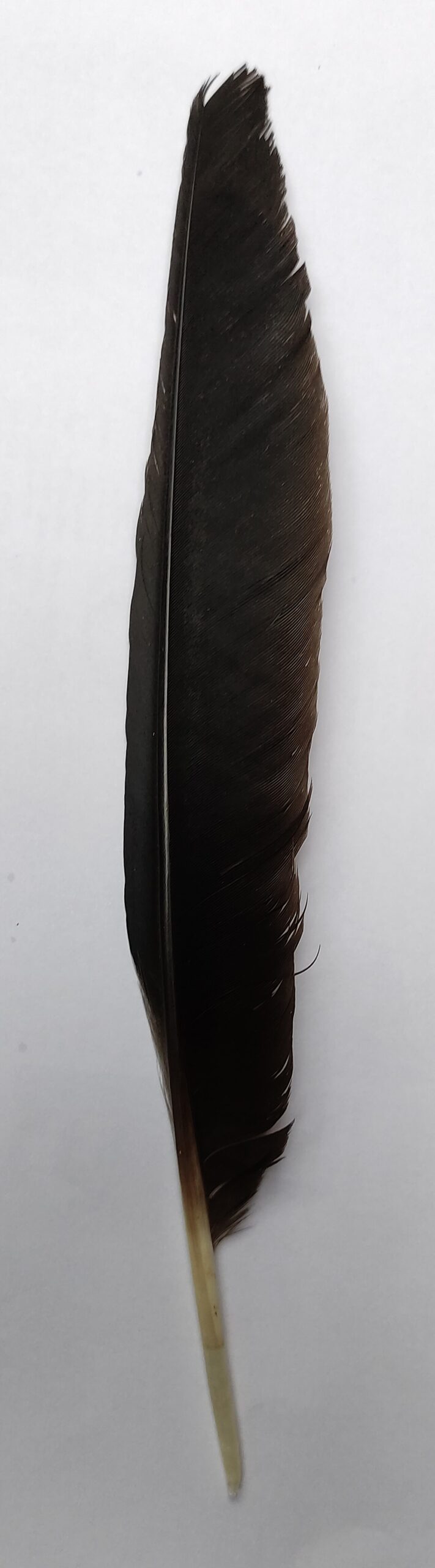
A crow carries all seven, but three matter for what you find. Flight feathers from the wing and tail are long, stiff and the most likely find. Contour feathers cover the body and are shorter and curved. Down sits underneath and turns up as small dark fluff.
| What you see | Feather type | What it tells you |
|---|---|---|
| Long, stiff, narrow vane on one side | Wing flight feather | Asymmetry helps identify a wing feather |
| Long, stiff, nearly even vanes | Tail feather | Shape suggests a tail feather |
| Short, curved, glossy tip | Contour feather | Forms the body’s outer covering |
| Soft, fluffy, no firm vane | Down | Provides insulation |
| Black with a purple or blue gleam | Glossy wing, tail or contour feather | Shows iridescence as the light angle changes |
| Dull brown tips and frayed edges | Weathered feather | Shows fading or wear |
Bird feather identification starts with the shaft and the vane. The vane consists of barbs, with smaller barbules that interlock in firm flight feathers. A wing feather typically has a narrow leading vane and a wider trailing one, while a tail feather is closer to symmetrical. Crows also carry bristles over the nostrils, but those rarely turn up on the ground.
What Are a Crow’s Natural Enemies?
The great horned owl (Bubo virginianus) is the American crow’s most dangerous predator, according to the Cornell Lab of Ornithology. Other natural enemies include hawks such as the red-tailed hawk (Buteo jamaicensis). Owls can attack roosting crows at night, while hawks hunt by day.
At the nest the threats change. Raccoons (Procyon lotor) climb to eggs and nestlings, and snakes raid nests in spring. A scatter of feathers under a roost tree can be the trace of one of these attacks.
Crows answer with mobbing. A group gathers around an owl or hawk, dives at it and calls until the predator leaves. Crow sounds grow loud and harsh during a mob, and that noise is often how people first notice an owl in the neighborhood.
Frequently Asked Questions
When do crows molt?
Crows molt once a year, mostly in summer and early fall. That is the season when most crow feathers drop and turn up on lawns and paths. A crow replaces its flight feathers a few at a time, so it keeps flying through the molt and grows glossy new feathers by late fall.
How can you tell a crow feather from a raven feather?
Raven feathers run larger than crow feathers, and ravens have long pointed throat hackles that give the neck a shaggy look. A raven’s tail is wedge-shaped in flight, while a crow’s tail looks rounded or square. A single loose feather is hard to assign, so compare it with a photo guide.
Why shouldn’t you pick up feathers off the ground?
Wild birds can carry germs, and in the US, feathers of protected birds are generally illegal to keep without a permit. The CDC notes many wild birds can have the same diseases as pet birds, and USDA APHIS reports H5N1 bird flu in wild birds worldwide. Wash your hands after contact.
Is it bad luck to find a crow feather?
It signifies bad luck in the Montgomeryshire custom recorded by Elias Owen, but good luck in his Llanfihangel Glyn Myfyr account when the feather is placed upright in the ground. Protection and change offer another reading, with the feather prompting attention to the moment of discovery.
Do crows leave feathers as gifts?
Not necessarily. Crows lose feathers during molt and preening, so a feather on your lawn does not by itself establish deliberate gift giving. Its symbolic meaning comes from where and when you find it.
Sources
- CDC, Healthy Pets: Birds
- USDA APHIS, Highly Pathogenic Avian Influenza H5N1
- Cornell Lab of Ornithology, All About Birds: American Crow