Dead Crow Meaning: What It Signals and What to Do
A dead crow spiritually marks the end of a cycle, a plan or habit or season closing so something new can start. That is the core of dead crow meaning, a closing rather than a threat to you or your household. The bird also died of something real, and that cause deserves a look before any reading.
The crow’s long history beside the dead makes the find feel heavier than it is. The practical side carries more weight. Health agencies watch dead crows for disease, and where you found the bird and how many lie there tell you more than any omen.
As a sign, a dead crow points to a change of course, something in your life ending to make room for the next step. It is not bad luck. Crows can carry West Nile virus and bird flu, so the find calls for gloves and a report, not fear.
What Does a Dead Crow Mean Spiritually?
A dead crow means a cycle has closed. The American crow (Corvus brachyrhynchos) is a watcher and a survivor, so finding one still and silent points to something in your life that has run its course. That can be a job, a worry, or a role you have outgrown. The ending clears space for what comes next.
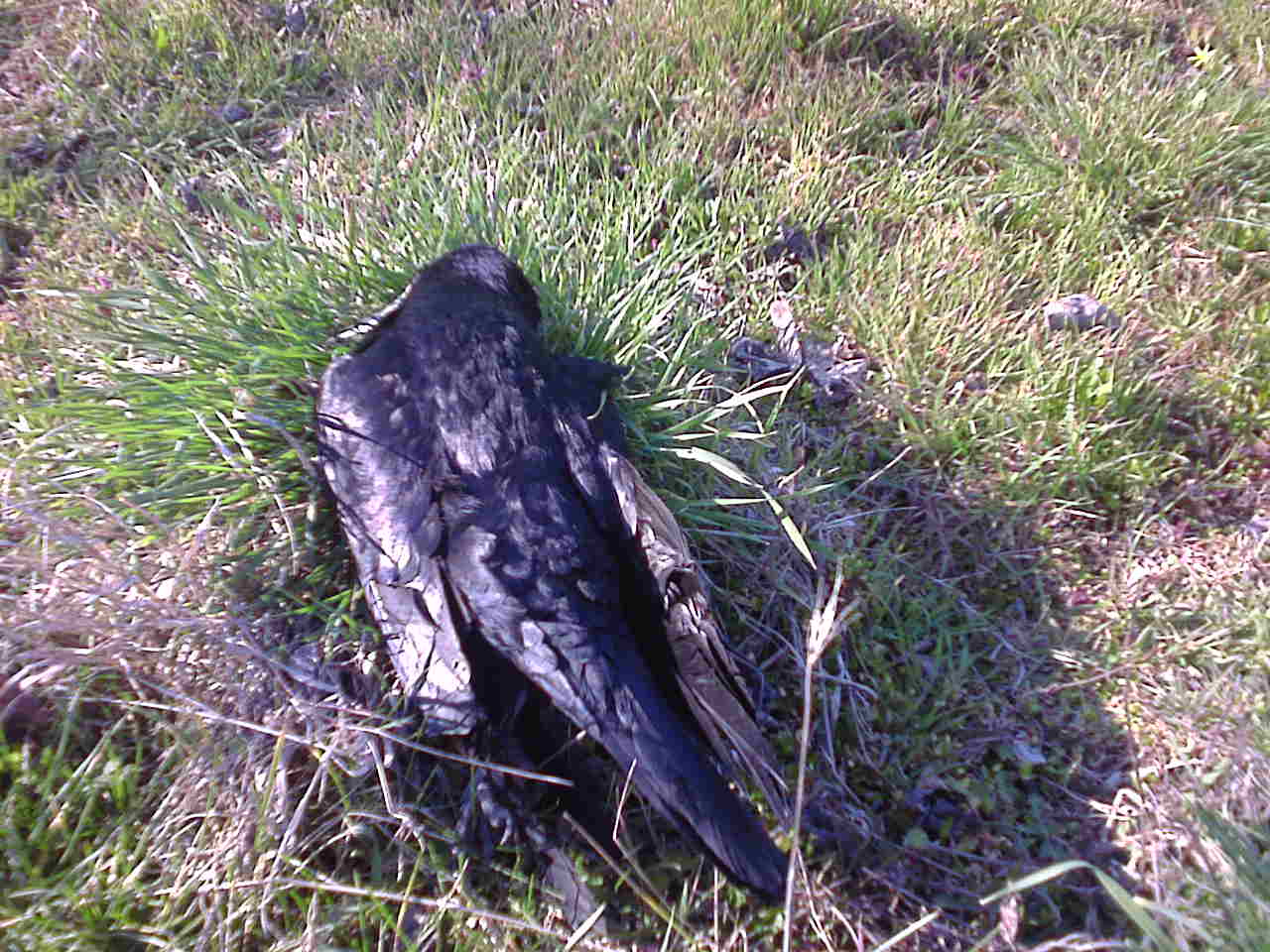
The place of the find shapes the message. A crow at your front door points to change at home or in the family. One on your daily route points to work and routine, and one under a window brings the message close. Crow dream meaning follows other rules, because a dream leaves no body to examine.
Ravens and crows look alike, so confirm the species before you read anything into the find. A common raven (Corvus corax) is larger, with a wedge-shaped tail and a deep, croaking call. No reading replaces a look at how the bird died.
What Should You Do If You Find a Dead Crow?
Do not touch a dead crow with bare hands. Put on disposable gloves, or turn a plastic bag inside out over your hand and pick the bird up through it. The CDC advises precautions around any wild bird, especially one that is sick or dead. Wash your hands with soap afterward, even if you wore gloves.
Report the find before you throw the bird away. Call your state health department or state wildlife agency and tell them the date, the place, and how many birds you see. The agency will tell you whether it wants the body for testing. Call the same day if several birds lie in one spot.
Keep children and pets away while you work. Dogs and cats will grab a carcass, and a bird that died from poison can pass that poison on. Seal the crow in a bag, place that bag inside a second one, and put it in an outdoor trash bin unless the agency asks for the body.
Why Are Crows Linked to Death?
Crows are linked to death because they eat carrion and showed up wherever bodies lay. After battles and at execution sites, crows arrived to feed, and people came to see them as the birds that follow the dead. American crows still scavenge roadkill and garbage today. The link began as observation, not superstition.
Rome turned the crow into a formal messenger. Roman augurs studied the calls and flight of crows as signs from the gods before public decisions were made. A messenger carries bad news as often as good, and the crow’s dark plumage made the bad news easier to remember. Seeing a raven carries its own set of meanings, because ravens have separate myths.
Hindu tradition gives the crow a gentler role in the same territory. During Pitru Paksha, the fortnight for honoring ancestors, families set out food for crows as an offering to the dead. The crow eats on behalf of the ancestors, so it links the living and the dead without any threat. Crow tattoos draw on this same mix of mourning and connection.
Is a Dead Crow a Warning or a Bad Omen?
A dead crow is more often a real warning than an omen. West Nile virus cycles between mosquitoes and birds, and crows are so susceptible that health departments have used dead crow reports to track the virus. Infected mosquitoes spread West Nile throughout the United States. In people its symptoms include fever and head and body aches, and the illness can be severe.
Bird flu adds a second reason to pay attention. According to the CDC, avian influenza has turned up in common backyard birds, crows included, and in more than 100 species of wild birds worldwide. People rarely catch it. Most cases follow close, unprotected contact with infected birds or other animals.
On your own property, three physical causes come before any omen. Rodent poison kills crows that eat poisoned prey, window glass kills birds that fly at reflections, and hawks or cats leave kills behind. Seeing black birds alive and moving points to messages and motion, while a dead one points first to a cause on the ground.
Do Crows Warn You of Danger?
Crows warn each other of danger, not you. When a crow spots a hawk, owl, or cat, it gives harsh alarm calls, and other crows fly in to mob the predator until it leaves. Mobbing is loud and can go on for many minutes. A crowd of crows screaming at one tree means a predator is perched there.
Crows also remember faces. Researchers at the University of Washington showed that crows recognize individual people who threatened them and scold those people on sight. Crows that never saw the original threat learn to scold the same person from the birds around them.
None of this is a message about your fate. A crow scolding you sees you as a risk to itself or its nest, and spring is the peak season, when young birds sit near the ground. Give the nest a wide berth for a few weeks and the scolding stops.
What Does the Bible Say About a Dead Bird?
The Bible treats a dead bird as something God sees, not as an omen. In Matthew 10:29, Jesus says that not one sparrow falls to the ground apart from the Father. The verse turns a small death into a sign of attention and care. It is the closest the Bible comes to a dead bird on your path.
Crows appear in the Bible mostly under another name. The Hebrew word oreb covers ravens and crows alike, and English translations render it as raven. Leviticus 11:15 lists the raven among the unclean birds, which is food law, not a death sign. In 1 Kings 17, ravens bring Elijah bread and meat, a sign of care rather than doom.
A dead crow carries no curse in biblical terms. Matthew 10:31 follows the sparrow verse with “Fear ye not therefore,” so the passage is about courage, not dread. The point is trust that nothing small goes unnoticed.
Is a Dead Crow Good Luck or Bad Luck?
A dead crow is neither good luck nor bad luck. The sense of bad luck comes from the crow’s old place beside the dead, not from anything a single dead bird can do. The crow did not pick your yard to send you a message. It died where its day ended.
Some of the fear is borrowed from another bird. The counting rhyme that starts with “one for sorrow” belongs to the magpie, not the crow, though both belong to the crow family. Mixing the two turns a single dead crow into a sorrow omen it never carried.
The useful reading is the one you can act on. Ask what in your life has run its course, and then check how the bird died. If you find several dead birds, the second question becomes the urgent one.
Is Finding a Dead Bird on Your Property a Bad Omen?
No, a dead bird on your property is not a bad omen, and the cause deserves a check before any reading. The scene tells you most of what happened. Look at where the bird lies, what shape it is in, and whether it is alone.
A crow under a window or glass door with no wounds most likely hit the glass. A ring of loose feathers or a partly eaten body points to a hawk, owl, or cat. A crow with no marks near a spot with rodent bait may have eaten poisoned prey.
Several dead birds in one area change the picture. Report them to your state wildlife agency the same day and keep pets inside until you hear back. A single bird with a clear cause needs only gloves, a double bag, and a few minutes.
Dead Crow Meaning at a Glance
The meaning of a dead crow shifts with the place and the number of birds. Each situation pairs a reading with a check that comes before it.
| Where you find it | What it points to | Check first |
|---|---|---|
| At your front door | Change at home or in the family | Cat, window strike, poison bait |
| Under a window | A message that has come close | Glass collision, no visible wounds |
| On your daily route | A routine or job running its course | Traffic or a predator kill |
| In your backyard | A personal chapter closing | Rodent bait, hawk or cat |
| Several dead crows | A shift beyond you, not a personal omen | Report to the state the same day |
| In a dream | Inner change with no physical cause | Nothing to examine or report |
Frequently Asked Questions
Is seeing a dead bird good luck or bad luck?
A dead bird brings neither good nor bad luck on its own. Crow luck depends on the tradition. In Japan, the three-legged crow Yatagarasu guided Emperor Jimmu in legend, and the crow there is a guide rather than a death sign. The meaning follows the culture, not the carcass.
What bird warns of death?
In Irish mythology, the war goddess Badb appears as a crow over battlefields and announces who will die. She is one of three Irish war goddesses known together as the Morrígna. In Navajo tradition, the owl holds that role, and an owl calling near a home is a warning of death.
Can you keep a feather from a dead crow?
No, not without a federal permit in most cases. The American crow is protected under the Migratory Bird Treaty Act, and the law covers feathers, nests, and eggs as well as live birds. Crows taken in a legal state hunting season fall under separate state and federal rules. Leave the feathers on the bird and bag it whole.
Do crows hold funerals?
Yes, in a sense. Swift and Marzluff at the University of Washington showed in 2015 that wild crows gather noisily around a dead crow. The birds then avoid that spot and stay wary of people or predators seen there. The gathering works as a lesson about danger, not as grief.
Is a dead bird a warning?
Yes, when you find several in one place. Report multiple dead wild birds at one site to your state wildlife or health agency, because a cluster can point to bird flu (H5N1). A single bird with a clear cause, such as a window strike, is a sad accident rather than a warning.
What does a dead crow symbolize?
A dead crow symbolizes release. The living crow stands for watchfulness and survival, so a crow at rest points to letting go of vigilance you no longer need, such as an old worry or a guarded habit. The message is to lower your guard where the threat has already passed.
Sources
- Centers for Disease Control and Prevention, West Nile Virus
- Centers for Disease Control and Prevention, How Bird Flu Spreads
- U.S. Fish and Wildlife Service, Migratory Bird Treaty Act of 1918