Seeing a Raven Meaning: Bad Omen or Sacred Messenger?
A raven sighting points to change, not to a death in the family. The common raven (Corvus corax) has carried two opposite reputations for centuries, messenger of the gods and herald of death, and both are old. Which one fits depends on the tradition and on the moment you saw the bird.
No, seeing a raven is not a death sentence. It signals change or a message on its way. The death omen comes from European folk belief, because ravens fed on battlefields, and from the goddess Morrígan. Odin’s ravens, Elijah’s ravens and the Haida Raven who freed the sun make it a messenger and guardian.
What Does Seeing a Raven Mean?
Seeing a raven means change ahead, hidden knowledge surfacing or a call to pay attention. The raven is a thinker’s bird. It solves problems, watches closely and seldom wastes a move, so its arrival points to something that needs your mind, not your nerves. Change is the reading that comes up most often in modern spiritual guides.
Context shifts the message. A raven on a gravestone on a grim day lands differently from one playing on the wind above a hiking trail. Your mood, the place and what the bird did all count. A raven that stares and calls asks for attention, while one that passes in silence marks a quiet transition.
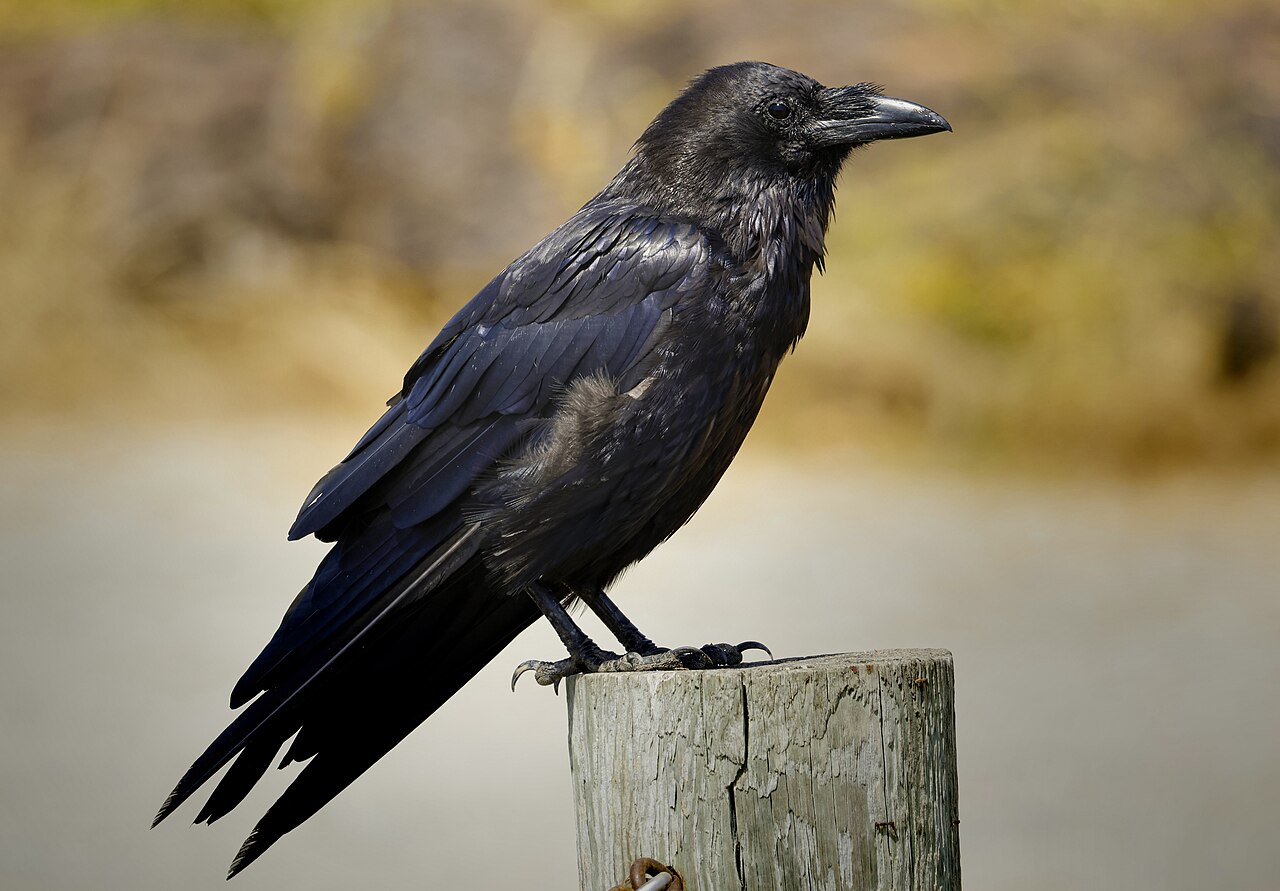
First make sure the bird is a raven. Ravens and crows look alike at a glance, but the raven is bigger, croaks deeper and shows a wedge-shaped tail in flight. Crow lore runs on a separate track, and mixing the two muddles the message.
What Does a Raven Crossing Your Path Mean?
A raven crossing your path marks a choice or a turn ahead. Roman augurs read the direction. Cicero writes in On Divination that a raven on the right confirmed a plan. A raven crossing from left to right reads as a green light, and one that lands in front of you asks you to commit to a direction.
Is Seeing a Raven a Bad Omen? Ravens, Death and Bad Luck
No, a raven is not a death sentence, though European folklore made it one for centuries. The reputation grew from what people saw. Ravens gathered wherever bodies lay, on battlefields and beneath gallows, and a bird that arrived after death came to stand for death itself.
A raven’s diet leans heavily on carrion, and that habit explains the gloom better than any curse. Village lore across Europe tied a raven on the roof or a croak near the house to a coming death in the family. The bird was simply doing its job as a scavenger, and people filled in the rest.
The modern spiritual reading turns that death into the end of a phase. A job, a habit or a relationship closes, and the raven marks the door. Danish ballads tell of the valravn, a raven that ate the slain on a battlefield and took on an uncanny, half-ghost form, the darkest version of the death omen in Scandinavian folklore.
Is It Lucky to See a Raven?
Yes, at least at the Tower of London. A legend says the kingdom will fall if the ravens leave, and the birds are kept as guardians. Elsewhere in British and European lore the raven was just as often read as a death omen, so luck depends on the context. In the legend, their presence at the Tower is a protection, not a warning.
Legend credits King Charles II with ordering that at least six ravens must always live at the Tower, and the Ravenmaster still keeps six plus a spare. A raven that settles near your home stands guard rather than counts the days, and a pair nesting nearby marks the spot as safe ground.
Good-luck readings center on a new start, protection and a problem about to solve itself. Modern spiritual readings count a calm or playful raven as a positive sign.
| What you see | Common modern reading | Tone |
|---|---|---|
| One raven | A personal message or a change that concerns you alone | Mixed |
| Two ravens | Partnership, balance, thought and memory working together | Good |
| Three ravens | The Three Ravens, an English ballad printed in 1611, pairs the birds with a fallen knight and his loyal hound and hawk | Warning |
| A flock | Community news, a group decision or a shared change | Mixed |
| Circling overhead | Something unresolved is close, act before it decides for you | Warning |
| At dawn | A fresh start, the day’s first messenger | Good |
| At dusk | An ending, time to close a chapter and rest | Mixed |
Celtic Folklore: The Morrígan and Bran the Blessed
In Celtic folklore the raven belongs to a war goddess and to a giant king who guards Britain. The Irish Morrígan appears as a crow or raven over battlefields. She chooses who falls, and warriors took her bird as a sign that the fight was already decided.
The death of Cú Chulainn is the best-known scene. Mortally wounded, the hero ties himself to a standing stone so he can die on his feet. His enemies keep their distance for fear of him. Only when a raven lands on his shoulder do they know he is dead.
Wales tells a gentler story. Bran the Blessed carries a name that is the Welsh word for raven. His severed head was buried in London facing France, to keep invaders out of Britain for as long as it stayed there. Many link the Tower ravens to that burial.
Norse Mythology: Odin’s Ravens Huginn and Muninn
In Norse mythology a raven is Odin’s eyes, so seeing one means you are being watched over. Odin keeps two ravens, Huginn (thought) and Muninn (memory). Each morning they fly out across the world, and each evening they return to his shoulders and tell him what they saw.
The Poetic Edda gives Odin a fear for them. In Grímnismál he worries that Huginn will not come back, but he worries more for Muninn. Thought can be lost and found again.
Viking warriors carried the link into battle. The raven banner flew over war bands, and a raven that seemed to beat its wings on the cloth promised victory. A raven over your path is a scout in Norse terms. The god knows where you are going and sends his bird ahead of you.
Ravens in the Bible: What Jesus Said About the Raven
Jesus used the raven as a lesson against worry. In Luke 12:24 he says “Consider the ravens,” birds that neither sow nor reap and have no storehouse or barn, yet God feeds them. If God cares for ravens, he cares far more for people.
The raven appears long before that. In Genesis 8 Noah sends a raven out of the ark first, before the dove, and it flies to and fro until the waters dry up. In 1 Kings 17 ravens bring the prophet Elijah bread and meat, morning and evening, by the brook Cherith.
Leviticus 11 lists the raven among the unclean birds. Scripture still shows it fed by God and used as his courier. A raven sighting in biblical terms is a reminder of provision. You are cared for, even in a dry season.
Raven as Creator and Trickster in the Pacific Northwest
On the Pacific Northwest Coast, Raven is the creator who made the world bright. Haida and Tlingit stories tell of an old chief who kept the sun, moon and stars locked in boxes. Raven slips into the house, is reborn as the chief’s grandson and cries until the boxes are opened. Then he flies off with the light.
Raven is greedy, vain and endlessly clever. His tricks cause trouble, yet nearly every one leaves the world better off than before. Raven symbolism on this coast is about creativity and cunning, not death.
Raven is also a crest. Haida and Tlingit society are each split into two halves, and Raven heads one of them. The Raven figure crowns many totem poles along the coast. A raven sighting here means a fresh idea or a clever way out of a tight spot.
Which Demon Is Associated With Ravens?
Stolas is the demon most closely tied to ravens. The Ars Goetia, a 17th-century grimoire in the Lesser Key of Solomon, describes him as a great prince who appears in raven form and teaches astronomy and the virtues of herbs and precious stones. Raum, an earl in the same book, appears as a crow and steals treasure.
The medieval church fed the dark image. Medieval Christian writers often linked black birds with the devil. Crow symbolism carries the same dark streak for the same reason.
Edgar Allan Poe sealed it in 1845. His poem “The Raven” sends a bird to a grieving man’s chamber, and its single word, “Nevermore,” turned the raven into pop culture’s favorite gloom.
Where You See a Raven: Window, Night, Dead Bird, Dream
At your window or on the roof. A raven at the window or on the roof carries a message for the whole household. Pay attention to the next serious talk at home.
At night. Ravens roost after dark, so most night encounters are sounds. Raven sounds carry far, and a croak in the dark points to intuition and hidden things surfacing.
A dead raven. A dead raven marks something that has already ended, not a death still to come. Leave the bird and its feathers where they are. Common ravens are protected under the Migratory Bird Treaty Act, and keeping any part without a permit is illegal.
In a dream. A raven in a dream signals inner change, a shift in how you see yourself before anything moves on the outside.
Seeing Ravens Again and Again, Even in Daylight
Seeing ravens again and again means a message is still unanswered or a transition is still underway. The bird keeps showing up until you act or until the change is complete.
Daytime ravens are normal. They forage by day across open country, forests and towns, as the Cornell Lab’s raven life history shows.
Ravens live in pairs that hold a territory together, so the two birds you keep meeting are probably the same couple. A group of ravens is called an unkindness or a conspiracy, and a large roost gathers dozens of young, unpaired birds.
Frequently Asked Questions
What is the definition of a raven?
A raven is a large all-black bird of the crow family, Corvidae. In North America the word means the common raven, Corvus corax, a corvid about 22 to 26 in long with a wingspan close to 4 ft, found from deserts to Arctic tundra. A smaller relative, the Chihuahuan raven, lives in the Southwest.
Is it rare to see a raven?
No, not in the western US, Alaska, Canada or the northern forests, where common ravens are a familiar sight. They are scarcer across much of the East and Southeast, though they have spread back into the Appalachians and parts of the Northeast. A sighting there feels more special.
What does it mean if the raven is your spirit animal?
As a spirit animal or totem, the raven stands for curiosity, problem-solving and adaptability. People drawn to it notice what others miss, ask awkward questions and find a way through tight spots. The raven favors brains over force and patience over hurry, and it rewards the same in you.
What does it mean when a raven follows you?
Usually it is checking whether you carry food. Ravens watch hikers, campers and drivers and learn quickly who drops scraps. In Wyoming, researchers found ravens flying toward gunshots during hunting season, because a shot often means a carcass.
When you see a raven, you will know?
In modern spiritual usage the line means a raven appears at the moment a gut feeling is confirmed, a decision is right or a change has begun. It builds on the Norse picture of Huginn and Muninn bringing Odin knowledge he did not have before.
Do ravens recognize human faces?
Yes. Crows remember people who threatened them for years, and captive ravens kept telling a “dangerous” mask from a neutral one for up to four years. University of Washington researchers showed that wild crows scolded masked people who had trapped them, for years afterward. Researchers are not sure whether the birds go by the face or by other cues.
Sources
- Cornell Lab of Ornithology, All About Birds, Common Raven Overview
- Cornell Lab of Ornithology, All About Birds, Common Raven Life History
- National Audubon Society, Guide to North American Birds, Common Raven