Steller’s Jay Spiritual Meaning: Why One Visits You
The Steller’s jay spiritual meaning centers on voice and nerve, because this is a bird that walks into a campsite and announces itself. Cyanocitta stelleri is the crested western cousin of the blue jay, a charcoal and deep blue bird of conifer forests, mountain trails and picnic tables from the Rockies to the Pacific.
Seeing a Steller’s jay is a call to speak up boldly, stay alert and use your resourcefulness. The bird comes close to people and scolds at danger, so its visit signals courage and watchfulness. Many people also take a visit as a sign of protection or a nudge from a loved one.
What Does It Mean When You See a Steller’s Jay?
Seeing a Steller’s jay means it is time to speak your mind. A sighting is permission to stop holding back.
Resourcefulness is the second message. Steller’s jays cache seeds and nuts to eat later, a reminder to plan ahead and store up what you will need. Alertness is the third. The jay scolds hawks, cats and people that come too near, and its visit asks you to watch your surroundings.
This is a western mountain bird, so its meaning leans toward courage in wild, unfamiliar places. Blue jay symbolism carries the eastern version of these themes into backyards and suburbs.
Is a Steller’s Jay a Good Omen or a Message From a Loved One?
Most modern spiritual readings treat a Steller’s jay as a good omen, not a warning. Its noise and nerve point to energy and protection.
Many grieving people take a jay’s visit as a loved one checking in. The bird arrives without fear, stays close and returns to the same spot. Repeated visits after a prayer or a hard decision serve as confirmation that you are on the right track.
A scolding jay is a call to stay alert, not a sign of doom. Blue jay spiritual meaning includes the belief that God sends a blue jay as comfort, and many people extend it to the western cousin.
Where You See a Steller’s Jay and What It Means
The place where you meet a Steller’s jay shapes its message.

At Your Window or Feeder. A jay at your window or feeder announces news or a guest on the way.
At a Campsite or on a Trail. A Steller’s jay that hops toward you at camp is a sign of courage on a new path. It asks you to be just as steady on unfamiliar ground.
Crossing Your Path. A jay flying across your path is a nudge to decide now instead of waiting. A blue jay crossing your path carries the same push to act.
In a Dream. A loud Steller’s jay in a dream points to something left unsaid.
Finding a Dead Steller’s Jay. A dead jay marks an ending that clears room for change.
Steller’s Jay as a Spirit Animal and Totem
As a spirit animal, the Steller’s jay stands for the outspoken, curious person who adapts fast when plans change.
The totem lesson is to guard your space firmly without turning hostile. The jay chases off intruders, then goes back to feeding. Its shadow side is noisy bravado. Blue Jay, the boastful trickster in the Chinook stories Franz Boas recorded in 1894, belongs to the lower Columbia River, where the local jay is the Steller’s jay.
It belongs to the crow family, Corvidae, and shares that family’s reputation for intelligence. Crow symbolism builds on the same thread of a sharp mind and a long memory.
What the Black Crest and Deep Blue Feathers Symbolize
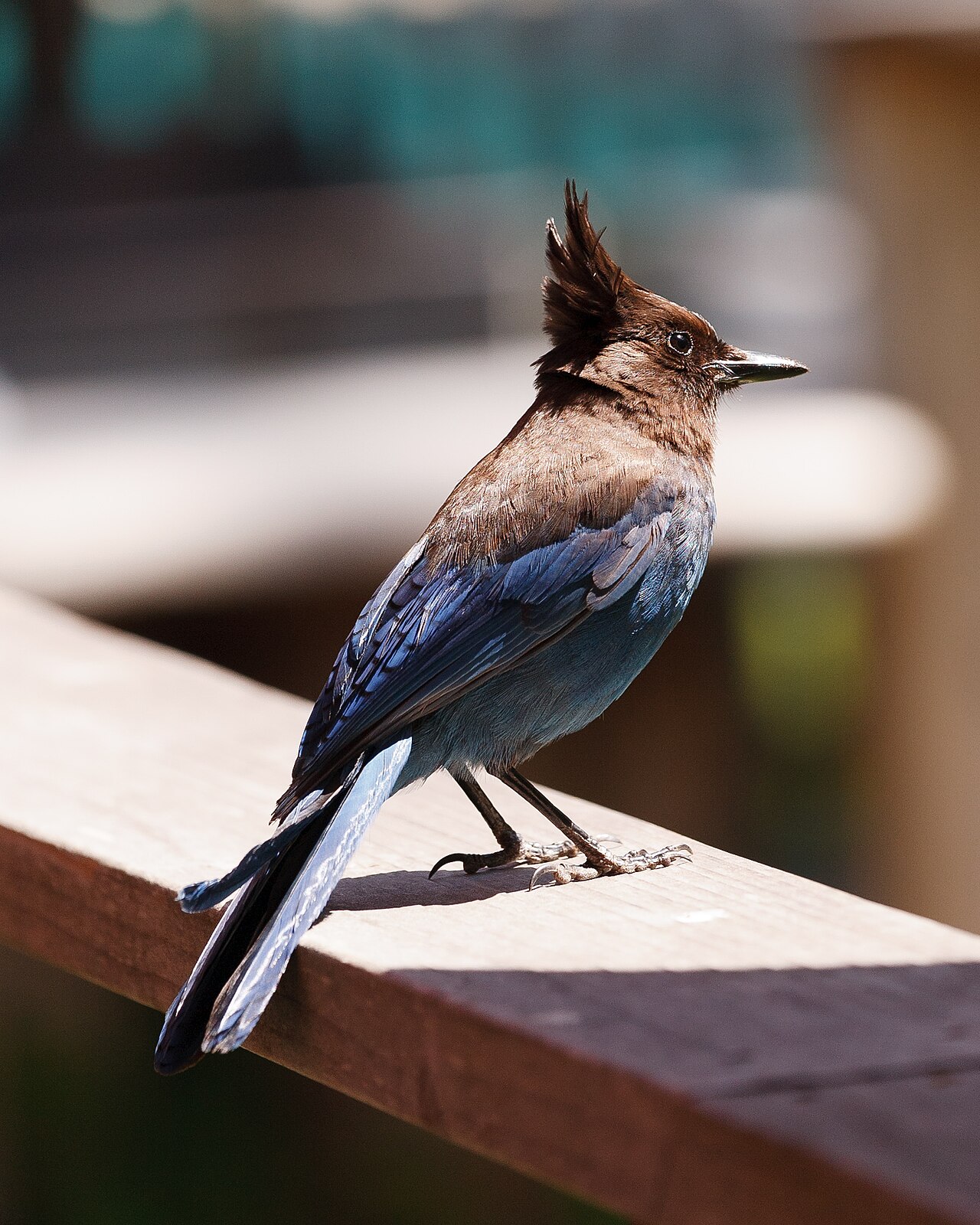
The charcoal head and tall black crest symbolize clear thinking and standing firm. The crest goes up when the bird is excited or aggressive and lies flatter when it is calm. A raised crest is a cue to hold your ground, a lowered one a cue to rest.

That blue comes from feather structure that scatters light, not from blue pigment, so the color shifts with the light. The shifting blue stands for a truth that looks different from each point of view.
The bird shares the genus Cyanocitta with the blue jay (Cyanocitta cristata). Other types of jays in North America wear blue or gray, but the crest marks these two as close relatives.
The bird carries the name of Georg Wilhelm Steller, the German naturalist who collected the first specimen on Kayak Island, Alaska, in 1741 during Vitus Bering’s expedition. Ornithologists split the species into more than a dozen subspecies. Interior birds of the Rockies show white streaks above the eye, while coastal birds are darker with blue streaks on the forehead. Along Colorado’s Front Range, where the two ranges meet, Steller’s jays and blue jays occasionally hybridize.
| Trait | Steller’s jay | Blue jay |
|---|---|---|
| Scientific name | Cyanocitta stelleri | Cyanocitta cristata |
| Habitat | Western conifer forests and mountains | Eastern and central woods and towns |
| Head and crest | Charcoal black head, tall dark crest | Blue crest, white face, black necklace |
| Wings and tail | Deep blue with fine black bars | Blue with bold white patches |
| Symbolic emphasis | Courage on a new path | Loyalty and protection of home |
What a Steller’s Jay’s Calls and Hawk Mimicry Mean
The harsh, repeated shack call is a wake-up to speak your truth. The jay uses it to announce itself and to sound the alarm. Hearing it before you see the bird means a message is about to reach you.
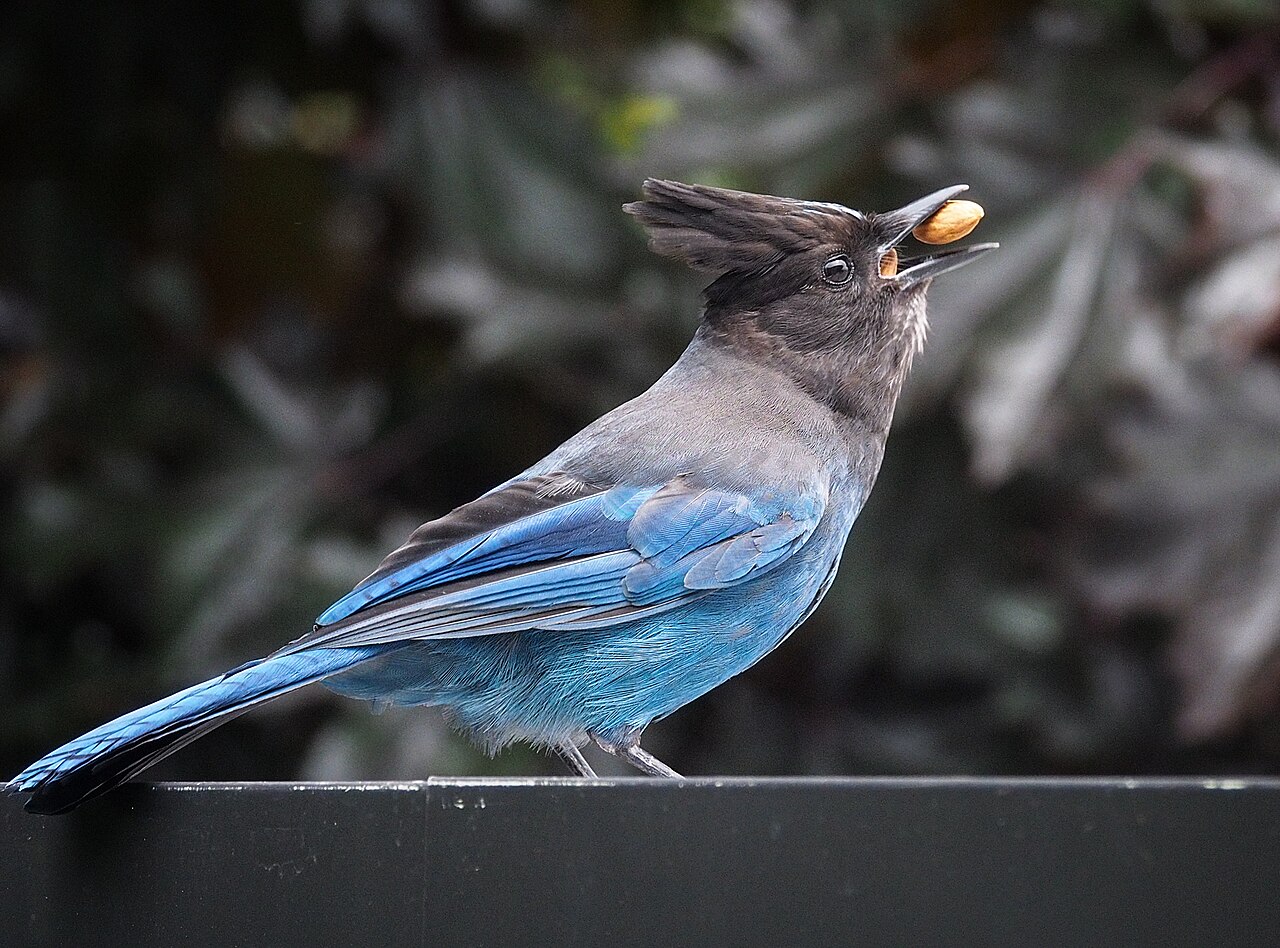
Besides the shack shack shack call, Steller’s jays give a rising wek wek and a dry rattle, and they imitate squirrels, cats, dogs and chickens as well as hawks such as the red-tailed hawk (Buteo jamaicensis). The imitation teaches when to bluff and when a bold front protects you. Near the nest the bird is typically much quieter and may give a soft, quiet song, a picture of tenderness kept private.
Blue jay sounds follow the same pattern of loud alarms and quieter private notes.
Frequently Asked Questions
Is it rare to see a Steller’s jay?
No, not in the West. Steller’s jays are common in western conifer forests and mountain towns. They are absent from most of the East, so a sighting far from the Rocky Mountain region, in the Midwest or East, is unusual and worth reporting to a local birding group.
Do Steller’s jays remember you?
Yes, at least the places that feed them. Steller’s jays learn which picnic tables and campsites offer food and return to them. Whether they recognize individual people is not tested for this species.
Do Steller’s jays eat hummingbirds?
No. Their diet is mostly seeds, nuts, berries and insects. Like other jays, they occasionally raid nests for the eggs or nestlings of small birds, but adult hummingbirds are not regular prey.
What is the lifespan of a Steller’s jay?
16 years and 1 month is the oldest recorded age, from a banded wild bird. Few jays reach that age, because hawks and owls take many young birds.
Do Steller’s jays like peanuts?
Yes. Whole peanuts in the shell are their favorite feeder food. Set a few on a platform feeder at the same time each morning, and a jay soon learns the routine and waits for you.
Sources