Crested Gecko Care: 8 Rules That Keep a Beginner Gecko Thriving
Crested gecko care comes down to a tall enclosure, room temperature in the low to mid 70s F (22 to 24 C), humidity that cycles wet to dry, and a powdered diet three times a week. That is genuinely most of it, which is why Correlophus ciliatus has become the default first reptile for people who do not want to manage a basking bulb or a rodent freezer.
The gap between a gecko that survives and one that thrives for 18 years sits in the details: ventilation, night temperature drops, what goes on the floor of the cage, and how much handling a nocturnal, arboreal lizard will actually tolerate. The eight rules below cover the setup, the feeding, and the mistakes that send new keepers to a reptile vet in month three.
Crested geckos need an 18 x 18 x 24 in (45 x 45 x 60 cm) vertical enclosure, daytime temperatures of 72 to 78 F (22 to 26 C), a night drop into the 60s F (16 to 20 C), humidity cycling between 60 and 80 percent, and a commercial powdered diet offered three times weekly. No heat lamp is required in most homes.
| Requirement | Target | Danger zone |
|---|---|---|
| Adult enclosure | 18 x 18 x 24 in (45 x 45 x 60 cm) minimum | Anything wider than it is tall |
| Daytime temperature | 72 to 78 F (22 to 26 C) | Above 82 F (28 C) sustained |
| Night temperature | 62 to 72 F (16 to 22 C) | Below 58 F (14 C) |
| Humidity | 60 to 80 percent, drying between mistings | Constant saturation, no dry period |
| Powdered diet | 3 fresh servings per week | Crickets only, no calcium source |
| Insects | Once or twice weekly, dusted | Prey wider than the gecko’s head |
| Adult lifespan | 15 to 20 years | Treating it as a short term pet |
Are Crested Geckos Easy to Take Care Of?
Yes, by reptile standards they are among the easiest. They live at normal household temperature, eat a premixed powder that you rehydrate with water, need no UVB in most setups, and tolerate being left alone. A keeper who is away for a long weekend can leave a fresh dish of food and a well misted cage without arranging care.
The honest caveat is that easy does not mean forgiving of one specific failure. Heat kills crested geckos faster than anything else on this list, and a sealed glass tank in a west facing window can pass 90 F (32 C) in an afternoon. Everything else on the care sheet has slack; temperature does not.
The other adjustment is expectation. These are nocturnal animals that spend daylight hours flattened against a leaf or a cork slab. If you want an animal that is visibly active at 4 pm, a crested gecko will look like an expensive ornament for most of the week.
Enclosure Size and Setup

Height beats floor space. Crested geckos are arboreal and use vertical territory, so an adult wants at least 18 x 18 x 24 in (45 x 45 x 60 cm), and a 18 x 18 x 36 in (45 x 45 x 90 cm) front opening terrarium is better. Hatchlings and juveniles under 10 g do better temporarily in something smaller, around 8 x 8 x 12 in (20 x 20 x 30 cm), because a tiny gecko in a large cage often fails to find its food dish.
Fill the volume densely. Cork bark, cork tubes, bamboo or vine branches, and either live or artificial foliage should break the interior into layers, with dense cover in the upper third where the animal will sleep. A bare cage with two branches leaves nowhere to hide, and a gecko with nowhere to hide sits on the floor and stops eating.
Ventilation matters as much as volume. Screen tops plus front or side vents keep air moving so the enclosure dries between mistings, which is what prevents mold and respiratory problems. A full setup guide lives in our crested gecko enclosure breakdown, including dimensions by age.
What Should I Put at the Bottom of My Crested Gecko’s Cage?
For a new or quarantined gecko, plain paper towel is the correct answer. It costs nothing, it shows you exactly what the animal passed, and it removes any chance of swallowed substrate while you are still learning the animal’s condition. Change it every few days.
For an established adult, a moisture holding soil mix works well: coconut fiber, sphagnum moss, and orchid bark, or a bioactive blend of topsoil, play sand, and leaf litter with springtails and isopods to process waste. Both hold humidity and let you keep live plants. Budget 2 to 3 in (5 to 8 cm) of depth.
Three substrates cause real harm and should never go in the cage: calcium sand, crushed walnut shell, and reptile carpet. The first two are impaction risks when a gecko snaps at food and gets a mouthful of floor, and the loose loops of carpet catch toes and tail tips.
Temperature: Is 70 Degrees Too Cold for a Crested Gecko?

No, 70 F (21 C) is comfortably within range and closer to ideal than most people assume. The target band is 72 to 78 F (22 to 26 C) during the day, and a steady 70 F room needs no heating equipment at all. These geckos come from the cool, humid forests of New Caledonia, not a desert.
Above 82 F (28 C) the animal begins to stress, and sustained exposure above 85 F (29 C) can be lethal within hours. Heat stress looks like a gecko pressed low to the substrate, open mouth breathing, and refusal to eat. In summer the fix is air conditioning, a fan near the room, or moving the enclosure away from windows, not a stronger light.
A night drop is beneficial rather than dangerous. Letting the enclosure fall to 62 to 72 F (16 to 22 C) after dark mirrors the natural cycle and appears to support appetite and long term breeding condition. Only reach for a low wattage ceramic heat emitter or a heat mat on a thermostat if the room genuinely sits below 68 F (20 C), and pair it with a digital probe thermometer.
Humidity and Misting

Aim for 60 to 80 percent humidity that cycles rather than sits. The practical routine is a heavy mist in the evening, a lighter one in the morning, and a dry stretch in between where readings fall to around 50 percent. Constant saturation causes skin and respiratory problems just as reliably as chronic dryness.
Dry air shows up first in the shed. A gecko that retains skin on its toes and tail tip will lose those toes, so a stuck shed is a signal to raise humidity and to offer a humid hide with damp sphagnum moss. Check a digital hygrometer rather than guessing from how the glass looks.
Provide standing water anyway. A shallow dish that the gecko cannot drown in gets used more than new keepers expect, and it buffers the enclosure between mistings. Replace it daily, because a warm, wet dish is a bacterial culture within about 48 hours.
Lighting and UVB
Crested geckos do not require UVB to survive, and millions have been raised under ambient room light with a vitamin D3 fortified powdered diet. A regular day and night cycle of roughly 12 hours is enough, and daylight through a window across the room supplies it.
That said, a low output UVB source measuring 2 to 5 percent, mounted so the gecko can move in and out of the gradient, is a reasonable upgrade. Studies on several crepuscular geckos show improved calcium metabolism and more natural behavior under low level UVB. Keep any bulb outside the enclosure or above the screen so the animal cannot press against it.
Never use a bright basking bulb pointed into the cage. It raises temperature into the danger zone and floods a nocturnal animal with light it will spend all day hiding from. The Smithsonian National Zoo keeps comparable New Caledonian geckos under similarly modest lighting.
Diet and Feeding Schedule
A complete commercial crested gecko diet is the foundation, not a supplement. These powders mix with water to a ketchup consistency and cover protein, calcium, and vitamins in one dish. Offer a fresh serving three times a week in the evening, in a shallow ledge mounted dish, and remove it after 24 to 36 hours before it spoils.
Insects are enrichment and extra protein, once or twice weekly. Appropriately sized crickets, dubia roaches, or black soldier fly larvae dusted with a calcium and D3 supplement all work, and nothing offered should be wider than the space between the gecko’s eyes. Many adults hunt enthusiastically even when powder is available.
Fresh fruit is a treat at most. Mashed banana, papaya, or peach in tiny amounts is fine occasionally, but fruit is calcium poor and phosphorus rich, and geckos that fill up on it develop metabolic bone disease. Our crested gecko diet guide covers ratios by age, and which foods are safe goes item by item.
Handling: Can I Just Grab My Gecko?
No. Grabbing is how keepers end up with a tailless gecko, because Correlophus ciliatus drops its tail readily under threat and, unlike many lizards, never regrows it. The tail loss is not a health emergency and the stump heals, but it is permanent and it is avoidable.
The method that works is hand walking. Open the enclosure, let the gecko step onto an open palm on its own, and move your free hand in front of it so it walks from hand to hand. Stay low over a sofa or bed, since these animals jump without warning and a fall onto a hard floor does real damage.
Keep sessions short and infrequent, five to ten minutes a few times a week at most, and skip handling entirely for the first two weeks after you bring a gecko home and while it is shedding. Never take hold of the tail for any reason.
What Not to Do With a Crested Gecko
Do not house two adults together without understanding the risk. Two males will fight, sometimes fatally, and a male kept with a female will breed her continuously, which drains her calcium reserves. Even two females can bully one another over the best sleeping spot, and single housing is the default recommendation.
Do not mix species. Larger New Caledonian relatives such as the giant gecko Rhacodactylus leachianus will treat a crested gecko as food, and any mixed enclosure also mixes parasites. Species from other regions bring pathogens that a crested gecko has no resistance to.
Do not use hot rocks, do not let the enclosure exceed 85 F (29 C), do not feed insects wider than the gecko’s head, and do not skip the calcium supplement because the powder already contains some. Each of these turns up repeatedly in reptile veterinary case notes.
What Stresses Geckos Out and How to Destress One
The reliable stressors are heat, exposure, and interference. A cage that is too warm, too bright, too open, or handled daily produces the same picture: an animal that sits on the substrate instead of climbing, refuses food, and darkens or pales persistently. Vibration from a nearby speaker or a busy doorway adds to it.
Destressing is mostly subtraction. Stop handling for two weeks, add dense cover in the top third of the enclosure, verify temperature with a probe rather than a stick on dial, and check that the room is quiet after dark when the gecko wants to be active. Feed on a consistent evening schedule so the animal can predict it.
Give it time on a reptile clock, not a human one. Appetite often takes one to three weeks to return after a move or a setup change, and a gecko that has lost noticeable weight, is sitting with eyes closed during its active hours, or is breathing with an open mouth at normal temperature needs a reptile vet rather than another adjustment.
What Are the Signs That a Crested Gecko Is Happy?
Healthy behavior is easier to read than mood. A well kept crested gecko is out and climbing after dark, sits in the upper third of the enclosure, has a firm rounded body with no visible hip bones or sunken flanks, and sheds cleanly in one go. Eyes are clear, and there is no retained skin on the toes.
Appetite is the best single indicator. A gecko that clears most of its powdered diet dish across a two day window and still chases a cricket is doing well. Regular, formed droppings with a white urate portion confirm the digestive side.
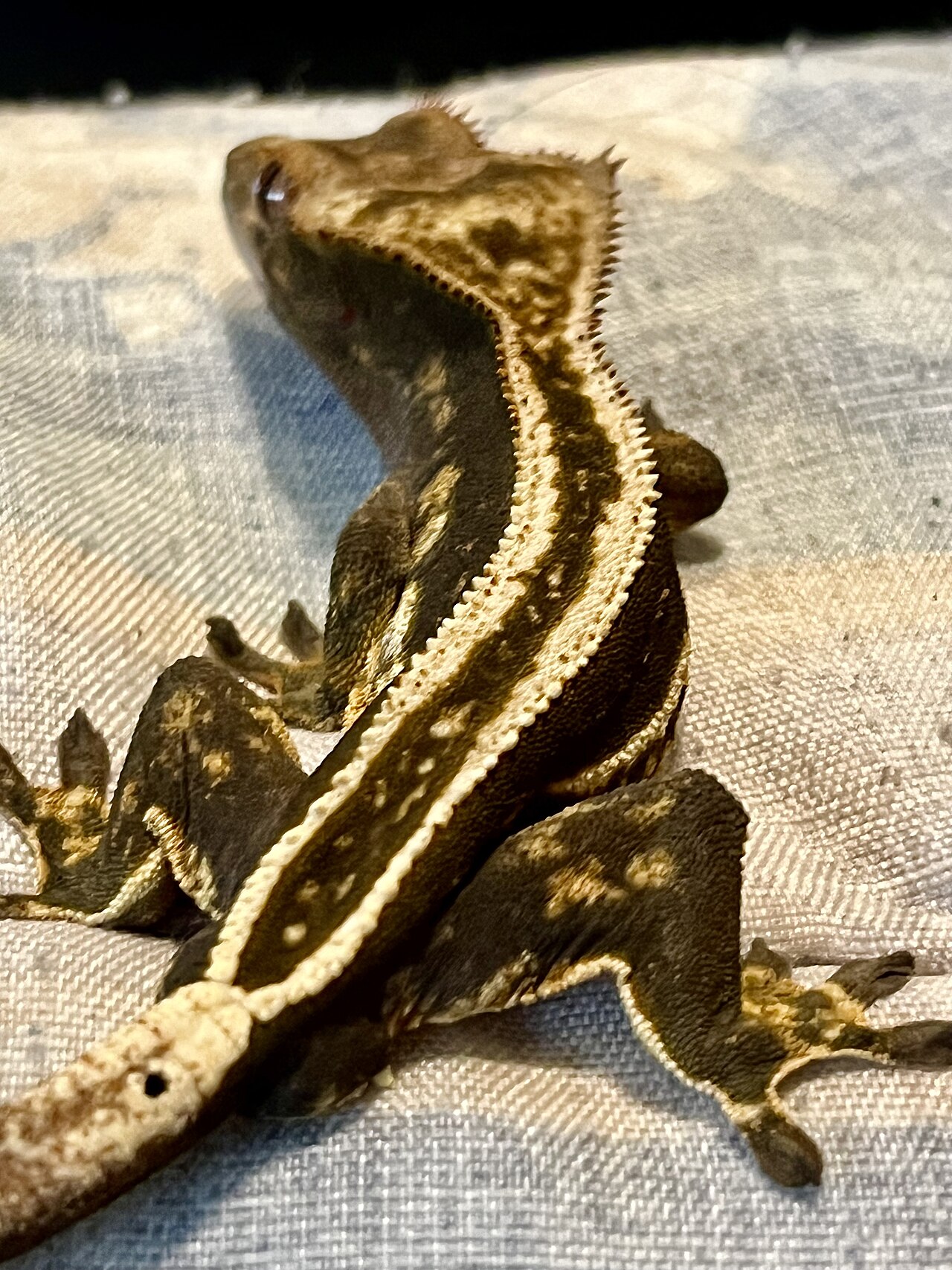
Colour changes are normal rather than diagnostic. Firing up to a darker, more saturated pattern at night and firing down to pale in the day is ordinary behavior in this species, and it varies by morph. A gecko stuck dark and flat on the floor for days is the pattern that should worry you.
What Are the Downsides of Owning a Crested Gecko?
The big one is the timeline. Captive crested geckos routinely reach 15 to 20 years, so a gecko bought for a ten year old is still alive when that child finishes college. Our crested gecko lifespan figures bear that out, and rescues are full of animals whose owners planned for three or four years.
Then there is the mismatch with what most people want from a pet. They are nocturnal, they do not enjoy handling, they jump unpredictably, they are fast escape artists through any gap in a lid, and they show no affection in any form a mammal owner would recognize. Watching is the hobby.
Practically, the humidity routine is a daily commitment, live insects require their own container of food, and heat waves mean managing room temperature for the animal’s sake. Keepers who want a lizard that is active in daylight and handles calmly are usually better served by leopard gecko care instead.
Frequently Asked Questions
Do crested geckos need a heat lamp?
Usually not. If the room stays between 70 and 78 F (21 and 26 C), no heating equipment is needed at all. Only rooms that fall below 68 F (20 C) call for a low wattage ceramic heat emitter or a heat mat, always controlled by a thermostat and never a bright basking bulb pointed into the enclosure.
How often should I clean the enclosure?
Spot clean droppings and remove the old food dish every one to two days. Wipe the glass weekly. On paper towel, replace it every two to three days. A non bioactive soil substrate should be fully changed every two to three months, while a well established bioactive setup with springtails and isopods can run a year or longer.
Why is my crested gecko not eating?
Check temperature first, then recent changes. Enclosures above 82 F (28 C), a move within the last two weeks, an imminent shed, or a cage with too little cover all suppress appetite. Seasonal slowdowns in winter are normal for adults. Weight loss over two weeks, lethargy during active hours, or open mouth breathing warrants a reptile vet.
Do crested geckos bite?
Rarely, and it barely registers. They have small teeth, no venom, and would rather jump or drop their tail than bite. A defensive nip from an adult feels like a pinch and seldom breaks skin. Bites almost always follow being grabbed from above, which is the one handling approach to avoid entirely.
Can a crested gecko live on powdered diet alone?
Yes. Complete commercial diets from established brands are formulated as sole nutrition and thousands of geckos have been raised and bred on nothing else. Insects one to two times weekly still add variety and hunting behavior, and most keepers offer both. Fruit alone is never adequate and causes metabolic bone disease.
How big do crested geckos get?
Adults reach about 4 to 4.5 in (10 to 11 cm) from snout to vent and roughly 7 to 8 in (18 to 20 cm) including the tail, at 35 to 55 g. They reach adult size in 12 to 18 months. An adult that has dropped its tail looks noticeably shorter but weighs and eats normally.