Great Horned Owl Feather Meaning: What Finding One Means and the Law
A great horned owl feather spiritually points to alertness, comfort with the dark and quiet protection, because it comes from a hunter that hears what others miss and flies without a sound. The great horned owl feather meaning has a practical side too. A found feather often comes from a healthy owl in molt, not from one that died.
Before you read the find as a sign, confirm the species and know the law. Great horned owls (Bubo virginianus) are protected under the Migratory Bird Treaty Act, so even a feather picked up on a trail is illegal to keep without a permit. The best way to hold on to it is a good photo.
As a sign, a great horned owl feather stands for alertness, quiet strength and protection at night. Check the soft, fringed leading edge and the brown, buff and gray bars to confirm the species. Then leave it where it lies, since the Migratory Bird Treaty Act bars keeping or selling owl feathers.
How to Tell a Great Horned Owl Feather
Tell a great horned owl feather by three traits together: a soft, comb-like fringe on the leading edge, a velvety surface, and bold bars of brown, buff and gray. The fringe breaks up the air over the wing, so the owl flies almost silently. Hawk and crow feathers feel stiff and glossy by comparison. One trait alone is not enough for a species call.
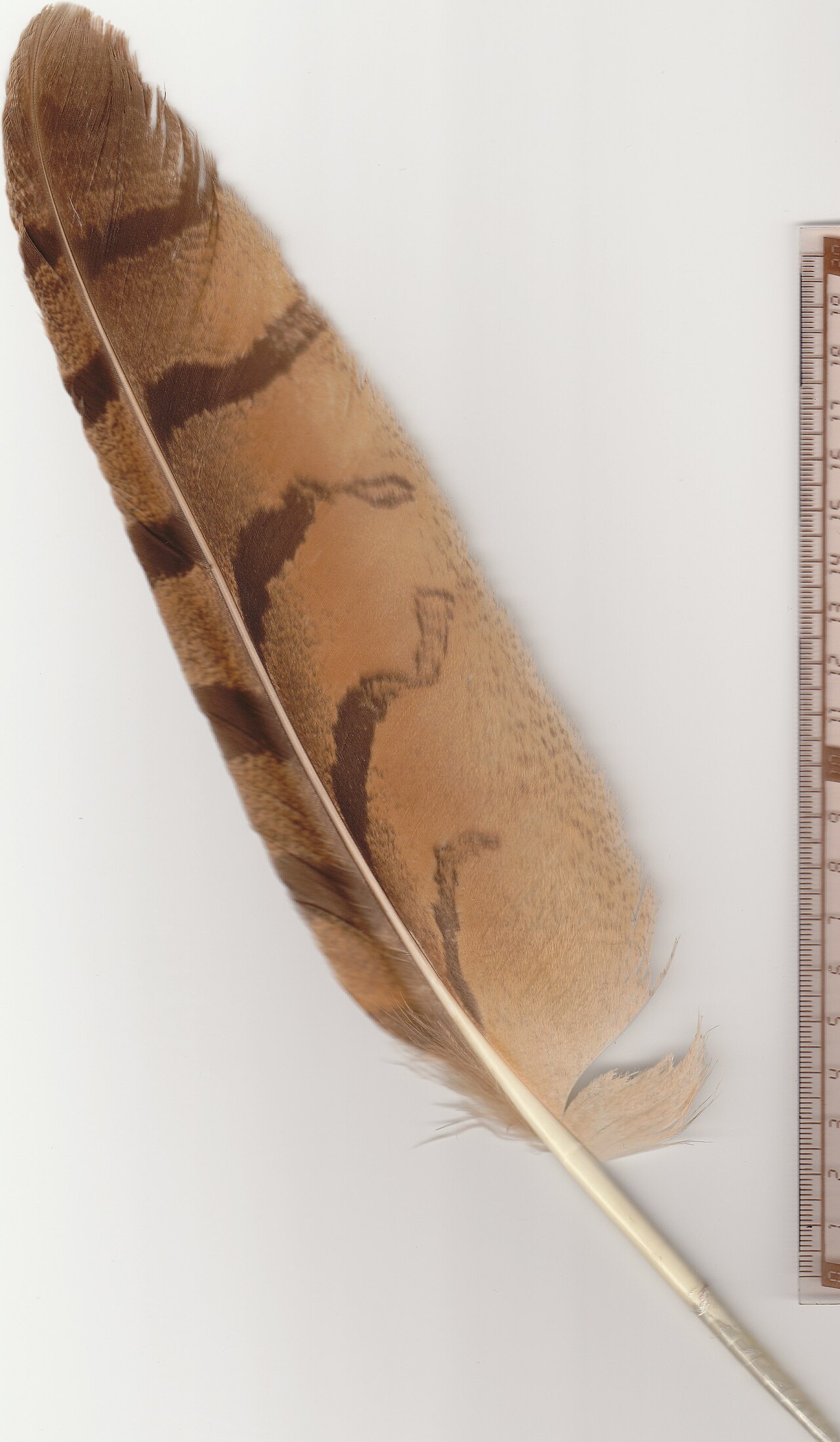
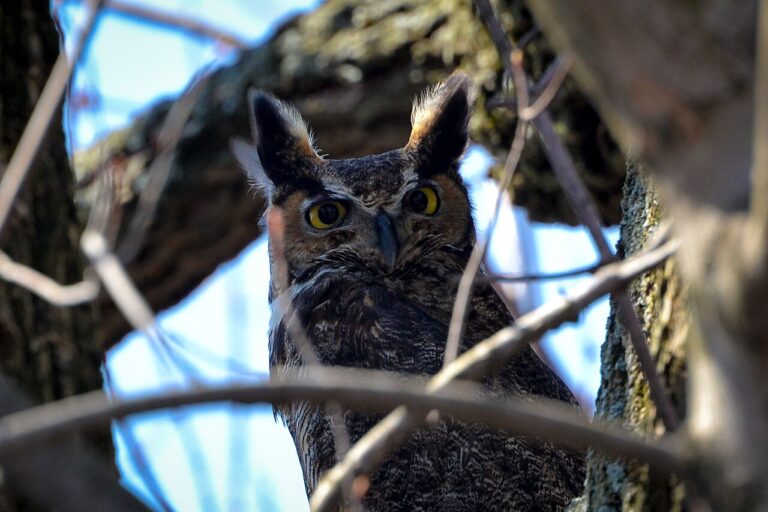
Great horned owls are large, heavy owls, and their wing and tail feathers run long and broad to match. The color is warmer than on many owls, with rusty buff between dark bars and a downy base. A curved, uneven feather comes from the wing, and a straighter, more even one from the tail.
Barred owls (Strix varia) are the closest lookalike, with cooler gray-brown feathers and even, pale bars. Red-tailed hawks (Buteo jamaicensis) drop banded feathers too, but without the soft fringe. Confirm the match against the USFWS Feather Atlas, which shows scanned flight feathers by species.
| Feature | Great horned owl | Barred owl | Red-tailed hawk |
|---|---|---|---|
| Leading edge | Soft, comb-like fringe | Soft, comb-like fringe | Stiff, smooth edge |
| Surface feel | Velvety | Velvety | Smooth and glossy |
| Main colors | Brown, rusty buff, gray | Gray-brown, pale cream | Brown, white, rust on the tail |
| Barring | Dense, irregular dark bars | Even, pale bars | Bold bands with plain gaps |
What to Do After Finding an Owl Feather
Leave the feather where you found it, take a photo, and wash your hands if you touched it. A photo gives you everything you need for identification without holding a protected item. Shoot both sides on a plain background with something for scale. Note the place and date, since habitat helps narrow the species.
Use soap and water, because the CDC advises washing your hands after touching birds or their droppings. Wild birds can carry many of the same diseases as pet birds. The CDC list for pet birds includes cryptococcosis, histoplasmosis and psittacosis. Keep children from putting a found feather near their faces.
Report the find only when it points to a problem. A pile of feathers, a dead owl, or an owl on the ground that does not fly away calls for your state wildlife agency or a licensed wildlife rehabilitator. A single feather on a lawn needs no report. Great horned owls molt gradually, so one feather is a normal trace of a living bird.
Is It Legal to Keep or Sell an Owl Feather?
No, keeping or selling an owl feather is illegal in the United States without a federal permit. The Migratory Bird Treaty Act of 1918 protects native owls, and it covers feathers, nests and eggs as well as live birds. The law makes no exception for a feather you found on the ground. Good intentions do not change that.
The reason is enforcement. An officer cannot tell a molted feather from one pulled from a killed bird, so the law bans possession outright. That rule took away the market that once drove the killing of birds for hats and decorations.
Permits exist for narrow uses such as research, education and wildlife rehabilitation, and the US Fish and Wildlife Service issues them. No permit category covers a found feather kept as a keepsake. Photos, drawings and replicas are the legal way to keep the memory. If you already hold one, ask your state wildlife agency how to hand it over.
How Much Are Owl Feathers Worth?
An owl feather has no legal market value in the United States, because selling, buying or trading it is illegal. Any listing that puts a price on a wild owl feather offers a federal violation, not a collectible. Feathers from domestic poultry, such as turkeys and chickens, can be sold legally.
The real worth of a found feather lies in the record it leaves. A clear photo can help a local birding group or nature center confirm a great horned owl in your area. Logging the sighting in eBird adds it to bird data that researchers use. That is the use the law leaves open.
What Finding a Great Horned Owl Feather Means
Finding a great horned owl feather points to alertness, comfort with the dark and quiet protection. The bird hunts at night, locates prey by sound, and strikes without warning. A feather from that hunter on your path asks you to watch closely and speak less. It favors patience over a fast reaction.
The biblical meaning of the owl begins with Leviticus 11:16, where the King James Version lists the owl among birds the Israelites were not to eat. The verse is a food law and gives no meaning to a found feather. Hebrew bird names in these lists are hard to match to modern species. Translations differ on which owls they mean.
Greek myth ties the owl to Athena, goddess of wisdom, but her bird is the little owl (Athene noctua), a small species of Europe and Asia. The great horned owl lives only in the Americas, so the Athena link describes owls in general, not this feather. What the great horned owl carries on its own is fierceness and endurance. It nests in late winter, often while snow still falls, and defends that nest hard.
What an Owl Visiting Your Yard or Dream Means
An owl visiting your yard means the yard offers prey and lies within its hunting range. Great horned owls hunt rabbits, rodents, skunks and other birds, and they return to perches that pay off. A repeat visit often points to a steady food source and a settled pair nearby. The visit asks you to notice what moves around you after dark.
Great horned owl sounds tell you the owl is near before you see it. The call is a deep, soft, stuttered hoot, and mated pairs answer each other in duets, the female higher than the male. Pairs call often in late fall and winter as they claim territory. A hoot outside your window is typically a territorial or pair call, not a warning aimed at you.
Owl dream meaning centers on insight that arrives in the dark. A great horned owl in a dream points to something you sense but have not named yet. A watching owl calls for attention to a situation at home or work. An owl in flight points to a decision you are ready to make.
Frequently Asked Questions
Do great horned owls drop feathers when they molt?
Yes, great horned owls shed feathers during a slow molt once a year, replacing a few flight feathers at a time so they can keep hunting. A single feather on the ground is a normal sign of molt. It does not mean an owl died or was hurt nearby.
Are the ear tufts of a great horned owl ears?
No, the ear tufts are feather tufts called plumicorns, not ears. The real ear openings sit on the sides of the head, hidden under the feathers of the facial disk. The tufts likely help with camouflage and display, rising or flattening with the owl’s mood and posture.
Why is it illegal to pick up an owl feather?
Picking up an owl feather is illegal because the Migratory Bird Treaty Act bars possessing parts of native owls without a permit. A feather found on the ground looks the same as one taken from a poached bird. A blanket ban protects owls by leaving no market for their feathers.
Which direction should an owl face?
Point an owl decoy or carving toward the area you want it to watch, such as a garden bed, porch or entry. Real owls turn their heads toward sound, and that forward stare is the trait people display. Move a garden decoy every few days, since birds can learn it never moves.
Do owl feathers make noise in flight?
No, owl flight feathers make very little noise. The comb-like fringe on the leading edge and the soft trailing edge break up the air rushing over the wing. That lets a great horned owl reach prey before the prey hears it coming. Hawk feathers lack this fringe and swish audibly.
Sources
- U.S. Fish and Wildlife Service, The Feather Atlas
- U.S. Fish and Wildlife Service, Migratory Bird Treaty Act of 1918
- CDC, Healthy Pets: Birds