Starling Symbolism: Spiritual Meaning, Omens and Folklore
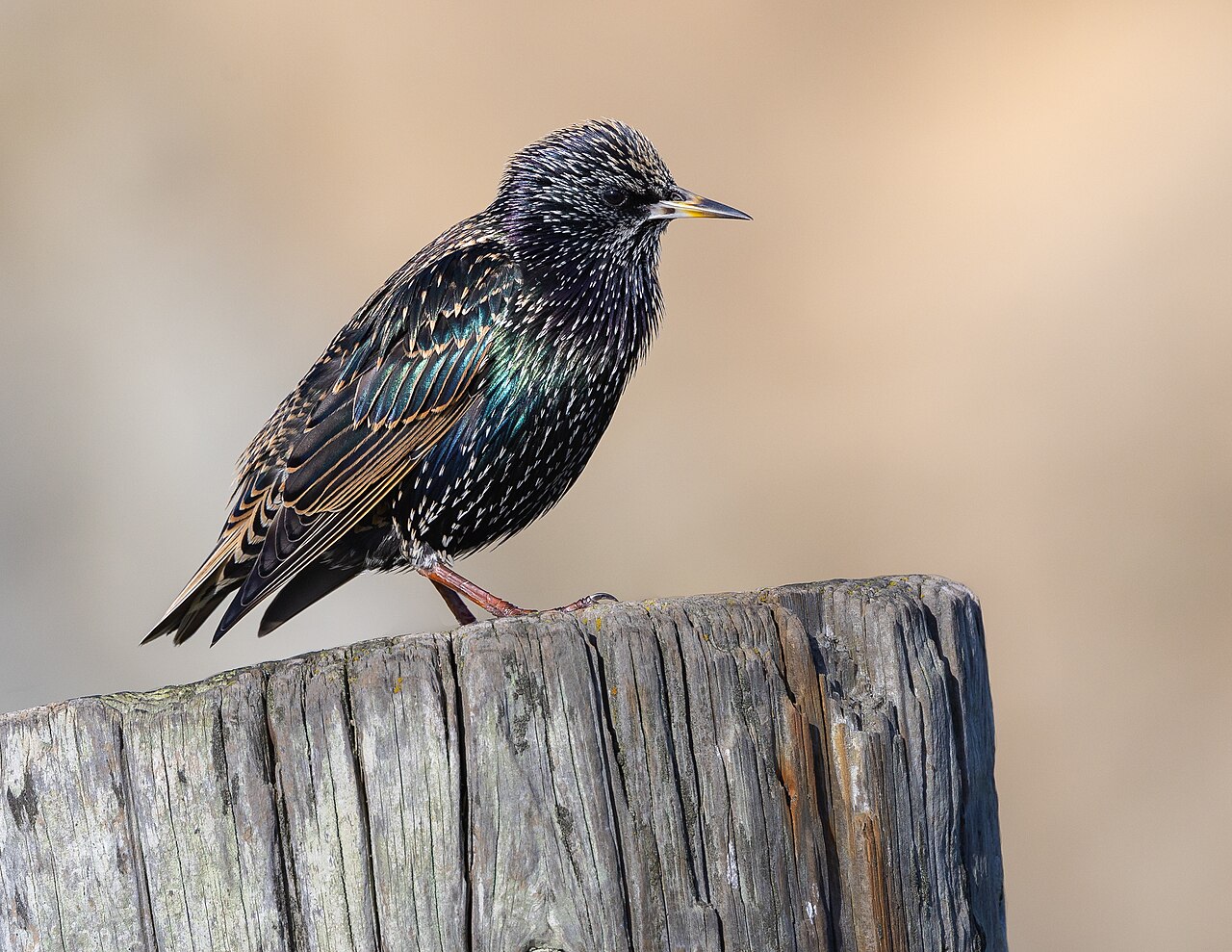
Seeing a starling is traditionally read as a sign about belonging: that you are part of something larger than yourself, for better or worse. The European starling (Sturnus vulgaris) moves in enormous coordinated flocks, mimics other birds and machines, and thrives wherever people build, and starling symbolism grew directly out of those three habits. The bird stands for community, communication, and adaptability.
Because the starling is also an introduced species that outcompetes native cavity nesters across North America, its symbolism carries a shadow side few other songbirds have. The same flock reads as unity in one culture and as an invasion in another.
Starling symbolism centers on community, communication, and adaptability. The bird’s huge synchronized flocks are read as a sign of group harmony and shared purpose, while its gift for mimicry ties it to speech, learning, and the power of words. In folk tradition a starling in the house is treated as a message arriving.
What do starlings symbolize spiritually?
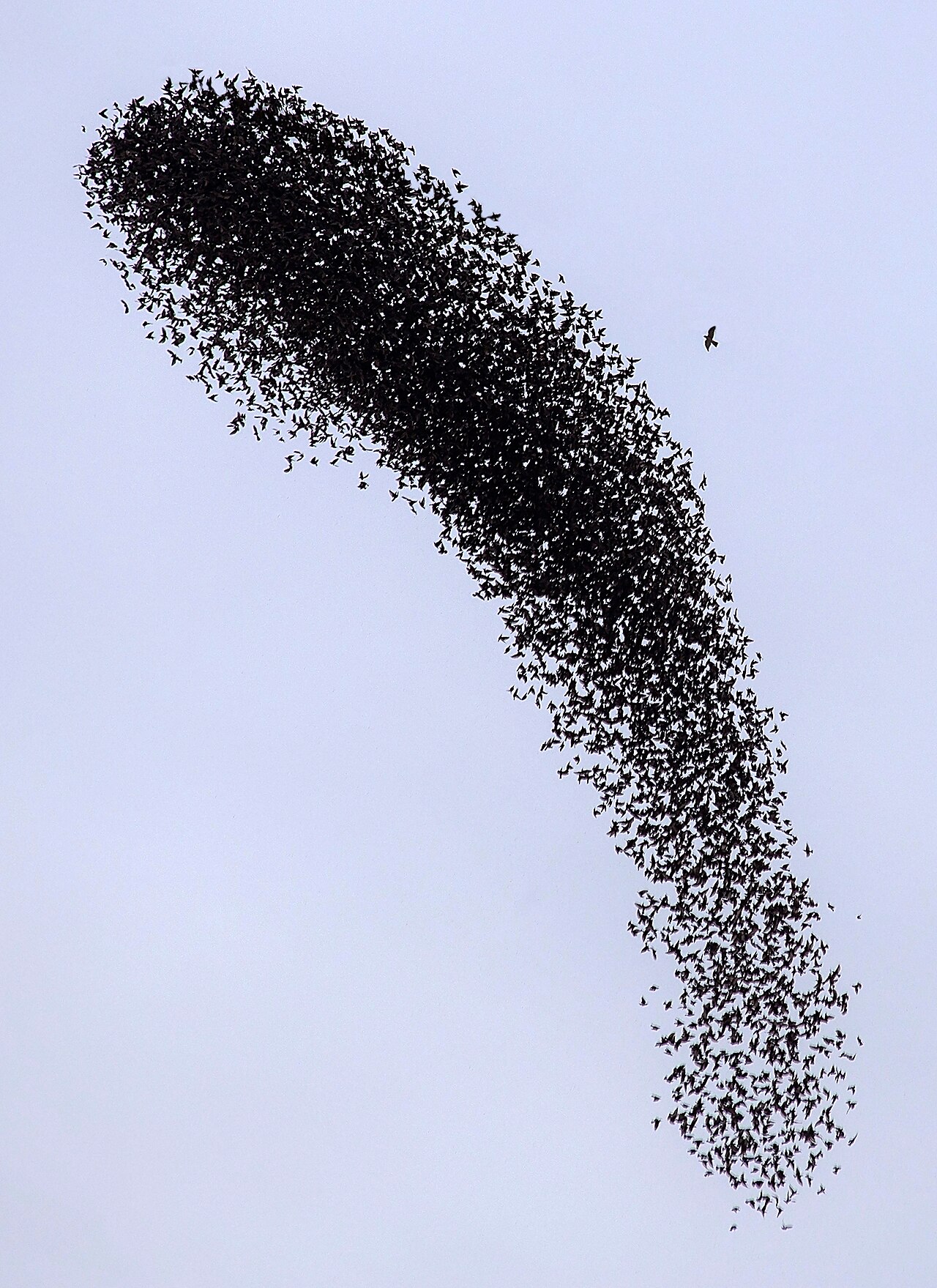
Spiritually the starling is read as a teacher of cooperation. A murmuration holds thousands of birds turning together with no leader, and that image is used to describe communities that work without a single voice in charge. People who claim the starling as a spirit animal or totem usually describe themselves as sociable, quick to adapt, and skilled at reading a room.
Mimicry gives the bird its second meaning. Starlings copy other species, car alarms, and human words, so interpreters connect them to speech, persuasion, and the responsibility that comes with both. A starling heard imitating another bird is sometimes read as a reminder to speak in your own voice rather than borrowing someone else’s.
The starling spiritual meaning in love readings follows from the flock: partnership built on constant small adjustments. Compare the solitary reading in loon symbolism.
| Situation | Common meaning |
|---|---|
| A starling singing near your home | News or a conversation approaching |
| A starling inside the house | A message arriving, traditionally one that cannot be ignored |
| A murmuration overhead | Group harmony, or being swept along by others |
| A starling mimicking another bird | A caution about borrowed words or false appearances |
| A lone starling away from its flock | Separation from a group you belonged to |
| A dead starling | In folk reading, the end of a social tie rather than a death omen |
| A starling nesting in a wall or vent | Something settling into your space uninvited |
What is the folklore associated with starlings?

The oldest surviving starling folklore is Welsh. In the second branch of the Mabinogi, Branwen trains a starling to carry a message across the Irish Sea to her brother, and the bird’s flight brings an army. That story fixed the starling as a messenger bird in Celtic tradition, and it is still the reference point for readings about words that travel farther than intended.
European farming folklore is more practical. Starlings arriving in numbers were taken as a sign of weather turning, and a murmuration settling on a roost at dusk was read as a season closing. In parts of Britain the first starlings of autumn marked the end of harvest work.
Starling symbolism in literature runs through Shakespeare, whose Henry IV mentions teaching a starling to speak a name, and that single line is the reason the bird lives in North America at all. For other dark plumaged birds with layered folklore, see blackbird symbolism.
What does it mean if a starling comes into your house?
A bird inside the house is one of the most consistent omens in European folk tradition, and the starling version is read as a message that has found its way in. Because the starling is a talker, the message is usually interpreted as spoken rather than written: a phone call, a confession, or news from family. Folk belief generally treats a bird that leaves on its own as good news and one that cannot find the way out as a worry that will take time to clear.
The darker strand of this belief links any bird in the house to death in the family, which is the root of searches about starling symbolism and death. That reading is not specific to starlings and attaches to nearly every bird in the same folk tradition, so it carries no particular weight here.
The ordinary explanation is usually the right one. Starlings nest in cavities and will push into dryer vents, soffits, and chimneys, so a bird in the room most often means a nest site in the structure. The practical response is to open one window, darken the rest of the room, and let the bird leave on its own.
Biblical and Christian meaning of starlings
The starling is not named in the Bible, so the biblical meaning of starlings is built by analogy rather than by chapter and verse. Christian interpreters usually place it among the small common birds of the Gospel passages about provision, where the point is that even the least valued bird is accounted for. Read that way, a starling is a sign of being counted when you feel ordinary.
A second Christian reading uses the flock as an image of the congregation: thousands of individuals moving as one body, each watching only its nearest neighbors. Preachers have used murmurations exactly that way, and it is the most common modern sermon use of the bird.
Where the bird’s status as a pest shapes the reading, interpreters sometimes treat it as a figure of the crowd that follows without discernment. These are interpretive traditions rather than scriptural statements, and they should be held as such. The same split appears in general bird symbolism.
Starlings in Native American and East Asian readings
Starlings have no deep Native American symbolism, and the reason is historical rather than cultural: the bird did not exist in North America before 1890, when roughly sixty European starlings were released in Central Park. Where modern readings exist, they usually extend existing teachings about blackbirds or about flocking birds, and they belong to the communities that hold them.
East Asian traditions give related starling species a warmer place. The white cheeked starling is a familiar urban bird in Japan, and its evening roosts are noted in poetry as a marker of the day ending. Chinese tradition associates mynas and other starling relatives with speech and with trained mimicry, sometimes as a caution about flattery.
Across both, the pattern holds: where the bird is native it reads as part of the ordinary order, and where it was introduced it reads as something out of place. For a bird whose symbolism depends just as heavily on where you stand, see bat symbolism.
Why do starlings have a bad reputation?
Starlings have a bad reputation in North America because they compete aggressively for nest cavities with native birds, including bluebirds, woodpeckers, and purple martins, and because winter roosts of hundreds of thousands foul buildings and feedlots. They are also implicated in aircraft strikes, most notoriously a 1960 crash in Boston. The Cornell Lab of Ornithology summarizes the species and its spread in its account of the European Starling.
That reputation is not universal. In their native range starlings are declining steeply, and in Britain they are a red listed species of conservation concern, which means the same bird is a pest on one continent and a priority on the other.
Symbolically this is the most interesting thing about the starling. It is the clearest case of an animal whose meaning is decided by human borders rather than by behavior. The bird that stands for unwelcome abundance in Ohio stands for loss in Yorkshire. For another animal read through usefulness rather than nature, see bee symbolism.
Frequently Asked Questions
What is special about a starling bird?
Starlings are among the best mimics in the bird world, copying other species, car alarms, and human speech, and they form murmurations of thousands that turn in unison. Their plumage is also unusual: it looks plain black at a distance but shows green and purple iridescence with white spots up close.
What are starlings’ powers?
In symbolic terms a starling’s powers are speech and coordination. It can learn and reproduce sounds it hears, including words, and it navigates dense flocks by tracking only its six or seven nearest neighbors. Folklore turned both abilities into message carrying and group harmony.
Is a starling a rare bird?
No. The European starling is one of the most abundant birds in North America, with a population in the hundreds of millions, and it is easy to find in cities, farms, and parking lots. In its native Europe, however, it has declined sharply and is red listed in the United Kingdom.
What is a flock of starlings called?
A flying flock of starlings is called a murmuration, which is the term for the swirling aerial display seen at dusk. A roosting group is sometimes called a chattering or a cloud, both older collective nouns that survive mainly in lists rather than in birding use.
What do starling tattoos mean?
Starling tattoos usually stand for adaptability, community, and finding a voice, and a murmuration design is often chosen to represent many people moving as one. Some wearers choose the bird specifically for its outsider status, marking survival in a place that did not welcome them.