Killdeer Sound: Why That Bird Screams Its Own Name at 2 AM
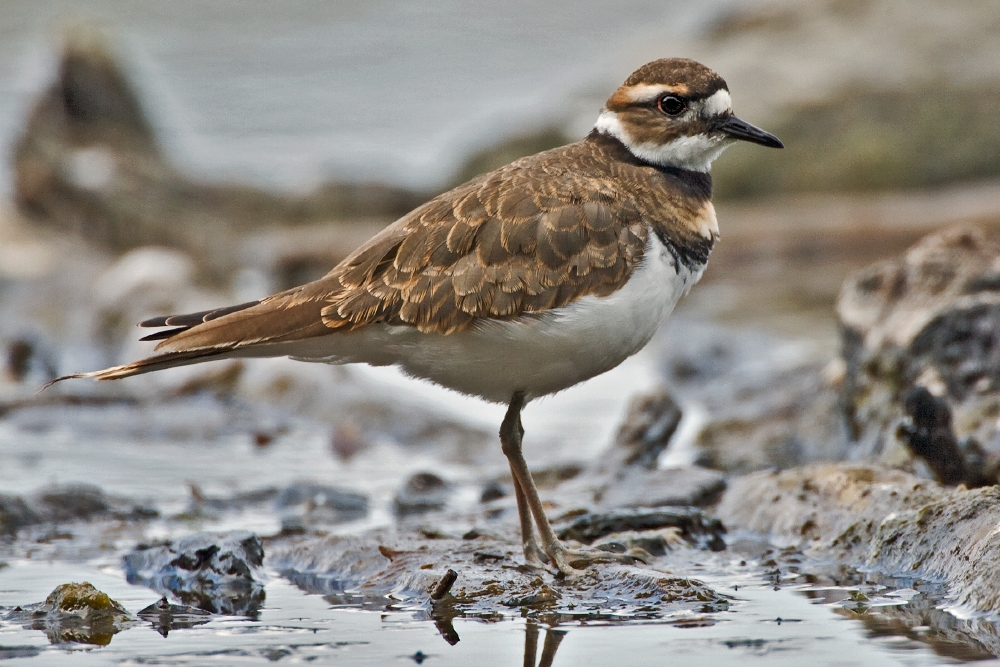
The killdeer sound is a loud, piercing kill-deeah that the bird repeats over and over, and it is one of the few American bird calls that literally says its own name. If something woke you at two in the morning shrieking across a parking lot or a gravel driveway, a Killdeer (Charadrius vociferus) is the most likely culprit.
The scientific name says it plainly: vociferus means noisy. This is a plover that lives on open ground, nests on gravel, and reacts to anything that comes near by screaming and running. Knowing its three main calls tells you what the bird is actually doing, whether it is claiming a field, flying over at night, or trying to pull you away from four eggs.
A Killdeer makes a high, sharp kill-deeah call, repeated in fast series when alarmed and drawn into a long trill during display flights. It calls day and night, especially in spring and during migration, and the most frantic version means you are close to its nest or chicks.
What Noise Does a Killdeer Make?
The main killdeer sound is a clear two syllable kill-deeah or dee-ee, pitched high enough to cut through traffic noise and repeated without pause when the bird is agitated. Calm birds give single, spaced notes while feeding; agitated birds run the same note into a rapid stutter.
There is also a long rolling trill, a stuttering deedeedeedee used in flight displays over territory, and a low rasping note reserved for close range threats. Three sounds, three meanings, and they are easy to tell apart once you have heard the trill once.
| Call | Written as | What it means | When you hear it |
|---|---|---|---|
| Name call | kill-deeah | Contact and mild alarm | All year, day and night |
| Rapid alarm | dee-dee-dee-dee | Predator is close to nest or young | March through July |
| Display trill | deedeedeedeedee | Territory claim or courtship | Late winter into spring |
| Flight call | single deee | Bird is moving between fields | Night, especially during migration |
| Distraction rasp | low, grating deer | Broken wing act in progress | Within yards of a nest |
| Chick call | thin, high peep | Chick separated from parent | May through August |
Why Do They Call Them Killdeer?
The name is pure onomatopoeia. Early settlers wrote down what the bird seemed to be shouting, and kill-deer stuck, even though nothing about the species involves deer or killing. It eats insects, worms and snails picked off bare ground.
Several American birds are named this way, including the Whip-poor-will and the Chickadee. The pattern is common enough that a name which sounds like a phrase is usually a clue to the call itself, the same way the Carolina Wren’s teakettle teakettle gets described in the field guides.
What It Means When a Killdeer Screams at You

A Killdeer that runs toward you calling hard is not being friendly. It is trying to move you, and the intensity scales with how close you are to its eggs or chicks. The calls speed up as you get warmer and slow down as you back off, which makes the bird an accurate proximity alarm for its own nest.
The right response is to walk in the direction that makes the calling quieter. Killdeer nest on gravel driveways, ballfields and flat roofs, so the eggs are often exactly where you were about to step, and they are almost invisible against stone.
Why Do Killdeer Yell at Night?
Killdeer are active after dark, which surprises people who think of them as daytime shorebirds. They feed by night on moonlit fields, migrate at night, and give flight calls as they move, so a single deee passing overhead at 2 a.m. is a bird in transit, not a bird in distress.
Nesting birds also call at night when a raccoon, skunk or cat crosses the territory. Nights around a full moon are the loudest, and April and May are the peak months. Nocturnal noise from other species is covered in our guide to owl calls after dark.
Killdeer Sound in Flight
In flight the call becomes more clipped and more musical. Birds crossing a field repeat a single rising deee with each wingbeat cycle, and males performing display flights over their territory stretch it into a long, wavering trill that can run for half a minute.
The display flight itself is slow and exaggerated, with deep wingbeats well below the body. Sound plus flight style identifies a Killdeer at a distance where the two black chest bands are impossible to see.
The Broken Wing Act and Its Soundtrack
The famous distraction display comes with its own audio. A Killdeer drags one wing, fans its rufous rump, and gives a low, grating call while limping away from the nest, then recovers instantly once the intruder follows. The sound is coarser and lower than the name call, which is the giveaway that the performance has started.
If you see this, the nest is behind you, not ahead. Stop, look down carefully, then retreat the way you came. The full behavior sequence is broken down in our longer piece on Killdeer calls and the broken wing act.
Baby Killdeer Sounds
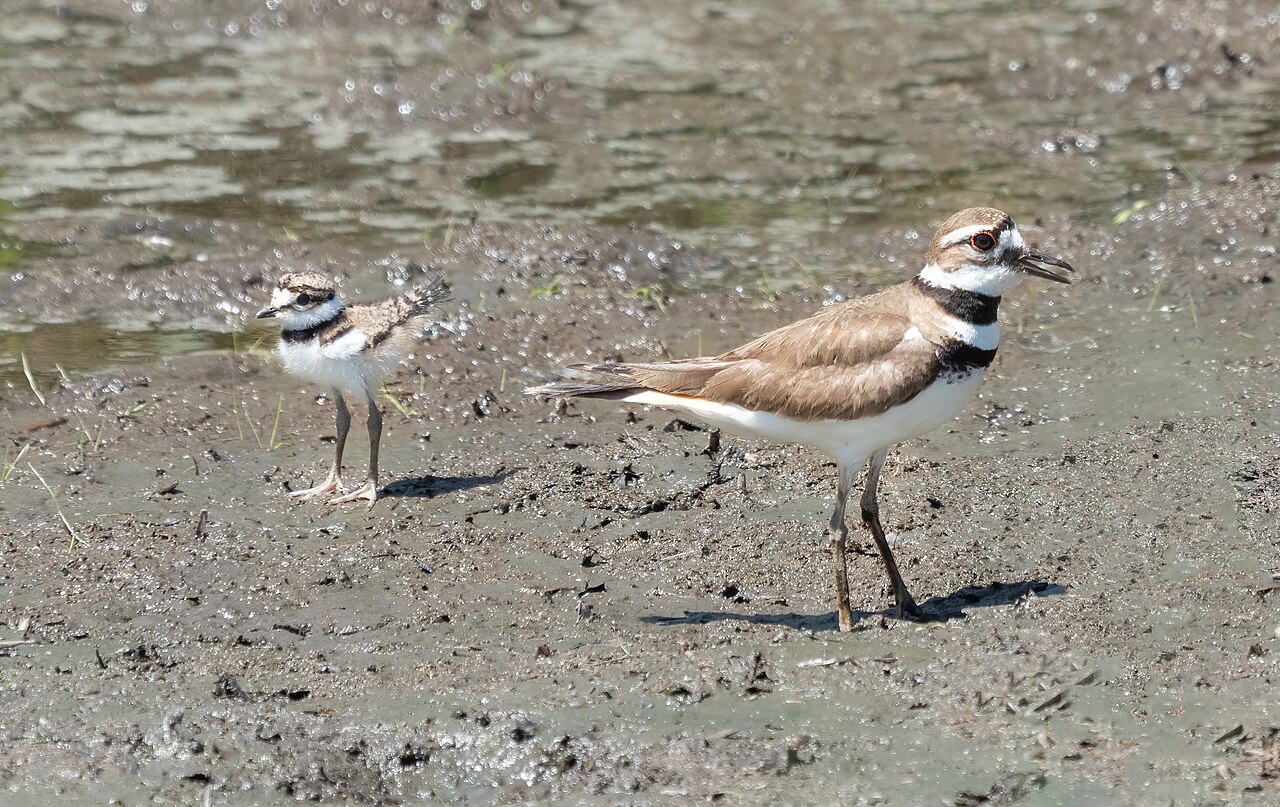
Killdeer chicks are precocial, which means they leave the nest scrape within hours of hatching and run around on long legs looking like cotton balls with one chest band. They give thin, high peeps that carry only a short distance, and they freeze flat on the ground the moment a parent’s alarm call changes pace.
That link between the adult call and the chick’s freeze response is worth watching for. A sudden silence from the chicks means the parent just told them to stop moving, and the whole family is somewhere within a few feet of you.
Where and When You Hear Killdeer
Killdeer are birds of bare, open ground rather than wetlands, so you hear them over gravel lots, athletic fields, golf courses, pastures and construction sites across the country. They breed as far north as Alaska and stay year round through the southern half of the lower 48.
Calling peaks from March through July, drops off in late summer, and picks up again on migration nights in September and October. In the Deep South you can hear them in any month of the year.
Sounds People Confuse With a Killdeer
Spotted Sandpipers give a similar high peet-weet, but in two or three notes rather than a long series, and they stay near water. Semipalmated Plovers sound softer and more whistled. Both are shorebirds, so habitat helps: a bird screaming over a Walmart parking lot is a Killdeer.
People also mistake Killdeer for Blue Jays at a distance, since both deliver sharp repeated notes, and squirrels or chipmunks get blamed for the nighttime version. Pitch settles it: the Killdeer is higher and more piercing than any of them.
How to Verify the Call You Heard
Compare your recording against a reference library rather than a stock sound site, because clips labeled killdeer sound mp3 are often something else entirely. The species account at All About Birds lists each call type with the date and place it was recorded.
Phone recordings work well here because the call is loud and high. Hold the phone still, record ten seconds, and note whether the bird was moving, since flight calls and ground alarm calls differ enough to confuse a match.
Related reading: Hawk Sound.
Related reading: Grackle Sound.
Related reading: Chickadee Sound.
Related reading: Fish Crow Sound.
Related reading: Nuthatch Sound.
Frequently Asked Questions
Is a Killdeer a rare bird?
No. The Killdeer is one of the most widespread shorebirds in North America and is common in every state. Populations have declined moderately over the past fifty years as open farmland changes, but the species is not threatened and remains easy to find in any gravel lot.
What states do Killdeer live in?
All fifty, at some point in the year. They breed across the lower 48, Canada and parts of Alaska, and stay through winter in the southern half of the country, along both coasts and in the Southwest. Northern birds move south when the ground freezes.
What are baby Killdeer called?
Chicks. They hatch fully feathered with open eyes, leave the scrape within hours, and feed themselves from day one while the parents stand guard. Broods are usually four, matching the four eggs a female typically lays.
Do Killdeer lay eggs twice a year?
Often, yes. Pairs in the southern states regularly raise two broods per season and occasionally three, while northern pairs usually manage one. A replacement clutch also follows quickly if the first nest is lost, which is common on gravel.
Can I keep a Killdeer as a pet?
No. Killdeer are protected under the Migratory Bird Treaty Act, so keeping one, or its eggs or feathers, is illegal without a federal permit. Injured birds should go to a licensed wildlife rehabilitator rather than a cardboard box in the garage.
What is a flock of Killdeer called?
There is no collective noun that birders actually use. Field guides simply say flock, and the words sometimes quoted online, such as a deceit or a congregation, were coined for lapwings and plovers in general rather than for this species.
Once the kill-deeah is locked in, the rest of the night chorus gets easier. Compare it against the cardinal whistling before dawn and you will notice how differently the two species use the same quiet hours.