Birds with Striped Heads: 12 Common Species in North America (2026)
A striped head is one of the most useful field marks for bird identification, bold patterns of contrasting stripes on the crown, face, or eyebrow help distinguish similar species. The ‘striped head’ template appears across multiple bird families: sparrows (most famously), warblers, woodpeckers (sapsuckers), and even shorebirds (Killdeer). This guide covers 12 common North American birds with notable head stripes, helping you identify the species through the specific arrangement and color of stripes. Many of these species are common backyard birds or migration visitors easily identified by their distinctive head patterns.
A striped head is one of the most reliable field marks in birding. In North America the striped-headed birds you will meet most are the White-crowned and White-throated Sparrows, the Black-and-white Warbler, the Yellow-bellied Sapsucker, the Killdeer and the Chipping Sparrow.
Quick Reference: 12 Birds with Striped Heads at a Glance
| Species | Size | Head Stripe Pattern | Range |
|---|---|---|---|
| White-Crowned Sparrow | 7″ | Bold black-and-white head stripes | Continent-wide |
| White-Throated Sparrow | 6.75″ | Striped head + yellow lores + white throat | Eastern US |
| Lark Sparrow | 6.5″ | Intricate chestnut-and-white face pattern | Central US |
| Black-Throated Sparrow | 5.5″ | Black throat + bold white facial stripes | SW deserts |
| Chipping Sparrow | 5.5″ | Rufous cap + black eye line + white eyebrow | Continent-wide |
| Yellow-Bellied Sapsucker | 8.5″ | Black-and-white facial stripes + red crown | Eastern forests |
| Red-Naped Sapsucker | 8.5″ | Black-and-white face + red crown/nape | Western US |
| Magnolia Warbler | 5″ | Striped face pattern + white wing bars | Eastern forests |
| Carolina Wren | 5.5″ | Bold white eyebrow stripe over eye | Eastern US |
| Wilson’s Warbler | 4.5″ | Yellow body + small black cap (male) | Continent-wide |
| Black-and-White Warbler | 5″ | Zebra stripes covering entire body and head | Eastern US |
| Killdeer | 10.5″ | Bold black face stripes + white forehead band | Continent-wide |
Species Identification
White-Crowned Sparrow
Among the most striking sparrows. White-Crowned Sparrows have bold black-and-white head stripes, alternating from the bill backwards in dramatic contrast. The body is gray-brown without prominent markings. Adult head pattern is unmistakable.
Range: Continent-wide. Northern in summer, southern US in winter.
Habitat: Brushy edges, gardens, weedy fields.
Key ID: Bold black-and-white head stripes + clean gray-brown body + pink bill. Juveniles have brown-and-tan stripes.
Where to see: Common winter feeder visitor. Ground-feeding. Visits platform feeders with millet.
White-Throated Sparrow
A common eastern winter sparrow with striking head pattern. White-Throated Sparrows have bold black-and-white (or tan-and-brown) head stripes, bright white throat patch, and small yellow patches between the eye and bill (lores).
Range: Eastern US and Canada in summer; eastern US in winter.
Habitat: Forest edges, brushy areas, backyards with cover.
Key ID: Striped head + bright white throat + yellow lores. Two color forms, both have white throat.
Where to see: Common winter feeder visitor in eastern US. Platform feeders with millet.
Lark Sparrow
An ornately marked sparrow. Lark Sparrows have an intricate chestnut-and-white face pattern: chestnut ear patch, chestnut crown with white central stripe, white throat outlined in black. One of the most facially-striped sparrows.
Range: Central US year-round.
Habitat: Open grasslands, prairies, ranchlands with scattered trees.
Key ID: Intricate chestnut-and-white face + heavy bill + central US habitat. Unique facial pattern among sparrows.
Where to see: Open grasslands. Often perches on fence wires.
Black-Throated Sparrow
A striking desert sparrow. Black-Throated Sparrows have a black throat patch outlined by bold white stripes (eyebrow stripe and mustache stripe), gray-brown back, and clean gray underparts.
Range: Southwestern deserts.
Habitat: Desert scrub, sagebrush, arid hillsides.
Key ID: Black throat + bold white facial stripes + desert habitat. Striking pattern for a sparrow.
Where to see: Desert habitats in the Southwest. Will visit feeders with millet in arid backyards.
Chipping Sparrow
A common feeder sparrow with subtle head stripes. Chipping Sparrows have a bright rufous (rust-red) crown, distinct black line through the eye, white eyebrow stripe above the eye line, and clean gray breast. Summer plumage particularly striking.
Range: Continent-wide in summer.
Habitat: Open woodlands, parks, backyards.
Key ID: Rufous crown + black eye line + white eyebrow + clean breast. Smallest common sparrow.
Where to see: Common at platform feeders in summer.
Yellow-Bellied Sapsucker
A woodpecker with striped face pattern. Yellow-Bellied Sapsuckers have alternating black-and-white facial stripes, red crown, red throat (males) or white throat (females), and a yellow wash on the belly.
Range: Eastern US in summer.
Habitat: Mixed and deciduous forests.
Key ID: Black-and-white facial stripes + red crown. The intricate face pattern is distinctive.
Where to see: Forests. Will occasionally visit suet feeders.
Red-Naped Sapsucker
Western counterpart to Yellow-Bellied Sapsucker. Red-Naped Sapsuckers have similar black-and-white facial stripes but with red also on the nape (back of head). Otherwise very similar pattern.
Range: Western US.
Habitat: Coniferous and mixed forests.
Key ID: Black-and-white facial stripes + red crown + red nape. Western range.
Where to see: Western forests.
Magnolia Warbler
Among the most striking warblers with face stripes. Magnolia Warblers have a yellow throat with black face streaks, gray head with black crown patch, yellow underparts with bold black streaks, and white wing bars.
Range: Northeastern US and Canada in summer.
Habitat: Coniferous forests, especially young pine and spruce stands.
Key ID: Striped face pattern + yellow underparts + white wing bars + heavy streaking on breast.
Where to see: Northern coniferous forests in summer.
Carolina Wren
A wren with bold head stripe. Carolina Wrens have rich rust-brown upperparts, buff underparts, and a striking bold white eyebrow stripe over the eye. The white eyebrow is the key ‘striped head’ feature.
Range: Eastern US year-round.
Habitat: Wooded yards, gardens with brush, edges of forests.
Key ID: Rich rust color + bold white eyebrow + larger than House Wren. Voice unmistakable (‘tea-kettle’ song).
Where to see: Common backyard bird in the Southeast. Will visit suet feeders.
Wilson’s Warbler
A small bright warbler with a ‘cap’ instead of facial stripes. Male Wilson’s Warblers have a brilliant yellow body and a distinctive small black cap on the head (technically a stripe of black covering the crown).
Range: Continent-wide in summer.
Habitat: Riparian thickets, willow stands, wet woodlands.
Key ID: All-yellow body + small black cap (male only). The black cap is the diagnostic head marking.
Where to see: Migration in spring/fall throughout the US.
Black-and-White Warbler
The most heavily striped songbird in North America. Black-and-White Warblers are covered in zebra-stripes from head to tail, entire body alternating black and white. Creeps along tree trunks like a nuthatch.
Range: Eastern US in summer.
Habitat: Deciduous forests, especially with mature trees.
Key ID: Bold zebra-stripes covering body + nuthatch-like creeping behavior + small size. Unique pattern.
Where to see: Forest interior in summer.
Killdeer
A shorebird often seen far from water with striking head and chest stripes. Killdeer have bold black face stripes (one through the eye, one across the forehead), white forehead band, and two black chest bands across the white breast. Famous for ‘broken wing’ display.
Range: Continent-wide year-round (some northern migration).
Habitat: Open habitats, fields, lawns, gravel parking lots, athletic fields.
Key ID: Black face/chest stripes + white forehead band + two chest bands + rufous rump. Distinctive ‘kill-deer’ call.
Where to see: Open habitats. Often nests on gravel surfaces. Distraction displays when predators approach nest.
How to Attract Birds with Striped Heads
Many striped-headed birds visit feeders:
Sparrows (White-Crowned, White-Throated, Chipping, Lark, Black-Throated): Platform feeders with millet and small seeds. Ground-feeding. Provide brushy yards with cover.
Carolina Wren: Suet feeders, mealworms. Will use nest boxes designed for wrens. Brush piles for cover.
Sapsuckers (Yellow-Bellied, Red-Naped): Don’t typically visit feeders. Mature trees they can drill sap wells in.
Warblers (Magnolia, Wilson’s, Black-and-White): Most warblers don’t visit seed feeders. Provide native trees and pesticide-free yards for insects.
Killdeer: Don’t visit feeders. Provide gravel areas if you want them to nest (parking lot gravel, dirt patches with rocks).
Universal: Native plants supporting insect populations are essential. Many striped-headed birds are insectivores.
What Sparrow Has a White Striped Head?
Two sparrows account for nearly every report of a white-striped head. The White-crowned Sparrow has a crisp black and white striped crown, a plain gray face and throat, and a pink or orange bill, and it feeds on the ground in open brushy places. The White-throated Sparrow has a similar crown but adds a sharply defined white throat patch and a yellow spot between the eye and the bill.
The yellow lore is the single detail that settles it, and it is present even on the drabber tan-striped form of the White-throated Sparrow. Immature White-crowned Sparrows are a common source of confusion, since their crown stripes are rusty brown and buff rather than black and white, which makes them look like a different species entirely for their first winter.
Birds With a Red Stripe on the Head
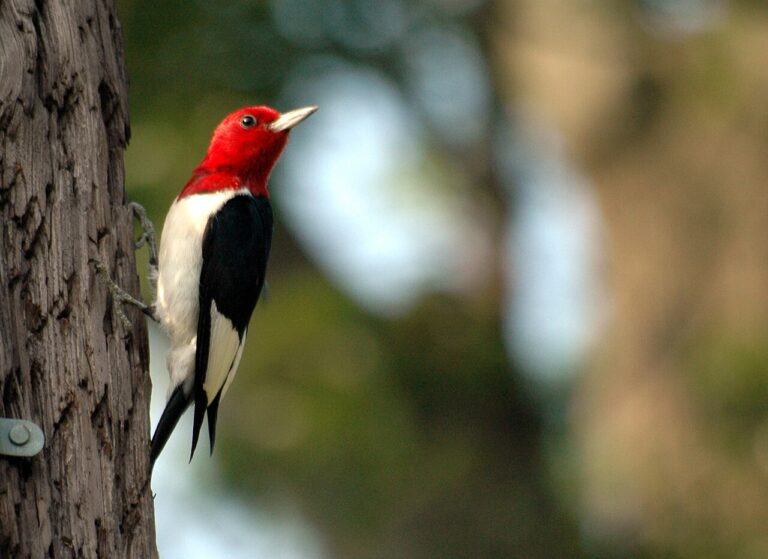
A red stripe or patch on the head almost always means a woodpecker. The Downy and Hairy Woodpeckers show a small red patch on the back of the head on males only. The Red-bellied Woodpecker carries a red stripe running from the bill over the crown and down the nape on males, and only over the nape on females, which is why it is so often misreported as a red-headed bird.
Outside the woodpeckers, the Ruby-crowned Kinglet has a red crown patch that is usually hidden and flashed only when the bird is agitated, and the Yellow-bellied Sapsucker shows a red forecrown along with its striped face. Audubon’s White-crowned Sparrow account covers the crown-stripe variation between adults and first-winter birds.
Frequently Asked Questions
What’s the most distinctive striped-headed bird?
White-Crowned Sparrow has the most dramatic black-and-white head stripes, clean, bold, and unmistakable. Black-and-White Warbler has the most striping overall (entire body), and Killdeer has multiple distinctive head/chest stripes.
How do I tell White-Crowned from White-Throated Sparrow?
White-Crowned has black-and-white stripes only on the head, no white throat patch. White-Throated has similar head stripes PLUS a bright white throat patch AND yellow lores (small yellow patches between eye and bill). The combination of yellow lores + white throat = White-Throated; just stripes = White-Crowned.
Why do birds have striped heads?
Stripes serve multiple functions: species recognition (precise stripe patterns are species-specific), social signaling (status displays among same species), and disruption camouflage (breaking up the bird’s outline against bark or brush). The variation between species allows reliable identification by both birds and birders.
What striped-headed bird visits backyard feeders?
White-Crowned Sparrow and White-Throated Sparrow are the most common striped-headed feeder visitors, both visit ground/platform feeders for millet. Chipping Sparrow is also common in summer. Carolina Wren visits suet feeders.
What’s that small bird with bold black and white stripes?
Most likely Black-and-White Warbler if it’s covered entirely in stripes, including the head. If only the head is striped, more likely White-Crowned Sparrow (larger, conical bill, ground-feeding) or Black-Throated Sparrow (in Southwest deserts).
Are immature birds’ stripes different from adults?
Often yes. Juvenile White-Crowned Sparrows have tan-and-brown head stripes (adults have black-and-white). Juvenile White-Throated Sparrows also have less bold stripes. Many sparrow species gain their full adult stripe patterns over their first 1-2 years.
What bird has black chest stripes?
Killdeer is the most familiar bird with bold black chest stripes, two black bands across the white breast. Also Killdeer have black face stripes. The combination is unique among common North American birds.
Related reading: Birds with Red Beaks.