Backyard Birds of Texas: 15 Common Species (2026 Identification Guide)
Texas is the most bird-diverse state in the continental US, over 660 documented species, second only to California. The state’s enormous size (covering plains, mountains, deserts, swamps, and Gulf Coast) creates dramatically different backyard bird communities depending on whether you live in Houston, Austin, El Paso, or the Rio Grande Valley. Texas backyards uniquely host species found nowhere else in the US: Green Jays in deep south Texas, Black-Crested Titmice across the Edwards Plateau, Pyrrhuloxias in west Texas deserts, and Golden-Cheeked Warblers (endangered, endemic) in Hill Country juniper-oak forests. This guide covers the 15 most common backyard birds across Texas with the field marks, regional ranges, and attraction strategies that work for the state’s diverse climate zones.
Quick Reference: 15 Common Backyard Birds of Texas
| Species | Size | Key ID Feature | Where in TX |
|---|---|---|---|
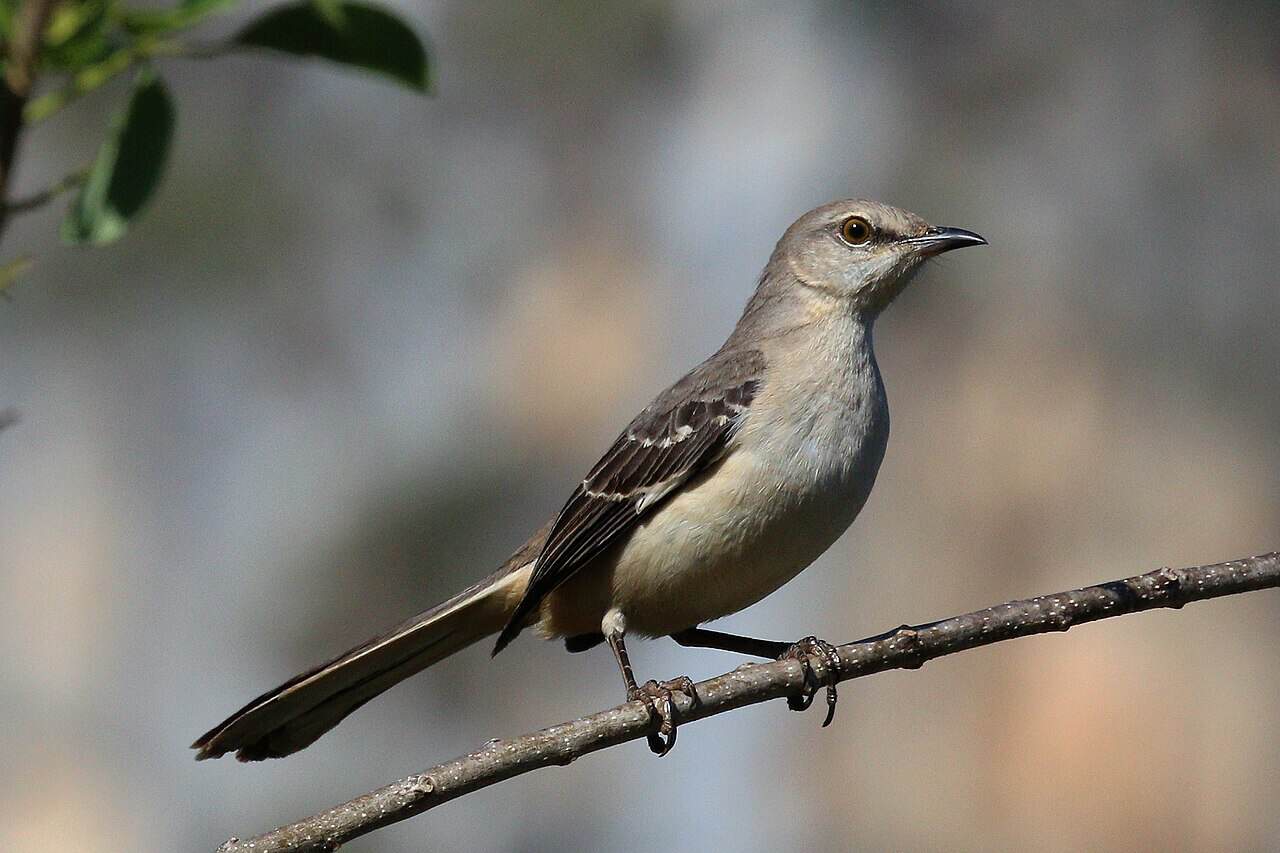
| Northern Mockingbird (state bird) | 10″ | Gray-white + white wing flashes + mimics songs | Statewide |
| Northern Cardinal | 8.5″ | All red (male) or tan with red crest (female) | Statewide |
| Carolina Chickadee | 4.75″ | Black cap + white cheeks + black bib | East/Central TX |
| Black-Crested Titmouse | 6.5″ | Solid black crest + gray body | Central/West TX |
| Tufted Titmouse | 6.5″ | Gray crest + buff flanks + black eye | East TX |
| House Finch | 5.5″ | Red head/breast (male) + streaky belly | Statewide |
| Mourning Dove | 12″ | Tan + long pointed tail + small head | Statewide |
| Inca Dove | 8.25″ | Tiny + scaly pattern + ‘no-hope’ call | South/Central TX |
| White-Winged Dove | 11.5″ | Large white wing patch + blue eye-ring | Statewide (expanding) |
| Carolina Wren | 5.5″ | Rust-brown + bold white eyebrow | East TX |
| Blue Jay | 11″ | Blue crest + black necklace + white below | East TX |
| Painted Bunting | 5.5″ | Multi-color: red, green, blue (male) | Texas in summer |
| Great-Tailed Grackle | 17″ | Long keel tail + iridescent black + yellow eye | Statewide |
| Pyrrhuloxia | 8.5″ | Gray + red highlights + yellow bill + crest | West/South TX |
| Black-Chinned Hummingbird | 3.5″ | Iridescent green back + black throat | Statewide summer |
Species Identification
Northern Mockingbird (State Bird)
Texas’s official state bird, designated in 1927. Northern Mockingbirds are gray-white with darker wings, bold white wing flashes visible in flight, and a long tail often held cocked upward. Famous for mimicry, Texas mockingbirds may imitate 200+ other species’ songs plus mechanical sounds like sirens, car alarms, and cell phone ringtones.
Range in Texas: Statewide year-round.
Habitat: Suburban yards, parks, ranchland edges, urban areas.
Key ID: Gray-white + white wing flashes + long tail. Often singing from prominent perches, sometimes through the night during breeding season.
Where to see: Yards with native shrubs producing berries. Will visit mealworm and fruit feeders. Plant native berry-producing shrubs like Texas Persimmon and American Beautyberry.
Northern Cardinal
One of Texas’s most beloved year-round birds. Male Northern Cardinals are brilliant red overall with a pointed red crest, black face mask, and thick orange-red bill. Females are tan-brown with red highlights on crest, wings, and tail. Pairs typically mate for life and stay together year-round.
Range in Texas: Statewide year-round.
Habitat: Yards with shrubby cover, parks, woodland edges, ranchlands.
Key ID: Brilliant red + pointed crest + black face mask + thick orange-red bill (male). The most familiar ‘red bird’ in Texas.
Where to see: Hopper or platform feeders with sunflower or safflower seed. Cardinals need a perching surface and prefer dawn/dusk feeding. Plant native shrubs for nesting cover.
Black-Crested Titmouse
A Texas specialty replacing the Tufted Titmouse across central and western Texas. Black-Crested Titmice have a solid black crest (vs the Tufted’s gray crest) with a white forehead patch, gray-brown body, and buff flanks. Where their ranges overlap (in a narrow band through central Texas), hybrids occur.
Range in Texas: Central and Western Texas (Edwards Plateau, Hill Country, Big Bend region).
Habitat: Oak-juniper woodlands, parks with mature trees, suburban yards.
Key ID: Solid black crest + white forehead + gray body. Replaces Tufted Titmouse west of an approximate line through Dallas-Austin-San Antonio.
Where to see: Common at backyard feeders with sunflower seed, peanuts, and suet. Will use nest boxes.
Painted Bunting
Often called the ‘most beautiful bird in North America.’ Male Painted Buntings have a vivid green back, royal-blue head, red eye-ring, and bright red underparts, a four-color spectacular found in very few US species. Females are uniformly olive-green. Texas is the heart of the breeding range.
Range in Texas: Most of Texas in summer (April-September), wintering in Mexico/Central America. Densest populations in east and south Texas.
Habitat: Brushy areas, woodland edges, ranchland with cover, suburban yards with dense shrubs.
Key ID: Multi-color male (green back + blue head + red body) is unmistakable. Female olive-green throughout, looks like ‘sparrow without markings.’
Where to see: Offer white millet on ground or platform feeders during summer. Plant native shrubs for cover. Painted Buntings are skittish, quiet observation rewards patience.
Black-Chinned Hummingbird
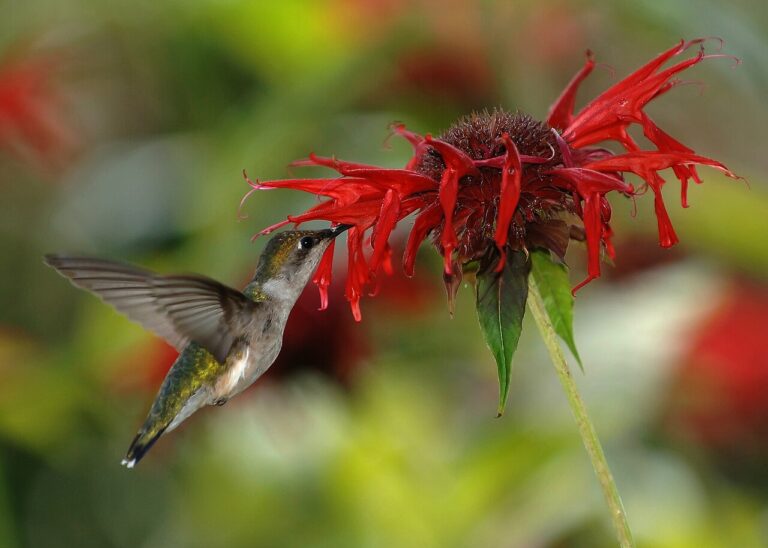
Texas’s most widespread breeding hummingbird. Male Black-Chinned Hummingbirds have an iridescent green back and a black throat with a thin purple band at the bottom (visible in good light). Females are similar but lack the throat markings. They migrate to Mexico for winter, returning to Texas in March-April.
Range in Texas: Statewide in summer (March-September). Most numerous in central and west Texas.
Habitat: Various, gardens, riparian areas, oak woodlands, deserts with flowering plants.
Key ID: Iridescent green back + black throat with purple edge (male, requires good light to see). Females are nearly identical to female Ruby-Throated Hummingbirds.
Where to see: Hummingbird feeders (4:1 ratio, no red dye). Plant native salvias, Turk’s cap, Tropical sage. Multiple feeders reduce male territorial fighting.
Pyrrhuloxia (Desert Cardinal)
A Texas desert specialty often called the ‘desert cardinal’ due to its cardinal-like silhouette. Pyrrhuloxias have a gray body with red wash on the face, crest, breast, and wings, plus a distinctive yellow bill (cardinals have orange-red bills). Females are duller. Found in west and south Texas deserts.
Range in Texas: West Texas (Big Bend, Davis Mountains) and South Texas (Rio Grande Valley).
Habitat: Desert scrub, mesquite thickets, arid backyards with native shrubs.
Key ID: Gray body with red highlights + yellow bill (NOT orange-red like cardinal) + pointed crest. Cardinal-like shape but different colors.
Where to see: Will visit feeders with sunflower or safflower seed in their range. Native mesquite and acacia provide essential cover.
Inca Dove
Texas’s smallest dove with a unique ‘scaly’ appearance. Inca Doves are tiny (8 inches), pale tan overall with dark feather edges creating a scaly pattern across the entire body. Rufous wing patches flash in flight. Their distinctive ‘no-hope’ call gives them their nickname.
Range in Texas: South and central Texas year-round; expanding northward.
Habitat: Urban and suburban areas, especially with bare ground and scattered cover.
Key ID: Small size + scaly pattern + rufous wing flashes + ‘no-hope’ call. Smaller than Mourning Doves.
Where to see: Ground feeders with millet or cracked corn. Often in pairs walking through bare ground.
White-Winged Dove
A larger dove with bold white wing markings. White-Winged Doves have grayish-brown bodies, a large WHITE patch on each wing (visible in flight as a bold white line), and a distinctive blue eye-ring. Their range is expanding rapidly northward, once primarily a South Texas bird, now common in Dallas, Houston, and beyond.
Range in Texas: South Texas year-round, expanding into central and east Texas.
Habitat: Urban/suburban areas, parks, agricultural edges.
Key ID: Larger than Mourning Dove + bold white wing patch + blue eye-ring + square tail (not pointed).
Where to see: Platform feeders with mixed seed, sunflower, or cracked corn. Often noisy in flocks.
Great-Tailed Grackle
Texas’s most ubiquitous blackbird, and increasingly common across the southern US. Male Great-Tailed Grackles are glossy black with iridescent purple-blue sheen, a very long keel-shaped tail (often longer than the body), and bright yellow eyes. Females are dark brown and smaller. Highly social in noisy flocks.
Range in Texas: Statewide year-round.
Habitat: Cities, parking lots, agricultural areas, urban edges.
Key ID: Very long keel tail + glossy black + yellow eye. Males are larger than females.
Where to see: Common in Texas cities. Will visit any feeder, many birders consider them nuisance species. Use feeders designed to exclude larger birds if undesirable.
Carolina Chickadee
East Texas’s familiar chickadee. Carolina Chickadees have a black cap, black throat/bib, white cheeks, gray-blue back and wings, and buffy flanks. Slightly smaller than the Black-Capped Chickadee (which doesn’t occur in Texas). Their fast, high-pitched ‘chick-a-dee’ call distinguishes them by voice.
Range in Texas: Eastern Texas, west to about the Hill Country.
Habitat: Wooded yards, parks, forests.
Key ID: Black cap + black bib + white cheeks + range. Black-Capped doesn’t occur in Texas.
Where to see: Common at sunflower, peanut, and suet feeders. Will use small nest boxes (1.125 inch hole).
Tufted Titmouse
East Texas counterpart to Black-Crested Titmouse. Tufted Titmice have a clean gray back, white underparts with buff flanks, a gray crest, large black eyes, and a black forehead. Where their range meets Black-Crested in central Texas, hybrid birds with intermediate crest colors occur.
Range in Texas: Eastern Texas (Piney Woods, eastern Hill Country edge).
Habitat: Mature deciduous forests, parks, suburban yards.
Key ID: Gray crest + buff flanks + black eye. Compare to Black-Crested Titmouse (black crest) by range.
Where to see: Common at backyard feeders. Sunflower, peanuts, and suet.
Blue Jay
Familiar eastern jay common throughout east Texas. Blue Jays have bright blue heads, wings, and backs (with black markings), white chests, and a prominent blue crest. Loud, intelligent, and dominant at feeders, they cache thousands of acorns each fall.
Range in Texas: Eastern Texas (Piney Woods), increasingly westward in urban areas.
Habitat: Forests, parks, suburban backyards with trees.
Key ID: Blue + black necklace + prominent crest + white below. The most familiar blue bird in east Texas.
Where to see: Common at platform feeders. Will eat sunflower seed, peanuts in shell, and corn. Bird baths.
Carolina Wren
East Texas’s voice. Carolina Wrens have rich rust-brown upperparts, buff underparts, and a striking bold white eyebrow stripe. Their loud, ringing ‘tea-kettle tea-kettle tea-kettle’ song fills east Texas yards. They often nest in unexpected places, flower pots, garage corners, hanging baskets.
Range in Texas: Eastern Texas year-round, expanding westward.
Habitat: Wooded yards, gardens with brush, edges of forests.
Key ID: Rich rust color + bold white eyebrow + loud voice. Larger than House Wrens.
Where to see: Common at suet feeders. Provide brush piles for cover. Will use nest boxes (Carolina Wren-sized openings).
Regional Variations Across Texas
Texas’s vast size creates dramatically different backyard bird communities by region. East Texas yards (Houston, Tyler, Beaumont) mirror the Southeast: Northern Cardinals, Carolina Chickadees, Tufted Titmice, Blue Jays, Carolina Wrens. Painted Buntings add southern flair in summer.
Hill Country and Central Texas (Austin, San Antonio) sit in the transition zone. Black-Crested Titmice replace Tufted Titmice. Golden-Cheeked Warblers (endangered) breed in juniper-oak woodlands in spring. Both Carolina and Black-Capped Chickadees can occur, though Carolina is more common.
West Texas (El Paso, Big Bend) hosts desert birds: Pyrrhuloxia, Cactus Wren, Verdin, Black-Throated Sparrow, Curve-Billed Thrasher, Costa’s and Black-Chinned Hummingbirds. Greater Roadrunners visit yards in arid areas.
South Texas (Rio Grande Valley) is the most distinctive, many species occur nowhere else in the US: Green Jay (vivid emerald-green), Plain Chachalaca, Great Kiskadee, Buff-Bellied Hummingbird, Audubon’s Oriole, White-Tipped Dove, and Plain Chachalaca. The Lower Rio Grande Valley is one of the top birding destinations in North America.
Panhandle and West Plains (Amarillo, Lubbock) host species more characteristic of the Great Plains: Western Meadowlark, Cassin’s Sparrow, Lark Bunting, plus eastern species at the western edge of their range.
The Northern Mockingbird: Texas’s Voice
The Northern Mockingbird (Mimus polyglottos) was designated Texas’s official state bird in 1927. Texas was the first US state to choose this species; four other states (Arkansas, Florida, Mississippi, Tennessee) later followed.
Mockingbirds embody the Texas spirit: bold, vocal, territorial, and adaptable. A single mockingbird may learn 200+ different sounds, copying robin songs, cardinal whistles, hawk screams, car alarms, sirens, even cell phone ringtones. Males sing aggressively during breeding season, sometimes performing through the night, especially under street lights.
Mockingbirds defend their territories aggressively. They’ll dive-bomb hawks, cats, and even humans who venture too near nests. This combative defense extends to mating displays, males perform ‘sing-and-flash’ maneuvers from prominent perches, vocalizing while jumping straight up to show off their bold white wing flashes.
Despite their abundance, mockingbird populations vary year-to-year with food availability. Plant native berry-producing shrubs (American Beautyberry, Texas Persimmon, Possumhaw Holly) to attract them. Mockingbirds will defend a favorite berry shrub aggressively from other birds, sometimes for weeks at a time.
How to Attract Texas Backyard Birds
Texas’s climate (hot summers, mild winters in most of the state) creates a unique backyard birding opportunity: year-round visitation by 30+ species. The key challenge is summer heat, birds need water and shade more than feed during July-August.
Water is the #1 attractant in Texas. A quality bird bath with daily fresh water (especially during summer) brings in 3x more species than feeders alone. Add a dripper or fountain, moving water is exponentially more attractive in hot, dry climates. Shaded baths under trees stay cleaner and cooler.
For seed feeders, focus on Texas favorites: black oil sunflower seed (universal), safflower seed (cardinals love it, grackles avoid it, useful for excluding nuisance species), white millet (for buntings, doves, sparrows). Position feeders within 10 feet of cover so smaller birds can retreat from hawks.
Hummingbird feeders are critical Texas equipment. Black-Chinned and Ruby-Throated Hummingbirds breed across most of Texas. In south Texas, Buff-Bellied Hummingbirds add another year-round species. Multiple feeders reduce male territorial fighting. Clean every 3-4 days in summer (sugar water spoils quickly in Texas heat).
Native plant gardening multiplies attraction. Plant Turk’s cap (red flowers) for hummingbirds, native salvias for both birds and pollinators, American Beautyberry (lavender-purple berries) for mockingbirds and thrushes, Texas Persimmon and Possumhaw Holly for winter berries. Native plants need far less water than turfgrass, important during droughts.
For Painted Buntings (a major target for many Texas birders), provide white millet specifically. Painted Buntings prefer ground or low platform feeders. Plant dense native shrub thickets for cover, Texas Persimmon, agarita, and cedar elm work well.
Top Native Texas Plants for Backyard Birds
**Turk’s Cap (Malvaviscus arboreus):** Native shrub with red turban-shaped flowers from spring through fall. Critical food for Black-Chinned Hummingbirds, Ruby-Throated Hummingbirds, and (in south Texas) Buff-Bellied Hummingbirds. Drought-tolerant once established.
**American Beautyberry (Callicarpa americana):** Native shrub producing dramatic clusters of bright lavender-purple berries in fall. Feeds Northern Mockingbirds, American Robins, Northern Cardinals, and various thrushes. Tolerates shade and various soil types.
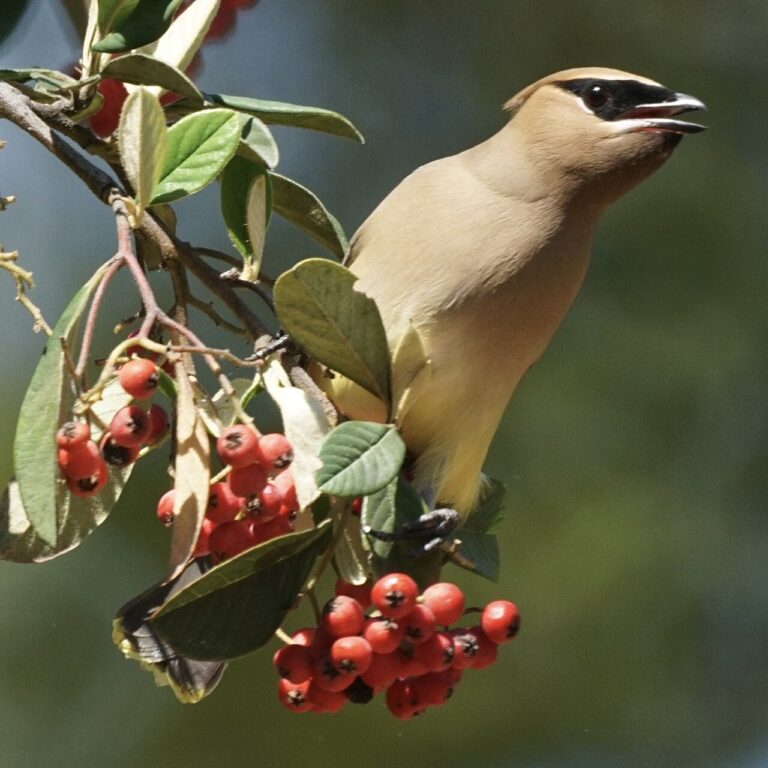
**Texas Persimmon (Diospyros texana):** Native small tree producing black fruits in late summer/fall. Feeds Northern Mockingbirds, Cedar Waxwings, robins, and wildlife generally. Highly drought-tolerant, perfect for Hill Country and west Texas yards.
**Cedar Sage (Salvia roemeriana):** Native salvia with red flowers blooming spring through fall. Major hummingbird attractant, especially valuable in central and west Texas. Tolerates shade.
**Possumhaw Holly (Ilex decidua):** Native deciduous holly producing bright red berries that persist into winter. Feeds Northern Mockingbirds, American Robins, Cedar Waxwings, and other winter berry-eaters. Beautiful winter display once leaves drop.
**Mesquite (Prosopis glandulosa):** Native tree producing seed pods that feed doves and quail. Provides essential cover for desert species in west and south Texas. Drought-resistant, survives extreme heat and minimal water.
Related reading: Backyard Birds of California.
Related reading: Backyard Birds of Ohio.
Related reading: Backyard Birds of Michigan.
Related reading: Backyard Birds of Massachusetts.
Related reading: Backyard Birds of Virginia.
Frequently Asked Questions
What’s the most common backyard bird in Texas?
Northern Mockingbird (the state bird) is the most ubiquitous backyard bird across Texas, found in essentially every neighborhood year-round. Northern Cardinal is the most popular yard visitor. House Finch and Mourning Dove are extremely abundant. Carolina Chickadee dominates east Texas; Black-Crested Titmouse replaces Tufted in central/west Texas.
Are there cardinals in Texas?
Yes, Northern Cardinals are common backyard birds throughout Texas year-round. Males are brilliant red with crests; females are tan-brown with red highlights. In west and south Texas, you may also see Pyrrhuloxias (the ‘desert cardinal’, gray with red highlights and yellow bill).
What’s that bird with the bright green back and red belly?
Painted Bunting male, one of Texas’s most spectacular birds. Males have green back, blue head, red eye-ring, and red underparts (four-color body). Females are uniformly olive-green and easy to overlook. Present in Texas spring/summer (April-September), wintering in Mexico/Central America.
What’s the small dove with the scaly pattern in my Texas yard?
Inca Dove, small (8 inches), pale tan with distinctive scaly feather pattern. Their ‘no-hope’ two-note call is a Texas city sound. Found in south and central Texas, expanding northward. Often in pairs walking through bare ground or sidewalks.
Do hummingbirds stay in Texas all winter?
Generally no, most Texas hummingbirds (Black-Chinned, Ruby-Throated) migrate to Mexico for winter. South Texas (Rio Grande Valley) hosts year-round Buff-Bellied Hummingbirds. Some western Texas yards have wintering Anna’s Hummingbirds (expanding from California). Most Texas yards see hummingbirds March-October.
How do I attract Painted Buntings to my Texas yard?
Offer white millet on ground or low platform feeders during summer (April-September). Plant dense native shrub thickets for cover (Texas Persimmon, agarita, cedar elm). Provide a quiet, undisturbed water source. Painted Buntings are skittish, quiet observation works better than active approach. They prefer rural and brushy suburban yards over urban locations.
What’s the difference between Tufted and Black-Crested Titmouse?
Tufted Titmouse (east Texas) has a gray crest with white forehead. Black-Crested Titmouse (central and west Texas) has a solid black crest with white forehead. Otherwise identical in body coloration and behavior. Range is the most reliable distinguisher, though hybrids occur in the narrow overlap zone through central Texas.
Why are there so many grackles in Texas?
Great-Tailed Grackles are native to South Texas but have expanded their range dramatically across the state and northward. Texas urban environments (parking lots, restaurant patios, agricultural areas) provide ideal habitat, abundant food (discarded human food, agricultural grain) plus warm winter climate. Populations can be controlled at feeders by using safflower seed (grackles dislike it) and feeders designed to exclude large birds.