Northern Cardinal: Complete Identification, Diet, and Behavior Guide (2026)
The Northern Cardinal (Cardinalis cardinalis) is among the most beloved and recognizable birds in North America. With brilliant red plumage, a distinctive crest, and a year-round presence at backyard feeders, Cardinals are state birds for seven US states, more than any other species. Cardinals symbolize qualities like loyalty (they mate for life), persistence (they sing year-round, even in winter), and resilience (they thrive in suburban environments). This comprehensive guide covers everything you need to know about Northern Cardinal identification (including the often-confused female), range, diet, behavior, breeding, vocalizations, regional variations, and proven strategies for attracting cardinals to your backyard.
Northern Cardinal: Key Facts at a Glance
| Attribute | Detail |
|---|---|
| Scientific Name | Cardinalis cardinalis |
| Family | Cardinalidae (Cardinals) |
| Size | 8.3-9.3 inches (21-24 cm) length |
| Wingspan | 9.8-12.2 inches (25-31 cm) |
| Weight | 1.5-1.7 oz (42-48 g) |
| Lifespan | 3 years average; up to 15+ years recorded |
| Diet | Seeds, fruits, insects (mostly granivorous) |
| Habitat | Woodland edges, gardens, suburban yards, brushy areas |
| Range | Eastern and central US, Mexico, Central America |
| Population Status | Very common, 130 million estimated North American population |
| Conservation Status | Least Concern (IUCN) |
| State Bird Of | Illinois, Indiana, Kentucky, North Carolina, Ohio, Virginia, West Virginia (7 states) |
| Distinctive Feature | Brilliant red (male), crest, black face mask, orange-red bill |
| Song | ‘What-cheer-cheer-cheer’ or ‘birdie-birdie-birdie’ |
| Migration | Nonmigratory, year-round residents |
Northern Cardinal Identification: Male vs Female
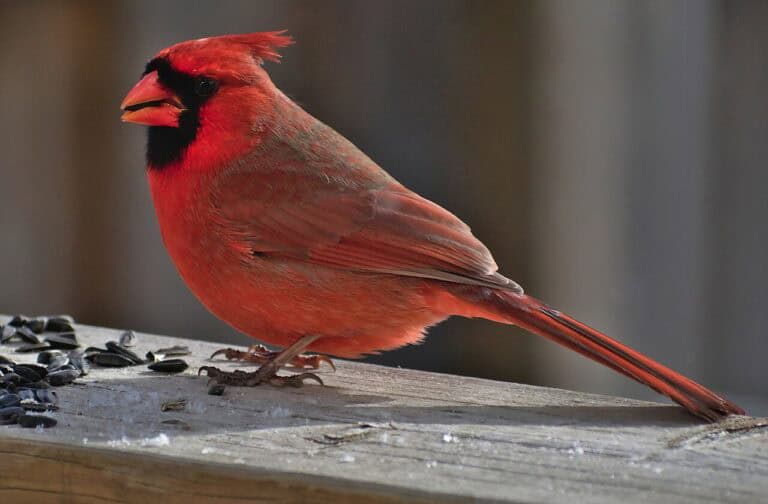
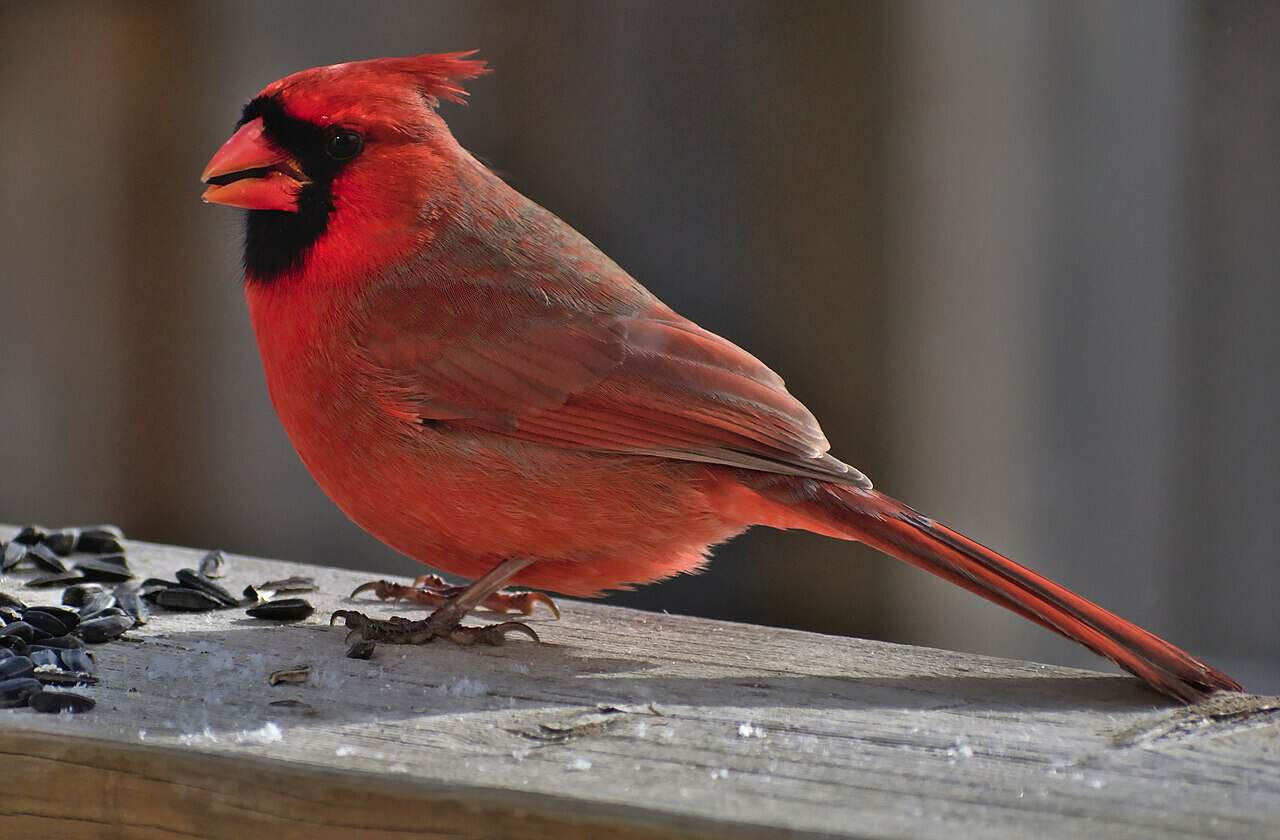
Adult male Northern Cardinals are unmistakable: brilliant red overall (head, body, wings, tail), with a prominent pointed red crest, a sharp black face mask surrounding the bill, and a thick orange-red conical bill. The red is intense and saturated, especially during breeding season. Males are larger than females.
Adult female Cardinals are subtle but beautiful, and often confuse new bird-watchers. Females have a tan-brown body with red highlights on the crest, wings, and tail. The bill is orange-red (same as male), and there’s a hint of black face mask. Most distinctively, females have the same crest as males. The combination of tan body + red highlights + crest + orange bill clearly identifies them as female Cardinals.
Juvenile Cardinals look like duller versions of females, with brown body, less red, and importantly, a BLACK bill (rather than the orange-red bill of adults). Juveniles molt into adult plumage in their first fall and gradually develop the orange-red bill over their first year.
Size: Northern Cardinals are 8-9 inches long, larger than House Finches (5.5 inches) but smaller than Blue Jays (11 inches). Their stocky, thick-billed appearance is distinct from other red birds.
Cardinals are sometimes confused with other species. Pyrrhuloxia (‘Desert Cardinal’ in the Southwest) has a similar crest but gray body with red highlights and a YELLOW bill (not orange-red). Summer Tanagers are entirely red but lack a crest and have a thinner bill. Scarlet Tanagers are red with black wings (not all-red). Vermilion Flycatchers are smaller and live in the Southwest.
Northern Cardinal Range and Habitat
Northern Cardinals occupy a vast range across eastern and central North America, plus Mexico and Central America. They’re year-round residents throughout, Cardinals are nonmigratory. Their range has expanded dramatically northward over the past century, from primarily a Southern bird to one that now breeds in southern Canada (Ontario, Quebec, Nova Scotia).
The northward expansion is attributed to climate change and the proliferation of bird feeders. Backyard bird feeding provides reliable winter food, allowing Cardinals to survive in regions that historically were too cold. Today, Cardinals are common in places where they were rare 50 years ago.
Western range: Cardinals occur from the Atlantic coast westward through the central US to roughly the eastern edges of the western states. They’ve expanded into riparian zones of Arizona and southern California. In the West, Cardinals occur along the Mexican border in Arizona, New Mexico, and Texas, plus expanding populations into desert riparian habitat.
Habitat: Cardinals prefer woodland edges, brushy areas, suburban yards with dense shrubs, parks, gardens, and overgrown fields. They don’t inhabit deep forests or treeless open areas. The species thrives in human-modified landscapes, suburban yards with shrubs and trees are often higher-quality Cardinal habitat than natural forests.
Cardinal nonmigratory behavior means the same individual birds may visit your yard for years. Banded Cardinals have been documented visiting the same feeder station for 10+ years. This loyalty creates strong personal connections between bird-watchers and ‘their’ Cardinals.
Northern Cardinal Diet: What Do Cardinals Eat?
Northern Cardinals are primarily granivorous, they eat seeds, fruits, and grains, with insects playing a smaller role except during breeding. The thick, conical bill is specifically adapted for cracking large seeds, Cardinals can easily crack sunflower seeds, safflower seeds, and other hard seeds that smaller-billed birds struggle with.
Top food choices include sunflower seeds (black oil is the universal favorite), safflower seeds, peanuts (shelled or whole), corn, native berries (American Beautyberry, Viburnum berries, Mulberry, Sumac), insects (during breeding season, important for nestlings), buds and flowers (especially in early spring).
Cardinals adjust their diet seasonally. Spring/summer breeding diet includes more insects (especially caterpillars), which provide essential protein for growing nestlings. Late summer through winter is heavily seed-based. Cardinals are major dispersers of native seeds and berries, they help maintain native plant communities.
Cardinals visit feeders reliably year-round. They prefer hopper feeders, platform feeders, or tray feeders that accommodate their weight and bill design. Tube feeders with small perches (designed for finches) often don’t work well for Cardinals, they have trouble perching and feeding comfortably.
Feeding times: Cardinals are crepuscular feeders, they prefer dawn and dusk feeding. They’re typically among the first birds to arrive at feeders each morning (often before sunrise) and the last to leave each evening. This timing pattern is reliable enough that bird photographers plan Cardinal sessions around it.
Northern Cardinal Behavior and Social Structure
Northern Cardinals are famous for mate fidelity, they typically mate for life. Once a pair forms, they remain together year-round. Pairs maintain territories together during breeding season and often forage together throughout the year. The bond is strong enough that a surviving partner may not re-pair until the following breeding season.
Cardinal courtship feeding is one of the most photographed behaviors in backyard birding. Males collect seeds and bring them to the female, placing the seed directly into her bill. This behavior occurs year-round but peaks in late winter and early spring before nesting. The courtship feeding strengthens the pair bond and provides extra nutrition for the female preparing to lay eggs.
Cardinals are territorial during breeding season (March-July). Males aggressively defend territories of 0.5-1 acre. Male-male fights are common, Cardinals will attack their own reflections in windows or car mirrors, mistaking them for rival males. This ‘shadow boxing’ behavior peaks in spring and can continue for hours daily. Putting a temporary cover over reflective surfaces (paper, cardboard) usually solves the problem.
Outside breeding season, Cardinals often form small flocks, particularly in winter at feeding stations. Multiple pairs may share a productive feeder station without aggression once breeding territories dissolve.
Cardinals have surprisingly long lives for songbirds. Wild Cardinals have been recorded surviving 15+ years. Adults that survive first-year mortality typically live 5-7 years. Major mortality factors: predation (Cooper’s Hawks are major predators of Cardinals at feeders), window strikes, outdoor cats, harsh winters in northern range edges.
Northern Cardinal Breeding and Nesting
Northern Cardinal breeding begins in March (south) to April-May (north). The breeding season extends through August, allowing 2-3 broods per year (rarely 4 in southern regions).
Nest construction: Female Cardinals build nests with limited male help. Nests are loose, cup-shaped structures made of twigs, bark strips, grasses, and rootlets, lined with finer materials. Nest height is typically 3-10 feet above ground in dense vegetation, often in shrubs, vines, or low tree branches. Cardinals strongly prefer nests with overhead protective cover.
Eggs: Each clutch contains 2-5 eggs (typically 3-4). Cardinal eggs are pale grayish-white with brown speckles. Incubation takes 11-13 days, performed almost entirely by the female. The male feeds the female during incubation.
Nestling period: Both parents feed the nestlings, primarily insects during the first days, then a mix of insects and seeds. Nestlings grow remarkably fast, they fledge (leave the nest) at 9-11 days old, much shorter than the equivalent period for many other backyard birds.
Post-fledging: After fledging, juveniles remain with parents for 2-4 weeks while learning to forage. Males often take over feeding duties for the recently-fledged young while the female begins building a new nest for the second brood. The combination of long breeding season + multiple broods allows successful Cardinal pairs to fledge 6-12 young per year.
Nest predation is a major mortality source. Common predators of Cardinal nests include Blue Jays, American Crows, snakes, raccoons, and outdoor cats. Dense, thorny shrubs (native plants like American Holly, native viburnums, hawthorn) provide best protection.
Northern Cardinal Vocalizations and Songs
Northern Cardinal songs are loud, clear, and whistled, distinctive enough that most bird-watchers can identify Cardinals by ear after just a few encounters. The most common song is variously described as ‘what-cheer-cheer-cheer’ or ‘birdie-birdie-birdie’ or ‘cheer-cheer-cheer.’ Phrases are clear, whistled, and slurred slightly downward. A typical singing bout includes 10-30 phrases.
Cardinals are unusual among North American songbirds because BOTH males and females sing. Female Cardinals sing actively, especially during nest building and incubation. Female songs are often quieter and more variable than male songs. Females may sing from the nest to communicate with the male, for example, signaling readiness to be fed during incubation. The mutual singing is one reason Cardinal pair bonds are so strong.
Cardinals sing year-round, even in winter. Most North American songbirds sing only during breeding season, but Cardinals sing through January and February as well. This year-round singing makes them particularly noticeable winter backyard birds.
Cardinal calls (distinct from songs) include the metallic ‘chip!’ (the most common Cardinal call, used as alarm or contact), softer chips between mates, and various begging calls used by juveniles.
Regional song variation: Cardinal songs vary subtly across their range. Cardinals in different regions sing slightly different phrase types and patterns. The variation is most noticeable comparing Southern, Northeastern, and Western populations.
Northern Cardinal Subspecies and Regional Variations
Northern Cardinals are divided into 19 recognized subspecies across their massive range from Canada through Mexico to Belize and Guatemala. Most subspecies are subtle variations on the basic Cardinal pattern, but a few are noticeably different.
Eastern Cardinal (C. c. cardinalis): The most familiar subspecies across the eastern and central US. Classic bright red males, tan females with red highlights.
Florida Cardinal (C. c. floridanus): Slightly paler than Eastern Cardinals, with longer crests.
Long-Crested Cardinal (C. c. magnirostris): Texas and Oklahoma subspecies with notably long crests.
Western Cardinal subspecies (multiple): Found in the southwestern US and into Mexico. Slightly paler overall, longer tails. Several closely-related subspecies extend the species’ range through Mexico into Central America.
Yucatan Cardinal (C. c. yucatanicus): Mexican subspecies notably brighter and more vivid red than Eastern Cardinals.
Cardinals show clinal variation, birds in the southern part of the range tend to be slightly larger and more brightly colored. The Northeast (Maine, New York) is the species’ northern range edge and birds there are sometimes slightly smaller.
How to Attract Northern Cardinals to Your Backyard
Northern Cardinals are among the easiest backyard birds to attract, their requirements align well with what most homeowners already provide. A few key strategies can dramatically increase Cardinal abundance.
1. Offer sunflower or safflower seed. Black oil sunflower is the universal Cardinal favorite. Safflower seeds are also excellent, Cardinals love them, and squirrels and grackles generally avoid safflower (a major bonus). Use hopper feeders, platform feeders, or tray feeders with stable perches. Avoid tube feeders with tiny perches.
2. Provide ground feeding. Cardinals frequently feed on the ground beneath feeders, picking up dropped seeds. A platform feeder positioned 1-2 feet above ground or just scattered seed on the ground works well. Cardinals are comfortable feeding on the ground unlike many other species.
3. Plant dense native shrubs for nesting. Cardinals strongly prefer nesting in dense vegetation. Top picks: American Holly, native viburnums (V. dentatum, V. lentago), American Beautyberry, native dogwoods, hawthorn, native viburnum. Thorny shrubs provide best predator protection. Dense plantings near (not against) your house attract breeding pairs.
4. Provide a quality bird bath. Cardinals are reliable bath users. Use a shallow bath (2-3 inches deep). Position the bath in dappled shade for cleanliness. Add a heated bath in winter for year-round water, Cardinals will use it during cold weather.
5. Time your feeding for Cardinal preferences. Cardinals prefer dawn and dusk feeding, refill feeders before dawn for the morning visit. Cardinals are often the first birds to arrive each morning and the last to leave each evening.
6. Avoid pesticides. Pesticides reduce insect populations needed by nesting Cardinals. They also can poison Cardinals directly through accumulated toxins.
7. Manage outdoor cats. Cardinals are highly vulnerable to predation by outdoor cats, especially at ground feeders. Keeping cats indoors dramatically improves Cardinal survival.
8. Provide cover for escape routes. Cardinals are wary at feeders, they prefer feeders within 10 feet of dense cover (shrubs, brush piles, trees) where they can escape from predators. Position feeders accordingly.
Patient yard owners often have generations of Cardinals visiting their feeders. The same male-female pair may visit your yard for 5-10 years, raising multiple generations of offspring that often establish nearby territories. This creates a ‘Cardinal dynasty’ across multiple years, one of the most rewarding outcomes of dedicated backyard birding.
Related reading: Baby Cardinal.
Related reading: Cardinal Symbolism.
Frequently Asked Questions
What does it mean when a Cardinal visits you?
Various cultures and folk traditions assign symbolic meanings to Cardinal visits. Common interpretations include: a deceased loved one visiting from beyond, a sign of good luck or hope, a reminder of family or spiritual connection. Scientifically, Cardinal visits typically just mean your yard offers good habitat and food, but the personal meaning people attach to these visits is part of why Cardinals are so beloved across cultures.
Why is my Cardinal attacking my window?
Male Cardinals attack windows because they see their own reflection and mistake it for a rival male defending territory. This behavior peaks in spring (breeding season) when males are most territorial. The ‘shadow boxing’ can continue for hours daily and can injure or exhaust the bird. Solutions: cover the reflective window with paper/cardboard temporarily (until breeding territoriality decreases), apply window film to reduce reflections, install screens on the outside, or hang a bird silhouette on the window. Most window attacks decrease by mid-summer.
Why are female Cardinals tan instead of red?
Female Cardinals are tan-brown rather than red because of sexual selection and energy economics. Females sit on nests for 11-13 days during incubation, requiring camouflage to avoid predators. The brilliant red of males would make a nesting female a beacon for predators. Females retain the crest and orange-red bill (Cardinal-identifying features) but with cryptic body coloring. Both parents help raise young, so females don’t need the bright color to attract mates, males do their attracting through song and display.
How do Cardinals get their red color?
Cardinals get their red color from carotenoid pigments in their diet. Carotenoids come from plant sources, especially berries and seeds. Males with the richest diet typically have the brightest red. Birds that eat fewer carotenoids develop duller plumage. Studies have shown that males with brighter red plumage typically have higher survival rates AND are preferred by females, making bright red a signal of overall health and fitness.
Do Cardinals migrate?
No, Northern Cardinals are nonmigratory. They’re year-round residents throughout their range. Cardinal pairs remain together year-round and often stay within a relatively small home range (under 10 acres). The same individual Cardinals may visit your feeders for 5-10+ years. This loyalty creates strong personal connections between bird-watchers and ‘their’ Cardinals.
How long do Cardinals live?
Wild Cardinals have been recorded surviving 15+ years (banded birds), but average lifespan is closer to 3 years due to high first-year mortality. Adults that survive their first winter typically live 5-7 years. Major mortality factors include predation by hawks (especially Cooper’s Hawks), window strikes, outdoor cats, and harsh winters in northern range edges.
Are Cardinals smart?
Cardinals are intelligent but not exceptional, they’re not in the same cognitive league as Blue Jays, crows, or magpies. However, Cardinals are excellent at remembering feeder locations, recognizing humans who feed them, and adapting to new food sources. Long-term studies have shown Cardinals develop complex relationships with mates and offspring.
What’s the difference between Cardinal and Pyrrhuloxia?
Pyrrhuloxias (sometimes called ‘Desert Cardinals’) are closely related to Cardinals but distinct species. Cardinals: brilliant red males, brown females with red highlights, ORANGE-RED bill, found in eastern and central US. Pyrrhuloxias: gray males with red highlights (no fully red body), YELLOW bill (very different from Cardinal), found in southwestern US deserts. Both have the distinctive Cardinal-family crest. Visit Arizona or southern Texas to see Pyrrhuloxias.
Related reading: what it means when you see a cardinal.
Related reading: state birds of all 50 states, birds that look like cardinals.
Related reading: types of cardinals.
Related reading: types of red birds.
Related reading: backyard birds of Texas.