Eastern Bluebird: Complete Identification, Diet, and Behavior Guide (2026)
The Eastern Bluebird (Sialia sialis) is one of North America’s most beloved and culturally celebrated birds, a symbol of happiness, hope, and renewal across many cultures. With brilliant royal-blue heads and backs, rust-orange breasts, and clean white bellies, male Eastern Bluebirds are among the most photogenic backyard birds. Beyond their beauty, Eastern Bluebirds represent one of the great conservation success stories in North American ornithology: their populations crashed dramatically in the early 20th century, then rebounded through massive volunteer-led nest box programs across the eastern US. The Eastern Bluebird is the state bird of Missouri and New York. This comprehensive guide covers Eastern Bluebird identification, range, diet, behavior, the famous nest box program story, breeding, vocalizations, and proven strategies for attracting bluebirds to your backyard.
Eastern Bluebird: Key Facts at a Glance
| Attribute | Detail |
|---|---|
| Scientific Name | Sialia sialis |
| Family | Turdidae (Thrushes) |
| Size | 6.3-8.3 inches (16-21 cm) length |
| Wingspan | 9.8-12.6 inches (25-32 cm) |
| Weight | 1.0-1.1 oz (28-32 g) |
| Lifespan | 6-10 years average; up to 10+ years recorded |
| Diet | Insects (summer, 70%) + berries (fall/winter, 70%) |
| Habitat | Open habitat with scattered trees, pastures, parks, golf courses, suburban yards |
| Range | Eastern and central US, Mexico, Central America |
| Population Status | Common, 23 million estimated North American population |
| Conservation Status | Least Concern (IUCN), recovered from earlier decline |
| State Bird Of | Missouri (1927), New York (1970) |
| Distinctive Feature | Bright blue back + rust-orange breast + white belly |
| Conservation Success | Recovered from severe decline through nest box programs |
| Song | Soft, musical ‘tu-a-wee’ phrases |
Eastern Bluebird Identification
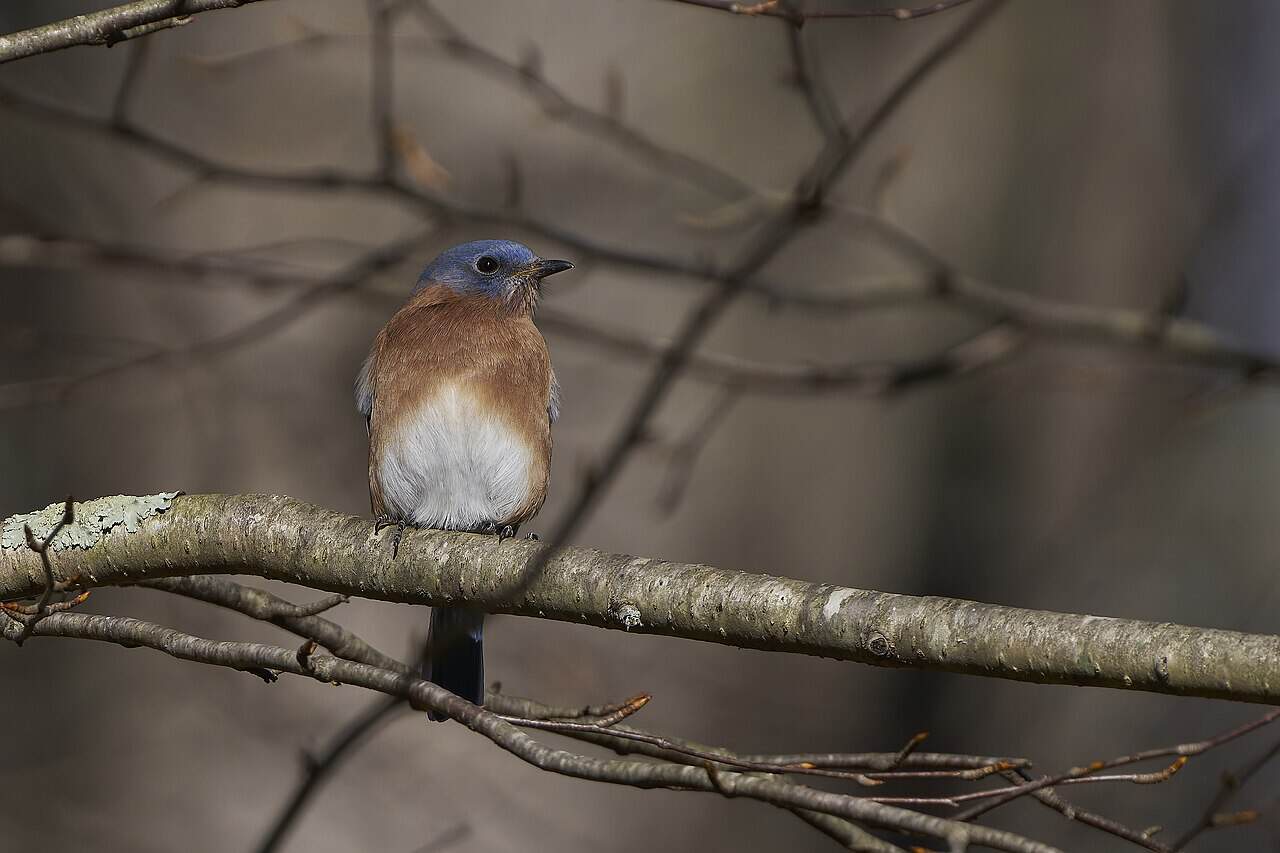
Male Eastern Bluebirds have a striking appearance: brilliant royal-blue head, back, wings, and tail; rust-orange (brick-red) throat and breast; clean white belly and undertail. The blue is structural (created by light scattering, not pigment) and varies in apparent intensity depending on the angle of light.
Female Eastern Bluebirds are paler, duller bluish-gray head and back, with a similar but paler rust-orange breast (sometimes described as buff-orange rather than bright rust), and white belly. Females have the same overall pattern as males but with less vivid colors.
Juvenile Eastern Bluebirds look quite different from adults, they’re brown-spotted with subtle blue wings (the spotted breast identifies them as thrushes, like juvenile American Robins). They molt into adult plumage in their first fall.
Size: Eastern Bluebirds are 6.3-8.3 inches long, medium-sized songbirds. Smaller than American Robins (10 inches) but larger than House Sparrows (6 inches).
Eastern vs Western vs Mountain Bluebird: Three Bluebird species occur in North America. Eastern Bluebird: blue back, rust-orange breast, WHITE belly. Western Bluebird: blue back, rust-orange breast, blue or gray belly (NOT white). Mountain Bluebird: entirely sky-blue overall, no rust orange on the breast. The three species have largely separate ranges, with some overlap zones.
Eastern Bluebird vs Indigo Bunting: Sometimes confused. Indigo Buntings are smaller (5.5 inches), entirely blue (no orange or white belly), and have heavier sparrow-like bills. Their songs are completely different.
Eastern Bluebird Range and Habitat
Eastern Bluebirds occupy a vast range across eastern and central North America, from southern Canada south through the eastern and central US to Mexico and Central America. The range covers approximately the eastern half of the United States.
Habitat: Eastern Bluebirds are highly specific about habitat preferences. They strongly prefer OPEN HABITAT WITH SCATTERED TREES, pastures, golf courses, cemeteries, parks, lightly-grazed fields, rural roadsides, suburbs with old open trees. They generally AVOID dense forests and treeless prairies.
Habitat changes over time: Eastern Bluebird populations have been strongly affected by land use changes. As European settlers cleared eastern forests, they created Bluebird habitat (open pastures with scattered trees). This led to Bluebird population peaks in the 1800s. Subsequently, suburban sprawl, fence-row removal, agricultural intensification, and the proliferation of introduced cavity-nesting competitors (House Sparrows, European Starlings) reduced suitable habitat.
Population decline: Eastern Bluebird populations crashed dramatically in the early-to-mid 20th century, from millions to perhaps a few hundred thousand pairs. The decline was caused by three main factors: competition from introduced House Sparrows and European Starlings (which take over Bluebird nest cavities), heavy pesticide use (especially DDT), and loss of dead trees for natural cavity nesting.
Recovery: Beginning in the 1970s, North American Bluebird Society and similar organizations launched massive volunteer nest box programs. Thousands of carefully-designed nest boxes have been installed across the eastern US. Bluebird populations have rebounded substantially, from perhaps a low of 500,000 pairs in the 1970s to today’s estimated 7-8 million pairs. This recovery is one of the great conservation success stories.
Year-round residency: Eastern Bluebirds are year-round residents across most of their range, though northern populations may move slightly south during severe winter weather. Many of the same individual birds may visit your yard for years.
Eastern Bluebird Diet
Eastern Bluebirds have dramatically seasonal diets, they shift from insect-heavy summer breeding diet to fruit-heavy winter diet.
Spring/summer diet: Approximately 70% insects. Eastern Bluebirds eat caterpillars (especially important for nestlings), beetles, grasshoppers, crickets, spiders, snails, and various other invertebrates. They hunt from elevated perches, dropping down to grab prey on the ground.
Fall/winter diet: Approximately 70% fruit and berries. Top picks include Eastern Red Cedar berries, Winterberry Holly berries, Mountain Ash berries, Native Viburnum berries, Sumac berries, and other native fruits.
Foraging behavior: Eastern Bluebirds are ‘perch hunters.’ They perch on prominent locations (fence posts, low tree branches, telephone wires) and watch for prey on the ground. When prey is spotted, they drop down to grab it. The hunting style is characteristic, bluebirds spend much of their time sitting on perches scanning the ground.
At feeders: Eastern Bluebirds DON’T typically eat at traditional seed feeders. They don’t crack seeds. The most effective feeder approach is MEALWORMS, both live and dried mealworms attract bluebirds reliably. Some bluebirds also eat suet, sliced grapes, sliced apples, and crumbled commercial ‘bluebird food’ from specialty feeders.
Mealworm feeding: Mealworms have become the standard Eastern Bluebird attractant. Many backyard birders provide live mealworms in shallow dishes during breeding season (when bluebirds need protein-rich food for nestlings). The mealworms can dramatically boost local bluebird breeding success. Some retailers sell freeze-dried mealworms as a less-fussy alternative to live ones.
Water requirements: Eastern Bluebirds visit bird baths regularly. They’re enthusiastic bathers, among the most reliable bath users of any backyard species.
Eastern Bluebird Behavior and Social Structure
Eastern Bluebirds are social, vocal, and family-oriented birds. Their behavior makes them among the most rewarding backyard birds to observe.
Family groups: Eastern Bluebird pairs and their offspring form family groups during breeding season. Juveniles from earlier broods often stay near parents during subsequent broods, sometimes helping feed siblings. Family groups may include 6-10 individuals during peak breeding season.
Pair bonds: Eastern Bluebird pairs often stay together for multiple breeding seasons. The bond is moderately strong, not as lifelong as Cardinals, but lasting beyond single seasons. Both parents work together on incubation, nestling care, and territory defense.
Territorial behavior: During breeding season, Eastern Bluebird pairs defend territories of 1-4 acres. Males perform aggressive territorial displays from prominent perches, flashing their wings and singing. Males will attack other male bluebirds that enter their territories.
Winter behavior: Eastern Bluebirds often form winter flocks of 5-20 birds. The flocks include both genders and multiple age classes. They roost communally at night during cold weather, sometimes squeezing into a single nest cavity for warmth (10-15 bluebirds may share a cavity during severe cold).
Lifespan: Wild Eastern Bluebirds have been recorded surviving 10+ years. Adults that survive their first year typically live 6-10 years. First-year mortality is high (~70%) due to learning challenges. Major mortality factors: predation by Cooper’s Hawks, outdoor cats, severe winter weather, and competition from House Sparrows for nest cavities.
Eastern Bluebird Breeding and Nesting
Eastern Bluebird breeding begins in March-April in the southern US, April-May in the central US, and May in northern regions. Most pairs raise 2-3 broods per year (occasionally 4 in southern regions).
Cavity nesting: Eastern Bluebirds are obligate cavity nesters, they MUST nest in a cavity (natural tree hole, old woodpecker hole, or nest box). They cannot excavate their own cavities (unlike chickadees and woodpeckers).
Nest construction: The female builds the nest, using grasses, pine needles, and other plant materials. Bluebird nests are neat, cup-shaped, often densely woven. Both parents may inspect the nest site, but the female does most construction.
Eggs: Each clutch contains 3-7 eggs (typically 4-5). Eastern Bluebird eggs are pale blue (the famous ‘bluebird egg blue’, slightly different from robin’s egg blue, lighter and more turquoise). Incubation takes 12-14 days, performed almost entirely by the female. The male feeds the female during incubation.
Nestling period: Both parents (often helped by older offspring from earlier broods) feed nestlings. Nestlings remain in the nest cavity for 17-21 days. Diet is primarily insects, caterpillars, beetles, and other invertebrates provide protein for rapid nestling growth.
Post-fledging: After fledging, juveniles remain with parents for 2-4 weeks while learning to forage. Older offspring may help feed siblings from subsequent broods, making bluebirds one of the few backyard birds where ‘helper at the nest’ behavior occurs reliably.
Nest box use: Eastern Bluebirds have benefited enormously from nest box programs. Boxes designed specifically for bluebirds (1.5 inch entrance hole, 5-inch by 5-inch floor, mounted 4-6 feet above ground on poles or posts in open areas) have allowed dramatic population recovery. Bluebird trails (chains of nest boxes maintained by volunteers) span thousands of locations across the US.
Eastern Bluebird Vocalizations
Eastern Bluebirds have soft, melodic songs and calls. Their voices are less loud than many backyard birds, but their musical quality is distinctive.
Song: A soft, warbling musical phrase often described as ‘tu-a-wee’ or ‘cher-wee.’ The song is sweet and clear, with multiple notes per phrase. Songs are typically 2-3 seconds long, with brief pauses between phrases.
Singing period: Eastern Bluebirds sing primarily during breeding season (February-July), with peak singing in early spring. Some singing occurs year-round, especially during warm winter days.
Calls: Soft ‘chip!’ contact calls between flock members; sharp ‘tu’ alarm calls; various begging calls used by juveniles.
Family communication: Eastern Bluebirds maintain constant low-volume communication between mated pairs and family groups. Listen for soft chips and warbles when bluebirds are in your yard, they’re communicating with each other constantly.
Compared to other species: Eastern Bluebird vocalizations are softer and more musical than many other backyard birds. Cardinals are louder and more whistled. House Wrens are bubbly and rapid. Bluebird songs reflect the species’ generally gentle, peaceful character.
Eastern Bluebird Subspecies and Regional Variations
Eastern Bluebirds are divided into eight recognized subspecies across their range. Most variations are subtle differences in plumage shade and body size.
Eastern Bluebird (S. s. sialis): The most familiar subspecies across the eastern and central US.
Bahama Bluebird (S. s. bahamica): Found only on the Bahamas. Now nearly extinct due to habitat loss and possibly hurricanes.
Several Mexican subspecies: Various populations across Mexico with subtle differences in size and color.
Florida and southern populations: Slightly paler than northern populations. Some authors recognize Florida Bluebirds as a separate subspecies.
Mountain populations: Eastern Bluebirds breeding at higher elevations in the Appalachians and Mexican mountains tend to be slightly larger.
Conservation considerations: Different regional populations have different conservation needs. The Bahama subspecies is critically endangered, while continental populations are common and stable.
How to Attract Eastern Bluebirds to Your Backyard
Eastern Bluebirds can be attracted to most yards with appropriate habitat features. A few key strategies dramatically increase Bluebird visitation and breeding success.
1. Install a NABS-approved bluebird nest box. The single most important Bluebird attractant. Use a nest box with 1.5-inch round entrance hole (essential, keeps out larger competitors). Mount on a smooth metal pole 5-6 feet above ground. Position in open habitat with scattered trees. Don’t mount on trees (predators like raccoons climb trees). Face the entrance away from prevailing winds.
2. Provide mealworms. Mealworms (live or freeze-dried) are the standard Eastern Bluebird attractant. Place them in a shallow dish or specialized mealworm feeder. During breeding season (May-July), provide mealworms 2-3 times daily. The protein boost dramatically improves nestling survival.
3. Maintain open habitat. Eastern Bluebirds need open habitat, they won’t visit yards with dense trees and shrubs. Keep some areas open with scattered trees rather than dense forest canopy. Lightly-grazed lawns work well; densely-shrubbed gardens are less suitable.
4. Plant native berry-producing trees. For fall and winter food, plant Eastern Red Cedar, Winterberry Holly, Mountain Ash, native viburnums, and other native fruit-producing plants. Bluebirds switch from insects to berries in winter.
5. Provide a quality bird bath. Eastern Bluebirds are enthusiastic bath users. Use a shallow bath (1-2 inches deep) with reliable fresh water. Heated baths in winter are valuable.
6. Avoid pesticides. Pesticides reduce the insect populations Bluebirds need during breeding. Organic lawn care is essential for breeding Bluebirds.
7. Control nest box competitors. House Sparrows are major competitors for Bluebird nest cavities and may even kill adult Bluebirds. Eastern Bluebird nest boxes should be monitored regularly during breeding season. If House Sparrows occupy your bluebird box, remove their nest immediately. House Sparrows are not protected, they can be legally controlled.
8. Manage outdoor cats. Outdoor cats kill many Eastern Bluebirds, especially during fledging when juveniles are vulnerable. Keeping cats indoors substantially improves Bluebird survival.
9. Join your local Bluebird society. State Bluebird societies (one in nearly every eastern state) coordinate volunteer nest box programs. Joining provides connections to local Bluebird experts and chances to participate in conservation work.
10. Be patient. Eastern Bluebird attraction can take 1-3 years. Once a pair establishes a nest box, they may use the same box for multiple seasons, and their offspring may settle nearby. Patient yard owners often have generations of Bluebirds visiting their property.
Related reading: Eastern Bluebird Symbolism.
Related reading: what do bluebirds eat.
Frequently Asked Questions
What does an Eastern Bluebird sighting mean?
In various spiritual and folk traditions, Eastern Bluebirds symbolize happiness, hope, renewal, and the presence of departed loved ones. The species is widely associated with positivity. Scientifically, Eastern Bluebird sightings simply indicate that your area has appropriate habitat, open areas with scattered trees, plus suitable cavity-nesting sites. But the cultural significance of bluebirds runs deep in North American symbolism.
How do I get Bluebirds to use my nest box?
Install a NABS-approved bluebird nest box (1.5-inch entrance hole) on a smooth metal pole 5-6 feet above ground in open habitat with scattered trees. Face the entrance away from prevailing winds. Don’t mount on trees (predators climb trees). Provide mealworms during breeding season. Monitor the box and remove House Sparrow nests immediately if they occupy it. Be patient, it may take 1-3 years for Bluebirds to discover and use your box. Once they do, they often return year after year.
Why did Eastern Bluebird populations decline?
Three main factors caused 20th-century Eastern Bluebird decline: 1) Competition from introduced House Sparrows and European Starlings, which take over nest cavities and sometimes kill adult Bluebirds; 2) Pesticide use (especially DDT) reducing food supply; 3) Loss of dead trees for natural cavity nesting (clean farming practices). Recovery through nest box programs is one of the great conservation success stories.
What’s the difference between Eastern, Western, and Mountain Bluebirds?
All three are bluebird species but distinct. Eastern Bluebird: blue back + rust-orange breast + WHITE belly. Western Bluebird: blue back + rust-orange breast + blue or gray belly (NOT white). Mountain Bluebird: entirely sky-blue overall, no rust orange anywhere. The species have largely separate ranges: Eastern in the East, Western in the Pacific Northwest, Mountain in the Rocky Mountains.
Do Bluebirds use the same nest box year after year?
Yes, Eastern Bluebirds show strong site fidelity. Successful pairs often return to the same nest box for multiple seasons. Their offspring may settle nearby, sometimes using neighboring nest boxes. Maintaining boxes year after year supports return visits. Some banded Bluebirds have been documented using the same box for 5+ consecutive years.
When do Eastern Bluebirds start nesting?
Eastern Bluebirds typically begin nesting in March in southern states, April in central states, and May in northern states. They raise 2-3 broods per breeding season, with the season extending through July or August. Have nest boxes ready by mid-February (south) or early March (north) for early breeders.
Why are some Bluebirds at my feeder duller than others?
Female Eastern Bluebirds are duller than males, they have paler, grayer blue and less vivid rust-orange. Juveniles look quite different, they’re brown-spotted with subtle blue wings (the spotted breast identifies them as thrushes). Juveniles molt into adult plumage in their first fall. The plumage variation is often confusing to new bird-watchers.
How long do Eastern Bluebirds live?
Wild Eastern Bluebirds have been recorded surviving 10+ years. Average lifespan for adults is 6-10 years, relatively long for songbirds. First-year mortality is high (~70%) due to learning challenges. The same individual Bluebirds may visit your yard for many years once established.
More in this series: the eastern bluebird nest box.
Related reading: female bluebird identification.
Related reading: types of swallows.
Related reading: types of blue birds in Florida.
Related reading: types of blue birds in Georgia.
Related reading: types of blue birds in North Carolina.
Related reading: types of blue birds in Virginia.
Related reading: types of blue birds in Tennessee.
Related reading: types of thrushes.
Related reading: types of blue birds in Michigan, types of blue birds in Texas.
Related reading: types of blue birds in California.