Grackle Sound: Why They Squeal Like a Rusty Gate
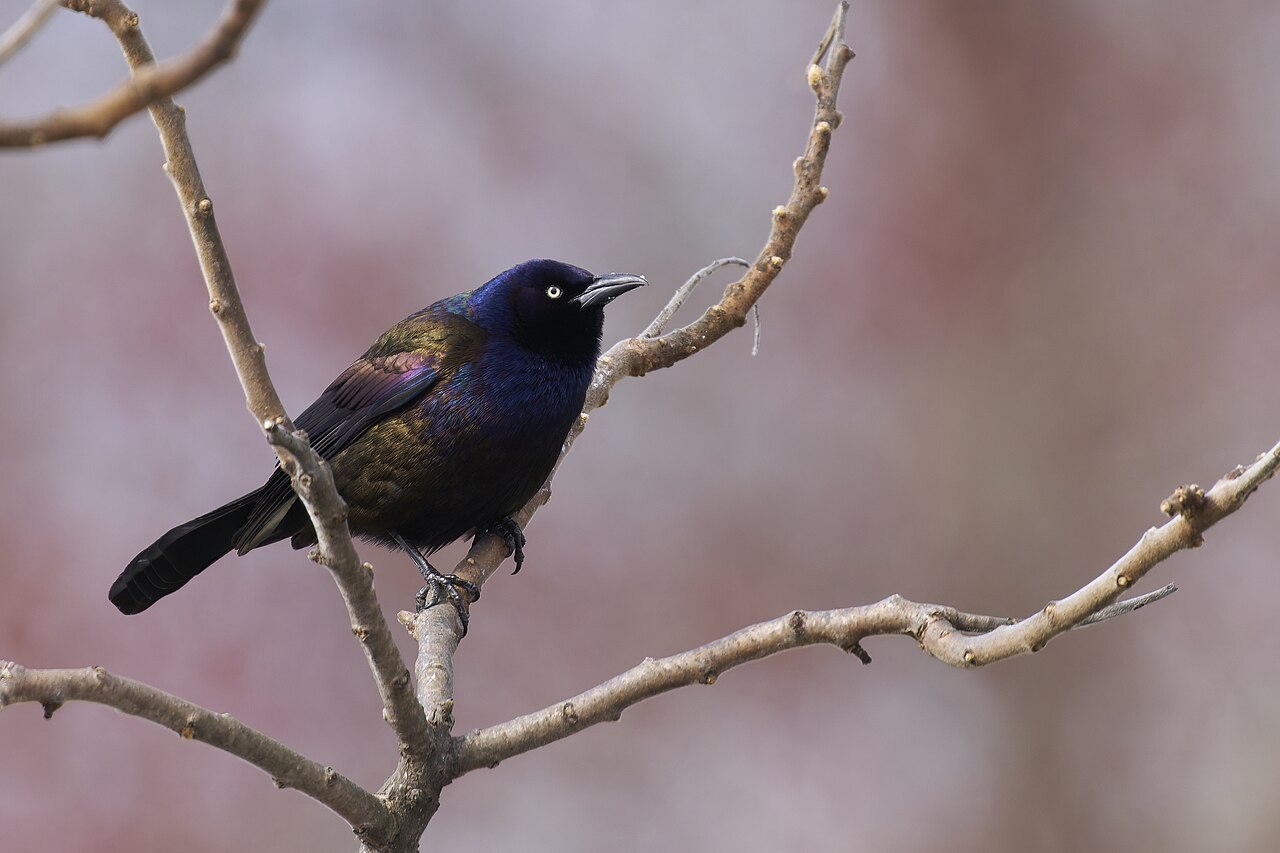
A grackle sound is a harsh, metallic squeal that most people compare to a rusty gate hinge swinging open. The Common Grackle (Quiscalus quiscula) delivers that one second screech as its full song, and it pairs the song with dry chack notes, thin whistles, and a scratchy chatter that carries across a parking lot or a backyard lawn.
Three grackle species live in the United States, and each one has a different voice. Once you learn the rusty hinge of the Common Grackle, the machine gun rattle of the Great-tailed Grackle, and the rolling jeeb of the Boat-tailed Grackle, a noisy flock stops being one wall of sound and becomes three separate birds you can name with your eyes closed.
Grackles sound like a rusty gate being forced open: a short, rising metallic squeal followed by dry chack notes. Common Grackles produce a one second readle-eak song, Great-tailed Grackles add loud whistles and mechanical rattles, and all three US species use a sharp chack as their contact and alarm call.
What Does a Grackle Sound Like?
The core grackle sound is not a melody. It is a compressed burst of noise that starts low, climbs fast, and ends with a metallic scrape. Birders write the Common Grackle song as readle-eak or gri-de-leek, and almost everyone who hears it for the first time reaches for the same comparison: an unoiled hinge, a wheelbarrow wheel, or a screen door pushed open in a hurry.
Surrounding that song is a working vocabulary of short calls. The chack note is the one you hear most, a flat wooden click the birds trade constantly while they forage on the ground. There are also thin, high seet notes used in flight, a lower rolling chatter from birds in a crowded roost, and a scream reserved for real danger.
Volume is part of the identification. A single grackle in a quiet yard is loud enough to pull your head around, and a roost of several thousand birds at dusk produces a steady roar that neighbors regularly mistake for machinery. For a softer, more musical contrast, listen to the clear whistles covered in our guide to cardinal calls.
| Sound | Species | What It Sounds Like | What It Means |
|---|---|---|---|
| Readle-eak song | Common Grackle | One second rusty hinge squeal | Male advertising a territory or a mate |
| Chack note | All three US species | Flat wooden click | Contact call between foraging birds |
| Machine gun rattle | Great-tailed Grackle | Rapid dry clatter | Male display at a roost or feeding site |
| Rising whistle | Great-tailed Grackle | Loud slide up in pitch | Territory claim, often from a wire or light pole |
| Jeeb jeeb jeeb | Boat-tailed Grackle | Rolling, reedy repetition | Male courtship near coastal marsh |
| Distress scream | All three US species | Harsh, tearing shriek | Predator contact, recruits the whole flock |
The Common Grackle’s Rusty Gate Song
The Common Grackle song lasts about one second and covers a wide band of frequencies at once, which is exactly why it registers as mechanical rather than musical. A clean whistle sits on one narrow frequency. This song smears across many of them, and the human ear reads that smear as metal on metal.
The delivery is as odd as the sound. The male fluffs his body feathers, spreads his wings and tail, points his bill toward the sky, and then forces the squeal out as the feathers snap back down. Birders call it the ruff out display, and it is the most reliable way to confirm that the rusty hinge you just heard came from a grackle and not from a gate.
Females sing too. Their version is shorter, rougher, and quieter, and it is usually given near the nest rather than from an exposed perch. Our profile of the female grackle covers the plumage differences that go with that quieter voice.
Great-tailed and Boat-tailed Grackle Calls
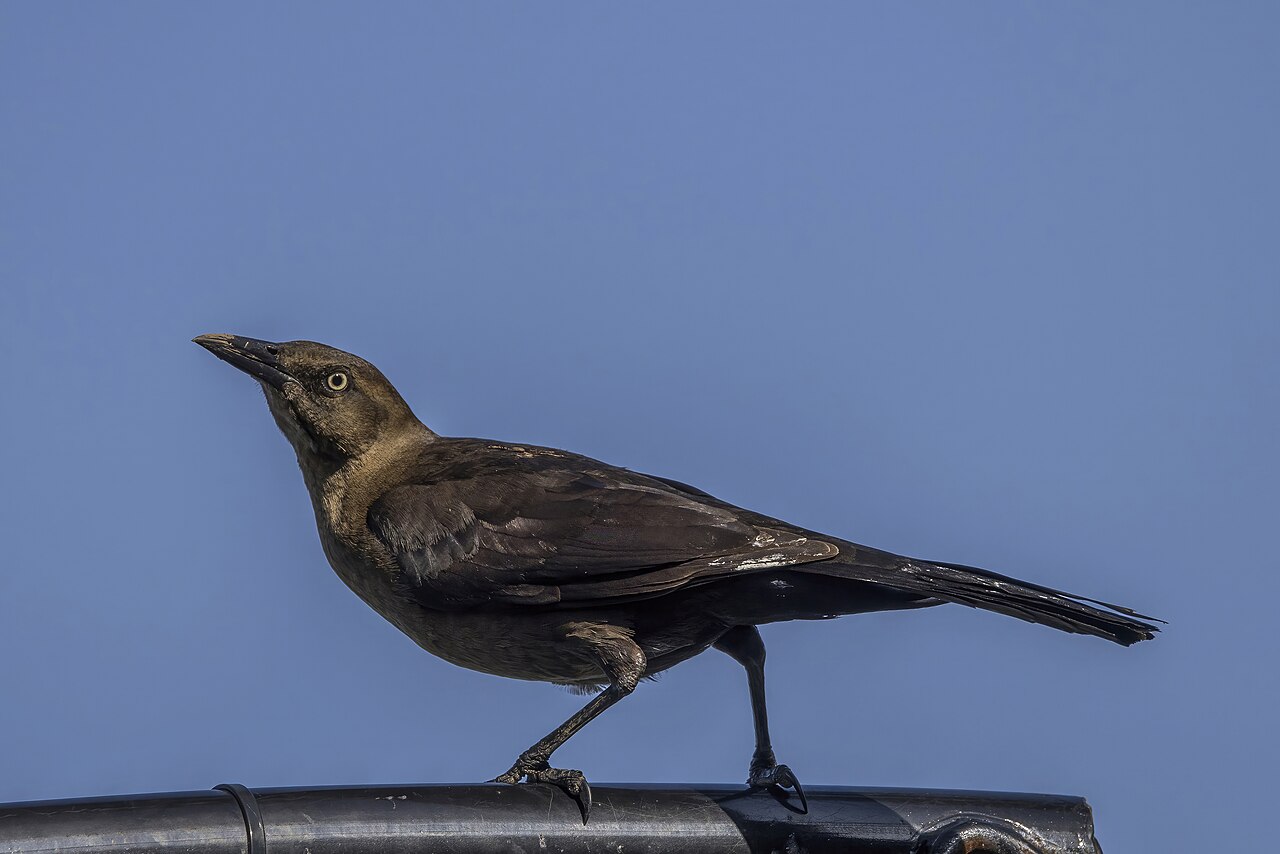
The Great-tailed Grackle (Quiscalus mexicanus) has the largest vocal range of the three and sounds almost electronic. A single male cycles through rising whistles, sharp tick series, dry rattles that sound like a stick dragged across a fence, and deep sweeping notes that drop through several octaves. In Texas and the Southwest, a shopping center roost at dusk is genuinely loud enough to hold a conversation over.
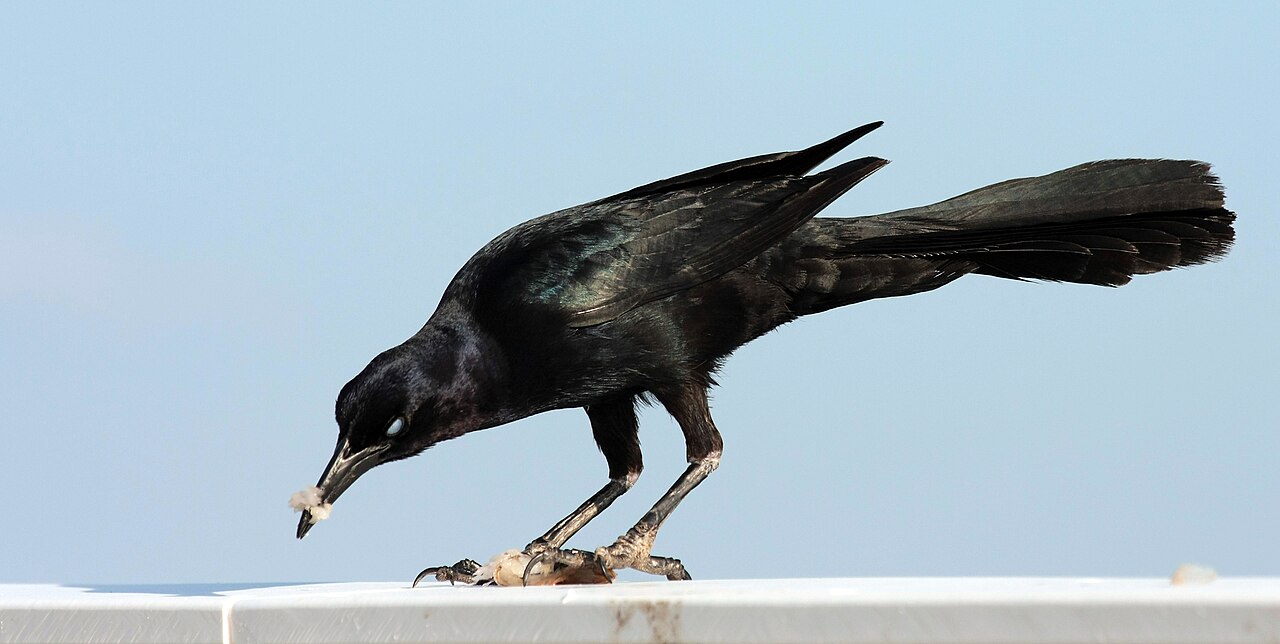
The Boat-tailed Grackle (Quiscalus major) sticks close to the Atlantic and Gulf coasts and favors a rolling, reedy jeeb jeeb jeeb that repeats in even bursts. It is lower and wetter than the Common Grackle squeal, and it carries well across open salt marsh, which is where you are most likely to hear it.
Range helps as much as sound. If you are east of the Rockies and inland, the squealing bird is almost certainly a Common Grackle. Along the Gulf Coast the big tailed bird on the beach railing is a Boat-tailed Grackle, and across Texas and the desert Southwest it is a Great-tailed.
Why Are Grackles So Noisy?
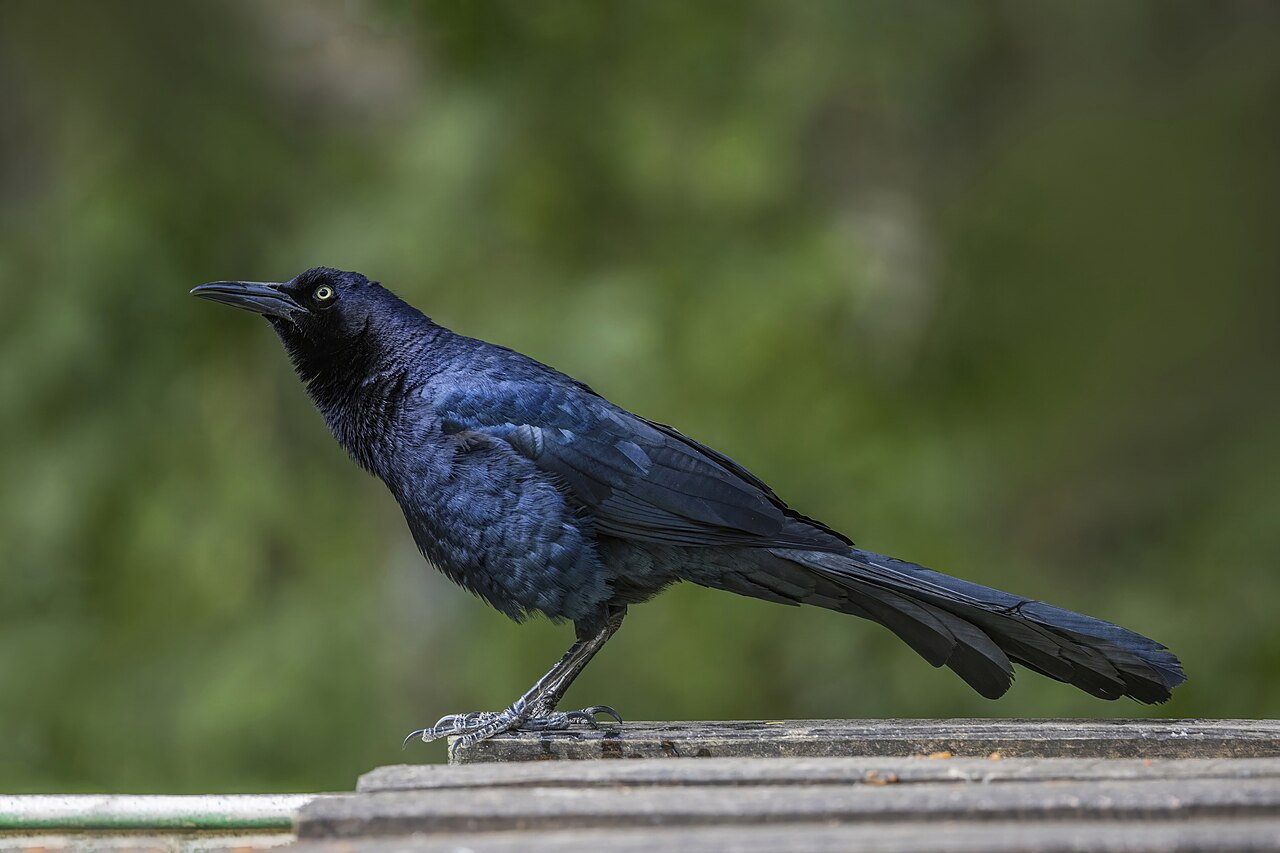
Grackles are so noisy because they live in dense flocks year round and every bird in that flock has to be heard. A species that forages shoulder to shoulder on open ground needs constant contact calls to keep the group together, plus an alarm loud enough to cut through hundreds of other voices the instant a hawk appears.
Their habitat pushes the volume higher still. Grackles thrive in mowed lawns, farm fields, parking lots, and city parks, all of which are acoustically open and full of competing noise. Sound spreads thin in that kind of space, so the birds that get heard are the ones with harsh, broadband, high energy calls.
Roosting multiplies it. Outside the breeding season grackles gather in communal roosts that can hold tens of thousands of birds, often mixed with starlings and blackbirds. The roar you hear at sunset is not aggression. It is thousands of individual contact calls landing at the same time, the same effect you get from a cicada chorus in August.
What Is the Most Obnoxious Bird Call?
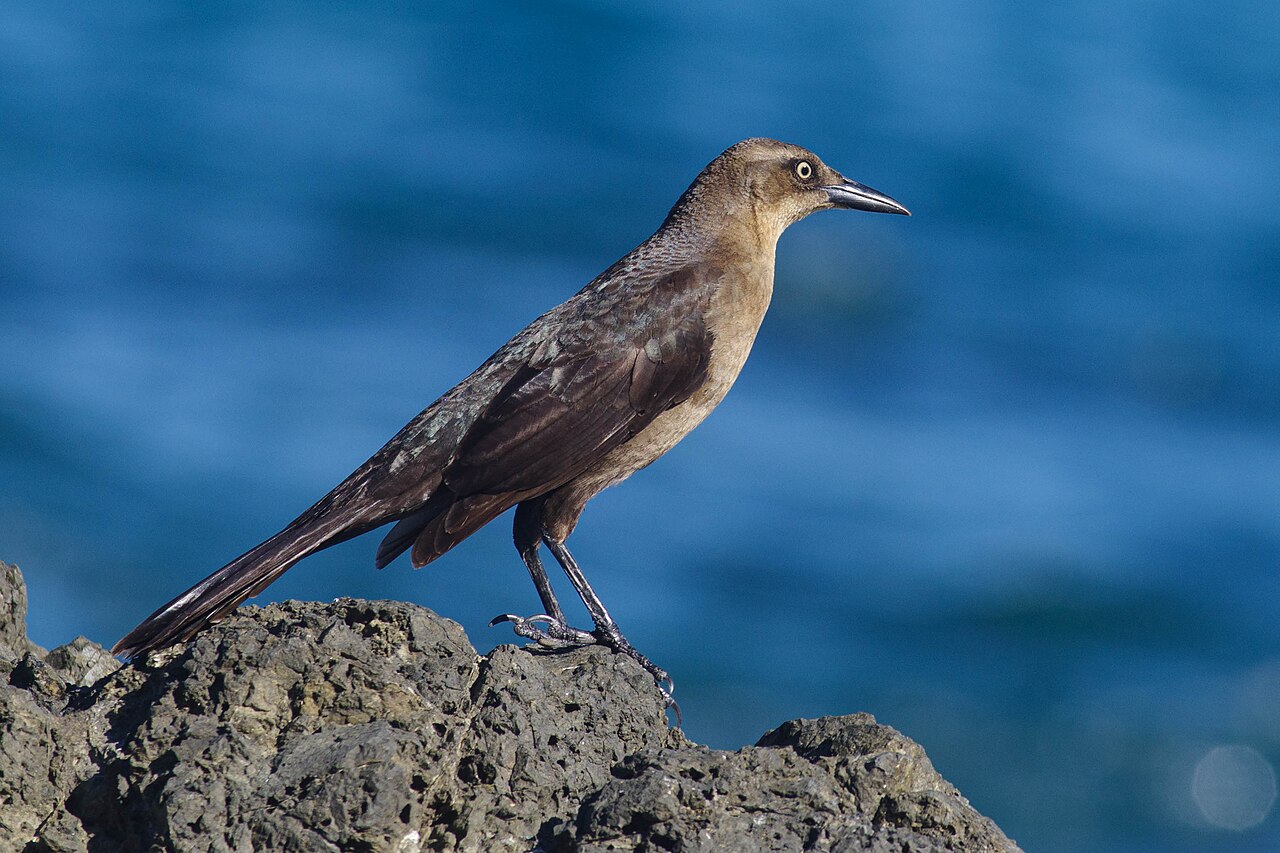
The Common Grackle regularly lands on lists of the most obnoxious bird calls in North America, and the rusty hinge squeal is the reason. Sounds that people rate as unpleasant tend to share three traits: they are loud, they are noisy across many frequencies rather than tonal, and they repeat without resolving. The grackle song hits all three.
It has competition. Blue Jays scream, Northern Mockingbirds run through borrowed phrases at two in the morning, and a House Wren can rattle for twenty minutes without pause. The blue jay call probably wins on sheer volume from a single bird, but nothing matches a grackle roost for accumulated racket.
Worth saying plainly: obnoxious is a human verdict, not a biological one. Every harsh note in the grackle repertoire does a job, and the birds that find the squeal attractive are other grackles.
Grackle Distress Call and Alarm Notes
The grackle distress call is a harsh, tearing shriek given when a bird is seized or badly frightened, and it is the loudest sound in the species repertoire. It works as a recruitment signal. Nearby grackles drop what they are doing, converge on the source, and mob the predator, which sometimes startles a cat or a hawk into letting go.
The alarm system has gradations below that. A sharp, repeated chack means a predator has been spotted but is not an immediate threat. A thin, high seet given in flight warns of a hawk overhead, and it is deliberately hard for a raptor to locate. Many songbirds share a near identical thin alarm note, which is why a chickadee alarm can send grackles into cover too.
Silence is a signal as well. A feeding flock that goes abruptly quiet and freezes has almost always seen something, and looking up at that moment is how most backyard hawk sightings actually happen.
Is a Grackle a Crow?
A grackle is not a crow. Grackles belong to the family Icteridae, the New World blackbirds, alongside orioles, meadowlarks, and cowbirds. Crows and ravens belong to Corvidae. The two groups are separate branches of the songbird tree, and the resemblance is a matter of shared color rather than shared ancestry.
The field marks separate them quickly. A Common Grackle is about 12 in (30 cm) long with a slim body, a long keel shaped tail, a slender pointed bill, and a pale yellow eye. An American Crow is roughly 17 in (43 cm), bulkier, with a thick bill, a fan shaped tail, and a dark eye. That yellow iris is the fastest tell at any distance.
Their voices are not confusable either. Crows caw with an open, nasal, fairly tonal note. Grackles squeal, click, and rattle. If the black bird in your yard sounds like metal rather than like a shout, it is a grackle.
Are Grackles as Intelligent as Crows?
Grackles are clever, but they are not in the same class as crows. Corvids solve multi step puzzles, manufacture tools, recognize individual human faces for years, and plan for future needs. No grackle has demonstrated anything at that level in a controlled study.
What grackles do show is strong behavioral flexibility. Common Grackles are well known for dunking hard bread in water to soften it, a food processing habit passed around by observation. They also practice anting, crushing ants into their feathers so the formic acid deals with parasites, and they follow plows and mowers to catch whatever gets flushed.
Great-tailed Grackles have become a favorite subject for cognition researchers precisely because they are spreading so fast into new cities. In lab tests they show real persistence and readiness to switch tactics when a familiar solution stops working, which is the toolkit a successful urban colonizer needs.
Is It Good to Have Grackles in Your Yard?
Grackles are a genuine mixed blessing, and an honest answer has to include both halves. On the credit side they eat enormous numbers of pest insects, including Japanese beetles, armyworms, cutworms, grubs, and grasshoppers, and a foraging flock can strip a lawn of grubs more thoroughly than any treatment you can buy.
On the debit side they arrive in numbers, empty feeders in an afternoon, dominate birdbaths, and will take eggs and nestlings from smaller birds. Large winter roosts create droppings and noise problems where they settle near houses. Those are the specific complaints behind most requests to get rid of them.
There is also a conservation fact that cuts against the nuisance framing. Common Grackle numbers have fallen by more than half since 1970, and the species is now listed as Near Threatened by the IUCN. The loud, abundant bird in your yard is a declining one.
How to Tell Grackle Sounds From Similar Birds
The birds most often confused with grackles by ear are European Starlings, Red-winged Blackbirds, and Brown-headed Cowbirds, all of which share the same fields and feeders. Starlings are mimics and run long, rambling sequences full of clicks, whistles, and stolen phrases, including car alarms. A grackle repeats the same short squeal instead of improvising.
Red-winged Blackbirds give a clear, liquid conk-la-ree that resolves into a musical trill, which no grackle ever does. Brown-headed Cowbirds produce a bubbling glug followed by a high thin whistle, a rising sound where the grackle song is a scrape. Both are more pleasant to the ear than anything in the grackle catalog.
Structure is the shortcut. Grackle sounds are short, harsh, and repeated at intervals. Mimic sounds run on and change constantly. If you want a full mimic to compare against, our guide to the gray catbird’s mewing calls shows how different that continuous, inventive style really is. The Cornell Lab keeps reference recordings of every call described here at All About Birds.
Frequently Asked Questions
Why do grackles have a bad reputation?
Grackles have a bad reputation because they show up in large flocks, monopolize feeders, raid the nests of smaller songbirds, and form winter roosts that leave noise and droppings behind. The harsh voice reinforces the impression. Their pest control work in lawns and crop fields rarely gets the same attention.
Can you befriend grackles like crows?
Not in the same way. Crows recognize individual human faces, remember them for years, and are known to bring small objects to reliable feeders. Grackles will learn to associate a person with food and approach closely, but there is no evidence they track individual humans the way corvids do.
What bird has the highest IQ?
Research points to the New Caledonian Crow and the Kea, a New Zealand parrot. The crow builds hooked tools from twigs and uses them in sequence, and the Kea solves cooperative puzzles. Corvids and parrots consistently outperform other bird families, grackles included, on cognitive tests.
What is the crows’ worst enemy?
The Great Horned Owl. It hunts at night when crows cannot see to defend themselves and regularly takes roosting adults and nestlings. That is why crows mob any owl they find in daylight. You can hear what they are reacting to in our guide to owl calls.
Do grackles make sounds at night?
Mostly no. Grackles are active by day and settle into roosts at dusk, though a large roost produces a low chatter for a while after dark and erupts if a predator moves through. Loud repeated calls in full darkness are far more likely to be an owl, a mockingbird, or a nightjar.
What does the grackle sound mean when it is repeated over and over?
A male repeating the same squeal from an exposed perch is advertising, claiming territory and signaling to females. Repeated sharp chack notes mean something different: a predator is nearby and the flock is being kept on alert. Position and posture tell the two apart faster than pitch does.