Catbird Sound: Why It Meows and What Else It Says
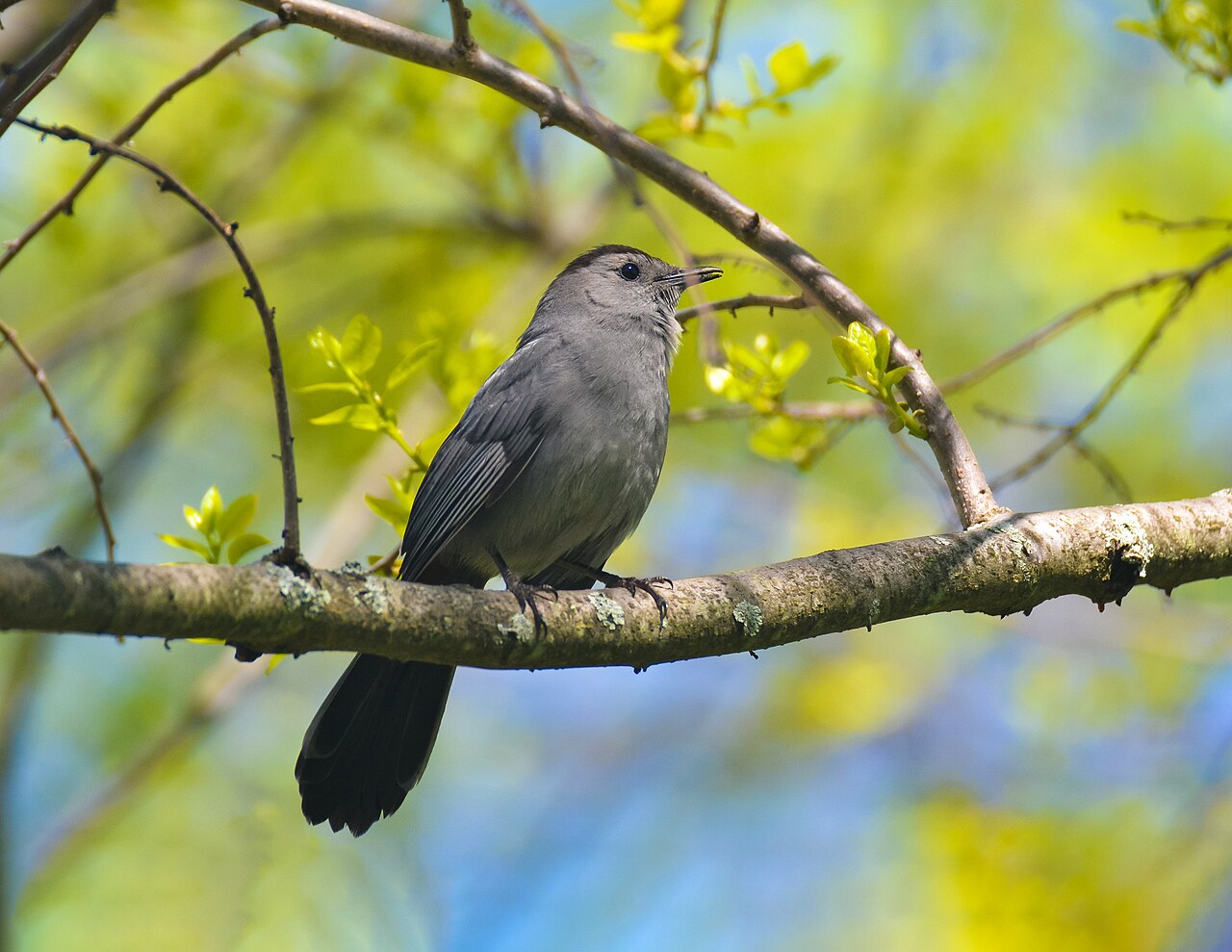
The classic catbird sound is a raspy, descending mew that really does sound like a cat complaining from inside a shrub. The Gray Catbird (Dumetella carolinensis) is named for it, and that one note is all most people ever learn, even though the bird also runs long, improvised songs full of stolen phrases, squeaks, and whistles.
Catbirds sing from cover rather than from an open perch, so the voice usually arrives before the bird does. Learning both halves of the repertoire, the cat call and the rambling song, turns an invisible bird in a hedge into one of the easiest species to identify in an eastern backyard.
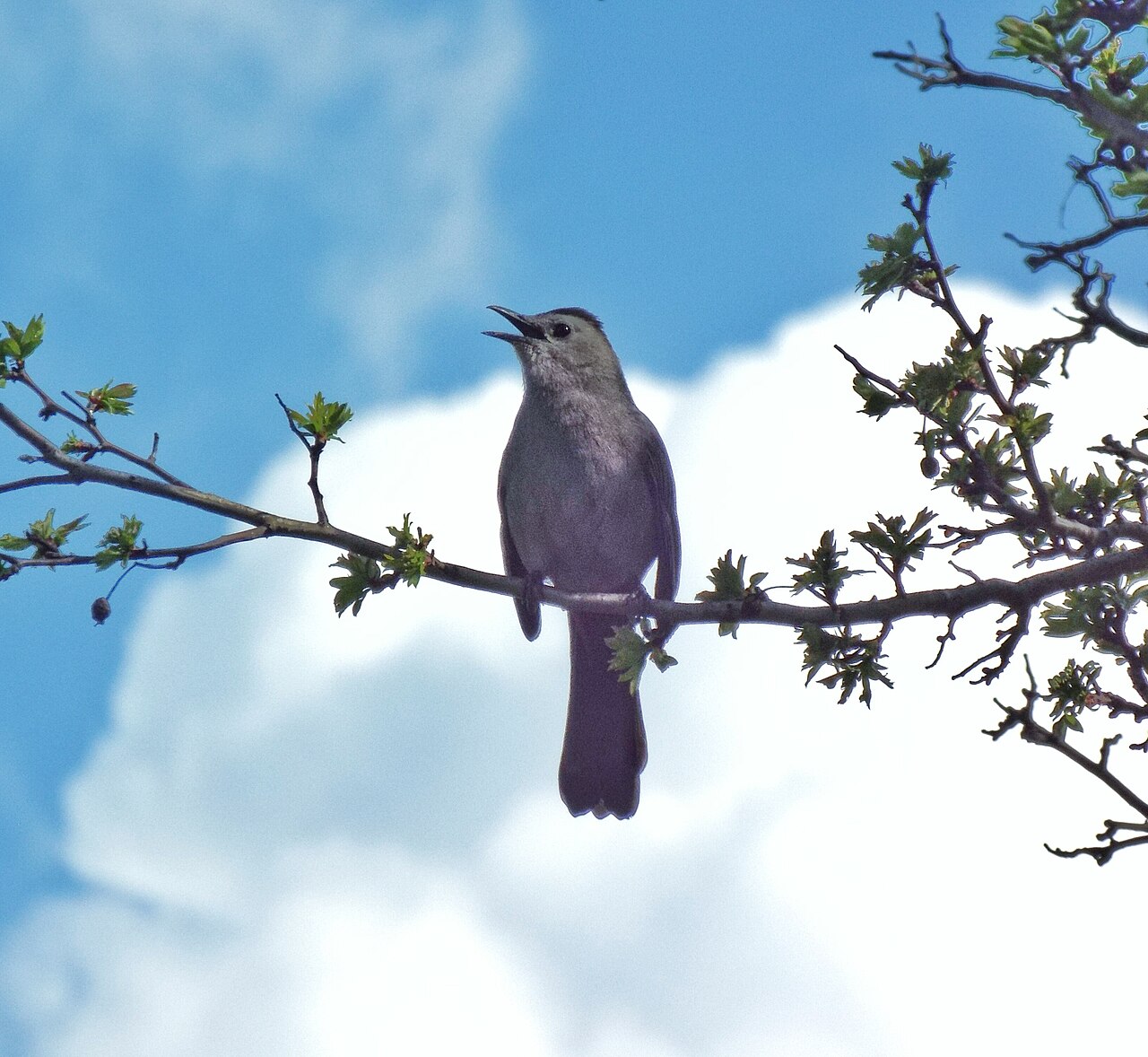
A catbird sounds like a cat: a nasal, raspy mew that slides downward and lasts about half a second. Gray Catbirds also sing long, jumbled songs of whistles, squeaks, and imitations of other birds, strung together without repeating any phrase, often for several minutes from deep inside a thicket.
What Does a Catbird Sound Like?
A catbird makes two very different kinds of sound, and they are easy to tell apart once you know both. The first is the mew, a single nasal note with a gravelly edge that drops in pitch as it fades. It is the call the bird is named for, and it is used for contact, mild alarm, and general commentary on whatever is happening near the nest.
The second is the song: a long, loose string of unrelated noises with no repeated phrases and no obvious structure. Whistles, harsh churrs, clear flute notes, clicks, and fragments of other species all appear in the same sequence. It can run for several minutes without pausing and it rarely lands on anything that resembles a tune.
The bird also gives a dry, rapid chatter when it is genuinely alarmed, plus a quiet, clicking note between mates. For a completely different approach to backyard singing, compare the short repeated whistles of the Carolina Wren, which builds its whole reputation on one loud phrase.
| Sound | Description | Length | When You Hear It |
|---|---|---|---|
| Mew call | Raspy, nasal, sliding down | About 0.5 seconds | All season, especially near a nest |
| Full song | Jumbled whistles, squeaks, imitations | 1 to 10 minutes | Dawn and dusk, May through July |
| Chatter | Dry, fast rattle | 1 to 2 seconds | Predator close to the nest |
| Quiet warble | Soft, muttered version of the song | Varies | Bird sitting low in cover |
| Chuck note | Short, flat, woody | Instant | Contact between a pair |
| Imitations | Borrowed phrases from other species | 1 to 3 seconds each | Mixed into the song at random |
Why Do Catbirds Meow?
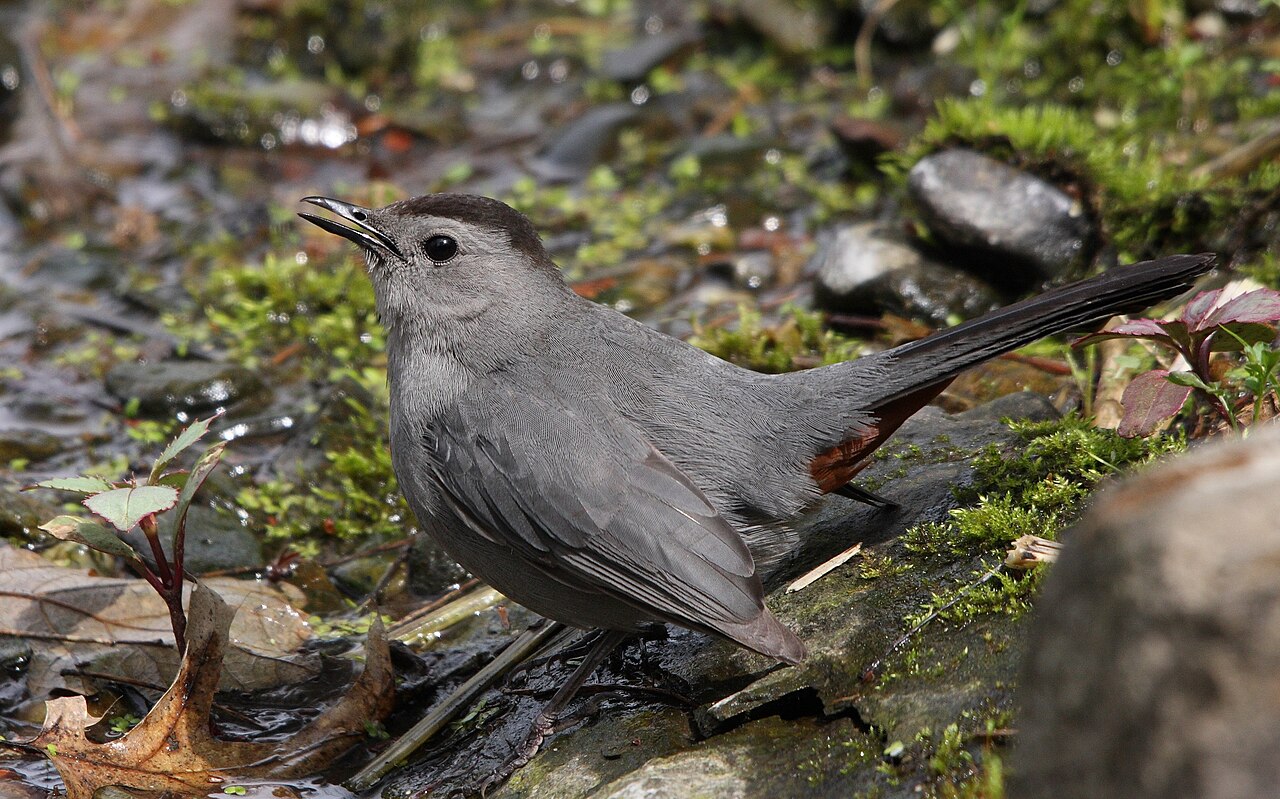
Catbirds meow because the mew call is their all purpose contact and alarm note, and the cat resemblance is an accident of anatomy rather than an imitation. The note is produced in the syrinx with a lot of harmonic noise and a downward slide, and those two features together happen to match the acoustic shape of a domestic cat’s complaint almost exactly.
Function matters more than resemblance. A catbird mews to keep track of its mate in dense cover, to tell a human or a snake that it has been noticed, and to keep intruders aware that the thicket is occupied. The rate climbs as the threat gets closer, which is why standing near a nest produces a steady stream of them.
There is no evidence catbirds are copying cats. Birds on remote islands and in habitats with no cat population give the identical call, and young catbirds develop it without ever hearing one.
The Gray Catbird Song: A Mimic That Never Repeats
Gray Catbirds belong to Mimidae, the mimic thrushes, alongside Northern Mockingbirds and Brown Thrashers. All three borrow phrases from other species, but they package them differently, and the packaging is the identification. Mockingbirds repeat each phrase about three times, thrashers about twice, and catbirds almost never repeat at all.
That single rule solves most confusions in the field. If the singer is cycling through borrowed material in triplets, it is a mockingbird. If every phrase is new and the sequence never settles, it is a catbird. The catbird version also sounds rougher and more muttered, because it mixes in squeaks and churrs that a mockingbird would not bother with.
Catbirds can also sing two notes at once. The avian syrinx has two independently controlled sides, and catbirds use both, producing overlapping pitches that no single human voice could manage. That doubled quality is part of why the song sounds mechanical rather than melodic.
What Bird Sounds Like a Cat Crying at Night?
If you hear a cat crying after dark, the Gray Catbird is usually the wrong answer. Catbirds are day active and mostly quiet once light fails. The common nighttime culprits are Eastern Screech-Owls, whose descending whinny is genuinely cat like, and Barn Owls, whose long shriek is closer to a scream than a mew.
Mammals account for most of the rest. Bobcats produce wails and yowls that carry a long way on still nights, red foxes give a harsh scream in winter, and raccoons fighting sound uncannily like distressed cats. Our guide to bobcat calls covers the ones most often reported as a woman or a cat screaming.
Timing and repetition sort it out. Catbird mews are short, dry, and repeated every few seconds from low cover. A screech owl whinny is smooth and tumbling, a barn owl shriek is long and rasping, and a bobcat call is far louder than any songbird.
What Bird Sounds Like It Is Saying Jerry?
This one has no single agreed answer, and it is worth saying so rather than inventing one. The most frequent attribution is the Carolina Wren, whose loud three part song is usually written as teakettle teakettle but which plenty of listeners hear as Jerry Jerry Jerry, especially in the two syllable variants some males use.
Gray Catbirds get named too, because their songs contain scattered two syllable phrases that can briefly resolve into something word like before the bird moves on. The difference is persistence. A wren repeats its phrase identically for minutes. A catbird produces a Jerry once and never returns to it.
Northern Cardinals are a third candidate in some regions, since their clear repeated whistles land on a two syllable pattern that people fit words to. If the sound is a hard, bright repetition from an open perch, start with the cardinal rather than the catbird.
Why Do Catbirds Stop Singing?
Catbirds go quiet in mid to late summer because the job the song does is finished. Full song peaks while males are claiming territory and attracting a mate, from roughly May into early July. Once pairs are established and the last brood has fledged, there is nothing left to advertise and singing costs energy for no return.
Molt closes the door the rest of the way. Adults replace their flight and body feathers in late summer, a physically demanding process that coincides almost exactly with the drop in song. Birds in heavy molt stay low, move less, and mostly limit themselves to mew calls.
Migration finishes the season. Most Gray Catbirds leave the northern and central United States between late August and early October for Mexico, Central America, the Caribbean, and the Gulf Coast. A silent yard in September usually means the birds have already gone, not that something happened to them.
Are Catbirds Friendly to Humans?
Catbirds are curious and tolerant rather than friendly, and they are noticeably bolder than most shrub nesting songbirds. They will hop into the open a few feet from a gardener, follow a person along a hedgerow, and investigate almost any unfamiliar sound, which reads as sociable even though it is really vigilance.
They are also willing to defend themselves. A catbird will mob a cat, a snake, or a person who gets close to an active nest, calling constantly and diving. Gray Catbirds are one of the few songbirds that recognize and eject Brown-headed Cowbird eggs from their own nests, which says something about how carefully they police their territory.
What they will not do is become tame in the way a chickadee can. They rarely take food from a hand and they keep a working distance. Compare that with the behavior described in our guide to blue jay calls, where a much bolder bird uses its voice very differently.
What Attracts Catbirds to Your Yard?
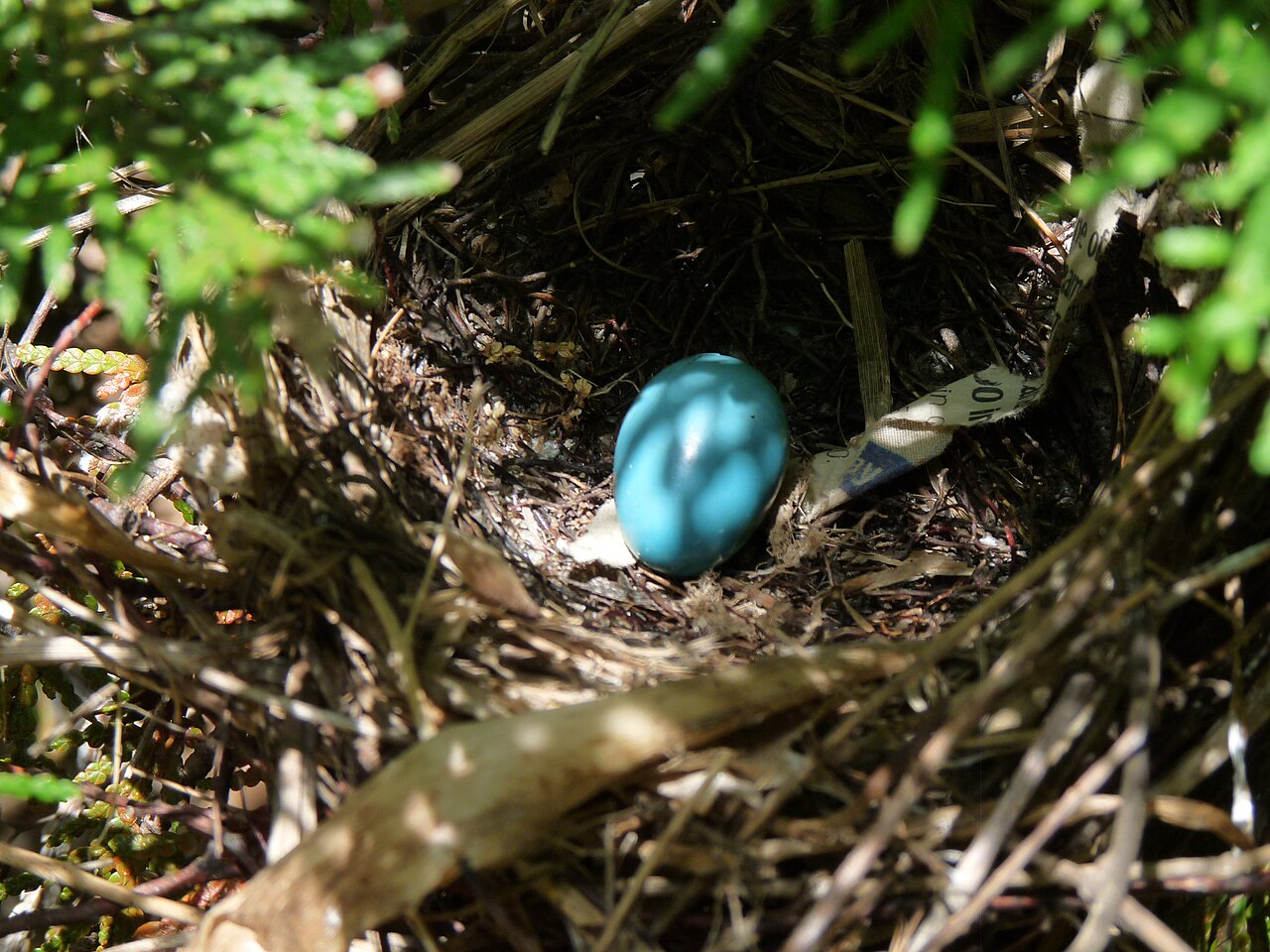
Dense cover comes first. Catbirds nest 3 to 10 ft (1 to 3 m) up in thick shrubs, brambles, and hedgerows, and a yard without a tangle somewhere will not hold them no matter what you put out. Native shrubs planted in a block work far better than single specimens in mown lawn.
Fruit brings them in. Catbirds eat more fruit than most backyard birds, especially in late summer and fall, and they favor serviceberry, dogwood, winterberry, elderberry, and wild grape. At a feeding station they will take grape jelly, raisins soaked in water, orange halves, and mealworms, the same menu that works for orioles.
Water seals it. A shallow bath with moving water is one of the most reliable catbird magnets there is, since the birds bathe often and the sound of a dripper carries into cover. Skip insecticides: nestlings are fed almost entirely on insects and spiders.
Is a Gray Catbird Rare?
The Gray Catbird is not rare. It is a common and widespread breeder across most of the eastern and central United States and southern Canada, with a global population estimated in the tens of millions and an IUCN status of Least Concern. Breeding Bird Survey data show the population roughly stable over recent decades.
It just does not behave like a common bird. Catbirds skulk inside shrubs, forage on the ground under cover, and are plain slate gray with a black cap and a rusty patch under the tail that only shows at close range. People hear far more catbirds than they see, which is why the species feels scarcer than it is.
Regional gaps are real. Catbirds are sparse across much of the Southwest and the Great Basin, where the dense shrub habitat they need is limited. Reference recordings of every call in this guide are available from the Cornell Lab at All About Birds.
Frequently Asked Questions
How do you befriend a grey catbird?
Be consistent and stay predictable. Offer grape jelly, raisins, or mealworms in the same dish each morning near dense shrubs, move slowly, and let the bird approach on its own schedule. Catbirds habituate to a regular gardener within a few weeks, though they almost never feed from the hand.
What do gray catbirds call at night?
Very little. Catbirds occasionally sing at dawn while it is still dark or continue briefly after sunset, especially on bright nights early in the breeding season, but sustained nighttime singing is unusual for the species. Persistent night song in the eastern United States is far more often a Northern Mockingbird.
Do female catbirds sing?
Females give the full range of calls, including the mew and the chatter, and occasionally produce a quiet, muttered version of the song. Loud, sustained song from an exposed perch is almost always a male, since its purpose is territorial advertisement and mate attraction.
Can catbirds really imitate other birds?
Yes. Gray Catbirds work fragments of other species into their songs, and individual birds have been documented borrowing from dozens of neighbors. They also copy tree frogs and mechanical noises. The imitations are shorter and less exact than a mockingbird’s, which is part of why catbird song sounds so jumbled.
How long does a catbird song last?
A single bout commonly runs 1 to 3 minutes and can continue for 10 minutes or more without a real pause. Because no phrase repeats, there is no natural stopping point in the structure, and the bird simply breaks off when it is done.
What is the fastest way to tell a catbird from a mockingbird by ear?
Count the repeats. Northern Mockingbirds deliver each phrase about three times before switching, Brown Thrashers about twice, and Gray Catbirds essentially never. A mew mixed into the sequence confirms the catbird, since neither of the other two uses that raspy cat note.