Red Ant Identification: 7 US Species and Which Ones Sting
A red ant in the United States is usually one of four things: an imported fire ant, a native southern fire ant, a red harvester ant, or a reddish carpenter ant. Only the fire ants sting in swarms, and they are the reason red ants have their reputation. The others either sting once when pressed, or cannot sting at all.
Telling them apart matters because the treatment differs. A fire ant mound in a lawn is a control problem with a short deadline, a harvester ant nest in a pasture is mostly harmless, and a red carpenter ant trail in a kitchen points at damp wood somewhere in the structure. This guide covers the red ants people actually find in US yards, starting with the ones that hurt.
Most red ants in the US are fire ants (Solenopsis species), which sting repeatedly and leave itchy white pustules, or red harvester ants (Pogonomyrmex), which are larger, slower and sting only when handled. Red carpenter ants do not sting at all. Red imported fire ants are native to South America and now cover the Southeast from Texas to Virginia.
Which Red Ants Actually Hurt You?
Fire ants are the dangerous group. They grip the skin with their jaws, then pivot and drive a stinger in repeatedly, so one ant leaves a ring of welts and a disturbed mound puts dozens on your ankles in seconds. The venom is alkaloid rather than protein based, which is why the reaction is a burning sting followed within a day by a sterile white pustule.
Red harvester ants sting too, and the sting is rated as more painful than a fire ant sting by people who have taken both, but they sting one at a time and only when trapped against skin. Carpenter ants have no stinger and defend themselves by biting and spraying formic acid, which stings in an open cut and nothing more.
A single fire ant sting carries far less venom than one from a red wasp, so the damage comes from the number of stings rather than their strength. The real medical concern with any of them is allergy. Roughly one percent of stung people develop large local reactions, and true anaphylaxis to fire ant venom is documented and treatable. Swelling of the face or throat, hives away from the sting site, or trouble breathing is an emergency, not a wait and see.
| Species | Color and size | US range | Nest | Sting |
|---|---|---|---|---|
| Red imported fire ant | Copper red, dark abdomen, 1/8 to 1/4 in (3 to 6 mm) | TX to VA, southern CA | Dome mound, no opening | Swarming, severe |
| Southern fire ant | Red head, dark body, 1/10 to 1/4 in (2 to 6 mm) | Southern US, CA to FL | Loose soil, under stones | Swarming, moderate |
| Red harvester ant | Rust red, 1/4 to 1/2 in (6 to 12 mm) | TX, OK, NM, AZ, KS | Bare gravel disc, central hole | Single, very painful |
| European fire ant | Red brown, 1/6 in (4 to 5 mm) | Northeast, Great Lakes, Pacific NW | Grass, mulch, under pots | Swarming, moderate |
| Red carpenter ant | Red brown to red and black, 1/4 to 1/2 in (6 to 13 mm) | Eastern and northern US | Damp or rotten wood | None, bites only |
| Red velvet ant | Red and black fuzz, 1/2 to 3/4 in (13 to 19 mm) | Southeast, Midwest | Solitary, no nest | Single, extreme |
| Pavement ant | Dark brown to reddish, 1/8 in (3 mm) | Nationwide | Cracks, sidewalk edges | Weak, rarely felt |
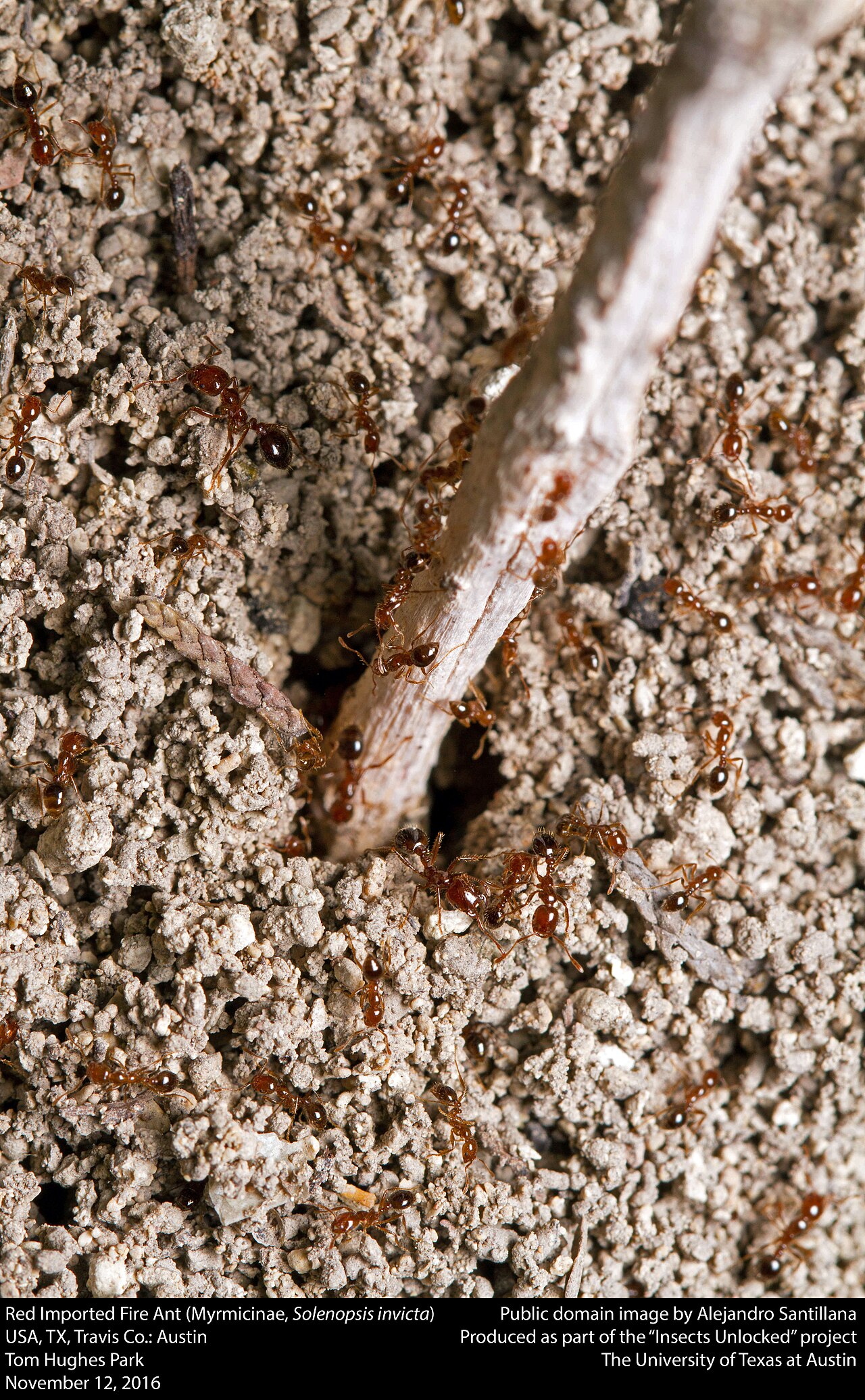
Red Imported Fire Ant (Solenopsis invicta)
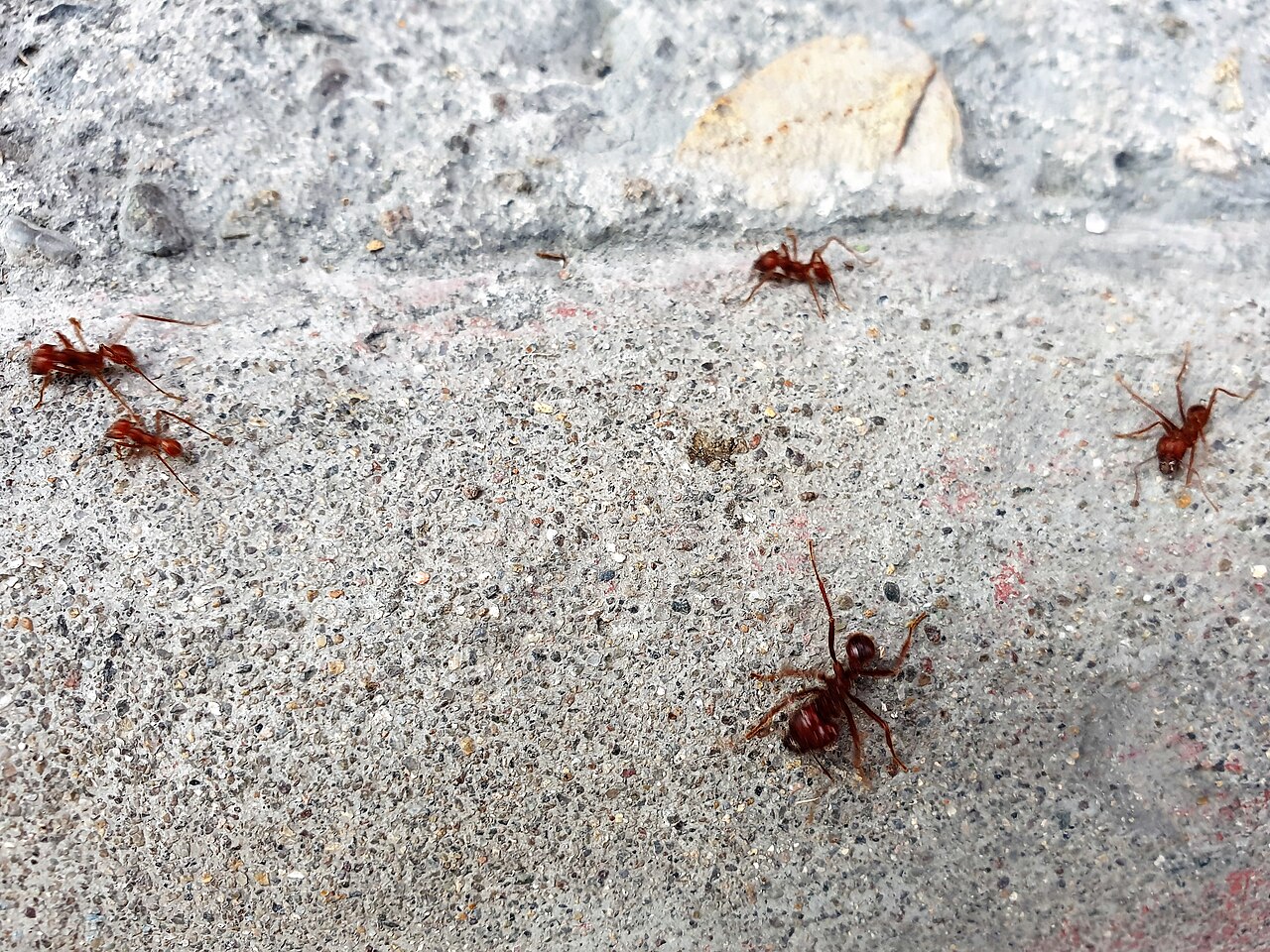
This is the red ant behind nearly every serious sting report in the country. Workers are copper red with a darker gloss to the rear body and come in mixed sizes in the same nest, 1/8 to 1/4 in long (3 to 6 mm). The giveaway is the mound: a loose dome of worked soil up to 18 in across (46 cm) with no visible entrance hole, which erupts with ants when you step near it.
Fire ants are native to the floodplains of Paraguay, northern Argentina and southern Brazil, and arrived in Mobile, Alabama in the 1930s in ship ballast. They now infest all or part of Texas, Oklahoma, Arkansas, Louisiana, Mississippi, Alabama, Georgia, Florida, South Carolina, North Carolina, Tennessee, Virginia, plus parts of California and New Mexico, under federal quarantine. Current extension guidance on identification and bait timing is published by NC State Extension.
Control is bait first, mound treatment second. Broadcast bait in spring and fall when ants are actively foraging, then treat individual mounds that remain, because digging or flooding a mound only moves the colony and risks a mass stinging event.
Southern Fire Ant (Solenopsis xyloni)
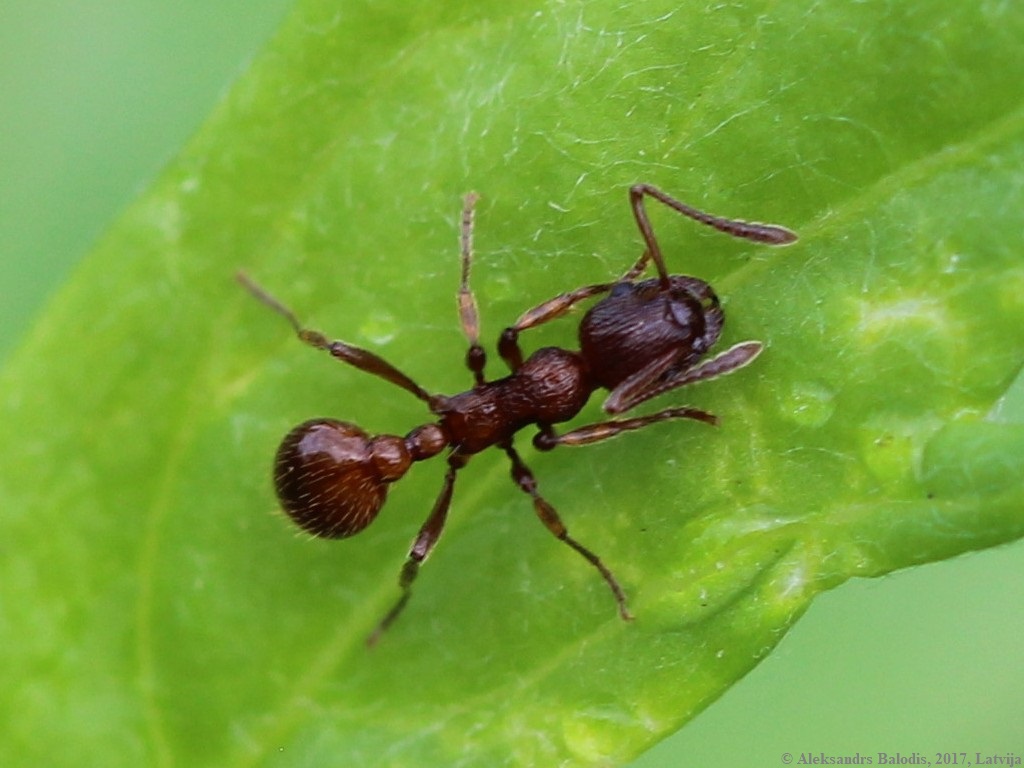
The native southern fire ant was the common stinging red ant across the South before the imported species displaced it. Workers have a distinctly red head and thorax with a blackish rear body, in the same size range as their imported relative, and they look like a two tone version of it.
It persists in drier country, from the Carolinas west through Texas to southern California, nesting in loose soil without a true dome, often under stones, boards and sidewalk edges. Colonies are smaller and less aggressive, and they forage more at night in hot weather.
Stings feel like a weaker version of the imported fire ant, with less chance of a pustule. In California and Arizona, where imported fire ants are patchy, a swarm of stinging red ants in a yard is often this species.
Red Harvester Ant (Pogonomyrmex barbatus)
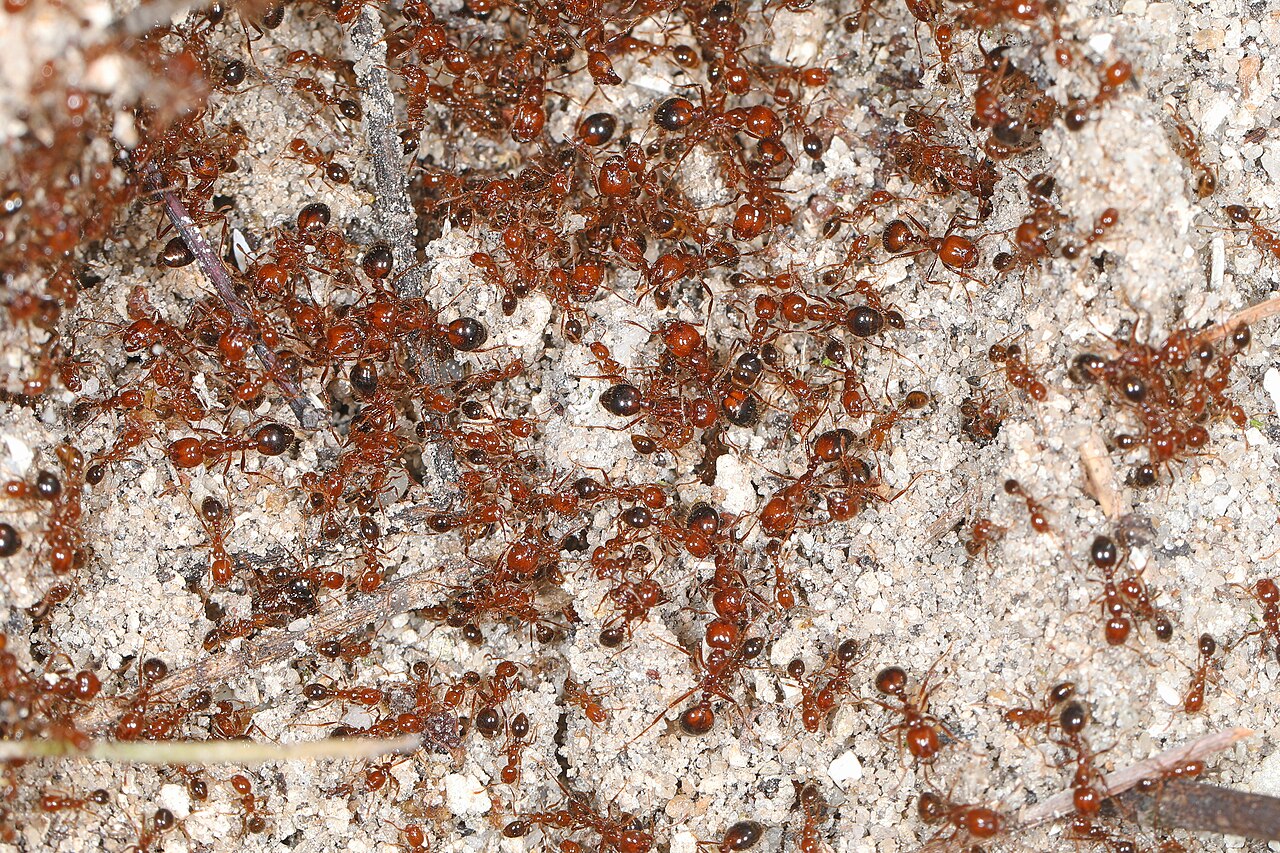
These are the big red ants people ask about. Workers are 1/4 to 1/2 in long (6 to 12 mm), rust red, with a square head, long hairs under the chin and a deliberate walk that looks nothing like fire ant panic. The nest is unmistakable: a cleared circle of gravel 3 to 10 ft across (1 to 3 m) with a single hole and trails of seed carrying workers.
They live in Texas, Oklahoma, New Mexico, Arizona, Kansas and Colorado, in short grass and desert, and they harvest seeds rather than hunt. Harvester ants are the ant of classic ant farms, and horned lizards depend on them almost entirely.
Large red ants are not harmful in the usual sense. They sting hard when you pin one against skin, and the venom can cause an impressive local swelling, but they do not swarm up a leg and they do not defend territory more than a few inches from the nest hole. Leaving a harvester nest alone is usually the right call.
European Fire Ant (Myrmica rubra)
In the Northeast, the Great Lakes region and the Pacific Northwest, where imported fire ants cannot survive the winter, stinging red ants in a lawn are usually Myrmica rubra. Workers are uniform red brown, about 1/6 in (4 to 5 mm), with two visible spines on the back of the thorax.
Nests are diffuse and hidden in grass, mulch, leaf litter and the soil under flowerpots, with no mound to spot, which is why people discover the colony with their hands while gardening. It is introduced from Europe and spreads mainly through nursery stock and moved soil.
The sting is sharp and immediate but milder than a fire ant sting, and multiple ants will sting at once when the nest is disturbed. Dense infestations in coastal Maine and Nova Scotia have made whole yards unusable, so early reports to a state extension office are worth filing.
Red Carpenter Ants and the Red Velvet Ant
Two red insects get called red ants and neither stings a lawn visitor. Red carpenter ants (Camponotus castaneus and the red and black Camponotus novaeboracensis) are large, 1/4 to 1/2 in (6 to 13 mm), smooth, with an evenly rounded thorax in profile, and they nest in damp or decaying wood rather than soil. Sawdust piles with coarse insect fragments below a window frame are their signature, and they signal a moisture problem in the structure.
The red velvet ant is not an ant at all. It is a wingless female wasp (Dasymutilla occidentalis), 1/2 to 3/4 in long (13 to 19 mm), covered in bright red orange fuzz, that walks alone across bare ground in the Southeast. Its sting is one of the most painful in North America, which earned it the name cow killer, though it is not dangerous to livestock or people.
Red and black is a warning pattern across unrelated groups, which is exactly why these mix ups happen. The same logic puts bold red and black on a red and black wasp, a red and black beetle, a red and black caterpillar and a red and black snake. Fuzzy, solitary and wandering means wasp, and smooth, in a trail, means ant.
Fire Ant Stings: What Works and What Does Not
Nothing neutralizes fire ant venom once it is in the skin. The alkaloid injected is not acid, so the household advice about baking soda, vinegar, bleach or meat tenderizer treats a chemistry problem that does not exist. What does help is cold: ice for ten minutes at a time, an oral antihistamine for the itch, and hydrocortisone cream on the welts.
Leave the pustule alone. It forms over 24 to 48 hours and is sterile at first, so popping it does nothing for the itch and opens the site to bacteria, which is how stings turn into cellulitis. Keep it clean and covered if it breaks on its own, and watch for spreading redness or fever.
Fire ant stings hurt out of proportion to their size because the venom is piperidine based and destroys cell membranes directly, triggering pain nerves and histamine release at once. That is also why dozens of stings on a child or a pet warrant a call to a doctor or vet, even without allergy.
Frequently Asked Questions
What are the big red ants called?
Large red ants in the Southwest and southern Plains are red harvester ants (Pogonomyrmex barbatus), 1/4 to 1/2 in long with a bare gravel nest. In the East, a big reddish ant indoors is usually a red carpenter ant. Neither forms the swarming mounds that fire ants do.
Are large red ants harmful?
Rarely. Harvester ants sting only when pressed against skin, and carpenter ants cannot sting at all. The harmful red ants are the small ones, 1/8 to 1/4 in, that pour out of a disturbed mound by the dozen. Size and aggression run in opposite directions here.
What is the deadliest ant ever?
By documented human deaths, the red imported fire ant leads, through anaphylaxis in sensitized people. The bulldog ants of Australia (Myrmecia pyriformis) have caused several fatalities and deliver a far stronger single sting. By venom toxicity alone, Pogonomyrmex harvester ants rank highest in North America.
How many people have been killed by fire ants?
There is no reliable national count, because deaths are recorded as anaphylaxis rather than by cause. Published case series document dozens of fatalities in the US since the 1960s, most in nursing homes or among people stung indoors while unable to escape. Against millions of stings a year, the risk per sting is very low.
Why do fire ant stings hurt so bad?
Their venom is about 95 percent piperidine alkaloids, which rupture cell membranes on contact and release histamine locally. That produces an immediate burn, then the itch, then the white pustule as dead tissue accumulates. Protein based wasp venoms hurt differently and fade faster.