Peregrine Falcon Sounds: 4 Calls, What Each Means, and How Females and Chicks Differ
Peregrine falcon sounds are loud, harsh and more varied than most people expect. The call you are most likely to hear is a rapid, scolding “kak-kak-kak-kak” that a peregrine falcon (Falco peregrinus) fires off when anything comes near its nest ledge. Around the nest you may also hear a long rising wail, a soft chipping between mates and, in late spring, the thin screaming of hungry chicks.
Which call you hear depends on season, time of day and who is calling. Females are larger than males and sound deeper and hoarser, while juveniles beg with a higher, thinner cry that carries across a city block. Here is each call, when it happens, who makes it and what you might be confusing it with.
Peregrine falcons make four main sounds: a harsh “kak-kak-kak” alarm cackle, a long rising wail used at the nest and in courtship, a soft “eechip” contact call between mates, and a high begging scream from chicks. Females sound deeper and hoarser than males, and juveniles sound thinner and more insistent than either adult.
| Sound | What it sounds like | Who makes it | When you hear it |
|---|---|---|---|
| Cackle (alarm) | Rapid “kak-kak-kak-kak” | Both adults, female louder | Intruder near the nest, March to July |
| Wail | Long, rising “waaaaik” | Both adults, mostly female | Courtship and food delivery |
| Eechip | Soft two-note “ee-chip” | Both adults, often the male | Mate greeting at the ledge |
| Begging scream | Thin, drawn-out “kee-kee-kee” | Chicks and juveniles | May to August |
| Creaky chitter | Low rasping chatter | Both adults | Close-range nest exchanges |
| Silence | No call at all | Hunting birds | Most of the day away from the nest |
The Cackle: The Alarm Call You Hear Most
The cackle is a fast, harsh “kak-kak-kak-kak” and it is the sound most people mean by peregrine falcon sounds. A peregrine gives it when a hawk, crow, gull, person or drone comes too close to the nest, usually launching off the ledge as it calls. The tempo speeds up and the pitch rises as the bird gets more agitated, and it can run for ten seconds or more without a break.
The notes are sharp and evenly spaced, so the call carries from a skyscraper ledge or bridge girder down to the street. Both adults use it, but the female delivers a lower, rougher version. You hear it from March through July, when there are eggs or chicks to defend; a lone bird on a winter perch may go a whole day in silence.
The Wail: Long Calls at the Nest and in Courtship
The wail is a single, drawn-out, rising note, something like “waaaaik”, lasting about a second. Peregrines use it when they want something: a female wailing at an incoming male is asking for the prey he carries, and a bird wailing on an empty ledge is calling its mate back.
In late winter and early spring the wail is part of courtship. The pair trades wails while the male dives and rolls near the ledge, and the calls get louder as they settle on a nest scrape. The wail is the peregrine sound most often mistaken for a gull; the peregrine’s is thinner, drier and more nasal, with none of a herring gull’s laughing quality.
The Eechip: Soft Contact Calls Between Mates
The “eechip” is a quiet, two-syllable note used at close range when the pair is together on the ledge. It is the greeting of a male arriving with food and the answer a female gives as she takes it. Nest camera viewers hear it constantly; people on the ground almost never do.
Alongside it you may hear a creaky, rasping chitter as the two birds bow to each other over the scrape. These close-range calls are the clearest sign that a ledge is an active nest and not just a favored perch, and on a nest cam the eechip is the most reliable cue that a feeding is about to start.
Female vs. Male Peregrine Falcon Sounds
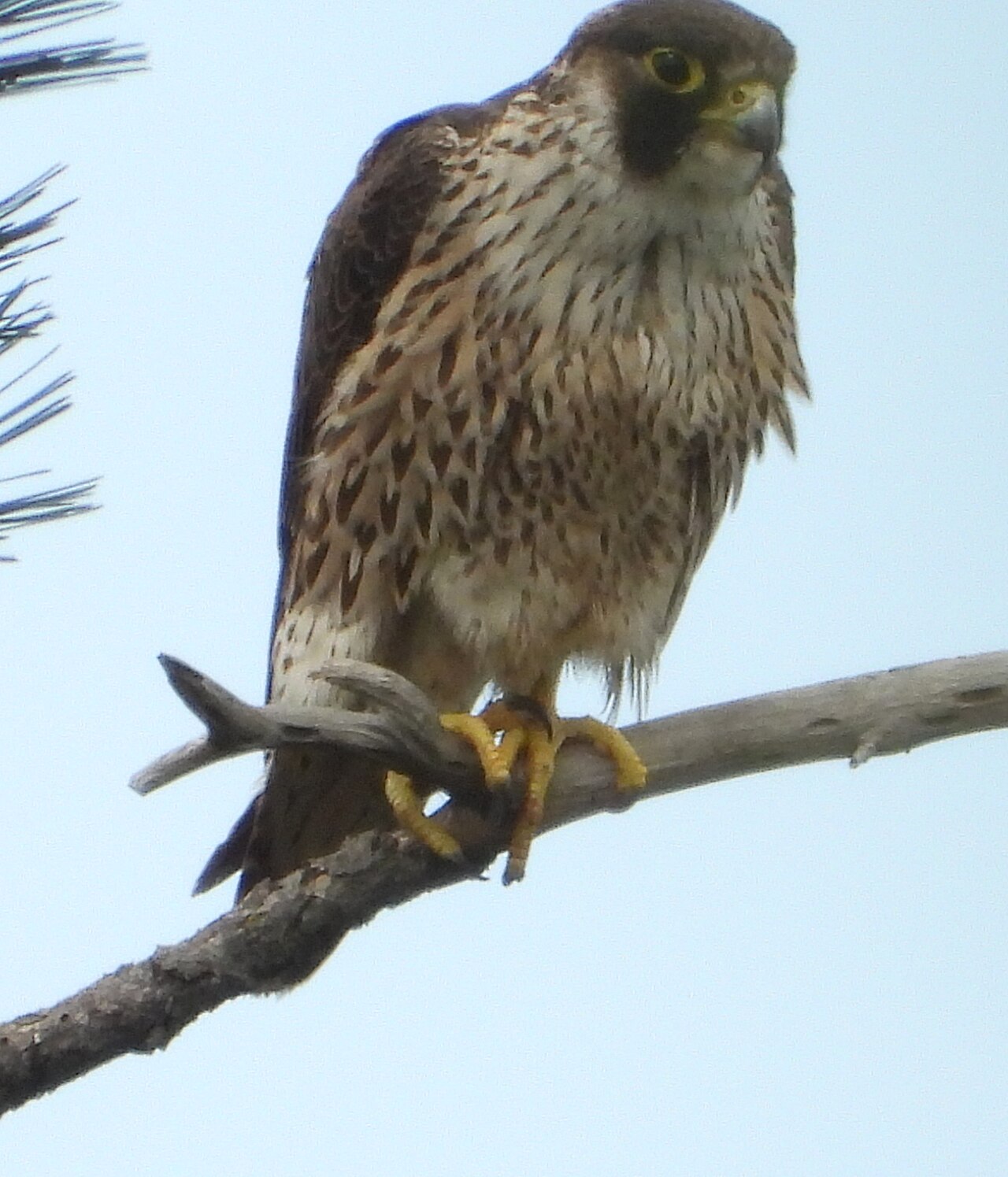
Female peregrine falcon sounds are lower, hoarser and louder than the male’s, because the female is noticeably bigger. The same cackle comes out as a deep, rough “kak” from her and a sharper, higher “kek” from him. Once you know a pair, you can usually tell who is calling without seeing the bird.
The female also does most of the talking at the nest. She sits the longer incubation shifts, guards the chicks and wails at the male for food, so the loud calls that reach the ground are more often hers. The male’s voice is heard mostly in courtship flights and food deliveries. If a peregrine call strikes you as unusually deep and raspy, you are almost certainly hearing the female.
Baby Peregrine Falcon Sounds: Begging Calls
Baby peregrine falcon sounds are high, thin, repeated screams that can go on for minutes whenever an adult is in sight. New chicks peep softly, but within a couple of weeks the begging call becomes a loud “kee-kee-kee” that echoes between buildings and makes people ask what the screaming bird is.
Begging peaks in the weeks around fledging, roughly late May through July in most of the United States. Fledged juveniles chase their parents through the air screaming for food and keep it up for weeks until they can hunt. Juvenile calls are higher and less structured than adult calls, and young birds also practice cracked, clumsy versions of the cackle and wail until their first autumn.
When and Where You Hear Peregrine Falcon Sounds
Peregrine falcon sounds are concentrated at the nest and in the breeding season, from courtship in February or March to the last begging juveniles in August. A pair on a bridge, cliff, cathedral or office tower is loud in spring and early summer and nearly silent the rest of the year. Hunting birds away from the nest rarely call.
Within the day, peregrines are most vocal in early morning and late afternoon, their main hunting windows, though the cackle can come at any daylight hour. Peregrines are not night birds, so a harsh call after dark is far more likely an owl, a gull or a heron. You can hear them across the US wherever there are tall structures or cliffs, and the species is protected under federal law, which is why so many urban nests are monitored.
Sounds You Might Confuse With a Peregrine Falcon
The peregrine’s cackle is most often confused with the American kestrel (Falco sparverius), which gives a similar but much higher and faster “klee-klee-klee”. A kestrel is about the size of a mourning dove, so its alarm sounds tinny next to the peregrine’s rough bark. Our guide to falcon sounds compares the whole family side by side.
Merlins (Falco columbarius) sound closer, with a rapid chattering “ki-ki-ki” intermediate in pitch, and they turn up in cities in migration and winter. Cooper’s hawks have a slower, more even “cak-cak-cak”. Gulls account for most mistaken wails on bridges, and blue jays imitate raptor calls well enough to fool experienced birders, so a falcon call from inside a suburban tree deserves a look for a jay first.
Peregrine Falcon Sounds on Buildings, Rooftops and Balconies
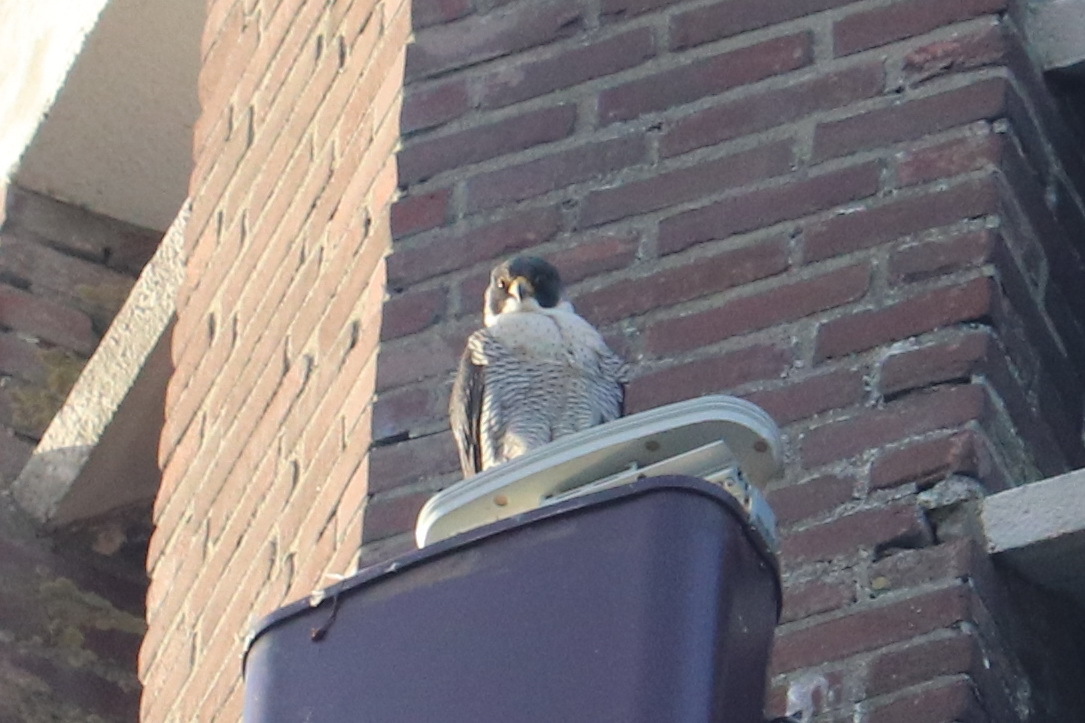
If you hear loud cackling or screaming from the roof of your building between March and July, a peregrine pair may be nesting on a ledge above you. Peregrines treat tall buildings as cliffs and use window ledges, planters, rooftop gravel and bridge girders as nest sites. The noise peaks at feeding time and whenever a crow or gull passes.
Peregrines do not get into attics, walls or chimneys, and they do not call at night. Scratching or squeaking inside the structure after dark is more likely rodents or bats, and a screech or long trill from the dark is more likely a barn owl or a barred owl. Below a peregrine ledge you may find pigeon feathers and wings; that is normal. Nesting peregrines and their eggs are protected under the Migratory Bird Treaty Act, so leave the ledge alone and contact your state wildlife agency if the nest is on your property.
How to Tell If a Bird Is a Falcon
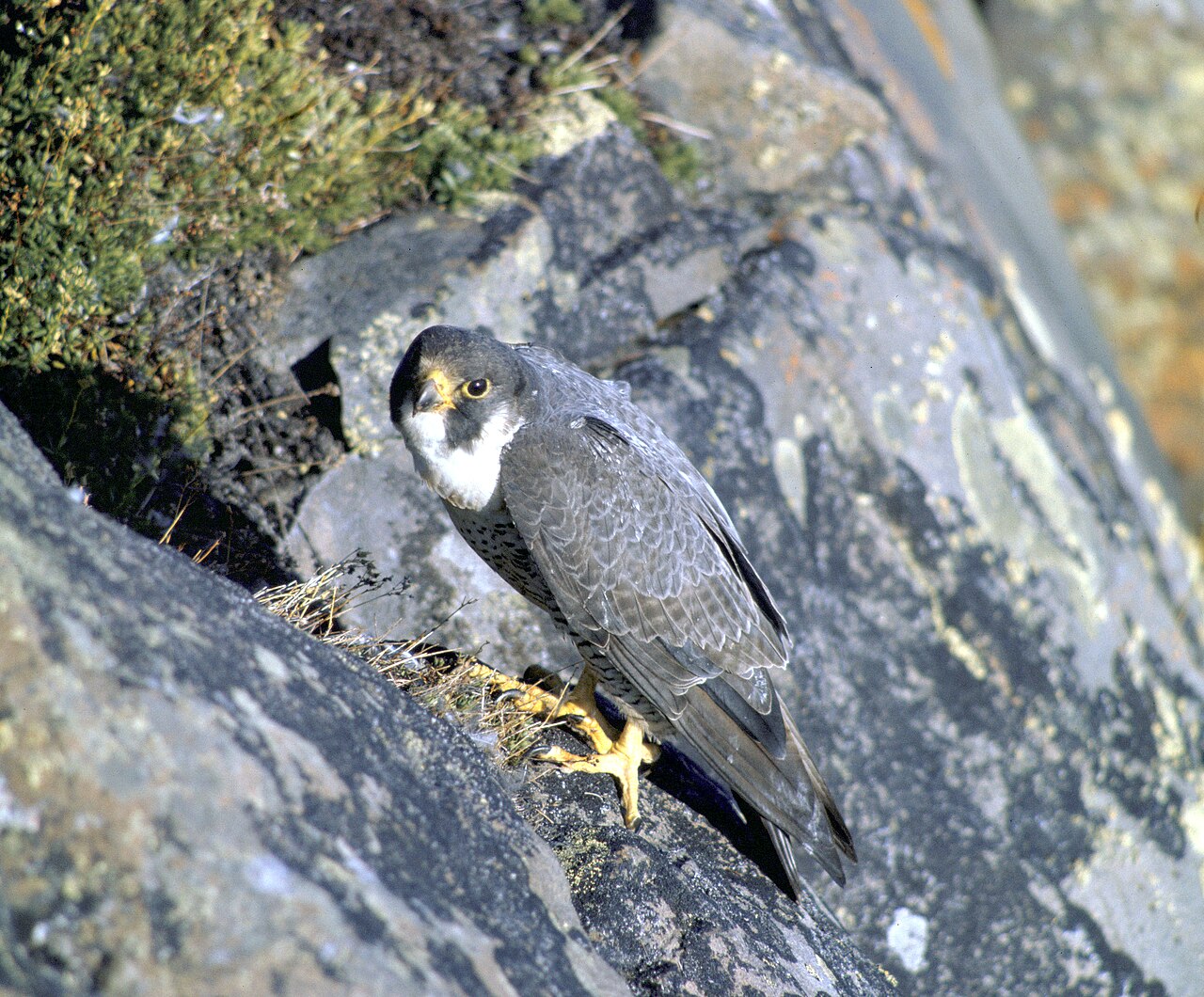
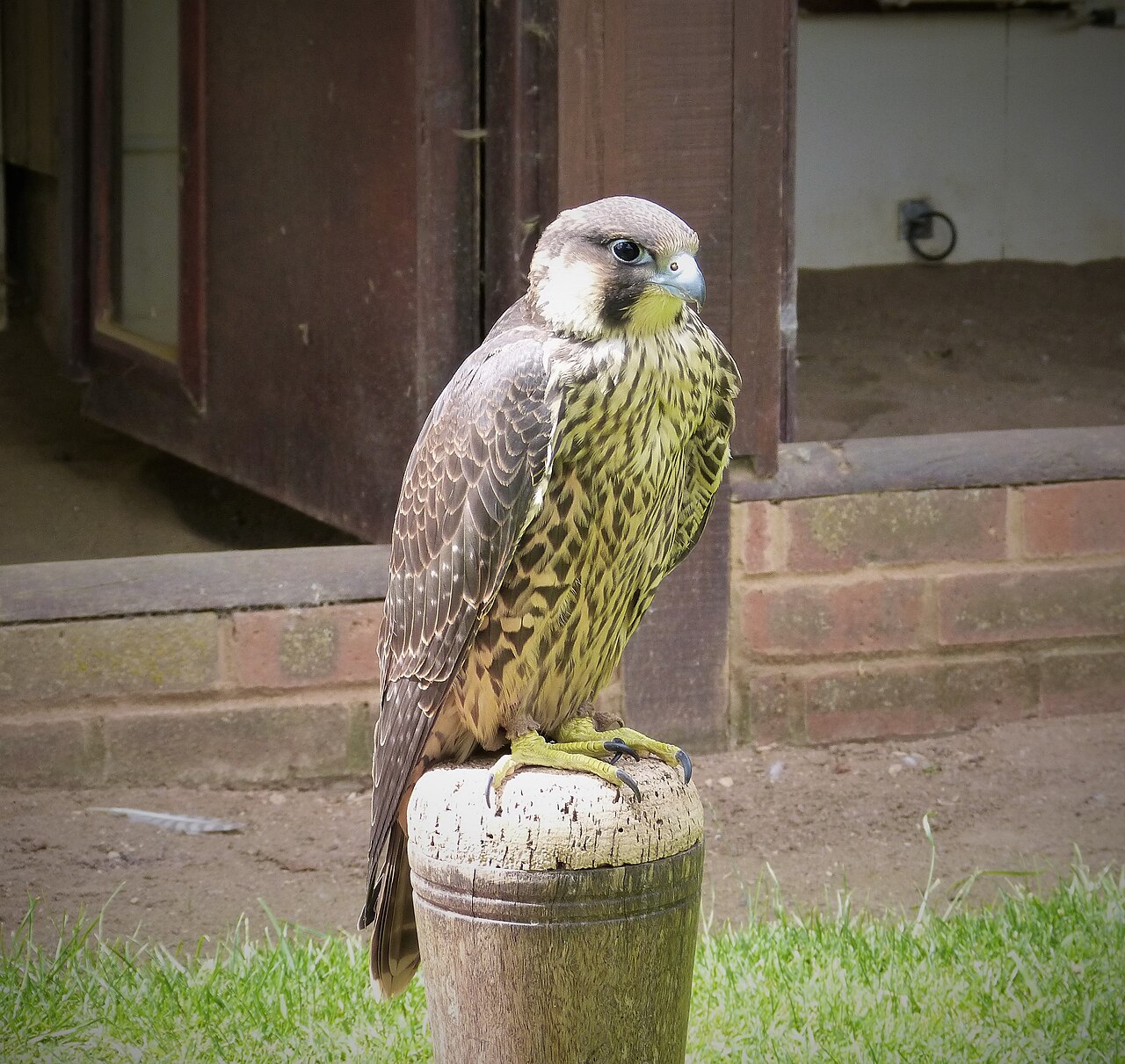
A bird is a falcon if it has long, pointed wings swept back like a boomerang, a narrow tail and a fast, stiff, rowing wingbeat with little gliding. Hawks have broader, rounder wings and soar more. Up close, a peregrine shows a slate-blue back, barred white belly and a bold dark helmet with a thick sideburn stripe; juveniles are brown above and streaked below.
Sound is the final check. An accelerating “kak-kak-kak” from a cliff, bridge or tall building means peregrine, not hawk, and it rules out the much larger bald eagle, whose call is a weak chirping whistle that surprises most people.
How Do Peregrine Falcons Behave?
Peregrine falcons are specialist bird hunters that spend most of the day on a high lookout and then launch into a steep dive, called a stoop, to strike a pigeon, duck, shorebird or songbird in mid-air. Dive speeds reported for the stoop are higher than for any other animal, while level flight is far slower, about the pace of a fast pigeon.
Pairs are territorial and typically return to the same ledge year after year. They build no nest; the female scrapes a shallow bowl in gravel and lays her eggs in spring, both adults incubate, and the male does most of the hunting while the chicks are small. Away from the nest, peregrines are quiet and easy to overlook, and they are not aggressive toward people unless someone climbs to the ledge.
Where to Hear Peregrine Falcon Recordings
The easiest way to learn peregrine falcon sounds is to listen to real recordings. The two best free collections are xeno-canto, which holds hundreds of peregrine recordings tagged by call type and location, and the Macaulay Library at the Cornell Lab of Ornithology, which also supplies the sounds on All About Birds.
Live nest cameras are even better for learning who makes which sound, because you can see the bird as it calls. Dozens of US cities run peregrine cams on bridges, towers and university buildings from March through July, and the notes often label the female and male for you.
Frequently Asked Questions
What does it mean when a peregrine falcon visits you?
In practical terms, a peregrine visiting your building or yard means there is a high perch, a ledge or plenty of pigeons nearby. In symbolic traditions the falcon stands for speed, focus and seeing the bigger picture, and many people read a visit as a nudge to act decisively on something they have been circling.
What eats a peregrine falcon?
Adult peregrines have very few predators. Great horned owls take adults and chicks at the nest, and golden eagles occasionally kill peregrines in the West. Eggs and chicks on accessible ledges can be lost to raccoons, ravens and gulls. Historically the biggest threat was the pesticide DDT, which thinned eggshells before it was banned.
Can a falcon lift a dog?
No. A peregrine typically takes prey it can carry, mostly birds up to about the size of a duck, and it cannot lift a dog, even a toy breed. Reports of falcons carrying off pets almost always involve larger birds or a misidentification.
Who would win in a fight, a peregrine falcon or a golden eagle?
A golden eagle would win. It is several times heavier than a peregrine and has far more powerful talons. Peregrines avoid fights with eagles and instead harass them from above with their speed, cackling the whole time, which is why you sometimes see a small falcon diving at an eagle over a cliff.
How much does a falcon cost for falconry?
In the US you cannot simply buy a wild peregrine. Falconry requires state and federal permits, a sponsor and an apprenticeship, and most apprentices start with a red-tailed hawk or kestrel. Captive-bred peregrines from licensed breeders are typically priced in the low thousands of dollars, plus housing, equipment and food.
How many mph does a peregrine falcon fly?
In level flight a peregrine typically cruises at roughly the speed of a fast pigeon. It is in the hunting stoop that it becomes the fastest animal on record; reported dive speeds vary by study, but they are consistently far above anything a bird reaches in flapping flight.