Seeing a Yellow Bird Meaning: Spiritual Signs and Rarity
Spiritually, seeing a yellow bird points to joy, light and a fresh start. The color matches sunlight and spring, and a bright bird that appears on a gray day feels like a nudge to lift your head. What the bird does matters as much as its color. A goldfinch at the feeder, a warbler in the hedge and a canary loose in the kitchen are three different moments.
The seeing a yellow bird meaning also has a practical half. You want to know which bird it was, whether it is rare, and what to do if it ends up inside. The answers below take the sign first and the bird second, because the bird shapes the sign.
As a sign, a yellow bird stands for joy, warmth and a new beginning, a cue to notice what is going well. In the US the bird is almost always an American Goldfinch or a Yellow Warbler. A bright yellow bird in January or inside your house is the unusual case.
What Does Seeing a Yellow Bird Mean?
Seeing a yellow bird means a moment of joy and light, and the bird invites you to take it that way. Yellow is the color of the sun, of spring growth and of ripe seed heads. A small bright bird that flashes across your path asks you to look up from the task in front of you.
Yellow bird symbolism as a color theme reaches into love, friendship and optimism. A sighting adds context to that theme. A bird at your feeder in summer points to abundance and a settled season. A bird that crosses your path on a hard day points to relief and a lighter mood ahead.
Which Yellow Birds Are You Most Likely to See?
The American Goldfinch (Spinus tristis) is the yellow bird you are most likely to see, followed by the Yellow Warbler (Setophaga petechia). Goldfinches visit feeders across the country, and many stay through winter. Yellow Warblers arrive in spring and nest in willows and shrubby edges near water. In the West, the Western Meadowlark (Sturnella neglecta) shows its yellow breast from fence posts and open grassland.
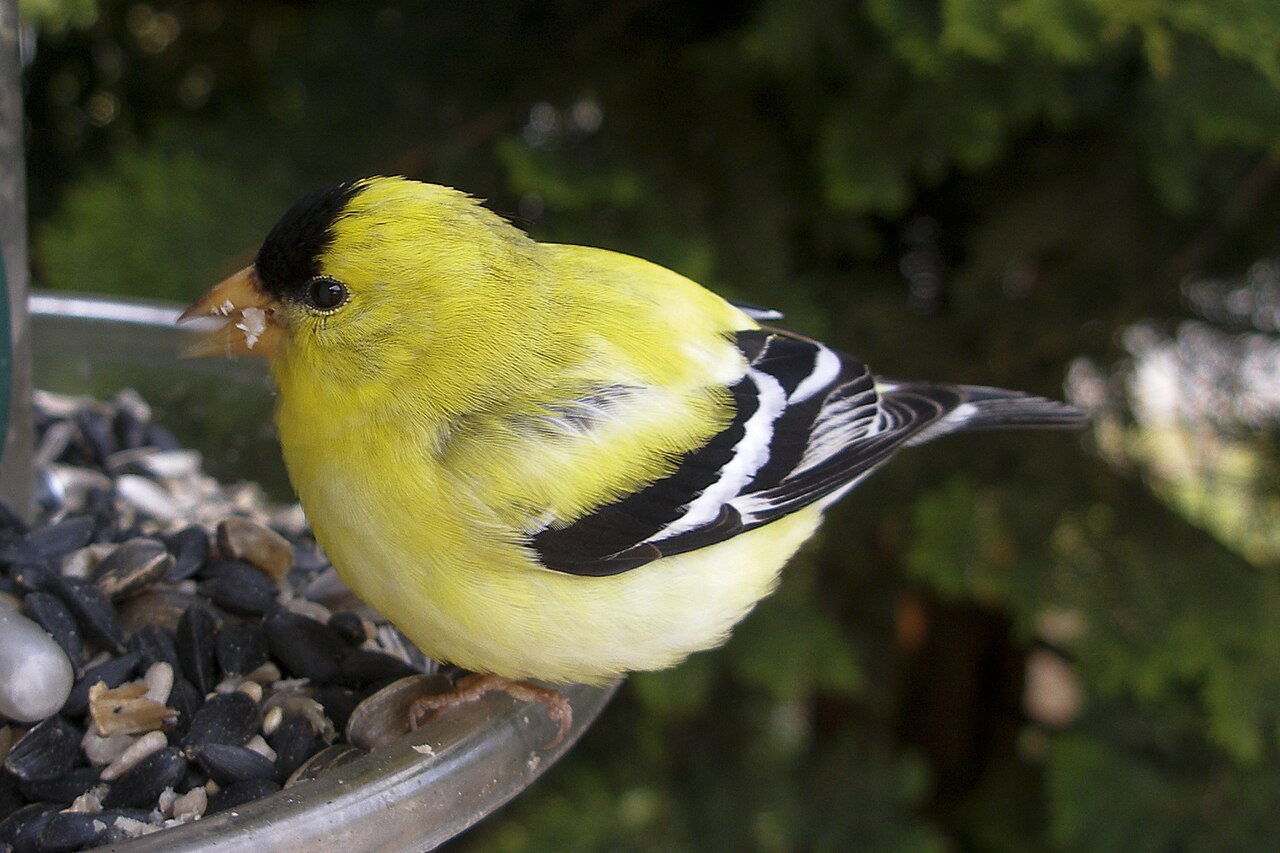
Types of yellow birds also include the Evening Grosbeak (Coccothraustes vespertinus), a stocky finch that shows up at northern feeders in some winters and skips others. The goldfinch causes most of the confusion. In winter the male molts into a dull olive brown and looks like a different bird.
Backyard birds with yellow bellies add a few more candidates, such as the Western Kingbird (Tyrannus verticalis) on summer wires across the open West. Truly rare is the all-yellow color variant. A yellow Northern Cardinal (Cardinalis cardinalis) carries a pigment mutation.
| Bird | Where and when in the US | How common | Field mark |
|---|---|---|---|
| American Goldfinch | Nationwide, all year in much of the range | Very common at feeders | Black wings with white bars |
| Yellow Warbler | Wet thickets, spring and summer | Common in season | All yellow, red streaks on male |
| Western Meadowlark | Western grassland and farmland | Common in open country | Black V on yellow breast |
| Evening Grosbeak | Northern forests and feeders in winter | Uncommon, varies by year | Huge pale bill, yellow brow |
| Escaped canary | Anywhere near homes | Occasional | Tame, no wing bars |
| Yellow Northern Cardinal | Anywhere in the cardinal’s range | Very rare mutation | Cardinal crest in yellow |
Why Does a Goldfinch Visit Your Yard?
A goldfinch visits your yard for seed. It favors thistle, sunflower, coneflower and the nyjer seed sold for tube feeders. The Cornell Lab of Ornithology calls it one of the strictest vegetarians in the bird world. A garden with seed heads left standing in fall draws goldfinches better than a tidy one.
Goldfinches travel in flocks. You can spot them in the air by their bouncing, roller-coaster flight and the call they give on each rise. Once the flock trusts the spot, it returns daily.
Practically, a goldfinch visit tells you the food and water in your yard are right. Keep feeders clean and dry, because wet nyjer spoils fast.
What Does the Bible Say About a Yellow Bird?
The Bible never speaks of a yellow bird, and no verse gives yellow feathers a meaning. The closest image is Psalm 68:13, where the King James Version pictures a dove with wings covered in silver “and her feathers with yellow gold”, a poetic image of beauty after hardship, not a teaching about birds. Any biblical reading of a yellow bird rests on what Scripture says about birds in general.
The clearest passage is Matthew 10:29. Jesus tells his followers that two sparrows sell for a penny, yet not one falls to the ground apart from the Father. The point is care, not color. A small, ordinary bird stands for the attention God gives to small, ordinary lives.
The yellow finch Jesus legend belongs to the European Goldfinch (Carduelis carduelis), not the American bird. Renaissance painters placed that finch in the hands of the Christ child as a sign of the Passion.
What Should You Do If a Yellow Bird Gets in the House?
If a yellow bird gets in the house, open one window or door wide and make it the brightest spot in the room. Close inside doors so the bird cannot fly deeper into the house. Put cats and dogs in another room first.
Do not chase the bird and do not grab it. A panicked bird flies into glass and walls, and a bird held in the hand can die of stress. Turn off the lights and draw curtains on the closed windows. A wild bird heads for the open daylight once the room calms. A bird in the house carries its own spiritual meaning, and that question can wait until the bird is outside.
A bright yellow bird that seems tame may be someone’s pet. Canaries (Serinus canaria domestica) and yellow budgerigars (Melopsittacus undulatus) escape from homes and land wherever they find people. A bird that walks toward you, perches on furniture or ignores the open window is a lost pet. Offer water, a dish of seed and a quiet room, then post it with local lost pet groups.
What Does It Mean If You Find a Dead Yellow Bird?
A dead yellow bird marks an ending, the close of a bright season, and safe handling comes before the meaning. Bird flu is caused by avian influenza A viruses that spread mainly between birds, not people, says the CDC. People rarely get it, and cases mostly follow close, unprotected exposure to infected birds or other animals.
Most common songbirds, like cardinals or blue jays, have not been reported to get infected. Still, never pick up a dead bird with bare hands. Use gloves or a plastic bag turned inside out, then wash your hands. If you find several dead birds in one place, call your state wildlife agency.
The loss itself points to release. A bright bird returning to the ground closes a chapter of easy days and makes room for the next one.
Does a Yellow Bird Mean Something Different by Season?
Yes, the season changes what a yellow bird points to. A spring sighting points to a fresh start, since male goldfinches regain their gold and warblers return from the tropics. A summer sighting points to abundance and a full table. A bright yellow bird in deep winter is the rare one, and it points to light in a dark stretch.
Behavior adds a second layer. A bird that lingers near you points to staying with a plan. A bird that crosses your path and leaves points to a brief chance worth taking. Two or more birds together point to company and shared good news.
Frequently Asked Questions
Is it rare to see a yellow finch?
No. The American Goldfinch is one of the most common feeder birds in the US, and it stays year-round across much of the country. A bright yellow bird in January is the rarer sight, and it is more likely a Pine Warbler (Setophaga pinus) at a suet feeder in the Southeast or an escaped canary than a goldfinch.
What does it mean if a goldfinch visits you?
A goldfinch visit means your yard offers the seed it lives on, and it points to a good season ahead. Goldfinches are among the latest nesting birds in North America and raise young into August, when thistle seed ripens.
Does God send birds as signs?
Yes, in single moments. The Bible reports God working through birds, but it sets no rule that birds are signs. A dove returns to Noah with an olive leaf in Genesis 8, and Noah knows the waters have gone down. The Spirit descends like a dove in Matthew 3:16, and ravens feed Elijah in 1 Kings 17.
Why does a yellow bird keep tapping at my window?
A yellow bird tapping at your window is fighting its own reflection. Males defend territory in spring and early summer and treat the image in the glass as a rival. Decals, soap streaks or a screen on the outside of the pane break the reflection and end the tapping within days.
How can you tell a goldfinch from a canary?
A goldfinch has black wings with white bars, and the summer male wears a black cap. A pet canary is plain yellow or patched, with no cap and no white wing bars.
Sources
- Cornell Lab of Ornithology, American Goldfinch Overview
- Cornell Lab of Ornithology, Yellow Warbler Overview
- Cornell Lab of Ornithology, Western Meadowlark Overview
- CDC, Bird Flu Virus Transmission