Female Northern Flicker: Identification Guide
A female northern flicker looks almost identical to the male but lacks the mustache mark, the malar stripe, that males show beside the bill. In the eastern yellow-shafted form, the male has a black mustache stripe, while the female has none, making this the quickest way to tell the sexes apart. This guide covers how to identify a female northern flicker, how she differs from the male, what she looks like, and where to see her.
| Feature | Female Northern Flicker |
|---|---|
| Mustache stripe | Absent (male has it) |
| Overall color | Brown, spotted, barred back |
| Chest mark | Black crescent bib |
| Underparts | Buff with black spots |
| Rump | White, obvious in flight |
| Wing and tail shafts | Yellow (east) or red (west) |
How to Identify a Female Northern Flicker
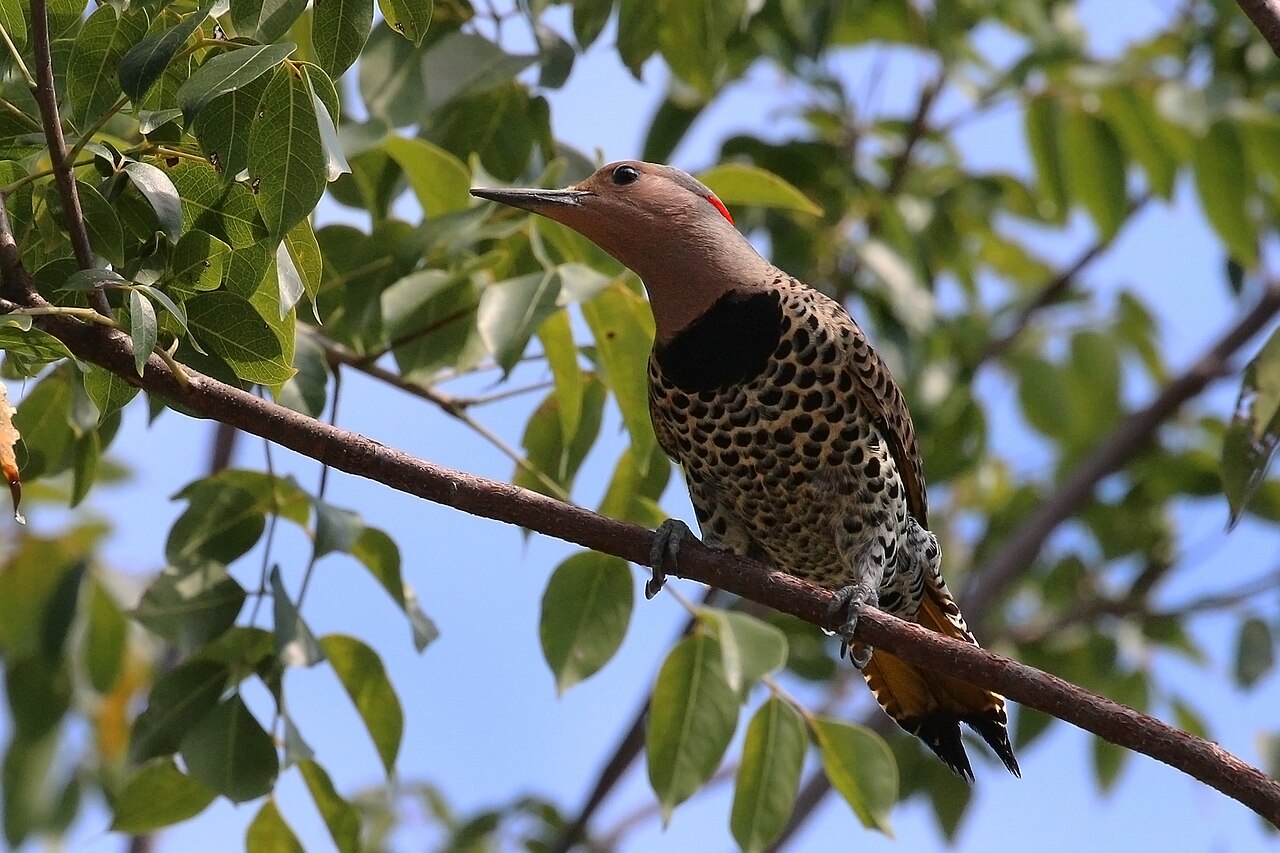
Identifying a female northern flicker starts with the mustache mark, the key difference between the sexes. The northern flicker is a large brown woodpecker with a spotted and barred plumage, and both males and females share most of their striking pattern, including a black crescent bib on the chest, buff underparts covered in bold black spots, a brown back with black bars, and a bright white rump that flashes in flight. The clearest way to identify a female is by what she lacks, since in the eastern yellow-shafted form the male has a black mustache stripe, called a malar stripe, extending back from the base of the bill, while the female has no mustache stripe at all. In the western red-shafted form, the male’s mustache is red and the female again lacks it. Both sexes of the yellow-shafted form also show a red crescent on the nape. Because the female is otherwise nearly identical to the male, the absence of the mustache is the feature to look for, part of the wider group covered in our guide to types of woodpeckers.
Female vs Male Northern Flicker
The difference between a female and male northern flicker comes down to one main field mark. The male has a bold mustache stripe beside the bill, black in the eastern yellow-shafted form and red in the western red-shafted form, which is obvious at close range. The female lacks this mustache entirely, showing a plain face beside the bill. Aside from the mustache, the two sexes are remarkably similar, both sharing the brown barred back, the buff underparts with black spots, the black chest crescent, the white rump, and the colorful yellow or red shafts in the wings and tail. This makes the northern flicker one of the easier woodpeckers to sex once you know to check for the mustache. Both males and females feed on the ground, an unusual habit for a woodpecker, searching for ants and beetles. Learning this single difference lets you confidently tell female from male flickers, as explored in our guide to the downy woodpecker.
What Does a Female Northern Flicker Look Like?
A female northern flicker is a large, handsome brown woodpecker with a richly patterned plumage. Her back and wings are grayish-brown with bold black bars, and her underparts are a warm buff color heavily marked with round black spots. Across her chest she wears a distinctive black crescent, like a bib, and her face is plain beside the bill, lacking the mustache mark of the male. In the eastern yellow-shafted form, she shows a soft gray crown, a tan face, and a red crescent on the back of the neck, and when she flies, the undersides of her wings and tail flash bright yellow, along with a conspicuous white rump patch. In the western red-shafted form, the shafts are salmon-red instead of yellow. She is larger than most backyard woodpeckers, roughly the size of a mourning dove, with a slightly curved bill. This beautiful, ground-feeding woodpecker is a delight to see, as explored in our guide to the red-bellied woodpecker.
Where to See Female Northern Flickers
Female northern flickers can be found across a wide range of habitats throughout North America, wherever the species occurs. Northern flickers favor open woodlands, forest edges, parks, yards, and areas with scattered trees and open ground, since they feed heavily on ants and other insects found on the ground. Unlike most woodpeckers, flickers are often seen foraging on lawns and in open areas, hopping about as they probe the soil, so a female may be spotted feeding on the ground as readily as on a tree trunk. They also visit backyards and will come to suet feeders, especially in the cooler months. In the East, the yellow-shafted form is widespread, while in the West, the red-shafted form predominates. Flickers nest in cavities they excavate in dead trees, and they may use nest boxes. Because they are common, widespread, and often feed in the open, female northern flickers are among the more observable woodpeckers, as detailed in our guide to attracting birds.
Female Northern Flicker Behavior
The female northern flicker shares the species’ fascinating and unusual behavior, which adds to the pleasure of watching her. According to the Cornell Lab of Ornithology, the northern flicker is unusual among woodpeckers for spending much of its time feeding on the ground, where ants are a favorite food. A female flicker may often be seen hopping about on lawns and open ground, probing the soil with her slightly curved bill and using her long, sticky tongue to lap up ants and beetles, a very different sight from a woodpecker hammering on a trunk. Like the male, she also drums on resonant surfaces to communicate and claim territory, and she helps excavate a nest cavity in a dead or dying tree, where both parents share incubation and care of the young. In flight, her bounding, undulating path and flashing white rump make her easy to recognize. This ground-feeding, ant-loving behavior makes the female northern flicker a distinctive and engaging bird, as explored in our guide to the female cardinal.
The Two Forms of Northern Flicker
Female northern flickers, like males, come in two regional forms that were once considered separate species. The yellow-shafted form occurs across the eastern and northern parts of the range, and in this form the undersides of the wings and tail are bright lemon-yellow, the face is grayish-tan, and both sexes show a red crescent on the nape. The red-shafted form occurs in the West, and in this form the wing and tail shafts are salmon to reddish, the face pattern differs, and there is no red nape crescent. Females of the yellow-shafted form lack the black mustache of their males, and females of the red-shafted form lack the red mustache of their males, so in both forms the plain face beside the bill marks the female. Where the two forms meet, on the Great Plains, they interbreed, producing birds with intermediate features. Knowing which form occurs in your region helps you interpret a female flicker’s colors, as explored in our guide to the female red-winged blackbird.
Appreciating Female Northern Flickers
Female northern flickers are a rewarding bird to appreciate, both for their beauty and for their behavior. Learning to recognize a female by her plain face, and to enjoy her rich spotted and barred plumage, adds a rewarding dimension to backyard birding. Watching a female flicker feed on the ground, an unusual sight for a woodpecker, or flash her bright rump and colorful wing linings in flight, is a treat, and noticing which regional form occurs in your area deepens your understanding. Because flickers are common, widespread, and often feed in the open, they offer excellent chances to observe woodpecker behavior up close. Taking the time to watch a female northern flicker and appreciate her subtle differences from the male makes birding more engaging and connects you to the wider world of woodpeckers across the continent.
Related reading: Female Yellow Warbler.
Frequently Asked Questions
How can you tell if a northern flicker is female?
A female northern flicker lacks the mustache stripe beside the bill that males have. In the eastern yellow-shafted form, males have a black mustache and females have none.
What is the difference between a male and female northern flicker?
The male has a mustache stripe beside the bill, black in the East or red in the West, while the female lacks it. Otherwise the two sexes look nearly identical.
What does a female northern flicker look like?
She is a large brown woodpecker with a barred back, buff underparts with black spots, a black chest crescent, a white rump, and yellow or red flashes in the wings and tail.
Do female northern flickers have red on the head?
In the eastern yellow-shafted form, both males and females have a red crescent on the back of the neck. The female lacks the mustache mark that the male shows.
Do female flickers feed on the ground?
Yes, both female and male northern flickers often feed on the ground, an unusual habit for a woodpecker, searching for ants and beetles, their favorite foods.
Are female northern flickers colorful?
Yes, female northern flickers are colorful, with a spotted buff breast, barred brown back, black chest crescent, white rump, and bright yellow or red wing and tail shafts.
Where can you see a female northern flicker?
Female flickers live in open woodlands, forest edges, parks, and yards. They often feed on the ground on lawns and visit suet feeders, especially in the cooler months.