Gray Catbird: Identification, Sound, and Behavior Guide
The gray catbird (Dumetella carolinensis) is a slate-gray songbird best known for its unmistakable call: a nasal, whining “mew” that sounds remarkably like a cat, which is exactly where its common name comes from. Beyond the cat-like call, gray catbirds are accomplished mimics and members of the same family as mockingbirds and thrashers, capable of stringing together an enormous variety of borrowed sounds into a long, rambling song. Common in dense shrubby thickets across most of the eastern and central United States, catbirds are more often heard than seen, preferring to stay hidden in cover rather than perch in the open, which makes learning the call an especially rewarding shortcut for identification.
| Quick Reference | Detail |
|---|---|
| Length | 8.3 to 9.4 inches |
| Wingspan | 8.7 to 11.8 inches |
| Color | Overall slate gray with a black cap and rusty undertail patch |
| Signature call | A cat-like “mew” |
| Family | Mimidae (mockingbirds and thrashers) |
| Diet | Insects and fruit, shifting seasonally |
| Habitat | Dense shrubby thickets, forest edges, gardens |
How to Identify a Gray Catbird
The gray catbird is, true to its name, almost entirely a uniform slate gray from head to tail, with a neat black cap on top of the head and a subtle but distinctive rusty-orange patch tucked under the tail, visible mainly when the bird flicks or raises its tail. It has a slim, long-tailed silhouette typical of the mimid family, often held cocked upward, and moves through dense shrubs and thickets with quick, low hops rather than long flights across open space, quite different from the constant open-perch tail-wagging habit of small flycatchers. Its plain coloring means catbirds are frequently overlooked visually, but the call almost always gives them away first, much like how a hidden common grackle flock is often heard chattering long before it comes into view.
The Cat-Like Call That Gives It Its Name
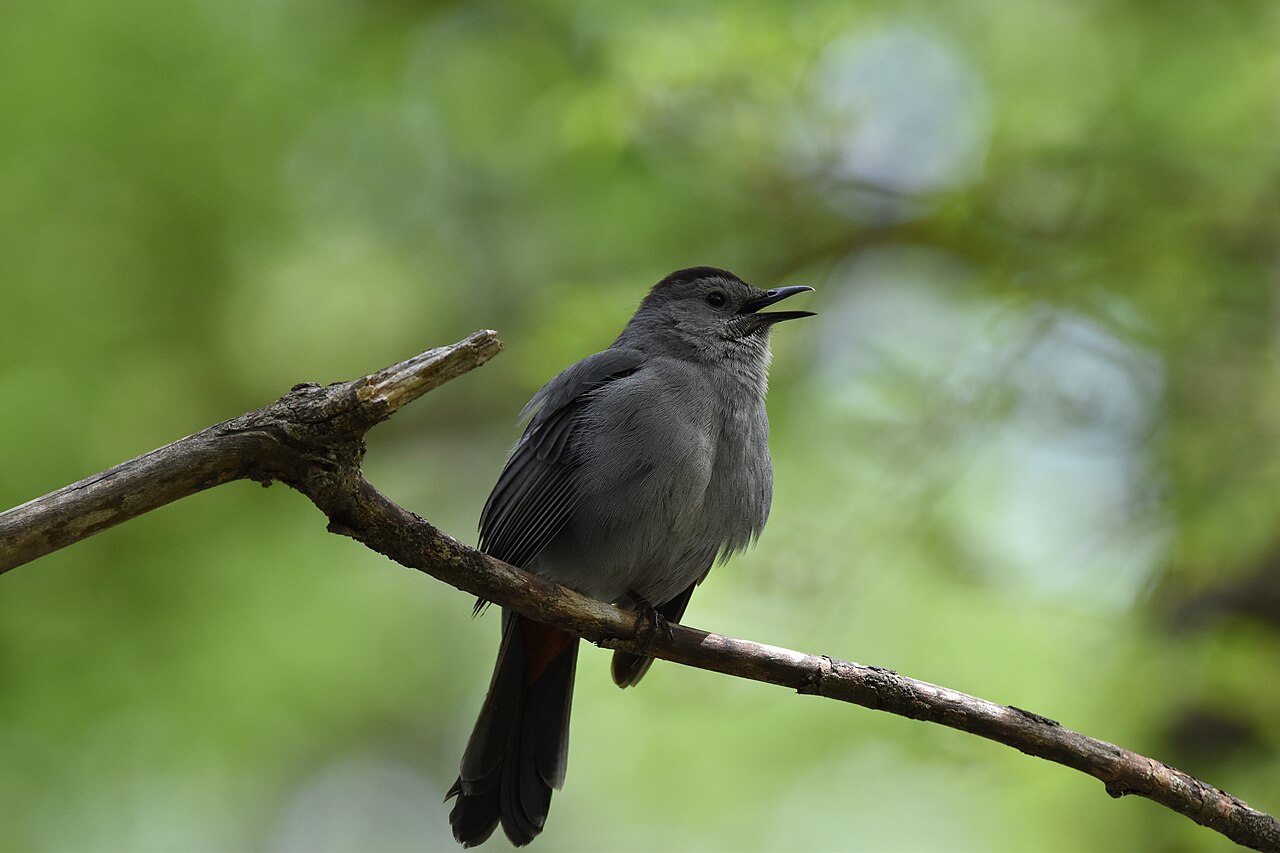
The gray catbird’s signature call is a nasal, drawn-out “mew” that is startlingly similar to a house cat, often the first clue that a catbird is nearby even before it’s spotted in the underbrush. This call is used as a contact and alarm note, distinct from the bird’s more elaborate song, and once learned it becomes one of the most recognizable sounds in eastern thickets and hedgerows during spring and summer. New birdwatchers often assume they’re hearing a stray or neighborhood cat somewhere in the yard, only to eventually track the sound to a small gray bird perched deep inside a shrub, a moment of recognition many birders remember clearly as one of their first real “aha” identification experiences.
An Accomplished Vocal Mimic
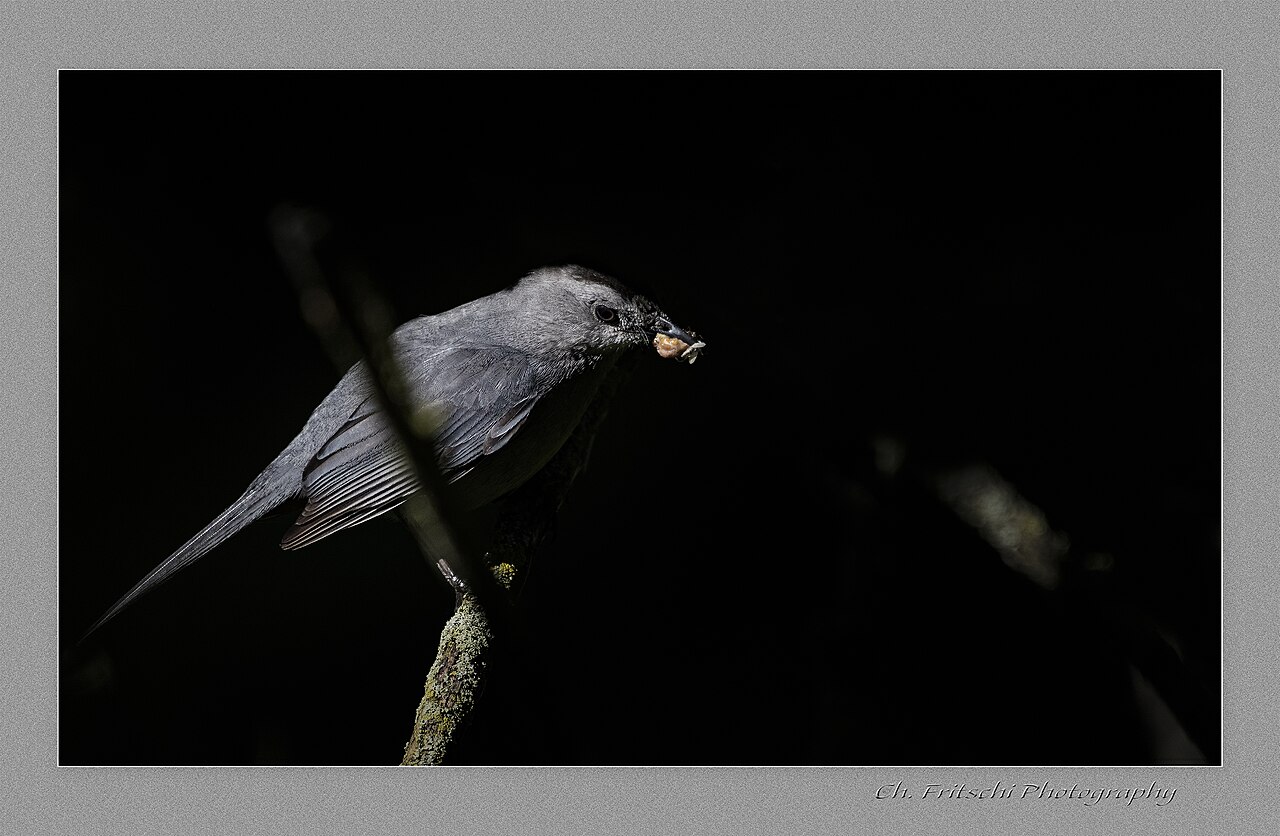
Beyond the famous cat call, gray catbirds are talented mimics capable of incorporating the songs and calls of other birds, and even mechanical sounds, into their own long, rambling, disjointed song, which can run for minutes without an obvious repeating pattern. This mimicry places catbirds firmly in the same family as northern mockingbirds and brown thrashers, both renowned for similar vocal versatility, though catbirds tend to sing in a quieter, more conversational tone rather than the loud, repeated phrases typical of a mockingbird. Some individual catbirds have been documented incorporating dozens of distinct borrowed sounds into a single extended singing bout, making a careful listen well worth the effort for anyone trying to appreciate just how varied and unpredictable the species’ vocal repertoire can be.
Diet and Foraging Behavior
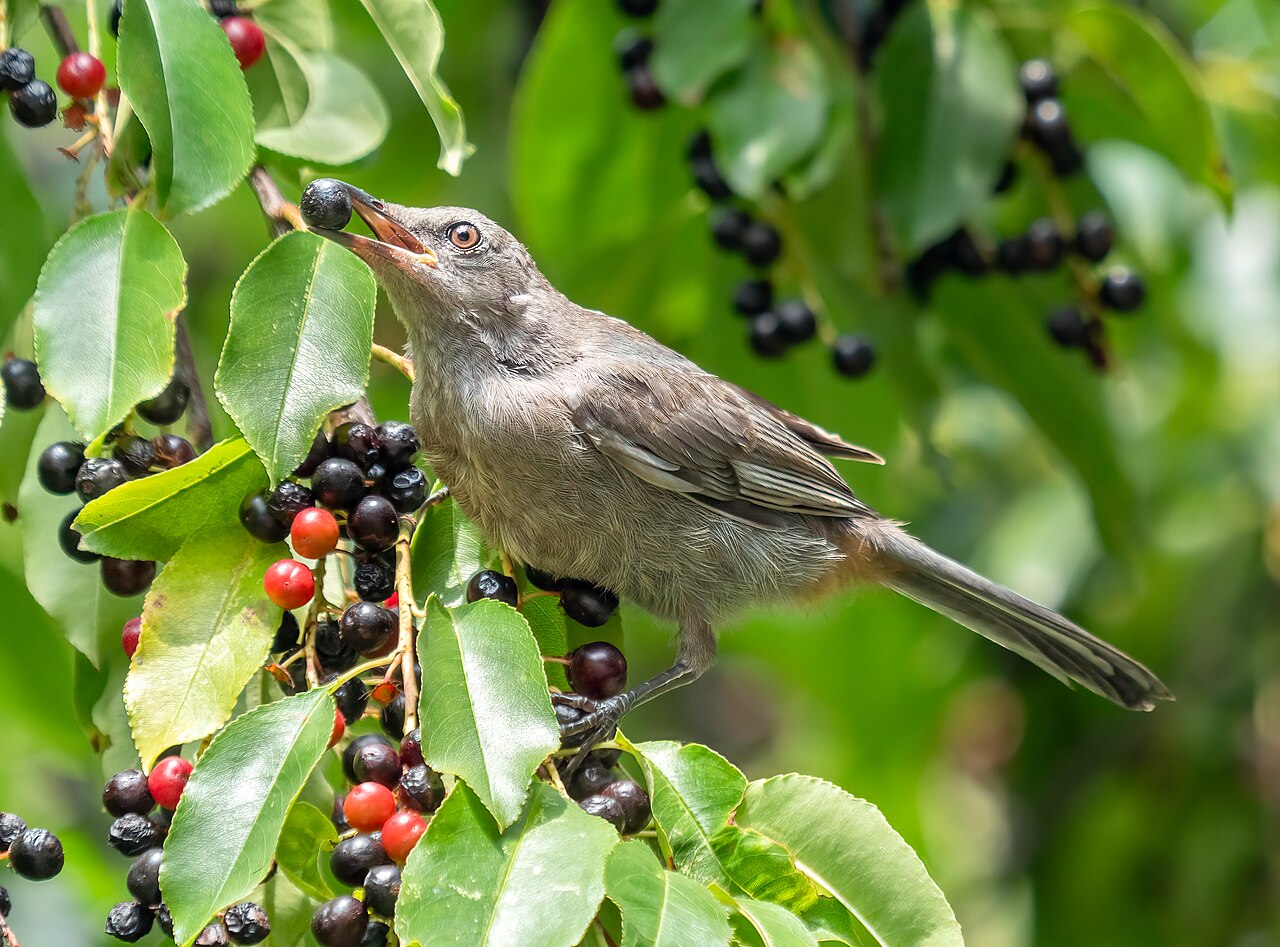
Gray catbirds eat a mixed diet of insects and fruit, leaning more heavily on insects, beetles, ants, and caterpillars during the breeding season when extra protein is needed for raising young, then shifting toward berries and small fruits in late summer and fall, a seasonal dietary pattern also seen in the fruit-loving cedar waxwing. They forage low in dense vegetation or on the ground under shrubs, rarely venturing into open lawns the way American robins do, which is part of why they’re heard far more often than seen despite being common backyard birds across much of their range.
Nesting Behavior
Gray catbirds build a bulky cup nest low in dense shrubs or tangles, well hidden from view, with the female doing most of the construction using twigs, grass, and often strips of bark or paper. A typical clutch contains 1 to 5 eggs, notable for their deep blue-green color, incubated by the female alone for about 12 to 14 days. Catbirds are also known for actively recognizing and ejecting the eggs of brown-headed cowbirds, a brood parasite that lays eggs in other birds’ nests, making catbirds one of the more effective species at resisting this particular reproductive strategy, unlike many other songbirds that unwittingly raise cowbird young alongside their own, including several species similar in size to the purple finch.
Habitat and Range
Gray catbirds breed across most of the eastern and central United States and southern Canada, favoring dense shrubby thickets, forest edges, overgrown fields, and garden hedges rather than deep forest interior or wide open habitat. Most populations migrate to the southeastern United States, Mexico, and Central America for winter, though a small number overwinter along the Gulf Coast and southern Atlantic coast where mild conditions and available fruit allow them to stay year-round.
Catbirds in the Garden
Gardeners with dense shrub borders or brushy hedgerows are especially likely to host breeding catbirds, since the species strongly favors this kind of thick, low cover over open lawns or manicured landscaping. Planting native berry-producing shrubs and leaving some areas of a yard less tightly manicured can make a property considerably more attractive to catbirds and other shrub-nesting species, and resisting the urge to prune every hedge into a tight, formal shape often pays off with a resident pair of catbirds rewarding you with their entertaining, unpredictable song each spring. For other backyard birds that favor similar dense cover, see our guide to attracting a wider variety of birds to your yard.
Conservation Status and Population Trends
According to the Cornell Lab of Ornithology, gray catbird populations have remained relatively stable across most of their range in recent decades, unlike many shrub-nesting songbirds that have declined significantly as suburban development and habitat fragmentation have reduced the dense, brushy cover this species depends on for nesting and cover. This stability is thought to be partly due to the catbird’s flexibility in using human-adjacent habitats like overgrown hedgerows and garden borders, provided enough dense cover remains available, unlike species with far narrower habitat requirements.
Catbirds Compared to Other Common Mimics
The gray catbird belongs to the same family as the northern mockingbird and brown thrasher, both similarly gifted vocal mimics, though each species has a distinct style and delivery. Mockingbirds typically repeat each mimicked phrase multiple times in a row before moving to the next sound, while catbirds tend to run through a longer, less repetitive, more meandering sequence of borrowed and original sounds. This distinction matters for identification by ear, since a catbird’s rambling, non-repetitive song pattern combined with its signature cat-like “mew” call usually rules out confusion with a mockingbird, even before you consider the very different plumage between the two species. Both mimic species stand in sharp contrast to simpler-voiced birds like the Eastern phoebe, which repeats the same basic call with little variation throughout its life.
Frequently Asked Questions
How do you identify a gray catbird?
Look for a uniformly slate-gray bird with a black cap and a rusty-orange patch under the tail, typically staying low in dense shrubs rather than perching in the open.
Why is it called a catbird?
It gets its name from its signature call, a nasal, drawn-out “mew” that sounds remarkably like a house cat, a source of confusion for many first-time listeners exploring their own backyard.
Do gray catbirds mimic other birds?
Yes, gray catbirds are accomplished mimics in the same family as mockingbirds and thrashers, incorporating other birds’ sounds into a long, rambling song that can run for minutes without repeating a clear pattern.
What do gray catbirds eat?
Gray catbirds eat insects and berries, favoring more insects during breeding season and shifting toward fruit in late summer and fall, a dietary pattern shared by several other North American songbirds.
Where do gray catbirds live?
Gray catbirds breed across the eastern and central United States in dense shrubby thickets and forest edges, and most migrate to the southeastern US, Mexico, and Central America for winter.
Do gray catbirds recognize cowbird eggs in their nest?
Yes, gray catbirds are notably effective at recognizing and ejecting the eggs of brown-headed cowbirds, a brood parasite that lays eggs in other species’ nests.
Why are gray catbirds heard more often than seen?
They stay low in dense shrubs and thickets rather than perching in the open, so their distinctive call is usually the first sign of their presence.