Baby Black Snake: Identifying Rat Snake and Racer Hatchlings
A baby black snake almost never actually looks black: hatchling black rat snakes and baby black racers, the two species Americans mean by the name, both emerge patterned in gray and dark blotches or bands, and only darken to solid black over their first one to three years. That mismatch between the name and the actual hatchling appearance is the source of more mistaken-identity panic than almost any other snake question, since a blotchy gray baby gets compared to copperheads and rattlesnakes far more often than to the plain black adult it will become.
The two species behind “baby black snake” also have different personalities worth knowing apart: black rat snakes are slow, calm climbers and constrictors, while black racers are famously fast, nervous, and difficult to catch. This guide sorts out which black snake you likely have, walks through both growth timelines, and covers the copperhead check that resolves nearly every worried sighting.
| Fact | Baby Black Rat Snake | Baby Black Racer |
|---|---|---|
| Hatchling pattern | Gray with dark blotches | Gray-brown with dark blotches/bands |
| Hatchling size | 10 to 16 inches | 10 to 15 inches |
| Adult color | Solid glossy black | Solid black, smooth scales |
| Behavior | Slow, climbs, constricts | Fast, flees, does not constrict |
| Adult size | 3 to 6 feet | 3 to 5 feet |
| Venomous? | No | No |
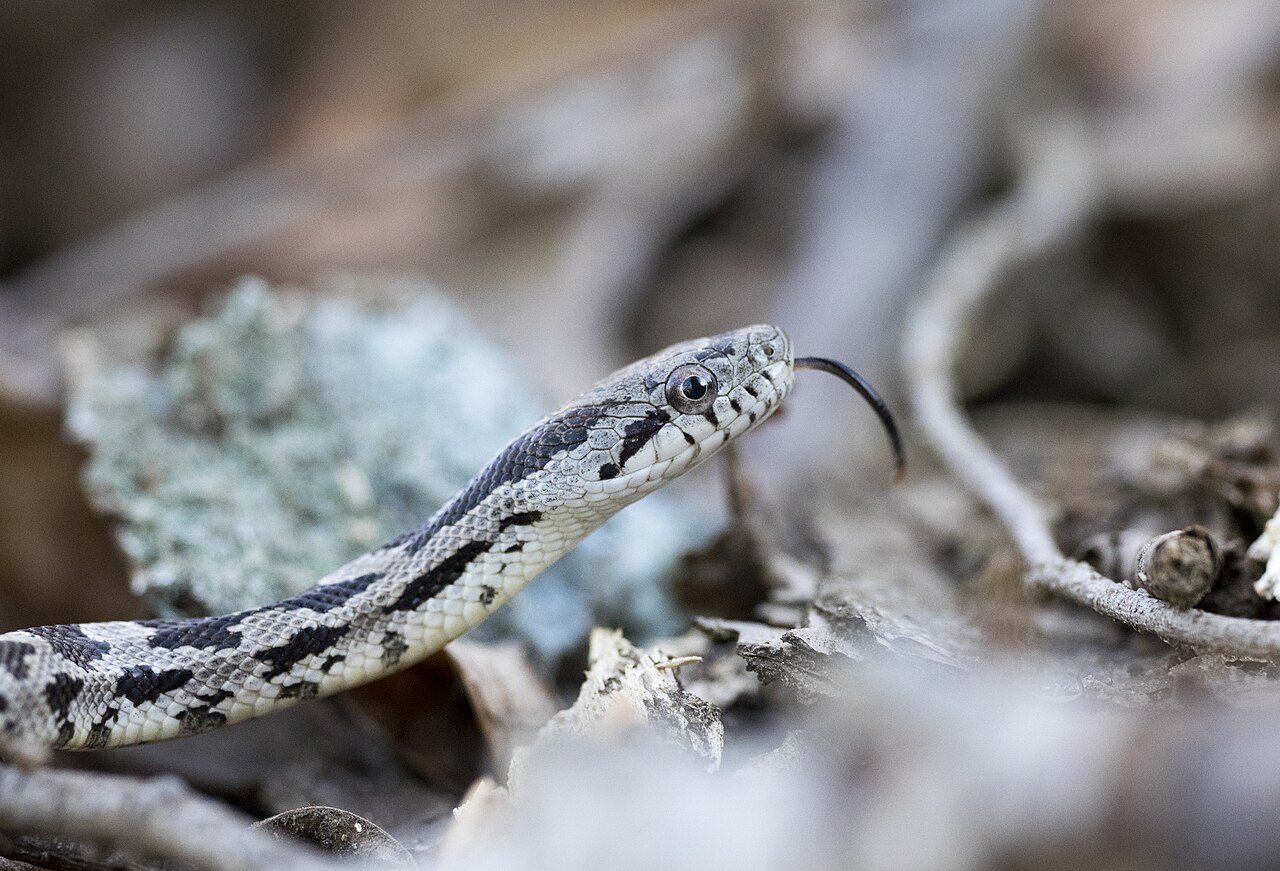
A baby black snake is almost never black. Hatchling black rat snakes and black racers both emerge gray with dark blotches or bands, then darken to solid black over one to three years. Neither is venomous, and neither is a copperhead.
Two Different Snakes Share One Common Name
“Black snake” is a folk name applied loosely to any solid-black adult snake, and in most of the eastern and central United States that means one of two unrelated species: the black rat snake (Pantherophis obsoletus and its regional relatives) and the black racer (Coluber constrictor, despite the misleading species name, racers do not actually constrict). Both hatch patterned and both darken with age, which is exactly why babies of either species confuse people who only know the black adult.
Range overlaps heavily, so either species is a reasonable first guess almost anywhere east of the Rockies, and telling them apart as adults is straightforward: rat snakes have weakly keeled (ridged) scales and a boxier head, racers have perfectly smooth scales and a slimmer head with notably large eyes. As hatchlings, the same texture cues apply if you can get a close, safe look, but pattern and behavior are usually faster tells, covered next.
Our full species profiles cover each adult in detail: the rat snake guide for the climbing constrictor, and background on the broader blotched-juvenile family in black and white snake for readers sorting through the whole gray-and-dark-pattern lookalike group that confuses late-summer sightings, and coral snake vs king snake for the venomous-mimic side of snake identification.
Identifying a Baby Black Rat Snake
Hatchling black rat snakes run 10 to 16 inches with a pale gray base and bold, squarish dark blotches running down the spine like saddles, plus a patterned head and often a dark stripe through the eye. The body is moderately stout, and the snake, even at this size, will readily climb anything nearby, screen, shrub, brick wall, when it wants to escape, a behavior that persists throughout its life.
Temperament at this age is notably calm for a wild reptile: a cornered baby rat snake typically freezes, vibrates its tail against dry leaves (a rattle-mimicking bluff with no rattle attached), and may release musk, but rarely strikes repeatedly or flees in a panic. Picked up gently, most settle within a minute rather than thrashing, a demeanor that carries into adulthood and makes rat snakes a favorite among reptile keepers.
Full identification detail, growth timeline, and the egg-to-hatchling nursery habits live in our dedicated baby rat snake guide; the short version here is that this is the slower, climbier, constricting half of the black snake identity crisis.
Identifying a Baby Black Racer
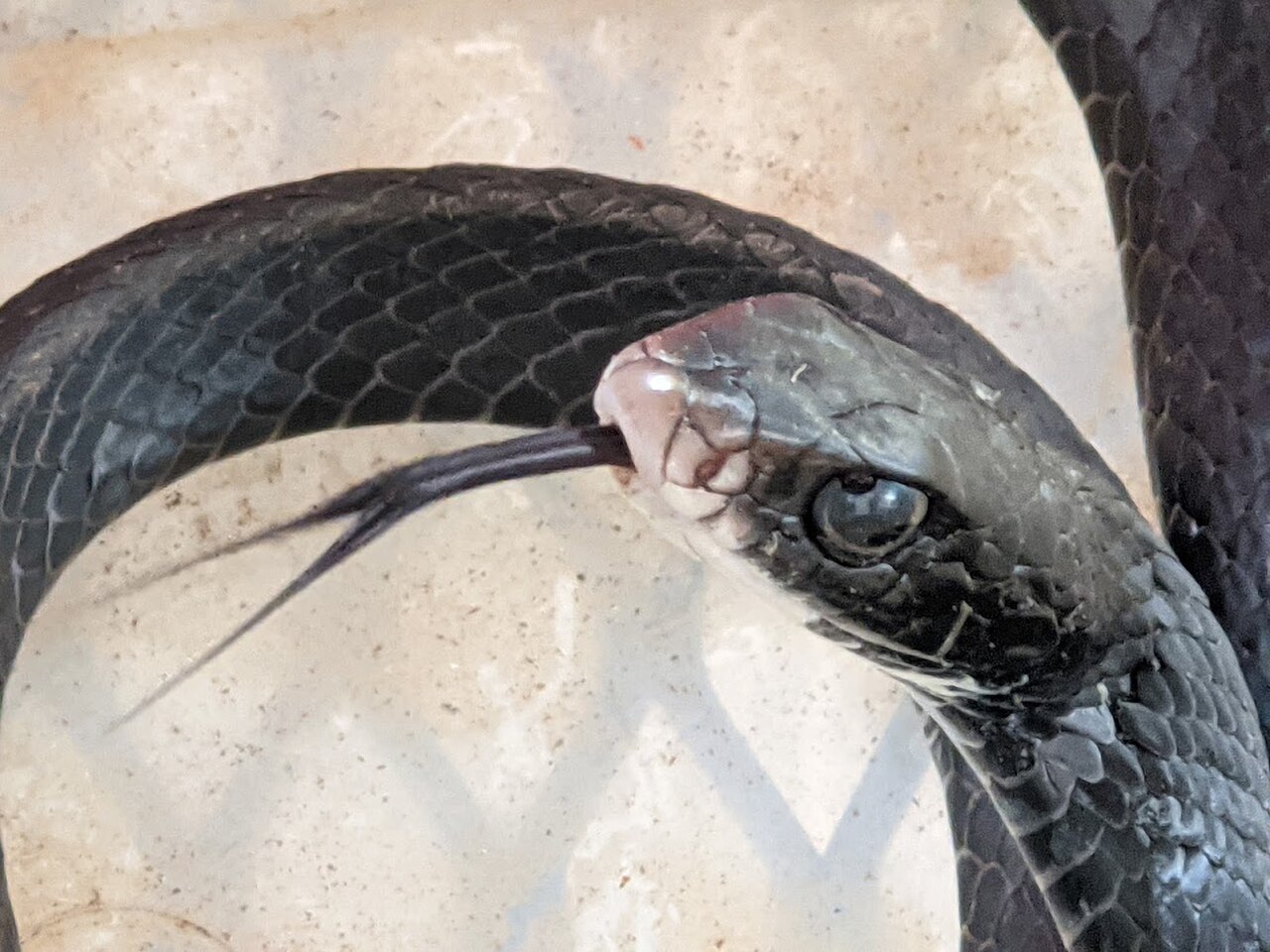
Hatchling black racers look superficially similar at a glance, roughly 10 to 15 inches, gray to brown with a row of darker blotches or crossbands down the back, but the details diverge on close inspection: racer blotches tend to be more rounded and less crisply squared than a rat snake’s saddles, the scales are glossy and completely smooth rather than lightly keeled, and the head is proportionally slimmer with strikingly large, dark eyes.
Behavior is the fastest real-world separator, and it shows immediately: baby racers are built for speed and live up to the name from birth, bolting explosively at the first sign of disturbance rather than freezing, often disappearing into cover so fast that a full look is impossible. Cornered racers vibrate their tails just like rat snake babies but tend to strike more readily and repeatedly if actually grabbed, though the bite remains harmless, just startling.
Diet also differs young: racers are active daytime hunters that chase down prey visually, including lizards, insects, frogs, and small rodents, swallowed alive rather than constricted, since racers lack the constriction reflex entirely despite their scientific name. A juvenile snake that vanished at your approach faster than seemed physically possible, and that hunts by sight in open sun rather than by scent in cover, is the racer half of the equation.
The Copperhead Check: Settling Every Panic
Whichever species you have, the identification that actually matters is ruling out copperhead, and one look at the pattern shape does it. Copperhead crossbands are hourglasses, narrow and pinched across the spine, wide on the sides, like a stack of Hershey’s Kisses viewed from above; both baby black rat snakes and baby racers show the opposite, blotches or bands that are widest across the back, not pinched.
Color and head add confirmation: copperheads are coppery, tan, or pinkish, with a solid unmarked copper-colored head and, in newborns, a bright sulfur-yellow tail tip used as a lure; both black snake babies are gray-toned with patterned (not solid) heads and no yellow tail. Build differs too, copperheads are thick-bodied ambush predators that hold their ground, while both black snake babies are proportionally slimmer and either freeze-and-bluff (rat snake) or bolt (racer) rather than standing firm.
For anyone still uncertain, the safest and most useful habit is the same regardless of species guessed: photograph from a safe distance, do not attempt to handle or kill the snake, and compare the spine pattern at leisure. This single check, saddle-shaped and wide-across-the-back means harmless black snake baby, hourglass and pinched means copperheads, resolves the overwhelming majority of late-summer snake scares without a single expert consultation needed, the same shape-first logic used throughout our baby snake identification guide.
Growth: From Blotchy Baby to Solid Black Adult
Both species follow a similar transformation arc, losing their juvenile pattern gradually as they grow rather than in one dramatic shed. Black rat snakes typically show mostly solid color by 2 to 3 years old, with faint ghost blotches sometimes visible in good light on subadults; black racers complete the shift a bit faster, often largely solid black by their second year, matching the “quick to grow into it” personality suggested by their name.
Growth rate itself runs close between the two, roughly a foot of length gained per year under good conditions for the first several years, slowing as adult size approaches: rat snakes top out longer overall (up to 6 feet in some regional forms) while racers plateau slightly shorter and leaner (rarely much past 5 feet), the rat snake’s greater bulk suiting its constriction hunting style and the racer’s leaner build suiting a sprinting, sight-hunting lifestyle.
Sexual maturity arrives around 2 to 3 years for both, and wild lifespans commonly reach a decade or more for survivors, though first-year mortality is steep for both species, hatchlings are prey for hawks, larger snakes (including king snakes, noted for eating other snakes, plus raccoons and outdoor cats, which is exactly why clutches run in the dozen-plus range and why so few of the blotchy babies people find in late summer are ever seen again as adults in the same spot.
Are Baby Black Snakes Dangerous?
Neither species is venomous, and neither poses any real danger to people or pets; both are, if anything, actively beneficial, since both prey heavily on rodents (rat snakes primarily) or on rodents, insects, and other small animals (racers), functioning as free pest control wherever they establish themselves. A bite from either species’ hatchling is essentially nonexistent as a real-world risk, too small to matter even in the rare case it happens.
The defensive behaviors, musk release, tail vibration, mock or genuine (harmless) striking, occasionally full-body thrashing when picked up, are all bluff and startle responses rather than anything requiring caution beyond simply not handling wildlife unnecessarily. Both species are also generally protected from casual killing under various state wildlife regulations, and state extension services, including guidance published through university herpetology programs, consistently recommend leaving harmless native snakes alone or relocating them gently rather than killing on sight.
The one legitimate caution applies equally to any unidentified snake: if a definitive copperhead or rattlesnake check cannot be completed confidently from a safe distance, treat the animal as potentially venomous until proven otherwise, keep pets and children back, and let it move along on its own rather than attempting closer inspection or capture.
What to Do With One in Your Yard or House
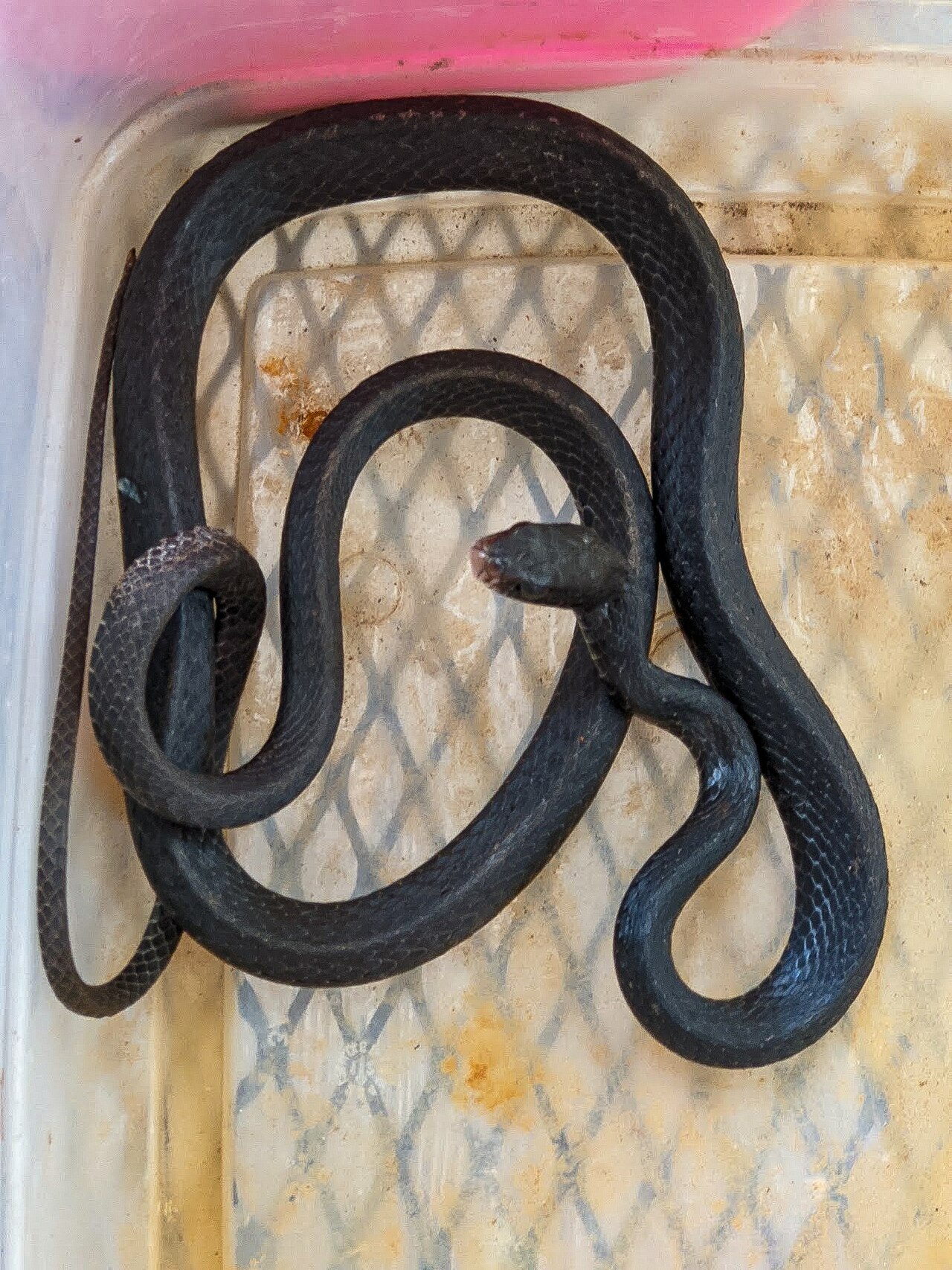
Outdoors, the correct response to either baby black snake is simply to leave it be; both are transient hunters passing through in search of prey, and neither denizens your yard the way a rodent or raccoon might, so no ongoing management is generally needed beyond the usual habitat-reduction steps (clearing brush piles, sealing foundation gaps) that discourage the rodents that attract snakes in the first place.
Indoors, the calm bucket-and-herd method works for a rat snake baby, given its slower temperament, while a racer’s speed may call for simply opening the nearest door or window and letting it find its own way out, since attempting to herd a fleeing racer often just prolongs an already brief encounter. Neither requires gloves for safety, though gloves make handling more comfortable for the nervous, and neither should ever be caught on a glue trap, a genuine hazard that traps and slowly injures the harmless snake instead of the rodent it likely followed inside.
If uncertainty about which of the two species (or a copperhead) remains after applying the checks above, the universal fallback holds: give the snake space, let it leave under its own power, and photograph from distance for identification at leisure rather than attempting anything up close. Most encounters resolve themselves within minutes if simply left alone.
Related reading: Baby Copperhead Snake.
What Kind of Small Black Snake Is in My Yard?
A small dark snake in a yard east of the Rockies is usually one of four harmless species, and adult size is the fastest way in. If it is under a foot and genuinely black with a pale ring behind the head, it is a ringneck snake. If it is under a foot, dark and glossy with a plain belly, it is likely a small brown snake or a young worm snake.
If it is 10 to 20 inches, gray with dark saddles or bands, it is a hatchling rat snake or racer that will darken with age. Adults of both reach four to six feet, which is why the same species can appear in the yard at wildly different sizes and colors through the season.
None of these bite with any medical consequence, and all of them eat rodents, slugs or insects. The one genuine question in the eastern states is copperhead, which is settled by pattern rather than color: copperheads carry hourglass crossbands that are narrow across the spine and wide on the flanks, a shape no rat snake or racer shows. Penn State Extension’s overview of snakes around the home covers identification and safe exclusion.
Frequently Asked Questions
What is a baby black snake?
Usually a hatchling black rat snake or black racer, the two common species that turn solid black as adults. Both hatch gray and blotched, not black, which causes most identification confusion.
Are baby black snakes venomous?
No. Neither the black rat snake nor the black racer is venomous, and both are harmless to people and pets, functioning as beneficial rodent and insect predators.
How can I tell a baby black snake from a baby copperhead?
Check the pattern shape: copperheads show narrow hourglass crossbands, while baby black snakes show blotches or bands that are widest across the spine. Copperheads also have solid copper heads and, as newborns, a yellow tail tip.
Why does a baby black snake look gray instead of black?
Both species hatch with a camouflage pattern of blotches or bands on a gray base and only darken to solid black over their first one to three years as they outgrow the predators the juvenile pattern evades.
How do I tell a baby rat snake from a baby racer?
Behavior is the fastest clue: rat snake babies freeze and bluff when disturbed, while racer babies bolt explosively and vanish. Racers also have smooth glossy scales and larger eyes versus a rat snake’s lightly keeled scales and boxier head.
What should I do if I find a baby black snake in my house?
Herd a calm rat snake baby gently into a bucket and release it outside, or simply open a door for a faster-moving racer to leave on its own. Neither needs to be killed, and glue traps should never be used since they injure the harmless snake.
Do baby black snakes bite?
They may strike defensively if handled, but the bite is harmless, too small to cause meaningful injury, and neither species is venomous. Most defensive behavior is bluff (tail vibration, musk) rather than actual biting.