What Is a Group of Parrots Called? Pandemonium and More
A group of parrots is called a pandemonium, and it is one of the most fitting collective nouns in English. A group of parrots is also called a company, a prattle, and a flock, with flock being the term ornithologists and aviculturists actually use. A group of parakeets or budgerigars is a flock or a chatter, and a group of macaws is sometimes given as a hoard.
Pandemonium earns its place because parrots genuinely are loud, chaotic, and impossible to ignore in numbers. The word was coined by John Milton in Paradise Lost in 1667 as the name of the capital of Hell, built from Greek roots meaning all demons, and it entered general English meaning wild uproar. A flock of wild parrots settling into a roost tree at dusk produces exactly that. This guide covers every term and how parrot flocks actually work.
A group of parrots is called a pandemonium, a company, or a prattle, with flock being the standard term. Parakeets form a chatter or a flock. Unlike most birds given dramatic collective nouns, parrots are genuinely highly social and flock in large numbers, with some roosts holding thousands of birds.
| Question | Answer |
|---|---|
| Main collective noun | Pandemonium of parrots |
| Other terms | Company, prattle, flock |
| Parakeets or budgies | Chatter or flock |
| Scientific term | Flock; roost for nighttime gatherings |
| Do parrots flock? | Yes, genuinely and in large numbers |
| Largest flocks | Budgerigars in the tens of thousands |
| Origin of pandemonium | Coined by Milton in 1667 |
Why Is a Group of Parrots Called a Pandemonium?
A group of parrots is called a pandemonium because of the extraordinary volume and chaos a parrot flock produces. Parrots are among the loudest birds on earth, with some macaw calls audible for several miles, and a flock arriving at a feeding tree or settling to roost generates a wall of screeching, squawking, and chattering that has no real equivalent among other birds.
The word has an unusually precise origin. John Milton invented it for Paradise Lost, published in 1667, as the name of the capital city of Hell, constructing it from the Greek pan, meaning all, and daimon, meaning demon or spirit. Within a century it had passed into general English meaning uproar and confusion, which is one of the more successful coinages by any single author.
Applied to parrots, it is a modern extension, since Milton was not thinking of birds and the medieval compilers of collective nouns had never seen a parrot. It belongs to the same recent tier as a flamboyance of flamingos and a waddle of penguins. What distinguishes it is accuracy: unlike a parliament of owls, which names something that does not happen, a pandemonium of parrots describes exactly what a flock sounds like.
Do Parrots Actually Flock?
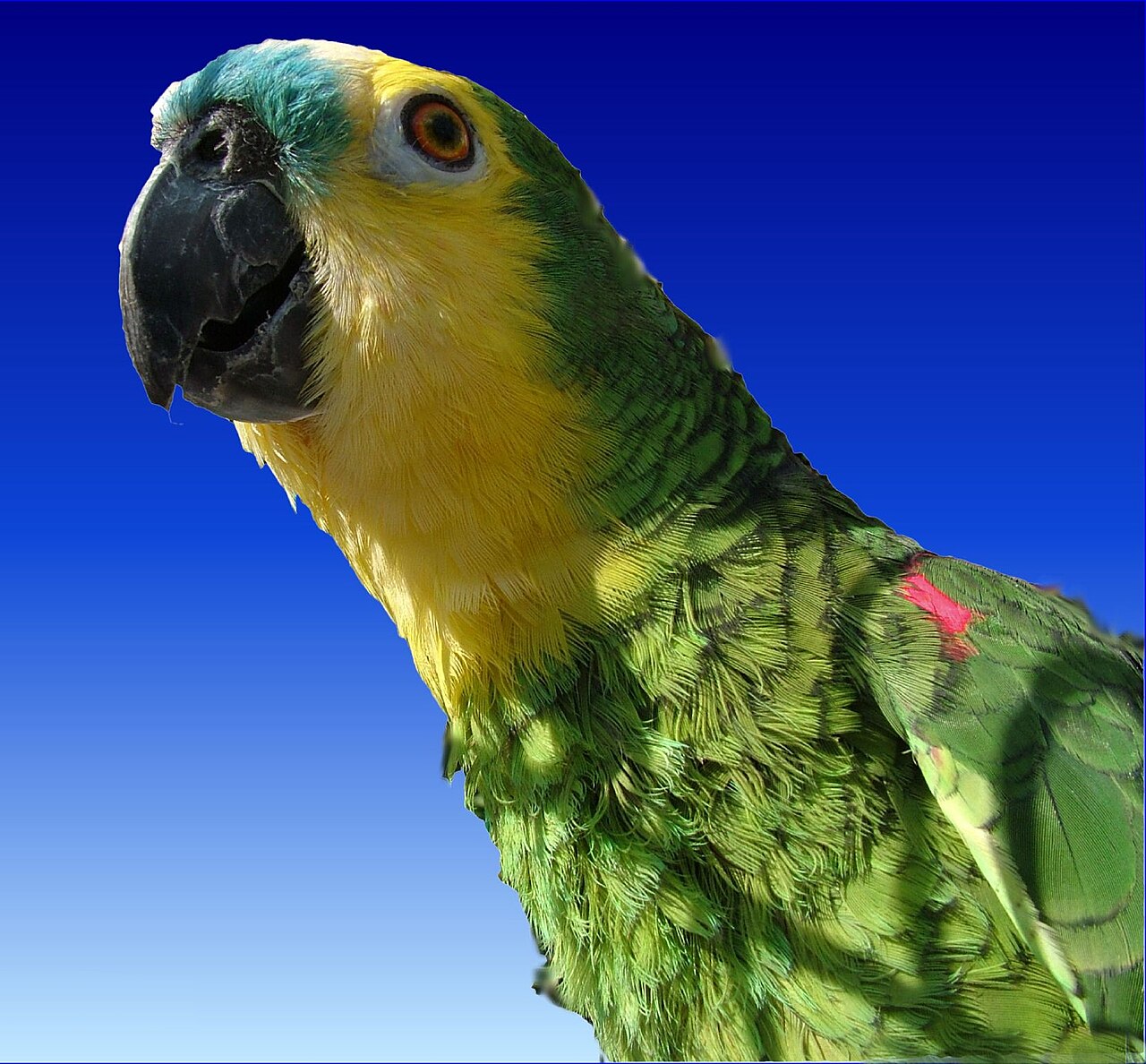
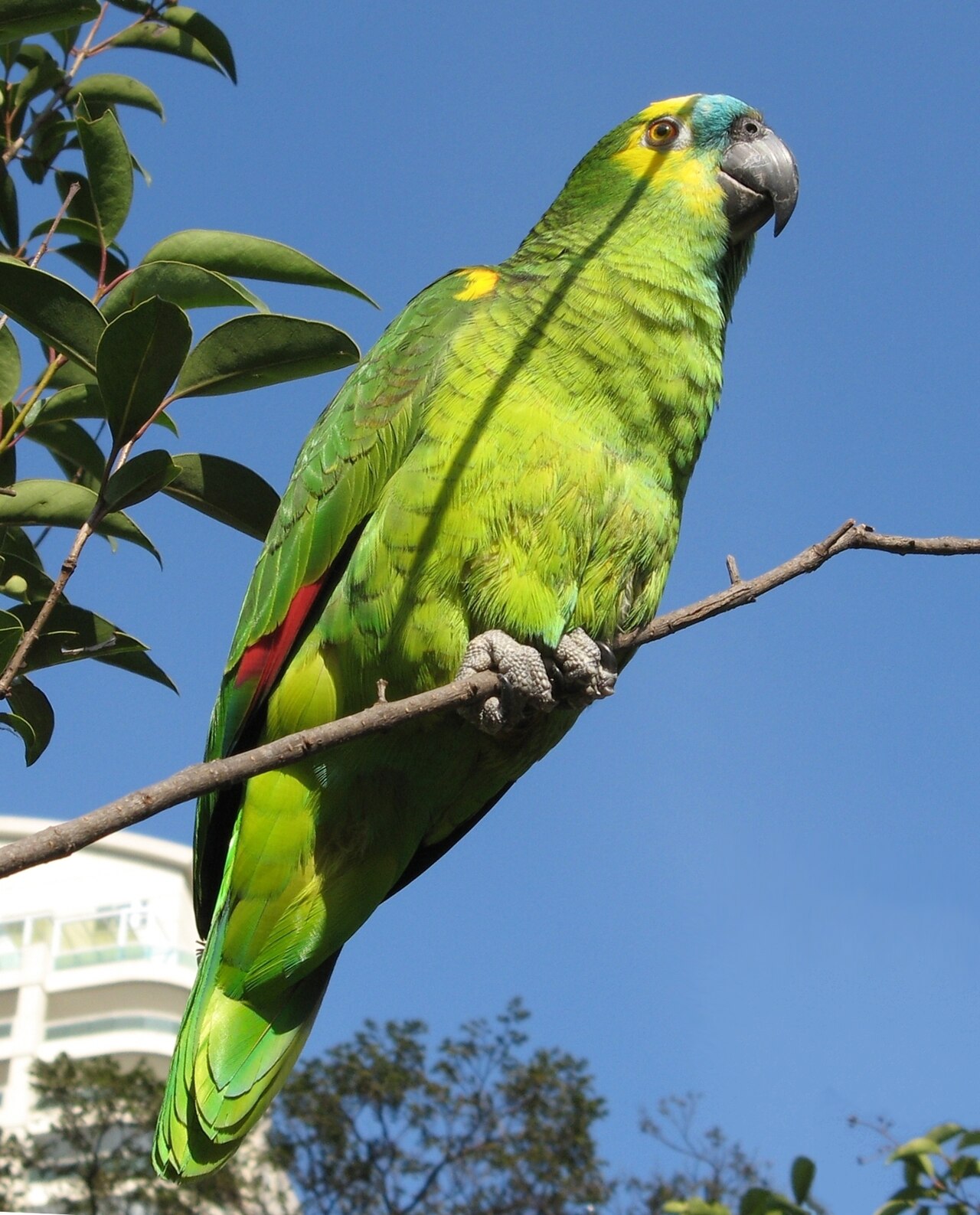
Yes, and this is what sets parrots apart from most birds given colorful collective nouns. Parrots are genuinely and intensely social. Nearly all of the roughly 400 parrot species live in flocks for at least part of the year, forage in groups, roost communally, and maintain complex social relationships within the flock. The collective noun describes real behavior rather than a literary idea.
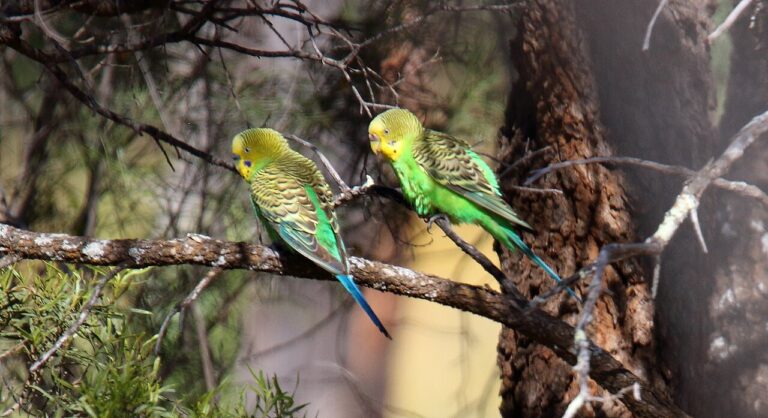
Flock sizes vary enormously. Budgerigars in the Australian interior form the largest gatherings, with flocks in the tens of thousands wheeling across the outback in response to rainfall and seeding grasses, and historical accounts describe flocks that darkened the sky. Monk parakeets, quaker parrots, build communal stick nests housing dozens of pairs, the only parrot that constructs a nest rather than using a cavity.
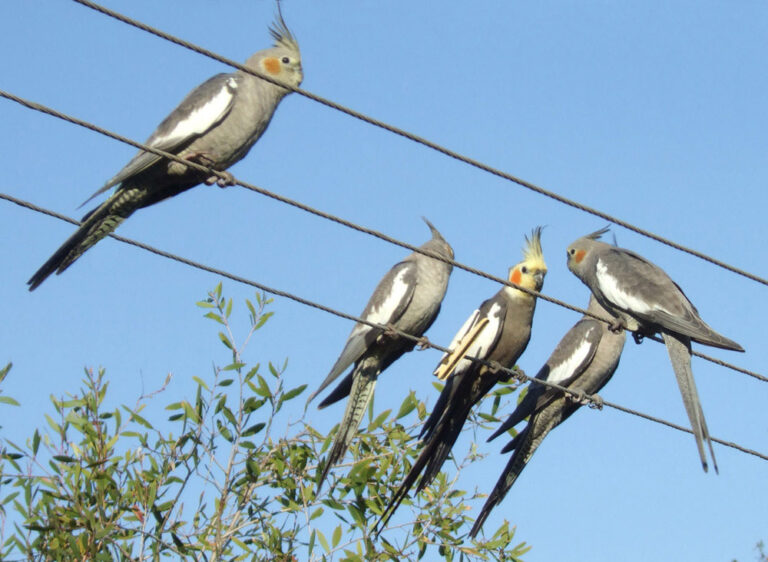
Most parrots form a pair bond within the flock and maintain it year-round, often for life. Pairs perch touching, preen each other, and coordinate movement, and a flock of parrots at rest resolves into pairs on close inspection. This combination of strong pair bonds inside a large social group is characteristic of the family and is one reason single pet parrots so often develop behavioral problems.
What Is a Flock of Parakeets Called?
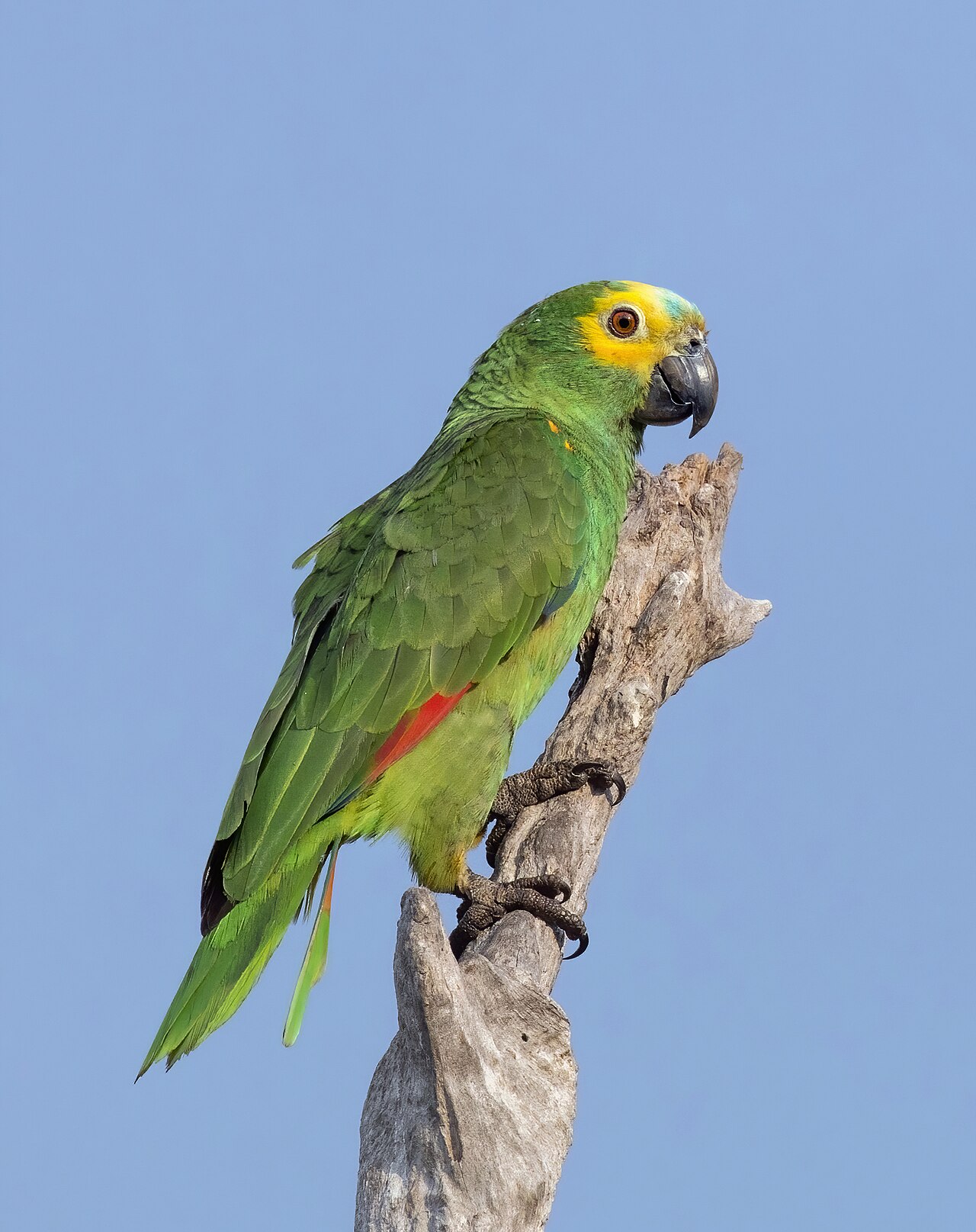
A flock of parakeets is called a chatter or simply a flock, and parakeets are parrots, so the parrot terms apply equally. Parakeet is not a taxonomic category but a loose description covering small to medium parrots with long tapered tails, including budgerigars, monk parakeets, ring-necked parakeets, and dozens of others.
Budgerigars are the world’s most popular pet bird and the third most popular pet overall after dogs and cats. Wild budgies are green and yellow with black barring, and the blues, whites, and yellows familiar from cages are captive-bred colour mutations. In the wild they are nomadic, following rain across the Australian interior in flocks that can appear and vanish from a region within days.
Feral parakeet populations, alongside the crow roosts that share the same urban trees, have established in many cities well outside their native ranges. Ring-necked parakeets number in the tens of thousands in London and across Europe, monk parakeets are established in Florida, Texas, Illinois, and Connecticut, and naturalized parrot flocks exist in Los Angeles, San Francisco, Miami, and New York. These urban flocks are among the most reliable places to see a genuine pandemonium in the Northern Hemisphere.
How Intelligent Are Parrots in a Flock?
Parrot flocks are held together by cognitive abilities that rival those of primates, and the social complexity is thought to be a major driver of that intelligence. Parrots have the highest neuron density in the forebrain of any bird group, with a macaw packing more neurons into its pallium than a macaque monkey does into its much larger cortex, according to research published in 2016.
Vocal learning is central to flock life. Parrots are one of only a handful of animal groups capable of true vocal learning, alongside humans, songbirds, hummingbirds, cetaceans, and bats, and this is what underlies their famous mimicry. Wild parrots use it to develop regional dialects and, in some species, individual signature calls that function like names. Research on wild green-rumped parrotlets in Venezuela has shown that parents assign a distinct call to each chick, which the bird then uses for life.
Problem-solving abilities are equally striking. Alex, the African grey studied for thirty years by Irene Pepperberg, demonstrated understanding of categories, numbers up to eight, and the concept of zero, and could answer novel questions about the properties of objects. Kea, the New Zealand alpine parrot, solve multi-step mechanical puzzles and cooperate in tasks requiring two birds to act simultaneously.
Why Do Parrots Roost Together?
Parrots gather at communal roosts each night for safety, warmth, and information, and the arrival at a roost is where the pandemonium is most obvious. Birds converge from feeding areas across a wide radius in the last hour of daylight, calling continuously, and the settling process can take twenty minutes of noise before the flock quiets.
Predator detection is the primary benefit. A parrot in a roost of hundreds has enormously better odds against raptors and arboreal predators than one alone, and roost trees are typically chosen for isolation, height, and clear sightlines. Some roosts are traditional and used for decades, and in the tropics the same trees may serve generations of birds.
Roosts also function as information centers. Parrots feed on patchy, seasonal resources, a fruiting tree, a seeding grass, a clay lick, in the way the vulture roost tracks scattered carrion, and birds that failed to find food appear to follow successful ones out of the roost in the morning. The famous clay licks of the Peruvian Amazon, where hundreds of macaws and parrots gather daily to eat mineral-rich soil, are the most spectacular parrot aggregations accessible to visitors.
Are Parrot Flocks in Trouble?
Yes, parrots are among the most threatened bird families on earth. Roughly a third of parrot species are considered threatened, a far higher proportion than birds as a whole, driven by habitat loss, the pet trade, and in some cases persecution as agricultural pests. Their reliance on tree cavities for nesting makes them especially vulnerable to the loss of old-growth forest.
The Carolina parakeet is the North American cautionary tale. The only parrot native to the eastern United States, it was abundant enough to form flocks of hundreds well into the nineteenth century, and it was hunted for feathers, shot as a crop pest, and lost its bottomland forest habitat. Its flocking behavior contributed directly to its extinction: birds circled back to fallen flock mates, allowing hunters to destroy entire flocks. The last known individual died in 1918.
Some populations are recovering. The Puerto Rican parrot fell to 13 wild birds in 1975 and has been slowly rebuilt through captive breeding, and the thick-billed parrot, the other parrot once native to the United States, survives in Mexico. The Convention on International Trade in Endangered Species restricts the wild parrot trade, and the European Union banned wild bird imports in 2007, which substantially reduced pressure on wild populations.
Collective Nouns for Parrots and Other Birds
Parrots sit among the modern collective nouns coined for species the medieval English never met, and the parrot terms hold up better than most. Pandemonium describes the noise, prattle describes the constant chatter, and company describes the sociability, and all three point at something real. That is unusual: a parliament of owls and a convocation of eagles both name gatherings that do not occur.
Other tropical and exotic birds got similar treatment. Flamingos get a flamboyance, peacocks an ostentation or a muster, toucans a durante, after the entertainer with the famous nose, and birds of paradise a paradise. All are twentieth century or later inventions, and the durante is about as clear a sign as one could want that these lists are entertainment rather than terminology.
The comparison worth drawing is with genuinely social birds. Starlings get a murmuration, which describes a spectacular real phenomenon; geese get a gaggle, which imitates a real sound. Parrots belong in that company rather than with the owls and eagles, because a pandemonium is something you can go and hear. The group of hummingbirds guide covers the opposite case, a charming term for birds that never gather, and the cockatiel guide and macaw guide cover two of the most commonly kept parrots.
Frequently Asked Questions
What is a group of parrots called?
A group of parrots is called a pandemonium, a company, or a prattle, with flock being the standard term used by ornithologists and bird keepers. Pandemonium is the most widely cited.
Why is a group of parrots called a pandemonium?
Because of the extraordinary noise a parrot flock makes. The word was coined by John Milton in 1667 as the name of the capital of Hell and later came to mean uproar. Unlike most collective nouns, it describes something real.
What do you call a flock of parakeets?
A chatter or a flock. Parakeets are parrots, so the parrot terms apply. Wild budgerigars form the largest parrot flocks on earth, numbering in the tens of thousands across the Australian interior.
Do parrots live in flocks?
Yes. Nearly all parrot species are highly social, foraging in groups and roosting communally, often in hundreds or thousands. Within the flock they form strong pair bonds that frequently last for life.
What is a group of macaws called?
A pandemonium or a flock, and some lists give a hoard. Macaws gather in large numbers at clay licks in the Amazon, where hundreds feed on mineral-rich soil daily.
Why do parrots roost together?
For predator detection, warmth, and information sharing. Birds that failed to find food appear to follow successful ones out of the roost in the morning, which matters when food sources are patchy and seasonal.
How intelligent are parrots?
Extremely. Parrots have the highest forebrain neuron density of any bird group, and a macaw has more pallium neurons than a macaque monkey has cortical neurons. They are true vocal learners and can solve multi-step problems.