Female Red-Bellied Woodpecker: How to Identify Her
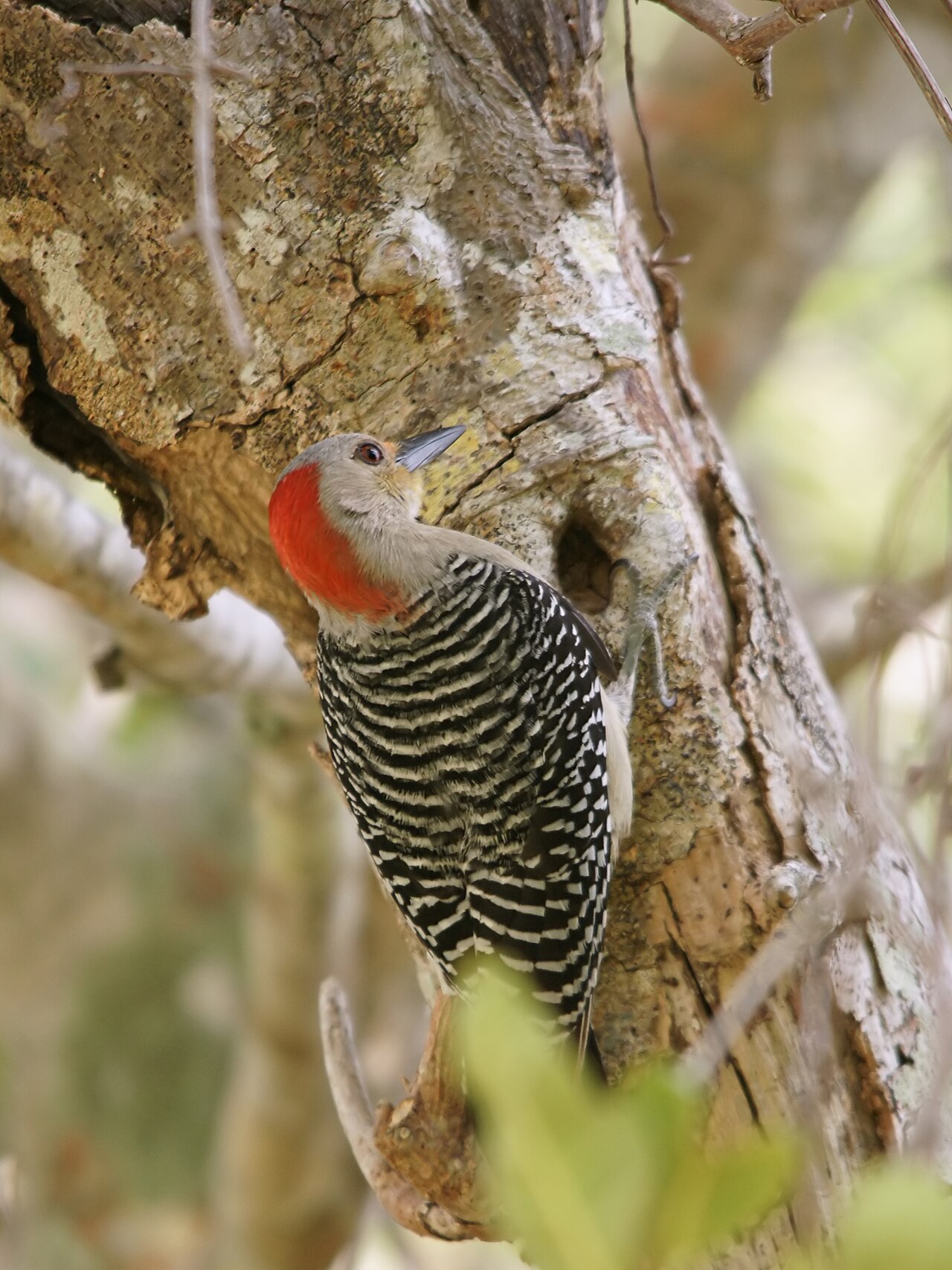
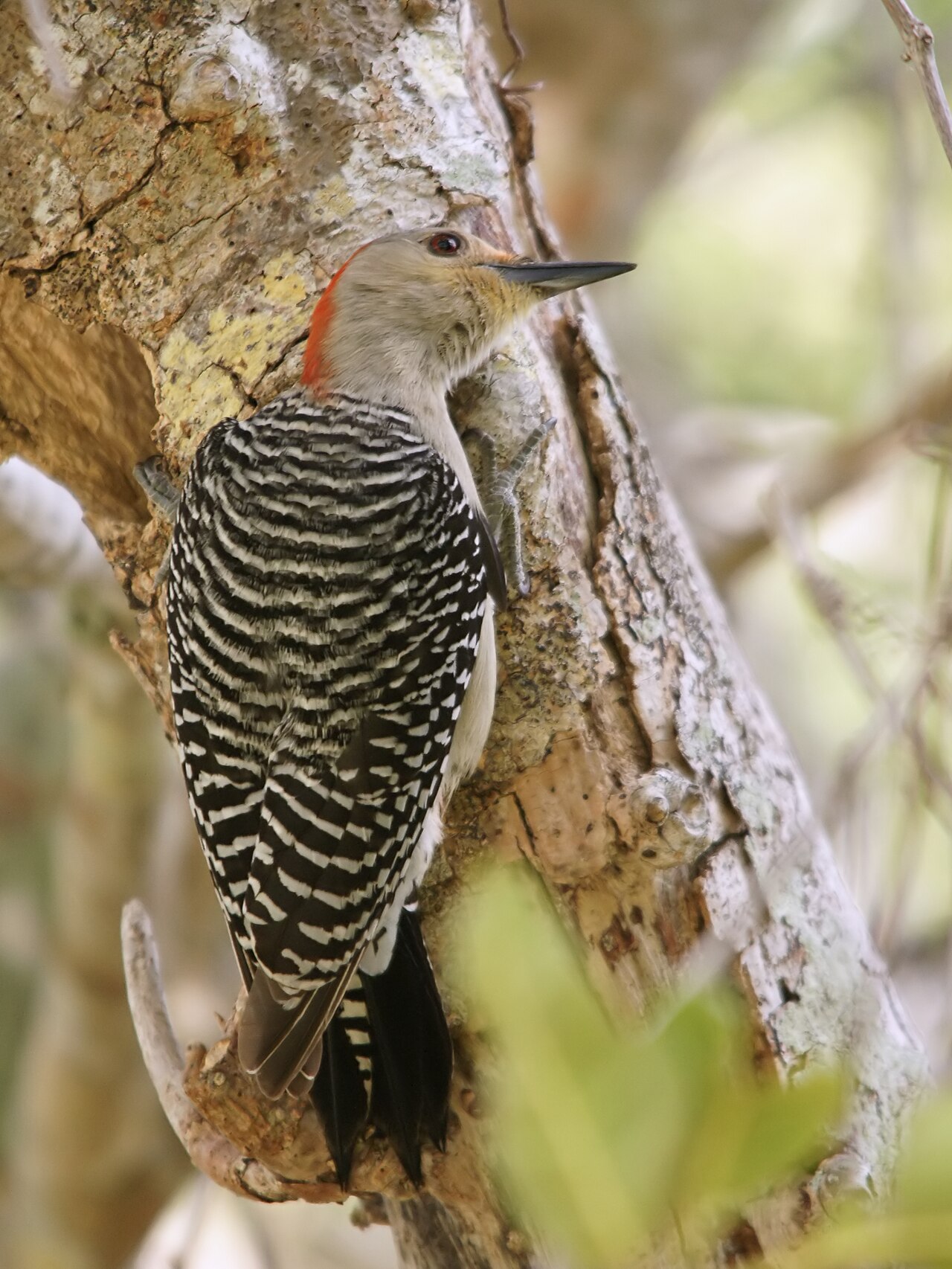
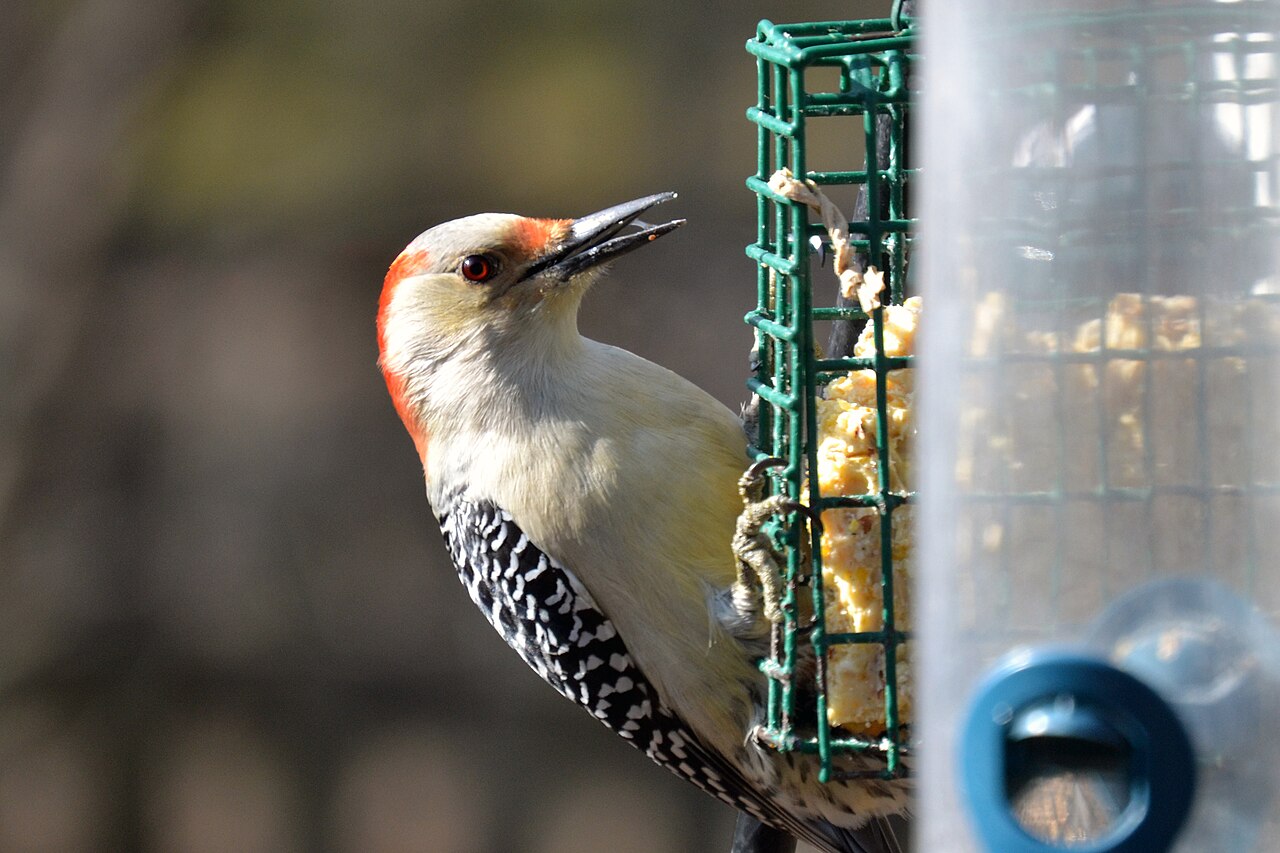
A female red-bellied woodpecker has red only on the nape, the back of the neck, with a grey crown between the red patch and the bill. The male’s red runs continuously from the bill over the whole crown and down the nape. That single difference in how far forward the red extends is the entire identification, and it is visible from a feeder window with the naked eye.
Both sexes are otherwise identical: a medium woodpecker about nine inches long with a black and white barred back, pale grey-buff underparts, and a faint red wash on the belly that is almost never visible. The name causes more confusion than any other feature, because the bird everyone calls a red-headed woodpecker is a different species entirely. This guide covers the identification, behaviour, nesting, feeding, and the birds most often mistaken for her.
A female red-bellied woodpecker has red only on the nape and a grey crown, while the male has red from the bill across the whole crown to the nape. Both have black and white barred backs, pale grey underparts, and a faint red belly wash that is rarely visible. Females also have a shorter bill and a shorter tongue than males.
| Feature | Female Red-Bellied Woodpecker |
|---|---|
| Red on head | Nape only; crown grey |
| Male comparison | Red from bill over crown to nape |
| Length | About 9 in |
| Back | Black and white ladder barring |
| Underparts | Pale grey-buff, faint red belly wash |
| Bill | Shorter than the male’s |
| Range | Eastern US, expanding northward |
How Can You Tell a Male From a Female Red-Bellied Woodpecker?
Look at the crown, the top of the head between the bill and the nape. On a female it is plain grey, and the red is confined to a band across the back of the neck plus a small patch just above the bill in some individuals. On a male the red is continuous from the base of the bill all the way back, forming an unbroken red cap and nape.
The difference holds at any angle where the top of the head is visible, and it is obvious at feeder range without binoculars. From directly behind, both sexes show red on the nape and look similar, which is the one view that causes trouble; wait for the bird to turn.
Bill length is a second, subtler difference. Male red-bellied woodpeckers have longer bills and longer tongues than females, and the sexes forage differently as a result, with males probing deeper into crevices and females working bark surfaces and smaller branches. This is one of the clearer cases of foraging niche division between sexes in a North American bird. The red-bellied woodpecker guide covers the species in full.
Why Is It Called Red-Bellied If the Head Is Red?
Because the belly genuinely does carry a red wash, and the name was assigned by ornithologists working with specimens in the hand rather than birds at a feeder. On a museum tray with the bird on its back, the pinkish-red patch between the legs is the distinctive feature; in life the bird is almost always seen pressed against a trunk with the belly hidden.
The name red-headed woodpecker was already taken, and it belongs to a strikingly different bird: an entirely crimson head, a solid black back, and large white wing patches, with no barring anywhere. The two are not similar, but the naming means that most reports of red-headed woodpeckers at feeders are red-bellied woodpeckers.
The red belly wash is occasionally visible, usually when a bird hangs upside down on a suet feeder or stretches at an odd angle, and it is stronger on males than females. On many females it is so faint as to be effectively absent. The types of woodpeckers guide covers all the North American species and their names.
What Birds Are Mistaken for Her?
Northern flickers cause the most confusion because they are brown-backed with black barring and also show red on the nape in the eastern yellow-shafted form. Flickers are larger, spend far more time on the ground eating ants, show a bold white rump patch in flight, and have a black crescent bib on the chest that no red-bellied has.
Downy and hairy woodpeckers are smaller and black and white with a clean white back stripe rather than ladder barring across the whole back, and the female of each has no red at all. Ladder-backed and golden-fronted woodpeckers overlap in Texas and the southwest and are the genuinely tricky ones, separated by face pattern and by the nape colour.
The other common mix-up is a young red-bellied woodpecker, which has a plain grey-brown head with no red at all through its first months and gets reported as an unidentified barred woodpecker. Juveniles also have duller, browner barring and a darker bill. The downy vs hairy woodpecker guide covers the pair most often confused with each other.
What Does She Eat?
Red-bellied woodpeckers are omnivorous and less insect-dependent than most woodpeckers, taking roughly half their diet from plant material. Acorns, beechnuts, hickory nuts, pine seeds, wild fruit, and berries make up a large share, alongside beetles, ants, caterpillars, grasshoppers, and spiders gleaned from bark.
They cache food, which is unusual for woodpeckers, wedging nuts and seeds into bark crevices, fence posts, and tree cracks and returning to them later. A bird making repeated trips between a feeder and the same tree is stockpiling rather than eating, and this behaviour peaks in autumn.
The tongue is what makes the feeding possible. A red-bellied woodpecker’s tongue extends about two inches beyond the bill tip, wraps around the back of the skull when retracted, and ends in a barbed, sticky point that hooks grubs out of tunnels. The sex difference in tongue length is the mechanism behind the different foraging depths, and it is measurable rather than inferred.
At feeders they take suet, peanuts, sunflower seed, and occasionally sugar water from hummingbird feeders, and they are among the easiest woodpeckers to attract. Suet is the reliable draw, and peanuts in the shell will often bring a bird in within days. They also occasionally take small vertebrates including nestling birds, tree frogs, and lizards, which surprises people. The guide to what woodpeckers eat covers the wider diet.
Do Females Drum and Call?
Yes, both sexes drum and call, which separates woodpeckers from songbirds where singing is usually male. Drumming is a rapid burst of blows on a resonant surface used for territory and pair contact, not for feeding, and red-bellied drums are relatively short and even, lasting about a second.
The main call is a rolling churr or kwirr, a low rich rattle that carries well through woodland and is the sound most people learn first for this species. A sharper cha-cha-cha is given in agitation or interaction, and quieter grunts pass between mates near the nest.
Pairs also drum to each other in a mutual exchange, one bird answering the other, which is part of pair formation in late winter and early spring. A female drumming on a gutter, chimney cap, or metal flashing is doing exactly what a male would: choosing the most resonant object available, which is why drumming complaints peak in March and April and are not necessarily male birds.
Where Does She Nest?
In a cavity excavated in dead wood, usually in a dead limb or a dead section of a living tree, typically 15 to 40 feet up. Both sexes excavate, taking one to three weeks, and the male usually starts the hole while the female inspects and either accepts or rejects it before work continues.
The female lays four to five white eggs, and incubation is shared, with the male taking the night shift, a pattern common across woodpeckers. Eggs hatch in about twelve days and young fledge at around 24 to 27 days, with both parents feeding. One to three broods a year are possible depending on latitude.
Pairs frequently return to the same tree in following years but usually excavate a new hole, often below the old one. Old cavities are then used by chickadees, titmice, bluebirds, flying squirrels, and screech owls, which makes red-bellied woodpeckers an important source of nest sites for other species. Competition from European starlings for fresh cavities is a real pressure, and starlings evict a substantial share of red-bellied pairs each season.
Are They Expanding Their Range?
Yes, and markedly so. The red-bellied woodpecker has moved north over the past century, colonising areas of the Northeast, the Great Lakes states, and southern Canada where it was formerly rare or absent, and it is now a common feeder bird well north of its historical range.
Milder winters, the maturing of eastern forests after farmland abandonment, and the spread of bird feeding are all cited as drivers, with winter feeding likely the most direct. A bird that can find suet and seed through a cold snap survives at latitudes that would otherwise be marginal.
The species is common and increasing according to Breeding Bird Survey data, which puts it in a small minority of North American birds, and the Cornell Lab of Ornithology (allaboutbirds.org) tracks the northward shift through its feeder watch programmes. That trajectory contrasts sharply with the red-headed woodpecker, which has declined substantially over the same period.
What Does It Mean When a Red-Bellied Woodpecker Visits You?
Woodpeckers generally are read as symbols of persistence, opportunity, and paying attention to a rhythm or a signal, drawn from the drumming and from the methodical way they work a tree. The red-bellied has no distinct folklore of its own, and readings applied to it are the general woodpecker ones.
Drumming in particular carries symbolic weight across several traditions, associated with communication, with announcing something, and in some Native American traditions with prophecy or warning. Modern readings emphasise determination and steady effort toward a goal that is not yet visible.
Practically, a red-bellied woodpecker showing up at a new feeder usually means suitable mature trees within a few hundred yards and a food source it has decided is reliable. Once established, individual birds visit the same feeder for years. The woodpecker spiritual meaning guide covers the symbolism in more depth.
Frequently Asked Questions
How can you tell a male from a female red-bellied woodpecker?
The crown. A female has red only on the nape with a grey crown; a male has continuous red from the bill over the crown to the nape. Females also have shorter bills and tongues.
What does a female red-bellied woodpecker look like?
About nine inches long with a black and white barred back, pale grey-buff underparts, a grey crown, and a red band across the nape. The faint red belly wash the name refers to is usually not visible.
Why is it called red-bellied?
Because there is a genuine pinkish-red wash on the belly, visible on a specimen in the hand but rarely on a bird clinging to a trunk. The name red-headed woodpecker already belonged to a different species.
What bird is mistaken for a red-bellied woodpecker?
Northern flickers, which also show red on the nape but are brown-backed, ground-feeding, and have a black chest crescent. Juvenile red-bellieds with no red at all are also frequently misreported.
Do female woodpeckers drum?
Yes. Both sexes drum and call, and pairs drum to each other in late winter. A bird hammering on a gutter or chimney cap in spring is signalling territory and may be either sex.
What is a red-bellied woodpecker’s favorite food?
Suet at feeders, and acorns, beechnuts, and hickory nuts in the wild. They are unusually omnivorous for woodpeckers, taking about half their diet from plant material, and they cache nuts in bark crevices.
Do woodpeckers return to the same nest every year?
Often to the same tree, but usually excavating a fresh cavity, frequently below the previous one. Abandoned holes are then used by chickadees, bluebirds, flying squirrels, and screech owls.